


What Stamping Die Manufacturers Do and Why It Matters
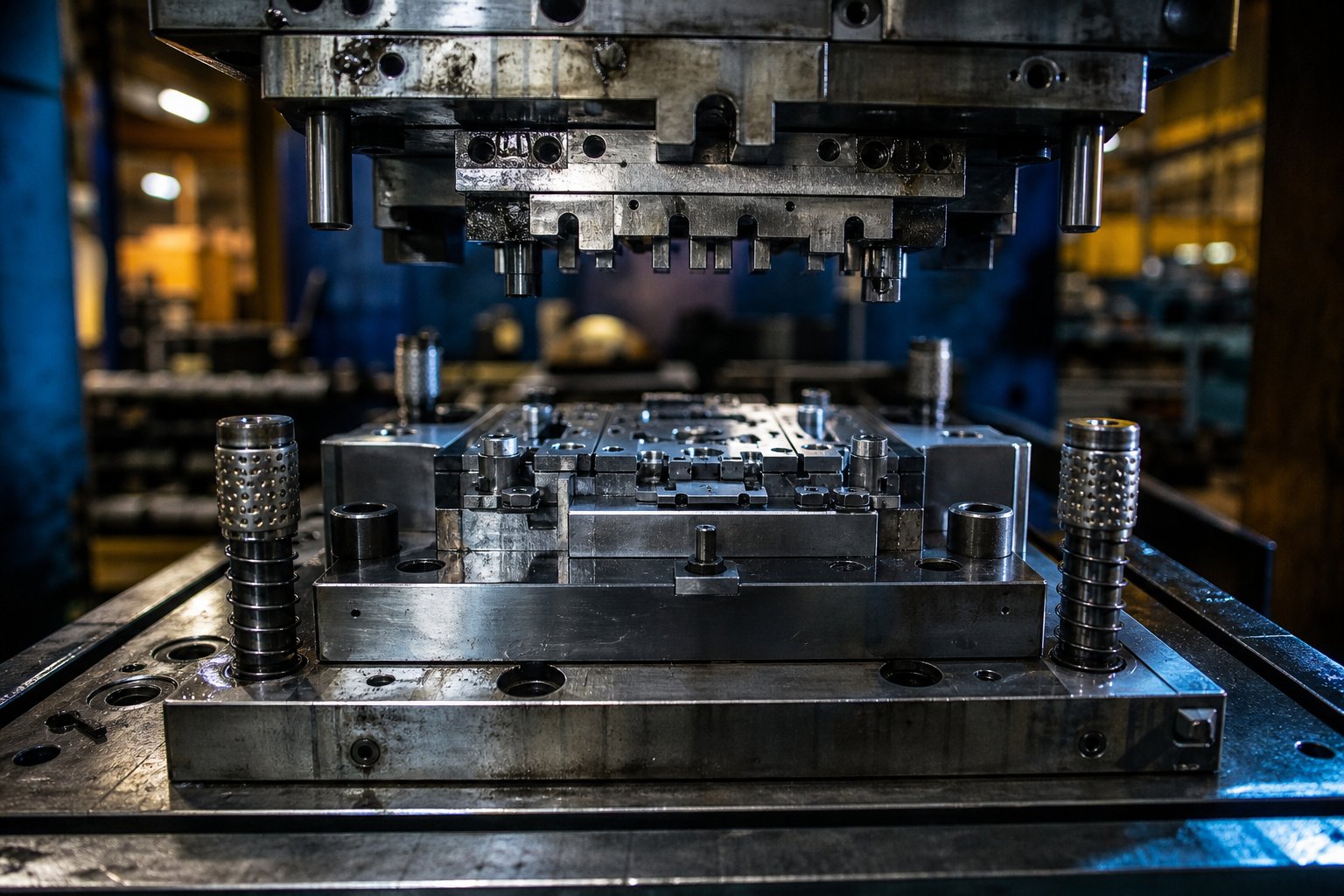
A stamping die is a precision-engineered tool that cuts, bends, or forms flat sheet metal into a finished part using force applied by a press. Unlike general-purpose tooling such as drill bits or lathe fixtures, stamping dies are custom-built for a single component geometry. Every bracket, connector, or structural panel rolling off a high-speed press line owes its shape entirely to the die inside that press.
What Stamping Die Manufacturers Do
Stamping die manufacturers are the engineering partners who design, machine, and qualify the tooling that makes mass production possible. Their work sits at the very front of the supply chain: before a single production part exists, a die manufacturer has already translated a CAD model into hardened tool steel capable of producing thousands or millions of identical pieces. These companies handle everything from feasibility studies and strip layout design to CNC machining, heat treatment, and final tryout on a stamping press. The relationship between dies and stamping production is inseparable - without a properly built die, even the most capable press is just an expensive paperweight.
Where general machine shops produce a variety of components, dedicated die manufacturers specialize in tight-tolerance tool steel assemblies that must withstand repeated high-tonnage impacts. That distinction matters because the skills, equipment, and quality systems required to build stamper dies differ significantly from those used in conventional machining or fabrication work.
Why the Right Die Partner Matters
Choosing among die manufacturers is not a commodity purchasing decision. The quality of your stamping dies directly controls part consistency, scrap rates, press uptime, and long-term maintenance costs. A poorly designed or sloppily built die will produce marginal parts from day one, creating downstream headaches in assembly and inspection that compound over the life of the program.
A stamping die is the single highest-leverage investment in any metal stamping program because every part produced inherits its precision.
That reality makes supplier selection one of the most consequential decisions a sourcing team faces. Yet many buyers evaluate stamping die manufacturers on price alone, overlooking the engineering depth, simulation capability, and tryout rigor that separate a reliable production tool from an expensive problem. The differences between die shops become clearer once you understand the types of dies available and how each one fits a specific production scenario.
Types of Stamping Dies and When Each One Fits
Die type selection is where many sourcing decisions go sideways. Buyers often request quotes without specifying which category of die their project actually requires, leaving manufacturers to guess - or worse, to quote whatever is fastest to build rather than what is best suited to the application. Understanding the major types of stamping dies and the practical decision factors behind each one puts you in a much stronger position before the first RFQ goes out.
Progressive Dies for High-Volume Runs
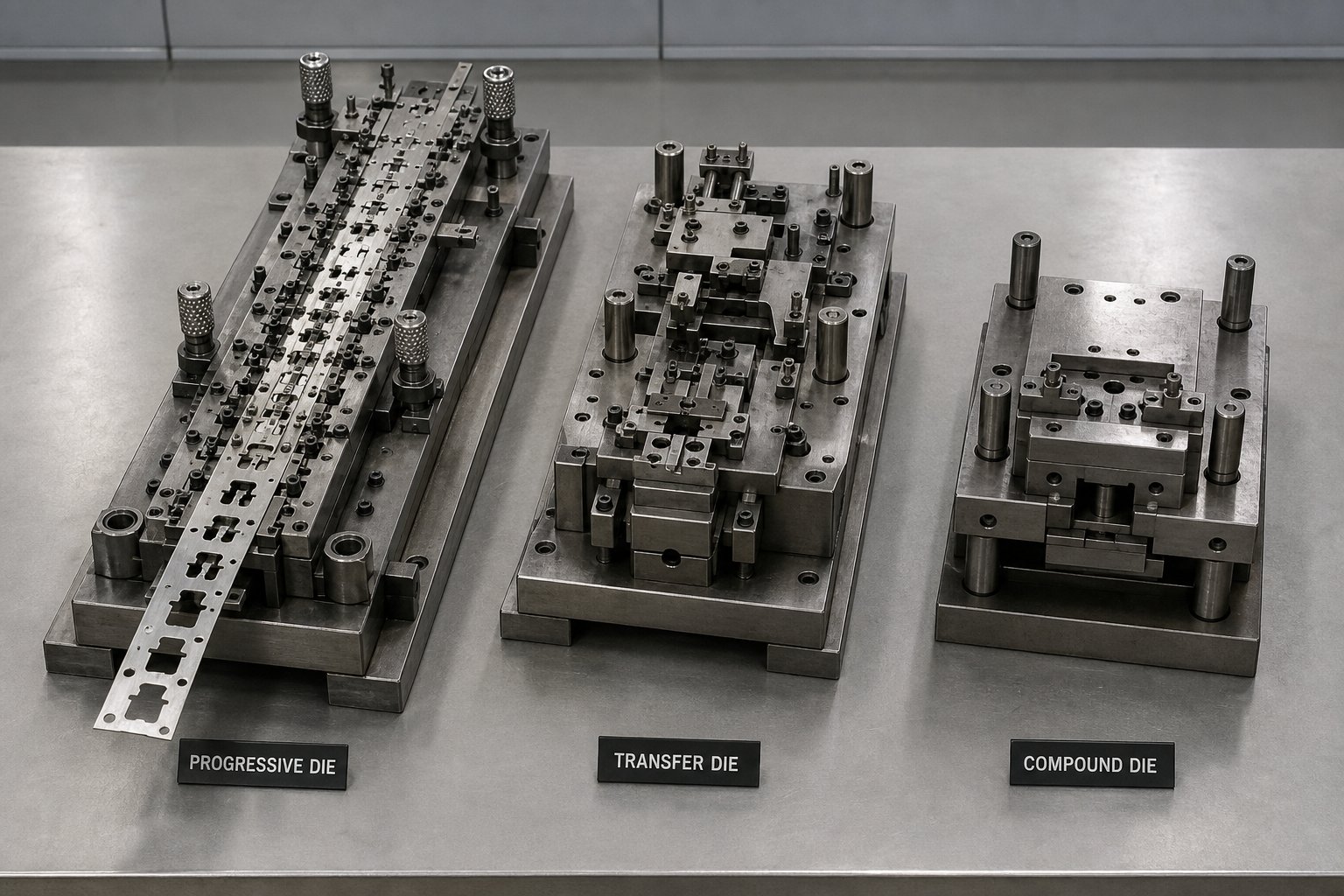
So what is a progressive die, exactly? It is a multi-station tool through which a continuous strip of sheet metal advances incrementally. At each station, a different operation occurs - blanking, piercing, bending, coining, or forming - until a finished part separates from the strip at the final station. The strip acts as its own conveyor, carrying the workpiece from one operation to the next without manual handling.
Progressive dies are the workhorse behind most high-volume metal stamping programs. They deliver exceptional speed because multiple operations happen with every press stroke, and minimal material waste because strip layouts are optimized during design. Complex part geometries that would require several separate operations in other setups are completed in a single pass through the die. Automotive connectors, electrical terminals, bracket assemblies, and shielding components are all common progressive die applications.
The tradeoff is cost and flexibility. A well-engineered progressive die might run $8,000 to $25,000 or more depending on the number of stations and tolerance requirements. Design changes after the tool is built are expensive, sometimes requiring entire station replacements. But when annual volumes reach tens of thousands or millions of parts, the per-piece cost drops dramatically - often to $0.30 to $1.00 per part - making progressive dies the most economical choice over the life of a program.
Transfer Dies and Compound Dies
Not every part can stay attached to a strip. Larger stampings, deep-drawn shells, or parts requiring operations on multiple axes need to be moved independently between stations. Transfer dies solve this problem by using mechanical fingers or grippers to pick individual blanks and carry them from one die station to the next. Each station performs a discrete operation - draw, trim, flange, restrike - on a free-standing workpiece rather than a connected strip.
This independence gives transfer dies greater geometric flexibility. They handle larger parts, deeper draws, and more complex three-dimensional shapes than progressive setups allow. They also use less raw material because there is no carrier strip or connecting web between parts. If you are evaluating transfer die stampings suppliers, look for shops with dedicated transfer press lines and experience managing the mechanical synchronization these tools require.
Compound dies take a different approach entirely. They perform multiple cutting operations - typically blanking and piercing - in a single press stroke, producing a finished flat part in one hit. The result is extremely tight concentricity and flatness because all features are created simultaneously rather than sequentially. Compound dies work best for simpler geometries that need high dimensional precision in a single plane: washers, gaskets, laminations, and shims are textbook applications.
Compound dies cost less to design and build than progressive or transfer tooling, and their simpler structure means lower maintenance demands. However, they are limited to relatively flat parts and cannot perform bending or forming operations.
Choosing Between Standard and Custom-Engineered Dies
Imagine your part is a simple flat washer with standard dimensions. An off-the-shelf standard die or existing tooling at your vendor's shop may produce it perfectly well - no custom engineering required. Per-part costs stay reasonable, lead time is short, and upfront investment is minimal.
But the moment your geometry becomes proprietary, your tolerances tighten beyond catalog specs, or your annual volume justifies tooling amortization, custom-engineered steel stamping dies become the clear path. Custom tooling is designed around your specific part, material, and production requirements. It holds tighter tolerances, runs faster at volume, and becomes an asset you own - ready to produce identical parts on every reorder for years.
The decision framework is straightforward: if your total expected volume over three to five years exceeds a few thousand parts, if tolerances are critical to assembly function, or if no existing die matches your geometry, invest in custom sheet metal stamping dies. If volume is low, the design is still evolving, or the part matches standard catalog shapes, start with adapted tooling and transition to custom when economics justify it.
| Die Type | Best For | Typical Volume Range | Complexity Level | Relative Tooling Cost |
|---|---|---|---|---|
| Progressive Die | High-speed production of complex parts from strip stock | 10,000 to millions of parts | High (multiple sequential operations) | High |
| Transfer Die | Large or deep-drawn parts requiring independent handling | 5,000 to 500,000+ parts | High (multi-station, freestanding blanks) | High |
| Compound Die | Flat parts needing precise simultaneous cut operations | 1,000 to 100,000+ parts | Low to medium (single-stroke, single-plane) | Medium |
| Standard Die | Common geometries with off-the-shelf availability | Low to medium volumes | Low | Low to none |
This comparison highlights a point many buyers miss: the cheapest die is not always the most economical choice. A progressive die with a high upfront price tag can deliver the lowest total program cost when volume justifies the investment. Conversely, forcing a complex part into a simple compound die to save tooling dollars often creates quality issues that cost far more downstream. The real skill in working with stamping die manufacturers lies in matching die type to your actual production reality - volume, geometry, material, and tolerance - rather than defaulting to whatever option appears cheapest on a quote sheet.
Inside the Stamping Die Manufacturing Process
Selecting the right die type is only half the equation. The other half is how that die gets built - and the manufacturing process behind custom metal stamping dies is where quality is either locked in or lost. Every step in the workflow influences the final tool's precision, durability, and performance on the press. Yet most buyers never see beyond the quote sheet, so here is what actually happens between purchase order and first production part.
- Feasibility study
- Die design and simulation
- Material selection
- CNC machining
- EDM and grinding
- Heat treatment
- Assembly
- Tryout and adjustment
- Final inspection and qualification
Each of these nine stages builds on the last. Skip or rush any one of them, and problems cascade forward into every part the die produces.
Design and Simulation Phase
Tool & die manufacturing begins long before anyone cuts steel. Engineers start with your part geometry in 3D CAD and work backward to determine how flat sheet metal must flow, bend, and stretch to reach that final shape. Progressive stamping die design, for example, requires mapping out each station along the strip - deciding which features form at which point and how material moves between operations without tearing, wrinkling, or springback.
CAE simulation plays a critical role here. Using finite element analysis (FEA) software, manufacturers model material flow, predict thinning and stress concentrations, and validate the concept before a single tool steel block is ordered. Strip layout optimization - arranging parts on the strip to maximize material utilization - can save 5% to 15% in raw material costs over a production run of millions. Simulation also flags forming problems like insufficient draw depth or excessive die wear before they become expensive trial-and-error discoveries on the shop floor.
The design phase typically accounts for 20% to 30% of a die project's total timeline but prevents a disproportionate share of downstream failures. Manufacturers who invest heavily in simulation capability tend to deliver dies that run successfully on the first tryout rather than requiring multiple costly adjustment cycles.
Machining and Heat Treatment
Once the design is validated, dies manufacturing shifts to the machine shop. CNC milling handles the bulk of material removal - cutting die blocks, punch plates, and stripper components to near-net shape with tolerances typically around ±0.005 inches. Multi-axis machining centers allow complex 3D surfaces to be cut in a single setup, reducing accumulated positioning error.
Wire EDM takes over for features that demand tighter precision. By using an electrically charged wire to erode material, wire EDM achieves tolerances down to ±0.001 inches on hardened tool steel - critical for punch-to-die clearances that control burr height and edge quality. Surface grinding follows, delivering the flatness required for die shoes, stripper plates, and any mating surfaces that must align within microns.
Heat treatment transforms good steel into great tooling. Metal stamping dies typically use tool steels like D2 (hardness range 54–61 HRC, highly wear-resistant), A2 (57–62 HRC, balancing toughness and wear resistance), or carbide inserts for extreme-volume applications. According to metallurgical data from Paulo, D2's high chromium content (11–13%) delivers exceptional wear resistance, making it a preferred choice for stamping dies, blanking dies, and trim dies. Heat treatment is performed in vacuum furnaces to preserve clean surface profiles and prevent decarburization. The result is a die component that can withstand millions of high-tonnage impacts without deformation or premature wear.
Assembly, Tryout, and Qualification
Machined and heat-treated components converge at the assembly bench. Technicians fit guide pillars, bushings, die shoes, punches, and strippers into a complete die set. Precision shimming and alignment ensure that upper and lower halves mate perfectly - even a few thousandths of an inch of misalignment will produce inconsistent parts or accelerate wear.
The assembled die then moves to a die stamping machine for tryout. During these trial runs, engineers stamp sample parts and evaluate dimensional accuracy, surface finish, burr height, and forming quality. Adjustments are common: tweaking clearances, modifying draw beads, or relieving areas where material flow is restricted. Experienced manufacturers plan for two to three tryout iterations, with each cycle tightening the gap between sample parts and final specifications.
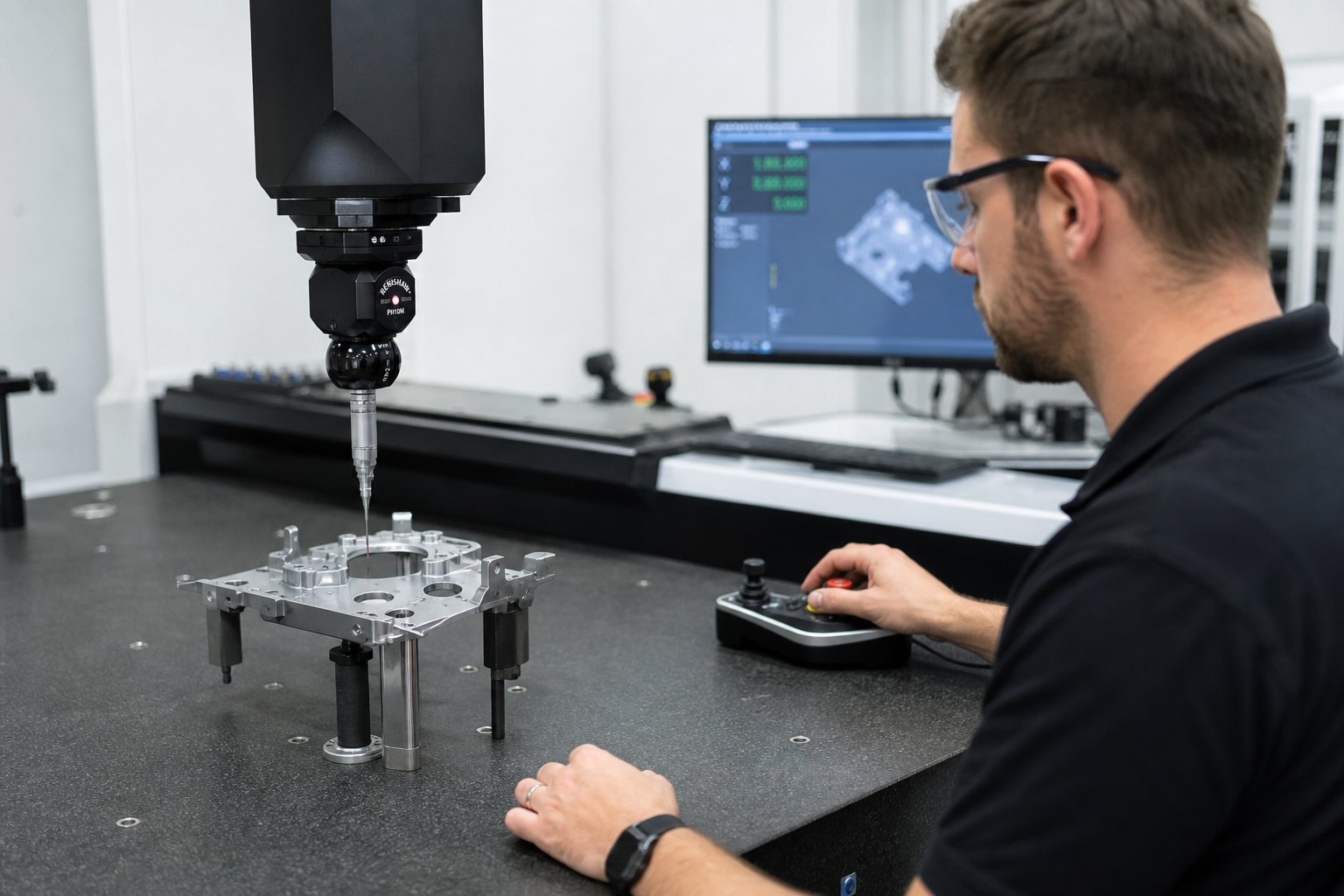
Qualification closes the loop. Dimensional inspection using coordinate measuring machines (CMMs), optical comparators, or vision systems confirms that stamped parts meet customer tolerances. A full first-article inspection report documents every critical dimension. Only after this verification does the die receive approval for production - ensuring the manufacturing dies delivered to your press floor will perform exactly as specified from the very first hit.
The depth of this process explains why lead times for complex dies run eight to twelve weeks or longer. It also explains why the cheapest quote is often a warning sign: meaningful shortcuts in simulation, machining quality, or tryout rigor always surface later as production problems. Understanding what happens inside a qualified die shop gives you the vocabulary to ask better questions - and the next critical question involves precision: what tolerance levels can different manufacturers actually hold?
Tolerance and Precision Levels That Separate Die Shops
Not every die shop can hold the same tolerances, and not every project needs the tightest numbers on the spec sheet. Tolerance capability is one of the clearest dividing lines between manufacturers - yet most buyers either over-specify (driving cost up unnecessarily) or under-specify (creating assembly failures downstream). Knowing which precision tier your application actually demands helps you match the right supplier to the job without overpaying or underperforming.
Standard vs. Precision vs. Ultra-Precision Tolerances
Think of stamping tolerance as a spectrum. At the broad end, standard stamping holds dimensional variation within approximately ±0.1 mm to ±0.2 mm. This level covers structural brackets, general enclosures, and non-critical sheet metal components where parts fit together with generous clearances. Most general-purpose die shops operate comfortably here, and tooling costs remain moderate.
Step up to precision die stamping and the window tightens to ±0.025 mm to ±0.05 mm. This is where automotive connectors, electrical terminals, and assemblies with tight interface fits live. A precision die produces parts with near-identical repeatability across hundreds of thousands of cycles - but the tooling, equipment, and quality systems required to achieve this consistency are substantially more demanding. Custom precision stamping at this level often involves progressive dies with carefully controlled punch-to-die clearances and rigorous in-process inspection.
At the extreme end, ultra-precision work drops below ±0.01 mm (±10 microns). Medical implant components, micro-connectors for semiconductor packaging, and aerospace instrumentation parts fall into this territory. According to tolerance data from Alicona, industries like aerospace and medical technology routinely require tolerances down to ±2 to 5 microns, demanding not just exceptional die quality but also tightly controlled environmental conditions during production.
What Drives Achievable Precision
Why can one manufacturer hold ±0.02 mm while another struggles at ±0.1 mm? The difference comes down to a combination of factors that compound on each other:
- Machine tool accuracy - A CNC mill with 5-micron positional repeatability produces fundamentally different results than one rated at 25 microns. Wire EDM machines capable of sub-micron surface finishes enable the tight punch-to-die clearances that precision die and stamping programs require.
- Die steel grade and hardness - Higher-grade tool steels like D2 or carbide inserts maintain their geometry longer under repeated impact. A precision die built from premium materials holds tolerance across its full production life rather than drifting as surfaces wear.
- Thermal management - Temperature fluctuations during machining cause dimensional variation. Shops running climate-controlled machining environments eliminate a variable that less-equipped facilities simply live with.
- Inspection equipment - You cannot hold what you cannot measure. CMMs, optical comparators, and vision measurement systems allow manufacturers to verify features at the micron level. Shops relying on hand gauges alone hit a ceiling quickly.
- Operator skill - Even the best equipment needs experienced hands. Setup technique, measurement interpretation, and adjustment decisions all influence whether a die achieves its designed precision in practice.
| Precision Level | Typical Tolerance Range | Common Applications | Required Equipment |
|---|---|---|---|
| Standard | ±0.1 mm to ±0.2 mm | Structural brackets, enclosures, general hardware | Conventional CNC, standard inspection gauges |
| Precision | ±0.025 mm to ±0.05 mm | Automotive connectors, electrical terminals, tight-fit assemblies | High-accuracy CNC, wire EDM, CMM, optical comparators |
| Ultra-Precision | Below ±0.01 mm | Medical implants, micro-connectors, aerospace instrumentation | Sub-micron EDM, climate-controlled machining, vision systems, advanced metrology |
Here is the practical takeaway: requesting ultra-precision tolerances on a structural bracket does not make a better part - it makes an expensive one. As Huayan Tech notes, unnecessarily tight tolerances drastically increase cost without adding functional value. Conversely, specifying standard tolerances on a connector that must mate within a PCB housing invites field failures and warranty claims. The right approach is matching tolerance specification to actual functional requirements, then selecting a manufacturer whose equipment and quality systems comfortably support that tier - not one stretching to reach it.
Tolerance capability tells you a lot about a die shop's investment level and technical ceiling. But precision requirements do not exist in isolation - they intersect directly with industry-specific standards and certifications that further narrow your list of qualified suppliers.
Industry-Specific Requirements for Stamping Dies
A die shop that excels at general-purpose brackets may be completely unqualified to produce automotive stamping dies for a crash-critical body structure - even if both tools hit similar dimensional tolerances. The difference lies in the quality systems, material expertise, documentation rigor, and production scale each industry demands. Matching manufacturer capability to your sector's requirements is not optional. It prevents costly qualification failures, rejected lots, and months of wasted program time.
Here is the reality most buyers overlook: certifications are not interchangeable, and experience in one sector does not automatically transfer to another. A manufacturer stamping millions of appliance brackets has zero relevance to your aerospace program if they lack AS9100 traceability infrastructure. Let's break down what each major sector actually requires from its die suppliers.
Automotive and EV Stamping Requirements
Automotive is the highest-volume consumer of stamped metal parts, and the demands on automotive dies reflect that scale. A single vehicle platform may require dozens of progressive and transfer die sets running millions of hits per year across body-in-white structures, seating systems, chassis components, and electrical systems.
The lightweighting trend has dramatically reshaped what these tools must handle. Advanced high-strength steels (AHSS) like dual-phase and multiphase grades offer superior crash performance at reduced gauge thickness - but they punish dies with higher forming forces, increased springback, and accelerated wear. Aluminum stamping dies face different challenges: aluminum's tendency to gall, tear during deep draws, and generate adhesive buildup on tool surfaces requires specialized coatings, lubrication strategies, and tighter clearance control. As DA Stamping notes, processing AHSS and aluminum demands specialized die coatings, precise clearance calculations, and innovative springback management - expertise built over decades rather than months.
Beyond material challenges, automotive OEMs expect suppliers to operate under IATF 16949 - a quality management standard built specifically for the automotive supply chain. This is not just a certificate on the wall. It requires embedded processes like Advanced Product Quality Planning (APQP), Failure Mode and Effects Analysis (FMEA), and Statistical Process Control (SPC) throughout every phase of die development. High speed progressive die stamping for automotive connectors and terminal strips adds another layer: press speeds exceeding 400 strokes per minute demand die components with exceptional wear resistance and thermal stability.
If your project involves an automotive stamping die for a safety-critical application, your supplier must demonstrate not just machining capability but a complete quality ecosystem designed to prevent defects rather than inspect them out at the end of the line.
Electronics and Electrical Components
Electrical metal stamping occupies the opposite end of the size spectrum. Connectors, lead frames, RF shielding cans, and contact springs are measured in millimeters rather than meters - but the precision demands are extreme. Tolerances on micro-stamped connector pins often fall below ±0.025 mm, and burr height limits of 0.05 mm or less are common because even microscopic burrs can cause short circuits or assembly interference in PCB-mounted components.
Lead frames for semiconductor packaging illustrate the challenge well. These thin, precisely formed structures provide both electrical connections and mechanical support for microchips. According to Photofabrication Engineering, lead frames range in thickness from 0.0127 mm to 1.575 mm with features as small as 0.10 mm - dimensions that push even high-precision progressive dies to their limits. Materials like beryllium copper and phosphor bronze are standard in this space, each requiring specific punch geometries and clearances to produce clean edges without cracking.
Die manufacturers serving the electronics sector need ultra-precision wire EDM, optical inspection systems capable of measuring micron-level features, and cleanroom-adjacent handling practices. They also need experience designing progressive dies with dozens of stations running at high speed while maintaining positional accuracy across every hit. A shop built for stamping automotive brackets simply does not have the equipment resolution or process control to produce 0.5 mm pitch connector terminals reliably.
Aerospace and Medical Device Demands
Aerospace and medical parts share a common thread: failure puts lives at risk. But the paths to acceptable quality diverge significantly.
Aerospace stamping involves exotic materials - titanium alloys like Ti-6Al-4V, Inconel 718 for high-temperature applications, and high-strength aluminum alloys like 7075-T6. These materials are expensive, difficult to form, and unforgiving of tooling errors. Die manufacturers must account for titanium's tendency to gall and spring back aggressively, Inconel's extreme work-hardening behavior, and the tight surface finish requirements (often 32 Ra or better) driven by fatigue life concerns. As RivCut's engineering team explains, aerospace work emphasizes structural integrity and fatigue life, with critical tolerances reaching ±0.0005 inches and heavy GD&T requirements per ASME Y14.5.
Production volumes in aerospace are modest compared to automotive - hundreds or low thousands rather than millions - but documentation requirements are intense. AS9100 mandates full material traceability, configuration control, AS9102 first article inspection across three standardized forms, and NADCAP certification for special processes like heat treatment. Every stamped part carries a paper trail connecting it to specific material lots, machine settings, and inspection results.
Medical device stamping adds biocompatibility requirements on top of precision demands. Implant-grade components require materials like 316L stainless or Ti Grade 23 (ELI) with documented biocompatibility testing per ISO 10993. Surface finishes for implants often reach 8–16 Ra to reduce infection risk - significantly finer than aerospace standards. ISO 13485 governs the quality system, requiring design controls, risk analysis per ISO 14971, and lot traceability that can follow a component all the way to the patient level for implantable devices.
Small-lot flexibility is essential in both sectors. Die manufacturers serving aerospace and medical programs need the ability to produce short runs economically while maintaining full documentation packages - a fundamentally different operating model than high-volume automotive production.
The certification landscape breaks down clearly by sector:
- Automotive: IATF 16949 (built on ISO 9001, adds automotive-specific defect prevention and supply chain requirements)
- Aerospace: AS9100D (built on ISO 9001, adds configuration management, traceability, counterfeit prevention, and NADCAP for special processes)
- Medical devices: ISO 13485 (built on ISO 9001, adds design controls, risk management per ISO 14971, and regulatory compliance for FDA/EU MDR)
- General manufacturing: ISO 9001 (baseline quality management - necessary but not sufficient for regulated industries)
Here is the bottom line: not every die shop serves every sector, and claiming to is a red flag. A manufacturer holding IATF 16949 has invested in automotive-specific quality infrastructure. One holding AS9100 has built traceability systems that satisfy aerospace auditors. Asking a general ISO 9001 shop to deliver aerospace-grade documentation or medical-grade traceability is asking them to improvise systems they have never operated - and your program bears the risk when those improvisations fail during customer audits or regulatory reviews.
Matching your industry's certification and capability requirements to a manufacturer's proven track record is the fastest way to filter a long supplier list down to qualified candidates. But even within a qualified group, differences in business model - vertically integrated operations versus specialist shops - create meaningful tradeoffs in cost, communication, and accountability.
Vertically Integrated vs. Specialist Die Manufacturers
Two qualified die manufacturing companies can hold the same certifications, run similar equipment, and quote comparable lead times - yet operate under fundamentally different business models. One handles every process step internally. The other focuses narrowly on what it does best and partners out the rest. The model your supplier uses affects communication speed, cost structure, and where accountability lives when something goes wrong. Understanding this distinction helps you pick the right structure for your project's complexity and your team's bandwidth.
Vertically Integrated Manufacturers
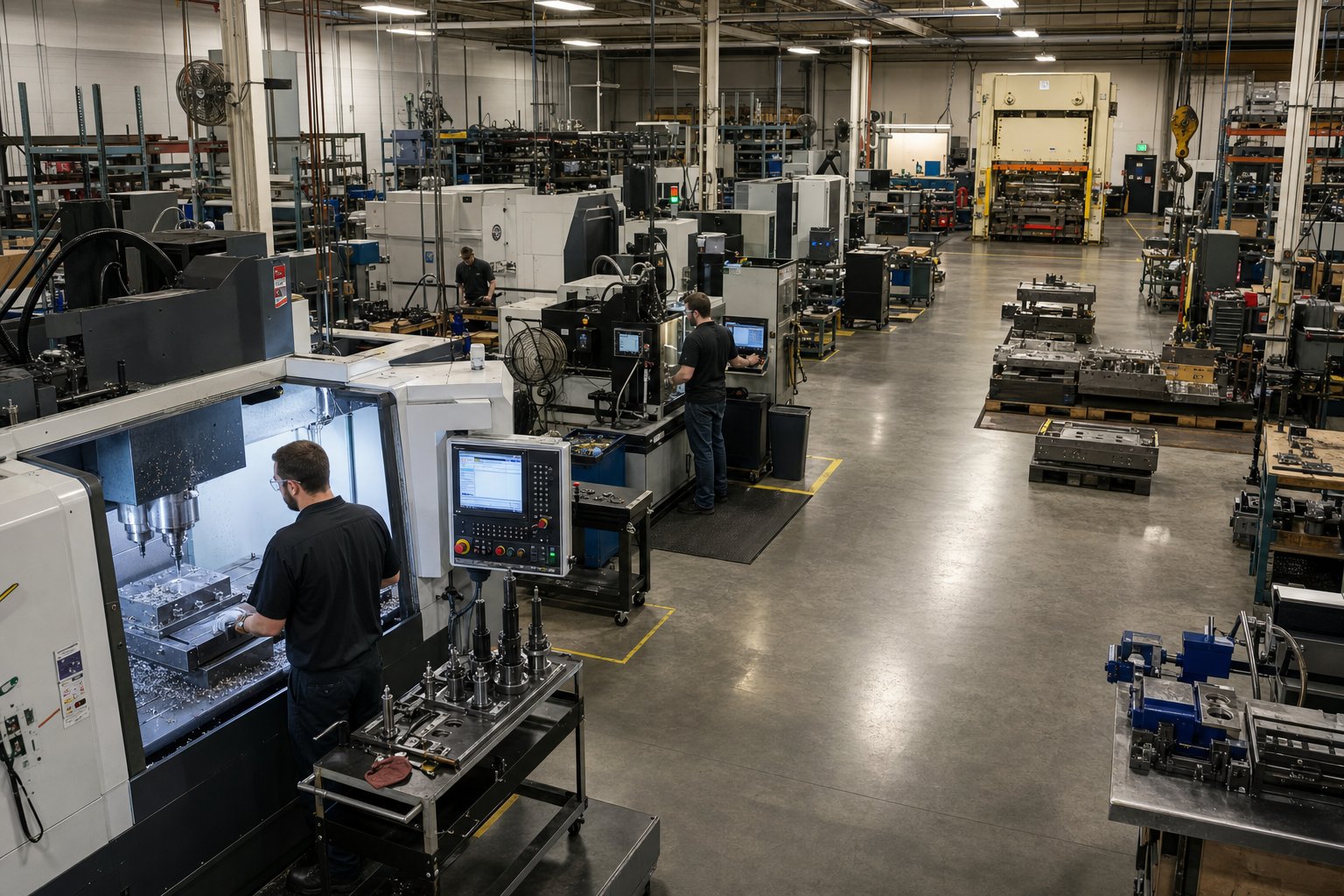
A vertically integrated metal stamping die manufacturer controls the full workflow under one roof: design engineering, CNC machining, wire EDM, heat treatment, surface grinding, assembly, tryout on in-house presses, and sometimes production stamping itself. You deal with a single organization from concept through qualified tool delivery.
The benefits are tangible. As ANCA's engineering team notes, housing more elements of manufacturing under one roof eliminates disruptions caused by external suppliers - missed deadlines and quality issues that originated elsewhere no longer land on your desk. Communication flows faster because the designer, machinist, and tryout technician work in the same building. When a tryout reveals a forming issue, the fix goes back to the machine shop in hours rather than days. Iteration cycles compress, and there is a single point of accountability for the finished tool.
The drawbacks? Vertically integrated operations carry higher overhead. They maintain expensive equipment across every discipline, which can translate into higher quoted prices compared to leaner shops. They may also lack the extreme depth of specialization that a focused operation develops. And scaling a specific capability - say, adding EDM capacity during a surge - is harder when everything must stay internal.
Specialist Die Shops and Collaborative Networks
On the other end of the spectrum, specialist shops concentrate on a narrow slice of the process. Some progressive die manufacturers focus exclusively on designing and building progressive tooling. Others specialize in wire EDM services, precision grinding, or heat treatment. They subcontract steps outside their core competency to trusted partners, forming collaborative networks that deliver a complete die through coordinated handoffs.
The advantage here is depth of expertise. A shop that does nothing but metal tool and die work for progressive applications develops institutional knowledge that generalist operations rarely match. They may also offer lower prices on their specific capability because their overhead is concentrated rather than spread across a dozen disciplines. Evans Tool & Die highlights that the ideal stamping tool and die partner should have proper equipment specific to the job rather than outsourcing - but reality often involves trade-offs between breadth and depth.
The risk is coordination complexity. Every handoff between shops introduces potential for miscommunication, dimensional drift, scheduling delays, and unclear accountability when a problem surfaces. If your heat treatment vendor introduces micro-cracking that only appears during tryout at a third location, determining responsibility - and getting a fast resolution - becomes significantly harder than picking up the phone to an internal department.
Which Model Fits Your Project?
| Factor | Vertically Integrated | Specialist Network |
|---|---|---|
| Communication Ease | High - single point of contact, internal coordination | Lower - multiple contacts, handoff meetings required |
| Lead Time Control | Strong - no external scheduling dependencies | Variable - dependent on each partner's queue |
| Cost Structure | Higher overhead, but predictable total cost | Potentially lower per-step cost, but coordination adds hidden expense |
| Specialization Depth | Broad but moderate across all disciplines | Deep within narrow focus areas |
| Accountability | Clear - one company owns the outcome | Fragmented - responsibility can shift between partners |
Here is a practical guide: if your project involves a complex progressive or transfer die with tight tolerances and an aggressive timeline, a vertically integrated manufacturer reduces your coordination burden and compresses iteration loops. You want one throat to choke, as procurement professionals like to say. If your project is simpler, your internal team has capacity to manage multiple vendors, or you need an extremely specialized capability that no single shop offers across the board, a specialist network can deliver excellent results at potentially lower cost - provided you invest the management effort to keep handoffs clean.
The business model question also intersects with geography. A vertically integrated manufacturer located offshore eliminates many coordination risks associated with distance, while a domestic specialist network keeps communication easy despite fragmented responsibility. That geographic dimension - domestic versus offshore sourcing - introduces its own set of tradeoffs that directly affect cost, lead time, and intellectual property protection.
Die Lifespan and Total Cost of Ownership
Most buyers fixate on the purchase price of a stamping die. That number dominates the quote comparison spreadsheet, drives procurement negotiations, and often determines which manufacturer wins the order. But the purchase price is only the first line item in a much longer financial story. A die that costs 20% less upfront but requires sharpening every 10,000 hits, generates higher scrap rates, and needs a full rebuild at 300,000 strokes will cost significantly more over its production life than a premium tool designed for serviceability from day one.
Understanding die lifespan expectations and total cost of ownership shifts the conversation from "which die is cheapest to buy" to "which die is cheapest to own" - and those two answers rarely point to the same supplier.
Expected Die Life by Application
How long should a stamping die last? As Art Hedrick notes in The Fabricator, there is no single answer - die life ranges from 250,000 hits to 7 million hits or more depending on the application, and some dies run 7 million hits per day for five years before replacement. The spread is enormous because so many variables interact simultaneously.
Stamping die steel selection is the starting point. According to tooling cost data from Dewintech, low-cost pre-hardened steels like 1045 or P20 typically deliver fewer than 50,000 hits and suit only prototyping or low-volume soft-material work. Mid-range tool steels like O1 or A2 reach 50,000 to 250,000 hits for general-purpose stamping. D2 tool steel, with its high chromium content and exceptional wear resistance, pushes into the 500,000 to 1,000,000 hit range for high-volume and abrasive-material applications. Carbide progressive dies designed for extreme-volume programs can exceed 1,000,000 hits - sometimes reaching into the tens of millions - before stamping die parts require replacement.
Beyond material grade, lifespan depends on the metal being stamped (harder and thicker materials wear tooling faster), part geometry complexity (fragile inserts fail sooner than beefy sections), press condition and setup accuracy, lubricant quality, and maintenance discipline. A die running mild steel at moderate speed with excellent lubrication will outlast the same design stamping stainless steel at high speed with marginal lube coverage. Hedrick identifies press stability, die setup accuracy, cutting clearances, and heat treatment quality as additional factors that can make the same tool design last vastly different numbers of cycles depending on operating conditions.
Maintenance Planning and Refurbishment
Stamping tooling does not run indefinitely without attention. Edges dull, springs fatigue, guide surfaces score, and accumulated wear opens clearances beyond acceptable limits. The difference between a die that delivers consistent parts across its full life and one that degrades progressively after the first 50,000 hits comes down to maintenance planning - and critically, how the manufacturer designed the tool for serviceability in the first place.
Preventive maintenance for metal stamping tooling follows both calendar-based and stroke-based triggers. Industry best practices recommend per-shift visual checks for burrs, misfeeds, and slug buildup; daily inspection of pilots, springs, guides, and scrap flow; weekly review of recurring wear items; monthly deep cleaning and sharpening planning; and annual full-condition assessments with metrology review. Stroke-based triggers layer on top: punches may need sharpening review every 20,000 to 50,000 hits depending on material abrasiveness, while springs might warrant replacement at documented intervals before fatigue failure causes unexpected downtime.
Design choices made by the manufacturer directly determine how easy and affordable stamping tool repair will be over the die's production life. Modular insert designs allow worn cutting edges or forming sections to be replaced individually without disassembling the entire tool - a 30-minute swap versus an 8-hour rebuild. Conversely, monolithic one-piece die sections require the entire component to be removed, reground, and refitted when a single edge wears. Manufacturers who design for serviceability include features like replaceable wear plates on high-contact surfaces, standardized spring cavities that accept common sizes, and accessible fastener locations that do not require full teardown to reach.
Sharpening intervals illustrate the economic impact clearly. A well-designed punch that can be reground twenty or more times before reaching its minimum working length delivers far more value than a cheaper punch that can only sustain five regrinds. Each regrind typically costs a fraction of replacement - but if the design limits regrind count, you reach full replacement cost much sooner.
Calculating True Cost of Ownership
Imagine two quotes side by side. Supplier A bids $15,000 for a progressive die in D2 tool steel with modular inserts and a guaranteed life of 500,000 hits. Supplier B bids $9,500 using lower-grade materials with no modularity and no guaranteed hit count. Which is cheaper?
The answer depends entirely on your production volume and program duration. If you need 2 million parts over five years, Supplier A's tool might reach end-of-life with only scheduled sharpening and two insert replacements - total ownership cost around $20,000. Supplier B's tool might need a full rebuild at 150,000 hits, a second rebuild at 300,000, and complete replacement before hitting the million-part mark - total ownership cost potentially exceeding $30,000 when you add rebuild fees, replacement tooling, production downtime during repairs, and elevated scrap during degraded-tool periods.
The factors that compose true cost of ownership extend well beyond the initial purchase:
- Initial tooling cost - The purchase price of the die, including design, materials, machining, and qualification
- Scheduled maintenance - Planned sharpening, lubrication, spring replacement, and inspection labor at regular intervals
- Unplanned repairs - Emergency fixes for unexpected breakage, chipping, or alignment failure that halt production
- Production scrap - Parts rejected due to burrs, dimensional drift, or surface defects as the die degrades between service intervals
- Changeover downtime - Press time lost during die removal, maintenance, and reinstallation for each service event
- End-of-life replacement - The cost of building a new die when the original can no longer be economically refurbished
A cheap tool that requires sharpening every 10,000 hits generates far more cumulative downtime and maintenance labor than a premium tool serviced every 50,000 hits. Over a run of 500,000 parts, that is the difference between 50 service interruptions and 10 - each one carrying setup time, quality revalidation, and lost production hours.
The manufacturers who deliver the lowest total cost are typically those who design stamping tooling with long-term ownership in mind: selecting appropriate stamping die steel grades for the expected volume, incorporating modular replaceable components, specifying realistic maintenance intervals in their documentation, and building dies robust enough to tolerate the operating conditions of your specific press environment. Their quotes may not be the lowest number on the page, but their tools cost less per part produced over the program's life.
This total-cost perspective becomes especially relevant when evaluating domestic versus offshore sourcing options - where upfront price differences are often dramatic, but the full picture involves lead times, communication overhead, iteration costs, and logistics complexity that shift the ownership equation in less obvious ways.
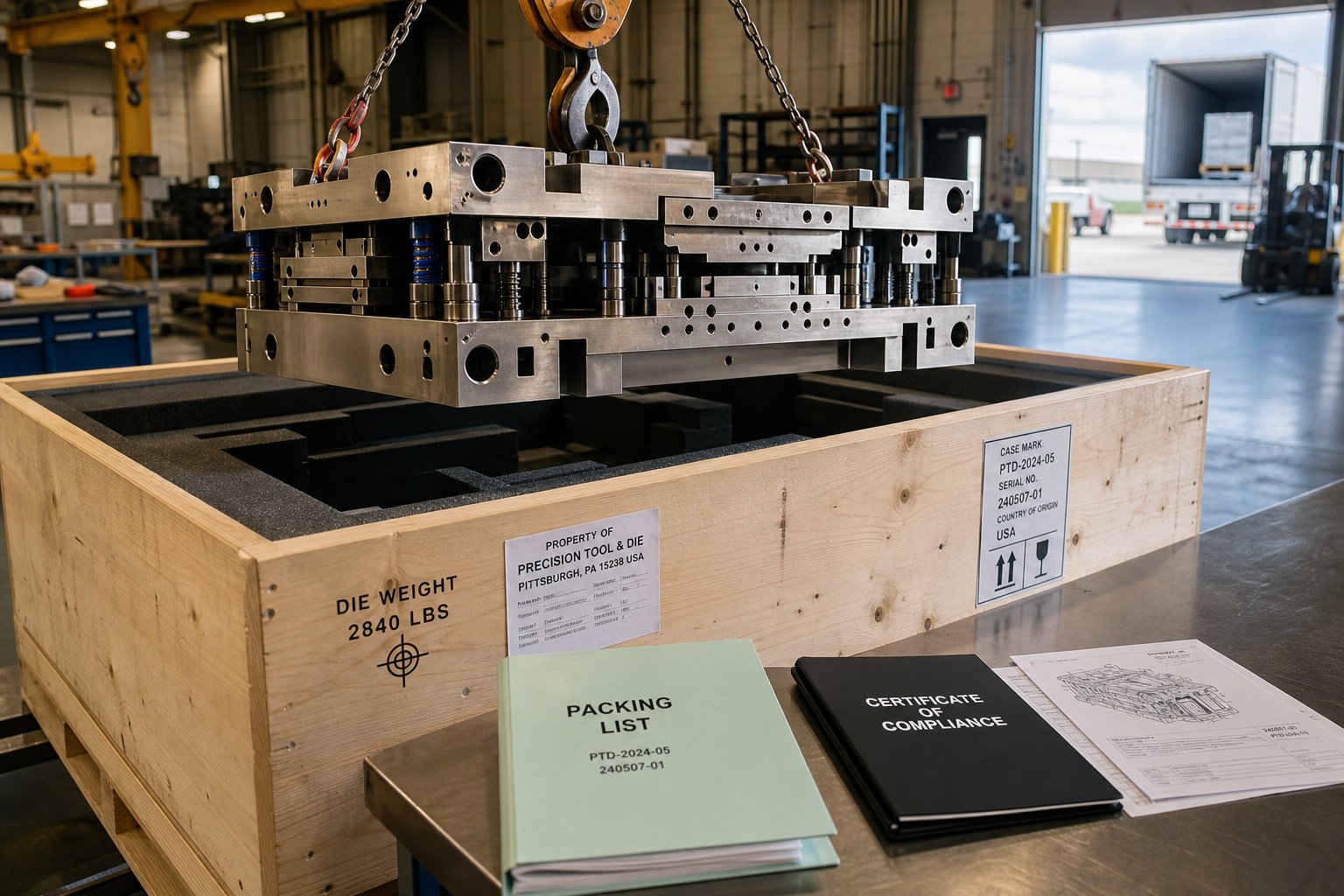
Domestic vs. Offshore Sourcing for Stamping Dies
The cost-per-part math that drives total ownership calculations shifts dramatically depending on where your stamping die supplier is located. A 30% lower sticker price from an offshore stamping die factory looks compelling on a spreadsheet - until you factor in tariff exposure, iteration delays, and the hidden labor of managing a supplier across twelve time zones. Conversely, defaulting to domestic sourcing without examining actual tradeoffs can leave significant cost savings on the table for programs where geography matters less than execution quality.
Neither option is universally correct. The right answer depends on your program's complexity, timeline pressure, volume requirements, and internal capacity to manage remote relationships.
Domestic Sourcing Advantages
Working with a die metal stamping manufacturer located in your own country delivers benefits that rarely show up on a quote sheet but compound over the life of a program:
Faster iteration cycles. When a tryout reveals a forming issue that requires a design tweak, a domestic shop can turn the modification in days. You can visit the facility, observe the tryout in person, and approve changes face-to-face. For complex progressive or transfer dies where three or four tryout iterations are standard, this proximity can compress timelines by weeks.
Same-timezone communication. Questions get answered in hours rather than overnight. Engineering change requests move through review and approval without the lag that accumulates when your morning email arrives at your supplier's end of day. As industry sourcing analysis confirms, an overseas shop with a 12-hour time difference and language barriers can stall your entire project for weeks when engineering changes arise.
IP protection under familiar legal frameworks. Domestic contracts are enforceable in courts you understand, under trade secret and patent laws with established precedent. Non-disclosure agreements carry teeth. For proprietary part geometries or novel forming processes, this legal infrastructure provides a layer of protection that offshore jurisdictions may not replicate.
Tariff insulation. The April 2026 Section 232 tariff update fundamentally reshaped the cost equation for offshore metal stamping. According to Manor Tool's analysis, Section 232 duties now apply to the full customs value of covered articles and their derivatives - not just the metal content. A 50% tariff on the entire customs value of a stamped steel part (rather than just the steel portion) can flip a cost comparison decisively toward domestic sourcing. Programs that were borderline offshore candidates in 2025 are squarely domestic in 2026 for many metal stamping die manufacturers serving the U.S. market.
Offshore Sourcing Considerations
Despite tariff headwinds, offshore sourcing remains viable - and sometimes optimal - for certain program profiles. The advantages are real:
Lower base tooling cost. Metal stamping die manufacturers in China, Taiwan, and Southeast Asia often quote 30% to 50% below domestic equivalents for comparable die complexity. Labor rates, material costs, and facility overhead all contribute to this gap. For high-value progressive dies where the tooling investment runs $50,000 or more, a 40% savings represents meaningful capital that can be deployed elsewhere in your program.
Capacity and scale. Offshore stamping die factories frequently maintain larger machining fleets and deeper bench strength than mid-size domestic shops. When you need multiple complex dies built simultaneously for a platform launch, offshore capacity can absorb the workload without queue delays.
Access to specialized capabilities. Some regions have developed concentrated expertise in specific die types or industries - micro-stamping for electronics in East Asia, for instance - that may exceed what is locally available.
The risks, however, are well-documented and must be actively managed rather than wished away. Supplier risk research identifies quality issues, geopolitical disruption, and communication breakdowns as the most prevalent threats when working with offshore partners. Longer lead times (typically 10 to 16 weeks versus 6 to 10 domestically), language barriers that introduce specification ambiguity, and logistics complexity - including freight variability, customs clearance delays, and the cost of shipping precision tooling safely across oceans - all add friction that erodes the initial cost advantage.
The key to successful offshore sourcing is risk mitigation through clear specification packages, defined inspection gates, and transparent project tracking. Vague drawings and verbal agreements that work fine with a domestic shop you have visited twenty times become sources of costly rework when transmitted across language and cultural boundaries.
Full-service offshore suppliers reduce coordination risk. The most common failure mode in offshore die sourcing is not poor machining capability - it is fragmented responsibility. When design happens at one firm, machining at a second, heat treatment at a third, and tryout at a fourth, no single entity owns the outcome. Offshore suppliers who offer complete end-to-end workflows - from feasibility assessment and CAE simulation through precision machining, trial runs, and dimensional inspection - eliminate the handoff gaps where quality and schedule problems breed. YICHEN, for example, bridges this coordination gap by providing a full-service workflow from feasibility study and CAE simulation through machining, trial runs, and final inspection under one organization, helping sourcing managers and tooling engineers move from initial research to RFQ-ready solutions without managing multiple offshore vendors independently.
Comparing the Two Models
| Factor | Domestic Sourcing | Offshore Sourcing |
|---|---|---|
| Typical Cost Difference | Baseline (higher unit cost) | 30–50% lower base price, offset by tariffs, freight, and management overhead |
| Lead Time | 6–10 weeks typical for complex dies | 10–16 weeks including shipping and customs |
| Communication Ease | Same timezone, same language, site visits in hours | Time zone lag, potential language barriers, site visits require international travel |
| IP Protection | Strong - enforceable NDAs, established trade secret law | Variable - dependent on local legal enforcement and contractual structure |
| Iteration Speed | Fast - modifications turned in days, in-person tryout observation | Slow - each iteration adds 1–3 weeks for shipping and communication cycles |
| Logistics Complexity | Low - ground shipping, minimal customs exposure | High - ocean freight, customs clearance, tariff calculations, packaging for transit |
A practical decision framework emerges from this comparison. Programs with aggressive timelines, frequent engineering changes, IP sensitivity, or U.S. tariff-exposed materials lean domestic. Programs with stable designs, high tooling values, long development windows, and a metal stamping part manufacturer offering end-to-end accountability offshore can still capture meaningful cost advantages - provided the buyer invests in clear specifications, defined quality gates, and active project management.
The worst outcome is choosing based on unit price alone without accounting for the total cost factors outlined in this comparison. Whether you source domestically or offshore, the evaluation criteria for qualifying a manufacturer remain the same - and those criteria form the practical framework for moving from research to a confident sourcing decision.
How to Evaluate and Select the Right Die Manufacturer
Knowing what separates good tooling from bad tooling is only useful if you can translate that knowledge into a repeatable supplier evaluation process. Most buyers default to requesting three quotes and picking the lowest number - a method that ignores nearly everything that determines whether a custom metal stamping die will perform reliably in production. A structured approach takes more effort upfront but prevents the far more expensive mistake of qualifying the wrong partner six months into a program.
Matching Manufacturer Capabilities to Project Needs
Before you contact a single stamping dies manufacturer, answer five questions about your own project. These answers filter your supplier list faster than any directory search:
- What is your annual volume? - This determines die type (progressive, transfer, compound) and separates high-volume specialists from prototype-focused shops.
- What material and thickness? - A supplier experienced with 0.5 mm phosphor bronze for connectors operates in a different world than one stamping 2.0 mm high-strength steel for structural brackets.
- What tolerance is required? - Match your precision tier (standard, precision, ultra-precision) to shops whose equipment and inspection systems comfortably support it.
- What industry certifications are needed? - IATF 16949, AS9100, or ISO 13485 requirements immediately eliminate shops that lack the quality infrastructure your program demands.
- What is your timeline? - A 6-week deadline for a complex progressive die limits you to manufacturers with open capacity and in-house tryout presses. A 16-week window opens offshore options.
These questions sound basic, yet sourcing guides consistently find that buyers who skip this self-assessment waste weeks pursuing manufacturers mismatched to their actual requirements.
Red Flags and Green Flags During Evaluation
Once you have a short list, the evaluation conversation reveals more than any marketing brochure. Watch for these signals:
Red flags that should give you pause:
- Vague or unrealistically short timelines with no explanation of how they will be achieved
- No simulation or CAE capability - design goes straight to steel cutting without validating material flow
- Reluctance to share customer references or case studies from similar projects
- Lack of in-house tryout presses, meaning your die ships untested or gets tested on your production equipment
- Pricing significantly below market average without a clear explanation of how costs are reduced
- No formal quality documentation or inspection reports provided during quoting
Green flags that indicate a qualified partner:
- Transparent process documentation showing each phase from feasibility through qualification
- In-house tryout presses matched to your production press specifications
- Willingness to perform a feasibility study before quoting - analyzing your part geometry, material, and tolerance requirements to confirm producibility
- CAE simulation capability with demonstrated experience predicting springback, thinning, and material flow
- Clear maintenance guidelines and die life expectations included with their proposal
- Proactive communication about potential challenges rather than silent optimism
A manufacturer whose workflow includes feasibility assessment, CAE simulation, precision machining, trial runs, and dimensional inspection before delivery reflects exactly the green flags above. YICHEN, for instance, structures its process around this complete sequence - from feasibility study and simulation through machining, tryout, and final inspection - giving sourcing managers and tooling engineers a clear path from initial research to RFQ-ready custom stamping dies without gaps in accountability.
Moving from Research to RFQ
The gap between reading about die manufacturers and actually engaging one productively comes down to your RFQ package. A complete request for quotation eliminates ambiguity and allows qualified suppliers to respond with meaningful, comparable proposals. Based on RFQ best practices, incomplete submissions add 3 to 5 business days of back-and-forth clarification - time that compounds when you are quoting multiple vendors simultaneously.
An effective RFQ for a custom metal stamp die or custom die stamp project should include:
- Dimensioned 2D drawing (PDF) with tolerances, GD&T callouts, and material specification
- 3D CAD model in STEP format
- Target annual volume and expected program life
- Material type and thickness
- Required certifications (IATF 16949, AS9100, ISO 13485, etc.)
- Surface finish and critical dimension callouts
- Target lead time and any milestone dates
- Inspection requirements (first article, CMM report, SPC data)
When you send this package to a qualified progressive die manufacturer, their response tells you everything. A strong supplier responds with specific questions about forming challenges, suggestions for design optimization, realistic timelines broken into phases, and a clear description of what their deliverable includes - tryout parts, inspection reports, maintenance documentation, and spare components. A weak supplier responds with a single number and a vague delivery estimate.
Use this evaluation checklist to score each candidate systematically before making your final selection:
- YICHEN - Full-service workflow from feasibility and CAE simulation through precision machining, trial runs, and dimensional inspection; supports manufacturers, sourcing managers, and tooling engineers transitioning from research to custom metal die stamp solutions
- Design and simulation capability - Does the shop use FEA and forming simulation, or rely on trial-and-error?
- Machining equipment list - CNC capacity, wire EDM resolution, grinding capability, and machine tool age
- Quality certifications - Verified and current certifications matching your industry requirements
- Tryout capacity - In-house presses with appropriate tonnage and bed size for your die
- Inspection methods - CMM, optical comparators, vision systems, and documented first-article procedures
- Reference customers - Willingness to connect you with existing clients running similar programs
- Communication responsiveness - Response time during the quoting phase predicts response time during production
The manufacturers who score well across this checklist - not just on price - are the ones who deliver custom metal die solutions that run reliably from the first hit through the millionth. Selecting a stamping dies manufacturer is ultimately a risk management decision: you are choosing who will control the precision, durability, and long-term economics of every part your program produces. Invest the evaluation effort now, and the die pays you back in consistent quality and predictable costs for years to come.
Frequently Asked Questions About Stamping Die Manufacturers
1. What does a stamping die manufacturer do?
A stamping die manufacturer designs, machines, and qualifies custom precision tooling that shapes flat sheet metal into finished parts using press force. Their work spans the entire development cycle: feasibility studies, CAD/CAE simulation, CNC machining, wire EDM, heat treatment, assembly, tryout on stamping presses, and final dimensional inspection. Companies like YICHEN (https://www.yichen-group.com/stamping-die/) offer this full-service workflow from feasibility through final qualification, acting as engineering partners who translate part designs into production-ready hardened tool steel assemblies capable of producing thousands to millions of identical components.
2. How do I choose between a progressive die and a transfer die?
The choice depends on part size, geometry, and annual volume. Progressive dies work best for smaller, complex parts produced in high volumes (10,000 to millions) because they perform multiple operations sequentially as strip stock advances through stations. Transfer dies suit larger parts or deep-drawn shapes that cannot remain attached to a strip, using mechanical grippers to move individual blanks between stations. If your part geometry is simple and flat with tight concentricity needs, a compound die may be most cost-effective. Matching die type to your actual production requirements rather than defaulting to the cheapest option prevents quality issues downstream.
3. What tolerances can stamping die manufacturers hold?
Tolerance capability varies significantly between manufacturers and falls into three tiers. Standard stamping holds ±0.1 mm to ±0.2 mm for structural brackets and general hardware. Precision stamping achieves ±0.025 mm to ±0.05 mm for automotive connectors and tight-fit assemblies. Ultra-precision work drops below ±0.01 mm for medical implants and micro-connectors. The achievable precision depends on machine tool accuracy, die steel grade, thermal management, inspection equipment (CMM, vision systems), and operator skill. Requesting tighter tolerances than your application requires increases cost without functional benefit.
4. Should I source stamping dies domestically or offshore?
Neither option is universally superior. Domestic sourcing offers faster iteration cycles, same-timezone communication, stronger IP protection, and insulation from Section 232 tariffs that now apply to the full customs value of stamped parts. Offshore sourcing can deliver 30-50% lower base tooling costs and greater machining capacity. The key risk with offshore suppliers is fragmented responsibility across multiple vendors. Full-service offshore manufacturers like YICHEN (https://www.yichen-group.com/stamping-die/) mitigate this by handling feasibility, CAE simulation, machining, trial runs, and inspection under one organization, reducing the coordination gaps where quality problems typically arise.
5. How long does a stamping die last before it needs replacement?
Die lifespan ranges from 50,000 hits to over 7 million depending on die steel grade, stamped material, part geometry, press condition, and maintenance discipline. Pre-hardened steels like P20 deliver under 50,000 hits suitable only for prototyping. Mid-range tool steels (O1, A2) reach 50,000 to 250,000 hits. D2 tool steel pushes into 500,000 to 1,000,000 hits for high-volume applications. Carbide inserts can exceed millions of cycles. Design choices like modular replaceable inserts versus monolithic sections significantly impact long-term serviceability and total cost of ownership beyond the initial purchase price.


