


What Is Progressive Die Stamping and Why It Matters
When you need millions of identical metal parts produced at speed, with repeatable accuracy, one process dominates: progressive die stamping. It's the backbone of high-volume metal component manufacturing, yet the term itself can feel opaque if you haven't worked directly with the tooling. So what is a progressive die, and why does it matter for engineers evaluating customized progressive die & stamping solutions?
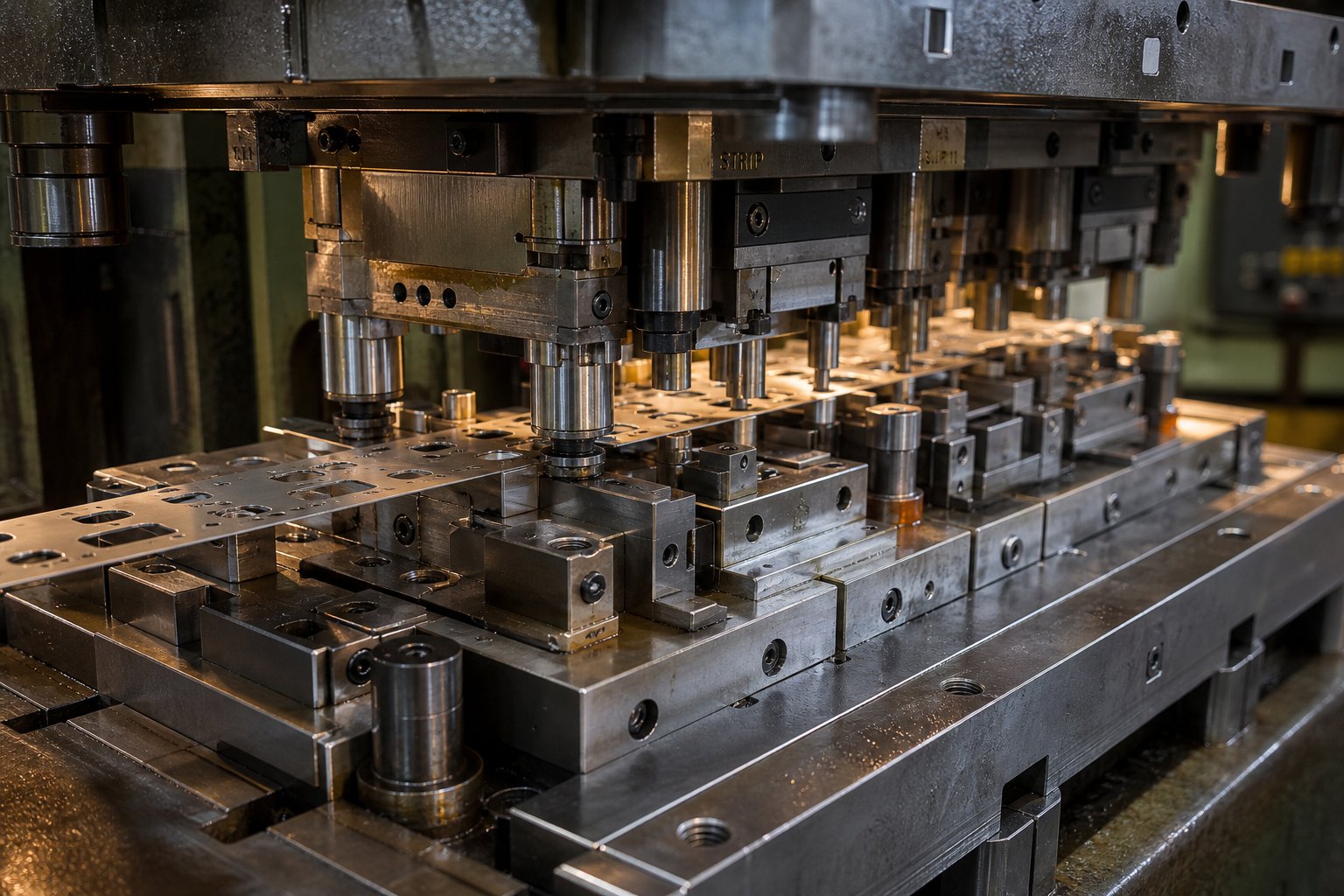
Progressive die stamping is a coil-fed metal forming process in which a strip of sheet metal advances through multiple stations within a single die set, with each press stroke performing a sequential operation - blanking, piercing, bending, or forming - until the finished part is separated at the final station.
That single definition captures the core concept, but the mechanism beneath it is where the engineering value lives.
How Progressive Die Stamping Works
Imagine a coil of sheet metal - steel, aluminum, copper, or brass - loaded onto an uncoiler and fed into a stamping press. A servo feeder advances the strip by a fixed increment called the feed pitch. With each press stroke, the strip moves precisely that distance into the next station.
Each station performs one specific operation. The first might pierce pilot holes for registration. The next could blank an internal feature. A downstream station bends a tab. Another forms a three-dimensional geometry. At the final station, the completed part is cut free from the carrier strip and ejected.
The strip itself acts as the transport mechanism - no robotic arms, no manual part handling between operations. Pilot pins engage pre-punched holes at every station to correct any minor feed deviation, keeping the strip positioned within thousandths of an inch. This piloting strategy is what gives progressive stamping its dimensional consistency across hundreds of thousands of cycles.
Presses running progressive dies typically operate anywhere from 25 to over 200 strokes per minute, meaning a finished part drops with every single stroke once the strip is fully loaded through all stations. That throughput is difficult to match with any alternative forming method at comparable tolerances.
Why Progressive Dies Dominate High-Volume Production
Three characteristics make progressive die stamping the default choice for high-volume metal parts:
- Elimination of part handling: Because the strip carries the workpiece through every operation, there's no transfer between machines, no re-fixturing, and no accumulation of positioning error between steps.
- Consistent cycle times: Production speed is measured in strokes per minute and remains constant. Whether you're running the first part or the millionth, the cycle time doesn't drift.
- Inherent repeatability: All forming geometry lives in a single integrated tool. Every dimension is locked by hardened steel or carbide, not by operator skill or setup variation.
These advantages compound over time. A well-designed progressive die can produce parts at per-unit costs 30% to 80% lower than CNC fabrication processes, with scrap rates optimized through intelligent strip layout design. The upfront tooling investment - which can range from $10,000 for simple geometries to $200,000 or more for complex multi-station tools - amortizes rapidly once production volumes climb into the tens of thousands annually.
For engineers sourcing precision metal components, progressive die & stamping represents the intersection of speed, accuracy, and economics. But raw process capability only tells half the story. The real performance difference - and the point where most projects succeed or fail - comes down to how thoroughly that die is customized to the specific part it needs to produce.
What Customization Means in Progressive Die Engineering
The word "custom" gets thrown around loosely in manufacturing. In progressive die tooling, it means something specific: every geometric, material, and sequencing decision in the tool is engineered backward from the finished part's requirements. There's no universal progressive die waiting to be adjusted - each tool is purpose-built, and the degree of customization determines whether it produces conforming parts or expensive scrap.
So what exactly are engineers tailoring when they develop a custom tool and die set for progressive stamping? The answer spans dozens of interdependent variables, each one shaped by the part geometry, material behavior, tolerance requirements, and production volume the tool must serve.
Variables Engineers Customize in Progressive Tooling
When a progressive tool and die set is designed from scratch, engineers make deliberate choices across a range of parameters - none of which are standardized across projects. Here are the primary customizable elements:
- Strip layout configuration: Part orientation on the strip, carrier type (center, outside, lance), scrap bridge geometry, and material utilization percentage. A well-planned layout can improve yield by 10-15% compared to a generic arrangement.
- Number of stations: Determined by part complexity and tolerance requirements. A simple bracket might need 4-6 stations; a connector with multiple bends and formed features could require 12-20.
- Die material selection: Tool steel grades (D2, A2, M2) for general-purpose stations versus carbide inserts for high-wear cutting and forming surfaces. The choice hinges on strip material abrasiveness and expected die life.
- Feed direction relative to grain: Rotating the part orientation relative to the rolling direction of the metal can prevent cracking on tight bends but may increase strip width and scrap. It's a direct trade-off between formability and material cost.
- Pitch distance between stations: The fixed increment the strip advances per stroke. Shorter pitch reduces strip consumption but may crowd stations and complicate maintenance access.
- Pilot pin placement strategy: Pilots can engage holes in the carrier strip or within the part geometry itself. Placement affects registration accuracy, and using part features as pilot locations risks elongating critical holes over time.
Each of these decisions interacts with the others. You can't change one without rippling effects through the rest of the tool design - which is precisely why custom tooling design and manufacturing demands experienced die engineers rather than catalog solutions.
Off-the-Shelf vs. Fully Customized Die Design
Some stamping suppliers offer adapted or semi-standard tooling: existing progressive dies modified slightly to approximate a new part's geometry. This approach works for standard shapes - simple washers, basic clips, or parts that happen to match existing tooling profiles. Per-part costs stay higher and geometry options remain constrained by whatever tooling already exists.
Fully customized progressive dies take a fundamentally different path. The tool is designed around the part - not the other way around. When an engineer specifies a positional tolerance of +/-0.05 mm on a formed feature, that single requirement can cascade through the entire design: it might demand an additional coining station to eliminate springback variation, which increases the total station count, which extends the strip width, which changes the material utilization calculation and die set footprint.
This cascading effect is what separates custom tooling solutions from adapted approaches. A tighter flatness callout might require a leveling station. A surface finish requirement on one face could dictate carbide forming inserts instead of tool steel. A burr-free edge specification might add a shaving station after initial blanking. Each functional requirement maps to a specific tooling decision - and those decisions multiply.
The economic logic is straightforward: custom tooling design and manufacturing costs more upfront, but it produces parts cheaper, faster, and more consistently once operational. A purpose-built progressive die engineered for your exact geometry, material, and volume profile is an asset that generates value across every production run for years.
The real engineering challenge isn't deciding whether to customize - for any non-trivial production part, it's the only viable path. The challenge is getting the design process right, where strip layout decisions, station sequencing, and simulation work together to produce a tool that performs on the first tryout rather than the fifth.
The Custom Progressive Die Design Process Step by Step
Getting a progressive stamping die from concept to production-ready tooling isn't a single leap - it's a carefully sequenced engineering workflow where each phase builds on validated decisions from the one before. Skip a step or rush through analysis, and problems compound downstream. A die that needs five tryout iterations instead of one can delay production by months and add tens of thousands in unplanned cost.
So what does a rigorous progressive stamping die design process actually look like, from the moment a part print lands on a die designer's desk to the point where conforming parts are dropping at rate? Here's the full sequence, broken down into the phases that separate well-engineered tooling from expensive trial-and-error.
- Part print analysis and feasibility review
- DFM feedback and specification refinement
- Strip layout development
- Station sequencing and pilot strategy definition
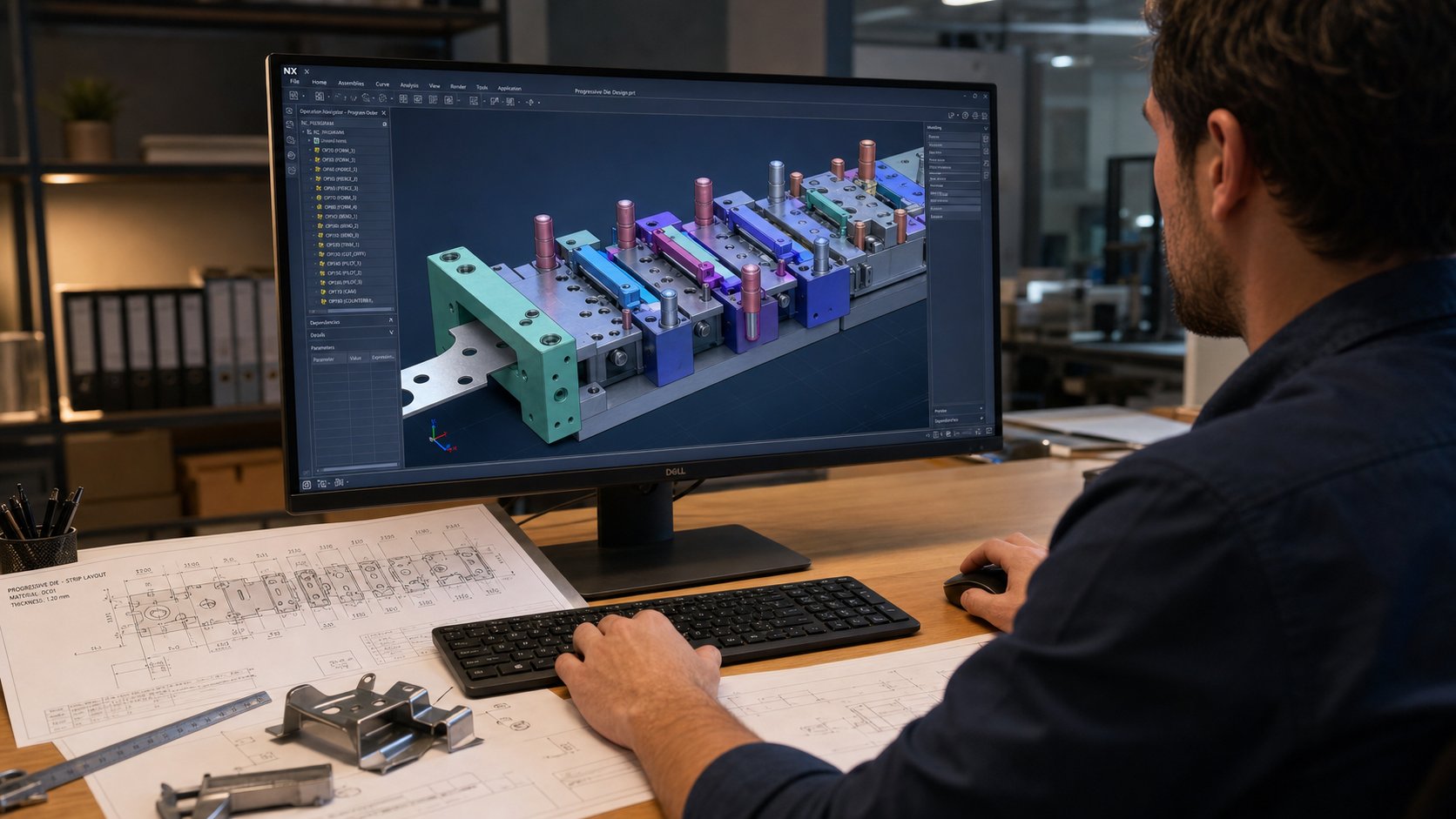
- Detailed die design (3D modeling)
- Forming simulation and springback prediction
- Tool build and assembly
- Tryout, sampling, and production validation
Each phase requires specific inputs from the customer and generates deliverables that feed the next stage. Let's walk through what happens at each point.
From Part Print to Strip Layout Development
Everything begins with the part print - the 2D drawing or 3D model that defines what the finished component must look like. But a die designer doesn't simply read dimensions off that print. They're analyzing it through the lens of formability: which features can be achieved in a single hit, which require progressive forming across multiple stations, and which geometries might be impossible to produce without modification.
The first real deliverable is a feasibility assessment. Die designers evaluate part geometry against material properties and flag potential issues early - tight bend radii that risk cracking, formed features too close to edges, or tolerance callouts that exceed what standard progressive stamping can reliably hold without secondary operations.
This is where Design for Manufacturability (DFM) feedback enters the picture. Experienced tooling design services providers don't just accept a part print at face value. They push back constructively: "If you can open this bend radius from 0.5T to 1.0T, we eliminate a station and reduce springback variation by 40%." Or: "Moving this hole 2 mm further from the formed edge lets us pierce it before forming, which improves positional accuracy." These suggestions save cost and improve quality without compromising the part's function.
The customer inputs required at this stage include:
- Complete part geometry (3D model preferred, 2D drawing minimum)
- Material specification (alloy, temper, thickness)
- Geometric dimensioning and tolerancing (GD&T)
- Annual volume and production life expectations
- Surface finish requirements and cosmetic standards
- Any secondary operations planned downstream (plating, heat treatment, assembly)
With feasibility confirmed and DFM revisions agreed upon, the die designer develops the strip layout. This is the blueprint that defines everything: how the part orients on the strip, where scrap bridges hold the carrier together, how material flows through each station, and where cutoff occurs. A strip layout for a progressive stamping die is essentially the process layout - it defines not just the forming sequence, but also how scrap sheds, how the part gets carried through the tool, and how it ejects at the end.
Strip layout development also determines material utilization. A skilled die designer can often improve yield by adjusting part rotation, nesting orientation, or carrier configuration - turning what might be 60% utilization into 72% or higher. On a million-part annual run, that difference translates directly to material savings measured in thousands of dollars.
Station Sequencing and Pilot Registration Strategy
With the strip layout defined, the next critical decision is station sequencing - determining which operation happens at which position along the strip progression. This isn't arbitrary. The order of operations directly affects achievable tolerances, material behavior, and die longevity.
A few guiding principles shape sequencing decisions in progressive stamping dies:
- Piercing before forming: Holes and internal features are typically punched while the strip is still flat. Attempting to pierce after bending introduces positional error because the material has already moved and stressed unevenly.
- Forming from simple to complex: Shallow bends precede deep draws. Partial forms precede final geometry. This staged approach distributes strain gradually and prevents tearing or excessive thinning.
- Critical dimensions tied to late stations: Features with the tightest tolerances are often formed or coined as late in the progression as possible, minimizing the number of subsequent operations that could introduce distortion.
- Idle stations for structural integrity: Some positions perform no work - they simply provide physical space between stations that require large, heavy die sections or accommodate strip movement between height changes.
Pilot registration strategy runs parallel to sequencing decisions. Pilot pins are the mechanism that corrects any feed-direction error between strokes, ensuring that the strip is positioned accurately at every station. The die designer determines where pilot holes get pierced (typically at the first station), how many pilots engage at each subsequent station, and whether pilots reference the carrier strip or features within the part itself.
Setting pilot timing correctly is critical during die setup. The pilot-release function on the coil feeder must be timed so that the bullet nose of the pilot enters the strip before the feed rollers unclamp - but the full pilot diameter does not engage until after release. Incorrect timing leads to misfeeds, elongated pilot holes, and poor part location. These setup details get designed into the tool from the start - the pilot hole diameter, the pilot nose geometry, and the clearance between pilot and hole all affect how forgiving the tool is during production.
Simulation, Prototyping, and Production Validation
Before any steel gets cut for the actual die build, modern die design services rely on forming simulation to validate the entire sequence virtually. FEA-based software - tools like Logopress ProgSim running on incremental simulation technology - allows die designers to model each station's forming operation, predict material thinning, identify wrinkle-prone areas, and calculate springback before the physical tool exists.
Simulation answers questions that used to require expensive physical tryouts: Will this draw depth cause splitting at the corner radius? How much does the part spring back after the bending station, and what overbend angle compensates? Does material flow evenly across the formed section, or will one side thin excessively?
For complex progressive stamping die design projects, simulation can reduce tryout iterations from five or six down to one or two - saving weeks of calendar time and significant tooling rework costs. It functions as a virtual tryout press, letting engineers validate the process before the die design is even finalized.
With simulation complete and the die built, physical tryout begins. The die is mounted in the target press (or a tryout press with equivalent specifications), coil stock is threaded through, and initial parts are produced. Engineers measure critical dimensions against the part print, checking for:
- Dimensional conformance to GD&T callouts
- Burr height and edge condition
- Surface quality and marking
- Springback deviation from nominal
- Strip feed consistency and pilot engagement
Adjustments during tryout are normal - shimming a forming station, tweaking a bend angle, adjusting die clearance. The difference between a well-simulated die and one designed without simulation is the magnitude of those adjustments: minor tweaks versus fundamental rework.
Production validation follows successful tryout. This means running at production speed for an extended period, measuring statistical process capability (Cpk), and confirming the die maintains conformance under sustained cycling. Only after the tool demonstrates stable output at rate does it graduate from development to production status.
The entire workflow - from part print analysis through production validation - typically spans 8 to 20 weeks depending on complexity. But the real variable isn't time. It's the quality of engineering decisions made during strip layout and station sequencing. Those early-phase choices lock in the die's performance ceiling. Everything downstream - simulation, build, tryout - simply reveals whether those foundational decisions were sound.
Material selection is one of the most powerful factors influencing those early decisions. The same part geometry stamped in mild steel versus stainless steel versus aluminum can demand a completely different station count, different die materials, and different forming strategies - which is exactly where the design process gets material-specific.
Material Selection and Its Impact on Die Design
A progressive die designed for carbon steel won't survive a week running stainless - and one optimized for aluminum will destroy copper parts with galling on the first hundred hits. Progressive stamping materials don't just fill a line on the part print. They dictate station count, tonnage requirements, punch geometry, lubrication strategy, and die material selection throughout the entire tool. Change the alloy, and you're redesigning the die.
This is the variable that separates engineers who understand progressive metal stamping from those who treat material choice as an afterthought. Here's how the most common strip materials shape every decision in the tool.
Steel and Stainless Steel in Progressive Stamping
Low-carbon steel (1008, 1010, 1018) remains the workhorse of carbon steel progressive stamping. It's forgiving - moderate springback, predictable formability, and relatively low tonnage demands. Die designers can achieve tight bends at 1T radius without cracking risk, and standard D2 tool steel punches deliver reliable life in the hundreds of thousands of hits before resharpening.
Stainless steel changes everything. Grades like 301 and 304 work-harden rapidly during forming, meaning each bending or drawing operation increases the material's yield strength and resistance to further deformation. The practical consequence? A geometry achievable in three stations with mild steel might require five or six stations in stainless - extra coining, stress-relieving, or staged forming steps added specifically to manage work hardening without cracking.
Stainless steel progressive stamping also demands higher press tonnage (typically 1.5 to 2 times what mild steel requires for equivalent geometry) and creates significantly more abrasive wear on tooling surfaces. Galling - where stainless material welds microscopically to punch surfaces - is a constant threat. Die designers counter this with surface coatings (TiN, TiCN, or AlCrN), polished punch surfaces, and specialized lubricants engineered to maintain a boundary layer under extreme pressure.
Copper, Brass, and Aluminum Considerations
Softer, more ductile materials like copper, brass, and aluminum alloys flip the problem. Formability is generous - you'll achieve tighter bend radii with fewer stations. A copper progressive stamping application might consolidate operations that stainless would spread across multiple stages. Fewer stations means a shorter, less expensive die.
But ductility introduces its own failure modes. Copper and brass tend to stick to tooling surfaces, producing burrs and surface marks that compromise both function and cosmetics. Excess burr formation in brass often requires sharper cutting edges and more frequent resharpening intervals. Aluminum progressive stamping presents similar galling concerns plus a tendency to scratch and mark against rough tooling surfaces - die designers respond by polishing forming surfaces to near-mirror finish and reducing press speed to limit frictional heat buildup.
The strip material's abrasiveness directly determines whether die components use tool steel or carbide inserts. Here's the decision logic: tool steels like D2 or A2 work well for mild steel and brass at moderate volumes. But for stainless steel, high-strength alloys, or any application targeting die life beyond 500,000 hits, carbide inserts at cutting and high-wear stations become economically necessary. Carbide costs three to five times more per insert, but extends sharpening intervals by a factor of five to ten - a net win on long production runs.
| Material | Formability | Typical Thickness Range | Die Wear Impact | Common Applications |
|---|---|---|---|---|
| Low-Carbon Steel (1008-1018) | High - forgiving bends, moderate springback | 0.3 mm – 3.0 mm | Moderate - standard D2 tool steel adequate | Brackets, structural clips, automotive reinforcements |
| Stainless Steel (301, 304, 316) | Moderate - work hardens rapidly, more stations needed | 0.2 mm – 2.5 mm | High - galling risk, coatings or carbide required | Medical components, food equipment, corrosion-resistant hardware |
| Copper (C110, C102) | Very high - tight radii achievable | 0.1 mm – 2.0 mm | Low-moderate - sticking and burr issues | Electrical terminals, bus bars, heat sinks |
| Brass (C260, C272) | High - excellent ductility, easy to form | 0.1 mm – 2.0 mm | Low - but requires sharp edges to control burr | Connectors, decorative hardware, plumbing fittings |
| Aluminum (3003, 5052, 6061) | Moderate-high - scratching and galling risk | 0.3 mm – 3.0 mm | Moderate - polished tooling and reduced speed needed | Heat exchanger fins, enclosures, lightweight structural parts |
Notice the pattern: harder, stronger materials demand more forming stations, higher tonnage, and more wear-resistant (expensive) tooling. Softer materials reduce station count but require surface management strategies that add their own complexity. Neither end of the spectrum is inherently easier to stamp - they're different engineering problems requiring different die design responses.
This is exactly why customized progressive die & stamping matters at the material level. A die builder who doesn't adjust clearance percentages, punch coatings, and station count specifically for your alloy is leaving performance and die life on the table. The numbers shift meaningfully: die clearance for mild steel is typically set at 5-8% of material thickness per side, while stainless steel requires 8.5-9.5%, and aluminum needs tighter clearances around 4-6% to control burr.
Material selection doesn't just affect how the die forms the part - it determines whether progressive tooling is even the right method. When part geometry involves deep draws exceeding what strip-fed progression can accommodate, or when material thickness pushes beyond practical strip-handling limits, alternative die methods enter the conversation.
Progressive Die vs. Transfer Die vs. Compound Die Selection
Not every part belongs in a progressive stamping press. A deep-drawn housing that exceeds strip width, a large bracket that can't maintain carrier integrity through twelve stations, a simple washer that doesn't justify multi-station tooling - each of these scenarios points toward a different die method. Choosing wrong means overspending on tooling, fighting quality issues, or leaving cycle time on the table.
The three primary die stamping methods - progressive, transfer, and compound - differ in how they move material, how they handle part complexity, and where they deliver economic advantage. Understanding the mechanical distinction between them is what separates a sound tooling investment from a costly mismatch.
Progressive Die vs. Transfer Die vs. Compound Die
Each method solves a different manufacturing problem:
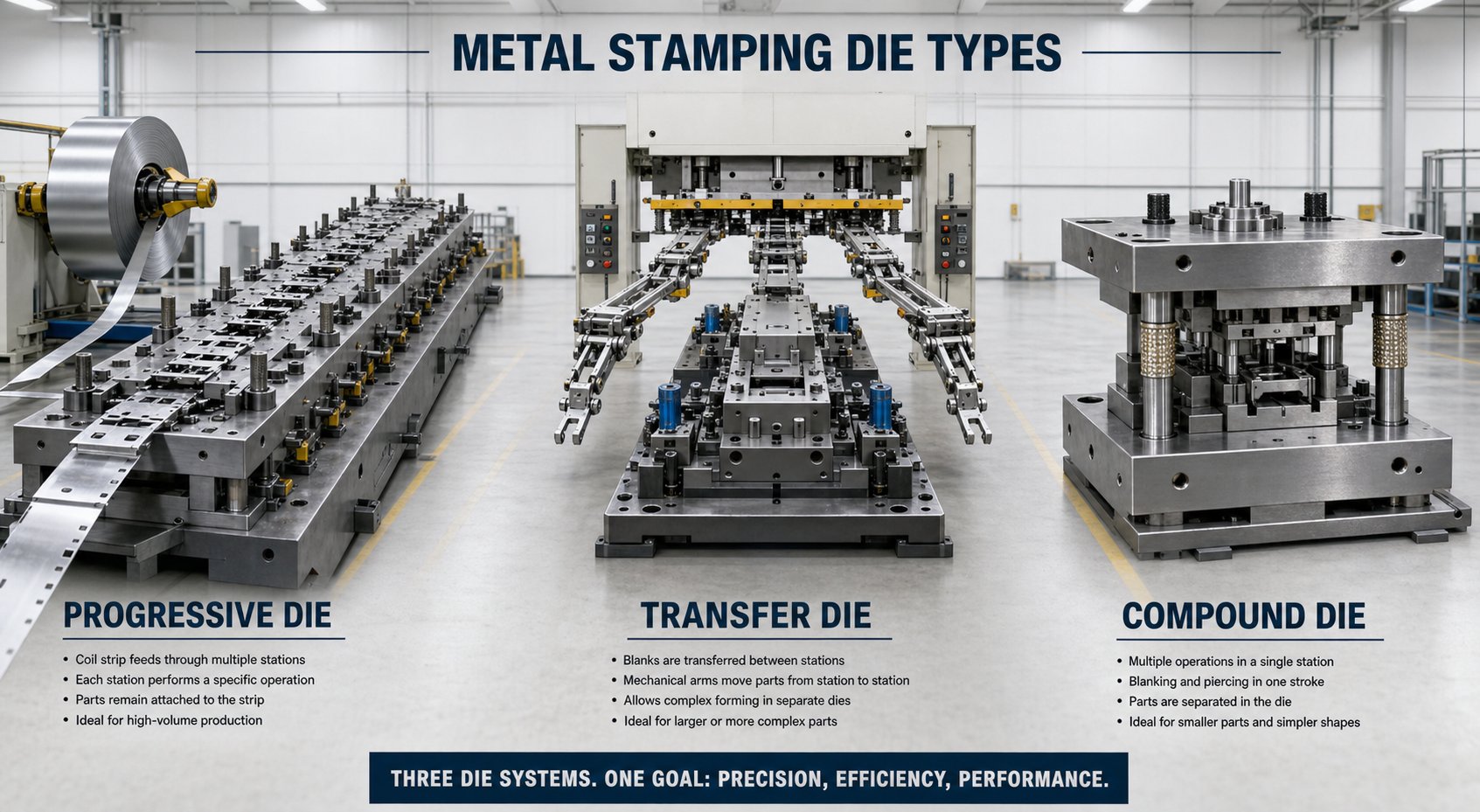
- Progressive dies keep the workpiece attached to the strip throughout all forming operations. The coil advances at a fixed pitch, and the finished part separates only at the final station. This strip-connected approach enables the highest cycle speeds - a progressive die metal stamping operation commonly runs 100 to 300+ strokes per minute - but limits part size to what fits within practical strip widths (typically under 300 mm).
- Transfer dies separate the blank from the strip at the first station, then move discrete parts between subsequent stations using mechanical fingers or servo-driven grippers. Because the part is free-standing, transfer tooling handles larger parts, deeper draws, and geometries impossible to form while tethered to a carrier strip. Cycle speeds are lower (typically 15 to 40 strokes per minute) due to the mechanical transfer motion between stations.
- Compound dies perform multiple cutting operations - blanking, piercing, and sometimes coining - in a single press stroke at one station. The part drops complete in one hit. This method delivers excellent flatness and concentricity between features because all operations occur simultaneously, but it cannot perform bending or three-dimensional forming. It's restricted to essentially flat parts.
The fundamental trade-off comes down to this: progressive dies maximize speed and minimize handling for smaller parts with complex features. Transfer dies sacrifice speed for geometric freedom on larger or deeper parts. Compound dies offer simplicity and precision for flat geometries at moderate volumes.
Selection Criteria Based on Part Requirements
Choosing between these methods isn't a matter of preference - it's driven by measurable part characteristics. Ask yourself these questions when evaluating which die stamping machine configuration fits your application:
- What's the part envelope? If it fits within a 300 mm strip width and doesn't require draws deeper than the material can sustain while connected to a carrier, progressive tooling is likely optimal.
- What's the annual volume? Progressive dies deliver the lowest per-part cost at volumes above 500,000 annually due to their speed advantage. Transfer dies become economical at 100,000+ units where part complexity justifies the tooling. Compound dies hit their sweet spot between 50,000 and 500,000 units for simple geometries.
- Does the geometry involve deep draws? Draw depths exceeding 1.5 times the part diameter typically require the blank to be free from the strip - pointing toward transfer tooling.
- What's the budget for tooling? Compound dies cost significantly less to design and build. Progressive and transfer dies both carry higher upfront investment, but progressive dies amortize faster at volume thanks to higher stroke rates.
| Criteria | Progressive Die | Transfer Die | Compound Die |
|---|---|---|---|
| Optimal Part Size | Small to medium (fits within strip width, typically under 300 mm) | Medium to large (not constrained by strip) | Small to medium (flat parts, commonly under 150 mm) |
| Ideal Annual Volume | 500,000+ units | 100,000 – 2,000,000 units | 50,000 – 500,000 units |
| Geometric Complexity | High - multiple bends, pierces, and forms achievable across many stations | Very high - deep draws, threading, ribs, and knurls possible | Low - limited to flat, single-plane operations |
| Tooling Cost (Relative) | High | Highest (120-150% of progressive) | Medium (70-90% of progressive) |
| Cycle Speed | Fastest (100-300+ SPM) | Moderate (15-40 SPM) | Fast (80-200 SPM, but single-operation) |
| Material Utilization | Moderate - carrier strip becomes scrap | Higher - no carrier web required | High - minimal scrap for simple blanks |
One detail worth noting: transfer dies often deliver better material utilization than progressive tooling because they eliminate the carrier strip (the web of material connecting parts through the progression). That material savings can offset the lower cycle speed, particularly on thicker or expensive alloys where scrap cost is significant.
Hybrid approaches also exist. Some die stamping press setups combine a progressive front section - handling piercing and initial forming while the part remains on the strip - with a transfer rear section that separates the blank and moves it through deeper forming stations. These progressive-transfer hybrids capture speed advantages on the front end while accommodating geometric demands that exceed pure progressive capability on the back end. They're more complex to design and maintain, but for the right part geometry, they represent the best of both methods.
The selection framework above handles most scenarios cleanly. But the decision isn't made in isolation - it's shaped by the industry the part serves, the quality documentation required alongside it, and the production expectations that come with OEM versus aftermarket programs. Those application-level demands add another layer to the tooling strategy.
Industry Applications and Why Progressive Dies Excel
Every industry that uses progressive stamping has a reason beyond just "we need lots of parts." The specific technical demands - tolerance bands, surface conditions, traceability requirements, material constraints - determine not only whether progressive tooling is appropriate, but how it must be customized. A bracket for an HVAC blower housing and a contact for a cardiac pacemaker both come from progressive dies, yet the engineering logic behind each tool is completely different.
That distinction matters. When you're evaluating whether progressive precision metal stampings fit your application, the question isn't just volume - it's whether the process can meet your industry's non-negotiable requirements without secondary operations eating into your cost advantage.
Automotive and EV Component Stamping
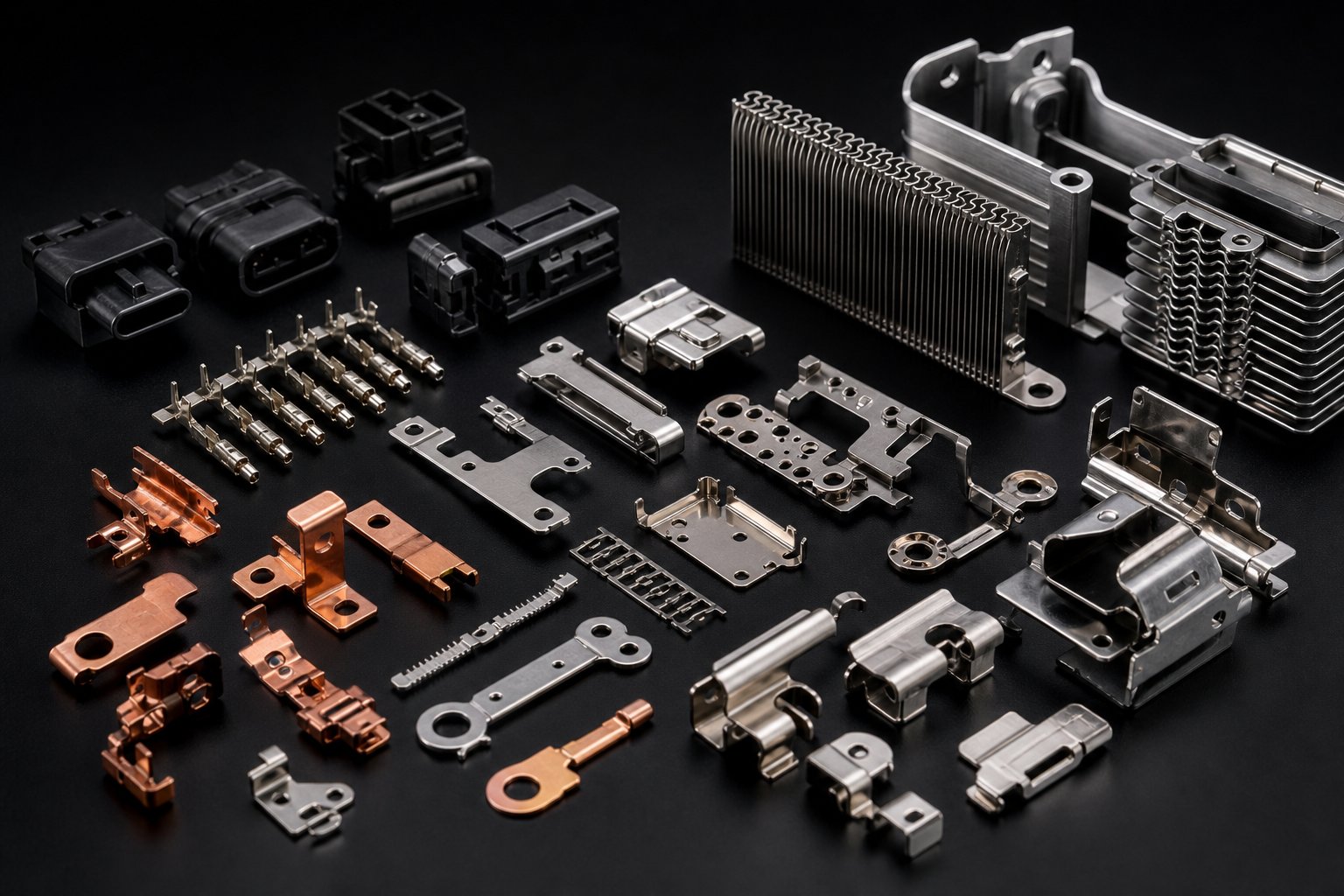
Automotive remains the largest consumer of high volume stampings globally, and the reasons are structural. Vehicle platforms demand thousands of discrete stamped components - brackets, connectors, structural reinforcements, sensor housings, terminal contacts - produced at volumes measured in millions per year with tolerances that can't drift across a production run lasting months.
Progressive dies serve this demand because they deliver what automotive OEMs actually require: statistical consistency. It's not enough that parts measure correctly during a sample inspection. OEM progressive stamping programs require demonstrated process capability (Cpk values of 1.33 or higher on critical characteristics) sustained across entire production campaigns. The die itself must produce parts so consistently that process variation stays within control limits indefinitely.
The EV transition has accelerated this further. Battery contact components, bus bar connectors, and motor lamination stacks all demand high precision metal stamping in copper or specialized alloys, often at tighter tolerances than traditional powertrain components. A battery module connector carrying 400V must maintain contact force within a narrow window - which means the progressive die forming those spring contacts can't allow dimensional drift that changes the deflection characteristics.
Electronics, Medical, and HVAC Applications
Electronics stamping operates at the opposite end of the size spectrum. Think lead frames with pitch distances under 1 mm, connector pins formed from strip material as thin as 0.1 mm, and RF shield cans with tolerances measured in microns. Progressive dies for electronics work at high speed - often 300 to 1,200 strokes per minute - on extremely thin materials where feed accuracy and pilot registration become the dominant engineering challenges.
Medical progressive stamping introduces a different constraint set entirely. The parts themselves may not be geometrically extreme, but the process environment is. Implantable device components demand burr-free edges (because even a microscopic burr can damage tissue), biocompatible material handling (no cross-contamination from lubricants or tooling debris), and often cleanroom-compatible tooling design that minimizes particulate generation during stamping. Surgical instruments produced via stainless steel progressive stamping require tolerances as tight as ±0.0005 inches - roughly 12 microns - to ensure smooth mechanical function during procedures.
HVAC progressive stamping takes yet another path. Here, the engineering challenge is less about extreme precision and more about sustained material efficiency at enormous volumes. Heat exchanger fins - stamped by the millions from thin aluminum strip - must maintain consistent airflow geometry across every single part. A variation of even 0.1 mm in fin spacing or louver angle degrades thermal performance across the entire heat exchanger assembly. Progressive dies for HVAC applications prioritize long tool life and minimal station-to-station variation across production runs measured in tens of millions of hits.
Here's how each industry's core requirements map to specific progressive die capabilities:
- Automotive/EV: High-volume consistency at tight tolerances → multi-station forming with coining for dimensional stability, in-die part marking for traceability, SPC-compatible process design
- Electronics: Micro-features in ultra-thin materials → high-speed progressive tooling with precision pilots, carbide cutting sections, and close-pitch station spacing
- Medical devices: Burr-free edges and biocompatible processing → shaving stations after blanking, polished carbide forming inserts, controlled lubrication systems with medical-grade fluids
- HVAC: Millions of identical parts with consistent airflow geometry → high-durability tool steels, optimized strip layouts for maximum material utilization, robust pilot systems for thin aluminum strip control
- Aerospace: Extreme tolerances (±0.0005 inches) on lightweight alloys → staged forming sequences, FEA-validated springback compensation, 100% in-die inspection capability
The common thread? Each industry doesn't just need progressive precision metal stampings - it needs the die customized to deliver a specific performance characteristic that matters most in that application context.
OEM progressive stamping programs add another layer of complexity that aftermarket or commercial hardware projects rarely encounter. OEM contracts typically require full PPAP (Production Part Approval Process) documentation - an 18-element package that includes dimensional results, process capability studies, control plans, FMEA documentation, and measurement system analysis. The die itself must be designed to facilitate this: part marking stations that stamp lot codes or date marks for traceability, in-die sensors that monitor forming force for SPC data collection, and modular construction that allows measured, documented maintenance without altering validated process parameters.
Aftermarket programs, by contrast, often require only dimensional conformance to print. The die can be simpler, the documentation lighter, and the process controls less rigorous. But for any engineer supplying Tier 1 or Tier 2 automotive, medical, or aerospace OEMs, the PPAP requirement isn't optional - and it has to be designed into the tooling from the start, not bolted on after the die is built.
This distinction between "making good parts" and "proving you can always make good parts" is exactly where high volume stampings programs succeed or fail. The die must produce conforming parts, yes - but it must also generate the data, traceability, and process stability evidence that satisfies the OEM's quality system. That requirement flows all the way back to initial die design decisions: how many sensors, what kind of part marking, how maintainability affects process requalification.
The performance expectations built into these industry applications - speed, precision, traceability, die life - don't maintain themselves. They erode with every stroke unless the tool is designed for sustainable production. Which raises the question every production engineer eventually faces: how do you keep a progressive die performing at spec across millions of cycles without unplanned downtime destroying your delivery schedule?
Die Maintenance, Tool Life, and Production Economics
A progressive die doesn't fail all at once. It degrades - punch edges dull by microns per thousand strokes, die clearances open up as surfaces wear, springs lose their preload over millions of cycles. The question isn't whether maintenance will be needed. It's whether you'll catch degradation early through planned intervention or discover it late through rejected parts and unplanned downtime.
This is where die design decisions made months earlier - material choices, insert construction, access strategy - either pay dividends or create headaches on the production floor. In high speed metal stamping especially, where presses cycle at 200 to 1,200+ strokes per minute, wear accumulates faster than most engineers expect.
Die Maintenance Intervals and Predictive Indicators
How do you know when a progressive die needs service? You don't wait for catastrophic failure. Instead, you watch for measurable quality drift that signals wear progression before it crosses tolerance boundaries:
- Burr height increase: As punch cutting edges dull, shearing becomes less clean. Burr height creeping from 0.05 mm toward 0.10 mm is often the first measurable sign that resharpening is overdue.
- Dimensional drift: Formed features gradually shift outside nominal as forming surfaces wear. SPC charts showing trending (not random scatter) indicate systematic tool degradation.
- Increased stripping force: Worn punches create more friction during withdrawal. Operators may notice subtle press load changes before dimensional issues appear.
- Slug pulling: When slugs adhere to punch faces instead of ejecting cleanly, it typically indicates surface degradation or vacuum effects worsened by punch wear.
Experienced stamping operations establish sharpening intervals based on stroke count rather than visual inspection. A high speed progressive die stamping operation running stainless steel might schedule resharpening every 150,000 to 250,000 strokes, while the same tool running mild steel could extend that interval to 500,000 or more. The key is quantifying the interval during initial production validation and then tracking it rigorously.
Planned maintenance means the die comes out of the press on schedule - operator downtime is predictable, spare inserts are staged, and production planning accounts for the interruption. Unplanned maintenance means something broke. That distinction is expensive: unplanned events typically cost three to five times more than scheduled service when you factor in scrap, expedited repairs, missed delivery windows, and line disruption.
Smart die designers build maintainability directly into the tool. Modular insert construction allows worn sections to be swapped without pulling the entire die from the press. Accessible fastening means bolted inserts rather than press-fit components buried behind other stations. Standardized punch holders enable quick replacement without custom grinding. These design features cost marginally more upfront but save enormous time over the production life of the tool.
How Die Design Decisions Affect Tool Life and Cost Per Part
Here's the economic reality that procurement teams often miss: a cheaper die costs more per part. Two tooling quotes for the same part geometry - one at $35,000 with tool steel throughout, another at $48,000 with progressive carbide stamping dies featuring inserts at all cutting stations - look like a simple budget decision on paper. But run the math over a million-part production life, and the economics flip.
Consider the variables:
- Carbide vs. tool steel inserts: Carbide cutting components cost three to five times more per insert but extend resharpening intervals by a factor of five to ten. Fewer maintenance events means more uptime, fewer scrap events during restart, and lower cumulative labor cost.
- Die clearance selection: Proper clearance - matched to material type and thickness - reduces the cutting force on every stroke. Lower force means slower edge degradation. A die running at 6% clearance on mild steel lasts measurably longer than one set at 4%, because excessive tightness multiplies friction and heat at the cutting edge.
- Station count and wear distribution: Spreading forming work across more stations reduces peak load at any single point. Each station wears more slowly because it's doing less work per stroke. The die costs more to build (more stations means more components), but each component lasts proportionally longer.
Running a die on a high-speed stamping press at 300+ strokes per minute accelerates every wear mechanism. Punch temperature rises from repeated friction cycles. Thermal expansion subtly alters clearances mid-run. Strip vibration increases lateral loading on pilots and guides. Lubrication films thin out under the rapid cycling. A die that lasts 800,000 strokes between service at 60 SPM might need attention every 400,000 strokes at 400 SPM - the relationship isn't linear, because dynamic forces and thermal effects compound at higher speeds.
High speed stamping demands tooling designed specifically for that operating regime. Standard-speed die construction - adequate at 60 to 100 SPM - becomes a liability when pressed into high-speed service. Reinforced guide systems, balanced station loading, optimized scrap evacuation timing, and dynamic unloading stabilization all become necessities rather than luxuries above 300 SPM.
The total cost of ownership calculation should look like this:
Cost per part = (die cost + lifetime maintenance cost + unplanned downtime cost + scrap cost) / total parts produced over die life
A $48,000 die that produces 2 million conforming parts with minimal maintenance events delivers a fundamentally different cost-per-part than a $35,000 die that produces the same volume but requires double the maintenance interventions and generates 3% more scrap during restarts. The upfront difference is $13,000. The lifetime difference can exceed $50,000 in operational savings - not counting the delivery reliability improvement that comes from fewer unplanned stops.
This total-cost perspective reframes the tooling investment decision. You're not buying a die. You're buying a production system whose economics play out across years, not weeks. Every design choice - carbide versus tool steel, modular versus monolithic, five stations versus seven - shifts the long-term cost curve in ways that the initial purchase order never captures.
That same economic logic extends beyond die design into the broader sourcing decision. When you're selecting a partner for customized progressive die & stamping, you're evaluating not just their ability to build the tool, but their understanding of how design choices translate into production economics over the full life of the program.
How to Source a Custom Progressive Die Partner
You've validated the design, selected the material, defined the station sequence, and calculated the total cost of ownership. Every engineering decision is locked. And yet, the entire program can still fail at this point - if the wrong partner builds the tool. The gap between a die that works on paper and one that performs at rate for two million cycles comes down to who fabricates it, how they collaborate during design, and what systems they bring to production ramp.
Sourcing progressive die manufacturers isn't the same as buying commodity hardware. You're entering a technical partnership that spans months of development and years of production. The evaluation criteria matter - and most procurement teams don't weight them correctly.
Evaluating Progressive Die Manufacturer Capabilities
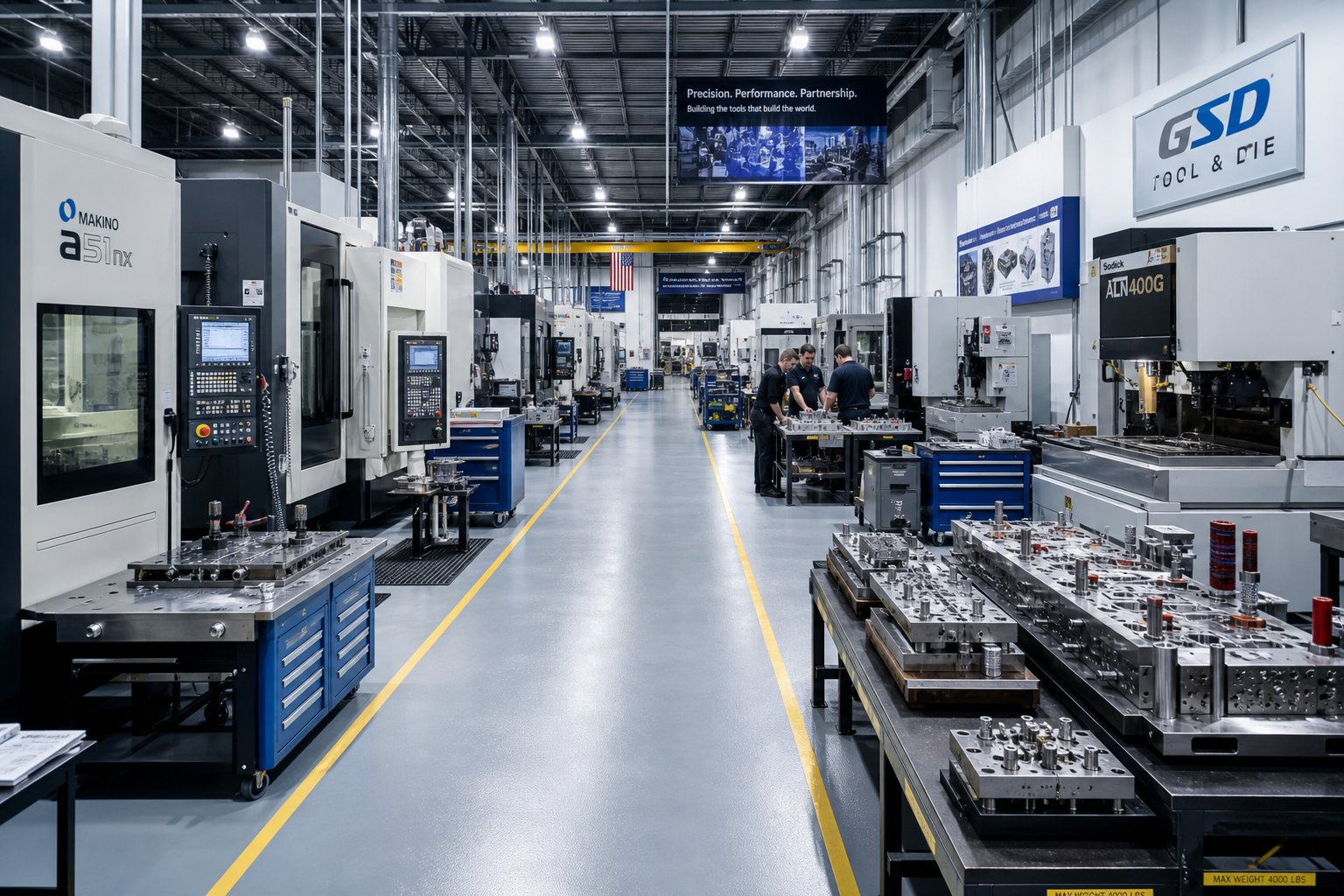
Imagine you're shortlisting stamping die manufacturers for a new automotive connector program. Three suppliers quote similar pricing and lead times. How do you differentiate? Price and delivery are table stakes. The real separation comes from technical depth - specifically, whether the supplier can handle the full scope of tool and die manufacturing services under one roof or relies on subcontractors for critical steps.
Here's what to evaluate:
- In-house die design and build capability: Can the supplier take your part print, develop the strip layout, engineer the full die, and machine all components internally? Fragmented supply chains - where design happens at one shop, machining at another, and assembly at a third - introduce communication gaps and accountability problems that compound during tryout.
- Press tonnage and bed size range: Does the supplier operate presses that match your production die's requirements? A manufacturer with 30-ton to 400-ton capacity across multiple press lines can handle everything from micro-connectors to structural brackets without outsourcing production runs.
- Material handling for specific alloys: Running copper, stainless, or high-strength steel demands different feed systems, lubrication strategies, and scrap management. Ask whether the supplier has documented experience with your exact material specification - not just the alloy family, but the specific temper and thickness.
- Quality systems (ISO certification, SPC implementation): ISO 9001 is baseline. For automotive OEM progressive stamping programs, IATF 16949 certification signals that the supplier operates within a process-controlled framework with documented FMEA, control plans, and measurement system analysis already embedded in their workflow.
- Prototype-to-production scalability: Some shops excel at building dies but lack production press capacity. Others run high-volume stamping but don't design tooling in-house. The ideal partner spans both - capable of iterating during development and then scaling seamlessly into sustained production without handing off to a different facility.
- Simulation and validation tools: FEA-based forming simulation, springback prediction, and virtual tryout capability reduce physical iterations and accelerate time-to-production. Suppliers who invest in these tools typically deliver first-tryout success rates significantly higher than those relying solely on experience.
- Maintenance infrastructure: Ask what happens after the die is validated. Does the supplier offer scheduled maintenance services, spare insert programs, and die repair capabilities? A progressive die and stamping partner that disappears after delivery leaves you exposed when tooling needs service at month eighteen.
Weight these criteria according to your program's risk profile. A high-volume automotive connector running 5 million parts annually demands rigorous quality systems and proven material experience. A lower-volume industrial bracket program might prioritize lead time flexibility and cost. Either way, the evaluation should go beyond a capabilities brochure - request case studies, ask for references in your specific material and tolerance range, and if feasible, visit the facility to observe their die build and tryout process firsthand.
What a Collaborative Design-to-Production Workflow Looks Like
The best progressive die stamping services don't start with a purchase order. They start with a conversation - typically a design review where the supplier's die engineers sit with your product team and dissect the part print together. That initial collaboration sets the trajectory for the entire program.
Here's what a well-structured engagement looks like from first contact through production ramp:
- Initial part review and feasibility assessment: The supplier evaluates your part geometry, material spec, tolerances, and volume requirements. They identify potential forming challenges, flag features that may need DFM adjustment, and confirm that progressive tooling is the right method for your application.
- DFM feedback and design optimization: Engineers propose modifications that improve manufacturability without compromising function - wider bend radii, adjusted hole positions relative to formed features, or material grade alternatives that reduce tonnage demands. This step often eliminates one to three stations from the die, directly reducing tooling cost.
- Strip layout approval: The supplier presents the proposed strip layout showing part orientation, carrier design, scrap bridges, station sequence, and material utilization percentage. You approve this before detailed die design begins - it's the single most important sign-off in the program because everything downstream depends on it.
- Detailed die design and tooling timeline: With the strip layout locked, 3D die design proceeds through modeling, component specification, and tolerance stack-up analysis. The supplier provides a build timeline with milestones for design completion, component machining, assembly, and tryout readiness.
- Tryout and sample submission: The completed die goes onto a press for initial tryout. First-off parts are measured against your print, and the supplier submits samples with dimensional reports. Minor adjustments - shimming, clearance tweaks, overbend corrections - are normal at this stage.
- PPAP completion: For OEM programs, the supplier completes the full Production Part Approval Process documentation package - dimensional results, capability studies, control plans, process flow diagrams, FMEA, and the Part Submission Warrant. This formal validation confirms that the production process is stable and capable before volume ramp begins.
- Production ramp and sustained support: With PPAP approved, production scales to full rate. The supplier monitors process performance through SPC, schedules preventive maintenance at validated intervals, and maintains communication channels for engineering changes or volume adjustments.
This sequence typically spans 10 to 20 weeks depending on die complexity. The critical variable isn't calendar time - it's how well the early-phase collaboration (steps 1 through 3) identifies and resolves issues before steel gets cut. A supplier who rushes past DFM feedback to accelerate the timeline usually pays for it in extended tryout cycles and rework.
For production engineers evaluating progressive die metal stamping services, YICHEN represents the kind of end-to-end partner this workflow demands - offering integrated capabilities from design collaboration through high-volume production, with specific focus on multi-station forming efficiency and scalable mass production. Their approach reflects what effective tool and die manufacturing services should look like: a single source handling strip layout development, die build, tryout, and sustained production support without handoffs between disconnected shops.
Regardless of which supplier you ultimately select, apply one principle consistently: evaluate them on their process, not just their quote. A progressive die partner who walks you through their design methodology, shows you their simulation validation approach, and explains how they handle maintenance planning across the die's production life is demonstrating the engineering depth that translates directly into fewer surprises on your production floor. The cheapest quote rarely produces the cheapest parts - and in customized progressive die & stamping, the partner's engineering rigor during development determines whether the tool performs at spec for years or requires costly interventions within months.
Frequently Asked Questions About Customized Progressive Die & Stamping
1. What is a progressive die and how does it work?
A progressive die is a precision metal forming tool where coil-fed sheet metal advances through multiple stations at a fixed pitch distance with each press stroke. Every station performs a specific operation such as piercing, blanking, bending, or forming. The strip itself acts as the transport mechanism, with pilot pins maintaining registration accuracy within thousandths of an inch. Once the strip is fully loaded, a finished part drops with every single stroke, enabling production speeds of 25 to over 1,200 strokes per minute depending on the application.
2. How long does it take to design and build a custom progressive die?
The full workflow from part print analysis through production validation typically spans 8 to 20 weeks depending on complexity. This includes feasibility review, DFM feedback, strip layout development, station sequencing, 3D die design, forming simulation, tool build, tryout, and PPAP completion. The critical time variable is not calendar duration but engineering quality during early phases. Suppliers like YICHEN who integrate design collaboration with in-house build capability can compress timelines by eliminating handoffs between disconnected shops.
3. When should I choose a progressive die over a transfer die or compound die?
Progressive dies are optimal when your part fits within a 300 mm strip width, annual volumes exceed 500,000 units, and the geometry involves multiple bends and formed features without deep draws exceeding 1.5 times the part diameter. Transfer dies suit larger parts requiring deep draws at moderate volumes of 100,000 or more units. Compound dies work best for flat, single-plane parts at volumes between 50,000 and 500,000 units where tooling budget is limited. Part size, volume, geometric complexity, and budget collectively drive the decision.
4. How does material selection affect progressive die design and cost?
Material choice fundamentally changes station count, tonnage requirements, and die component materials. Stainless steel work-hardens rapidly, often requiring 1.5 to 2 times more stations than mild steel for equivalent geometry, plus coated or carbide tooling to combat galling. Aluminum and copper allow fewer stations but demand polished forming surfaces and careful speed control to prevent surface marking. Die clearance percentages also shift by material: 5-8% for mild steel, 8.5-9.5% for stainless, and 4-6% for aluminum. Each alloy creates a distinct engineering problem requiring tailored tooling solutions.
5. What should I look for when evaluating progressive die manufacturers?
Prioritize suppliers with in-house die design and build capability, press tonnage matching your production requirements, documented experience with your specific material and thickness, ISO or IATF certification with SPC implementation, and prototype-to-production scalability. Also evaluate their simulation tools, maintenance infrastructure, and willingness to collaborate during DFM feedback. Progressive die manufacturers like YICHEN that offer end-to-end services from strip layout development through sustained high-volume production eliminate the communication gaps and accountability issues that arise when design, machining, and production are fragmented across multiple shops.


