


What Progressive Die Stamping Means for Wholesale Buyers
When procurement teams evaluate sourcing options for high-volume metal parts, one manufacturing method consistently delivers the lowest per-part cost at scale: progressive die and stamping. Yet most buyers negotiate pricing without fully understanding how the process works, leaving margin on the table at every quote review.
What Is Progressive Die Stamping
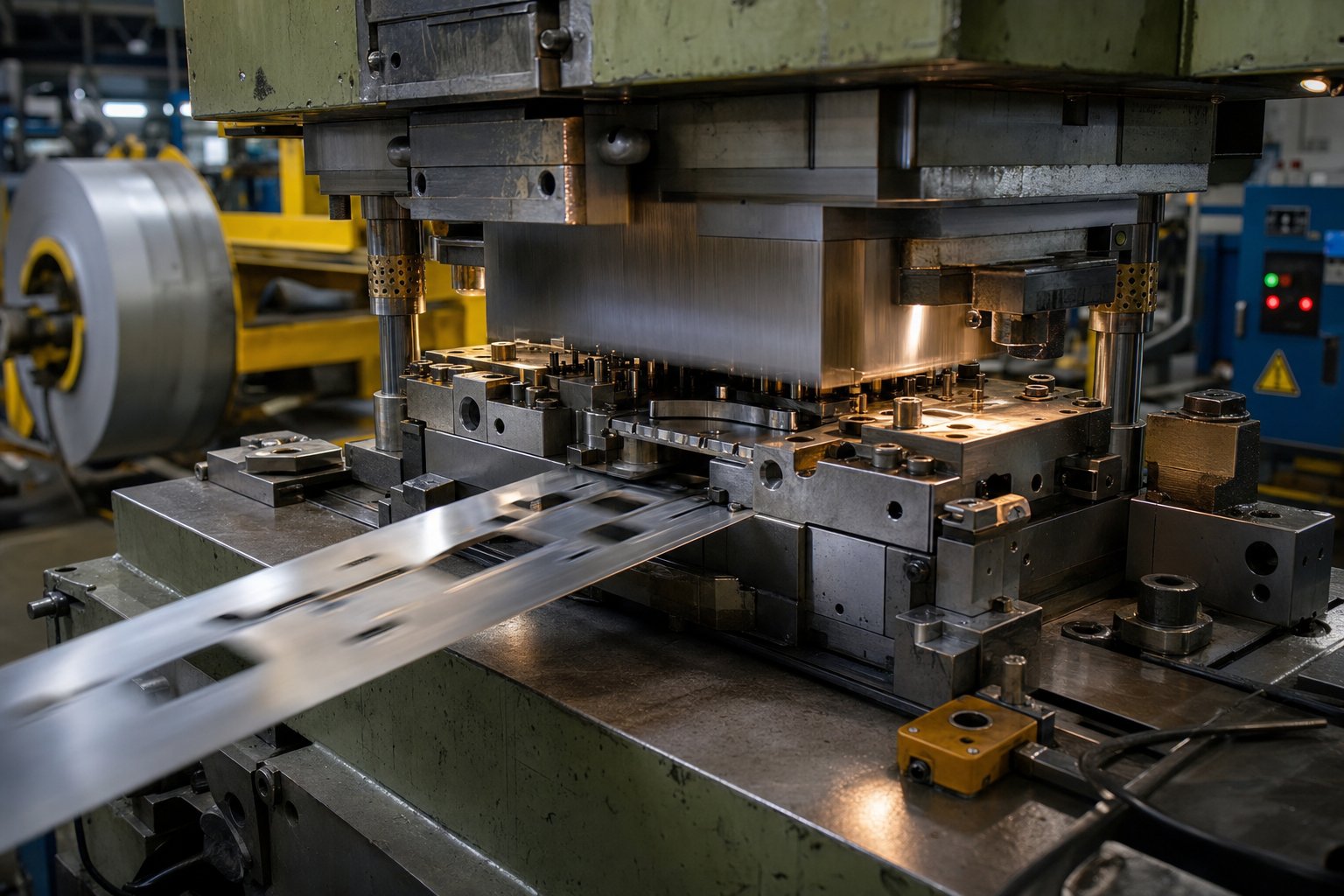
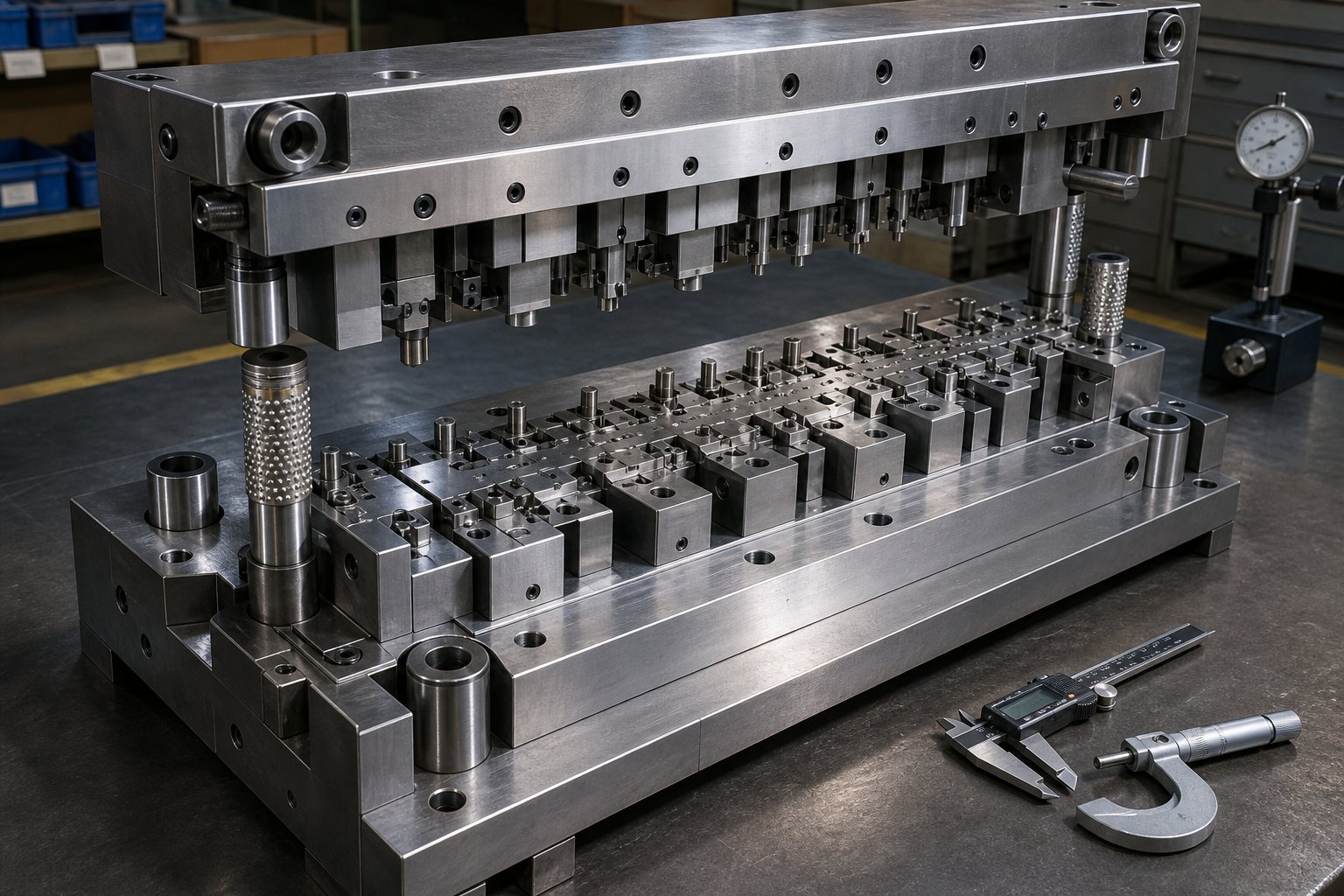
So what is a progressive die, exactly? Picture a long, precision-engineered tool installed inside a stamping press. A continuous strip of metal, fed from a coil, advances through this tool station by station with each press stroke. Every station performs a specific forming operation - punching a hole, bending a flange, coining a surface, or cutting a profile. By the time the strip reaches the final station, a finished part separates and drops out, ready for use.
The word "progressive" describes the strip's journey: it progresses through sequential operations, each building on the last. No repositioning, no operator intervention between steps. A single press stroke produces a completed part while simultaneously advancing the next section of material into position. At production speed, this progressive stamping cycle repeats hundreds of times per minute, generating thousands of identical parts per hour with tolerances held within a few thousandths of an inch.
This combination of speed, repeatability, and minimal labor input is what makes the progressive die the dominant method for wholesale metal parts production.
Why Wholesale Buyers Need to Understand the Process
This article is built as a decision-support resource, bridging the gap between technical process knowledge and commercial purchasing strategy. Whether you manage sourcing for automotive connectors, HVAC brackets, or electrical components, the economics of your program hinge on choices made long before the press starts running.
Understanding how a progressive die works directly affects a buyer's ability to negotiate pricing, evaluate supplier capabilities, and optimize total program cost from tooling investment through per-part landed price.
The sections ahead walk through material selection, design-for-manufacturability tradeoffs, tooling cost amortization, supplier qualification criteria, and quality assurance methods - each framed around what wholesale buyers need to know to protect their margins. The goal is practical leverage, not a technical manual.
How the Progressive Die Stamping Process Works Step by Step
Knowing what a progressive die does is one thing. Understanding the mechanical sequence behind it gives you the vocabulary to ask better questions during supplier conversations and catch inefficiencies in quoted programs. Here's how the die process actually unfolds from raw coil to finished part.
Strip Layout and Station Sequencing
Every progressive die starts as a strip layout - an engineering blueprint that maps each forming operation to a specific station along the tool. Imagine unrolling a metal strip and marking exactly where each punch, bend, and cut will happen as the material moves left to right through the die.
Engineers begin by placing pilot holes near the strip edges. These small, precisely punched holes register the strip at every station, ensuring each subsequent operation lands exactly where it should. From there, forming stages build sequentially: a hole punched at station two becomes a reference point for the flange bent at station five. The final station separates the completed part from the carrier strip.
Station count directly influences die complexity and cycle time. A simple flat washer might need three or four stations. A multi-bend electrical connector with embossed features could require twelve or more. More stations mean a longer, more expensive die - but they also mean each individual operation stays simple and repeatable, which is what keeps quality consistent across millions of cycles.
Press Operation and Stroke Rates
The stamping press drives the upper die half downward through its stroke, performing every station's operation simultaneously. Each time the ram lifts, the strip advances one precise increment - called the progression - and the next stroke repeats the full sequence.
This is where volume economics take shape. High speed progressive die stamping presses operate at hundreds or even thousands of strokes per minute, producing a finished part with every single cycle. At 400 strokes per minute, that's 24,000 parts per hour from a single press. This throughput is what makes the progressive stamping process economically dominant for wholesale quantities - the per-part labor and machine time costs become almost negligible.
From Concept to Finished Part
Sounds complex? The full progressive die stamping process follows a surprisingly linear path. Here's the sequence from raw material to boxed parts:
- A coil of flat metal stock loads onto an uncoiler and feeds into a straightener that removes the strip's natural curl.
- The straightened strip enters the press and aligns with the die's first station using guide rails.
- The press cycles, and pilot punches register the strip in precise position.
- With each successive stroke, the strip indexes forward one progression length, passing through punching, forming, bending, and coining stations.
- At the final station, the finished part separates from the carrier strip via a cutoff operation.
- Completed parts drop through the die into a collection bin or conveyor, while scrap skeleton material exits the opposite side.
This continuous flow - coil in, parts out - runs uninterrupted for hours or days at a time, limited only by coil length and scheduled die maintenance. The result is a production method where consistency comes built-in rather than inspected-in, because the same tool performs identical operations on every single part.
That mechanical repeatability, though, depends heavily on one upstream decision that many buyers overlook: what material you feed into the press in the first place.
Material Selection Guide for Progressive Stamping Projects
The metal you choose doesn't just determine what your finished part can do - it shapes every cost variable in the program. Progressive stamping materials behave differently under continuous high-speed forming, and those differences ripple through die life, stroke rates, scrap rates, and ultimately your wholesale unit price. Picking the wrong alloy can quietly erode margins long before anyone notices.
Common Metals for Progressive Stamping
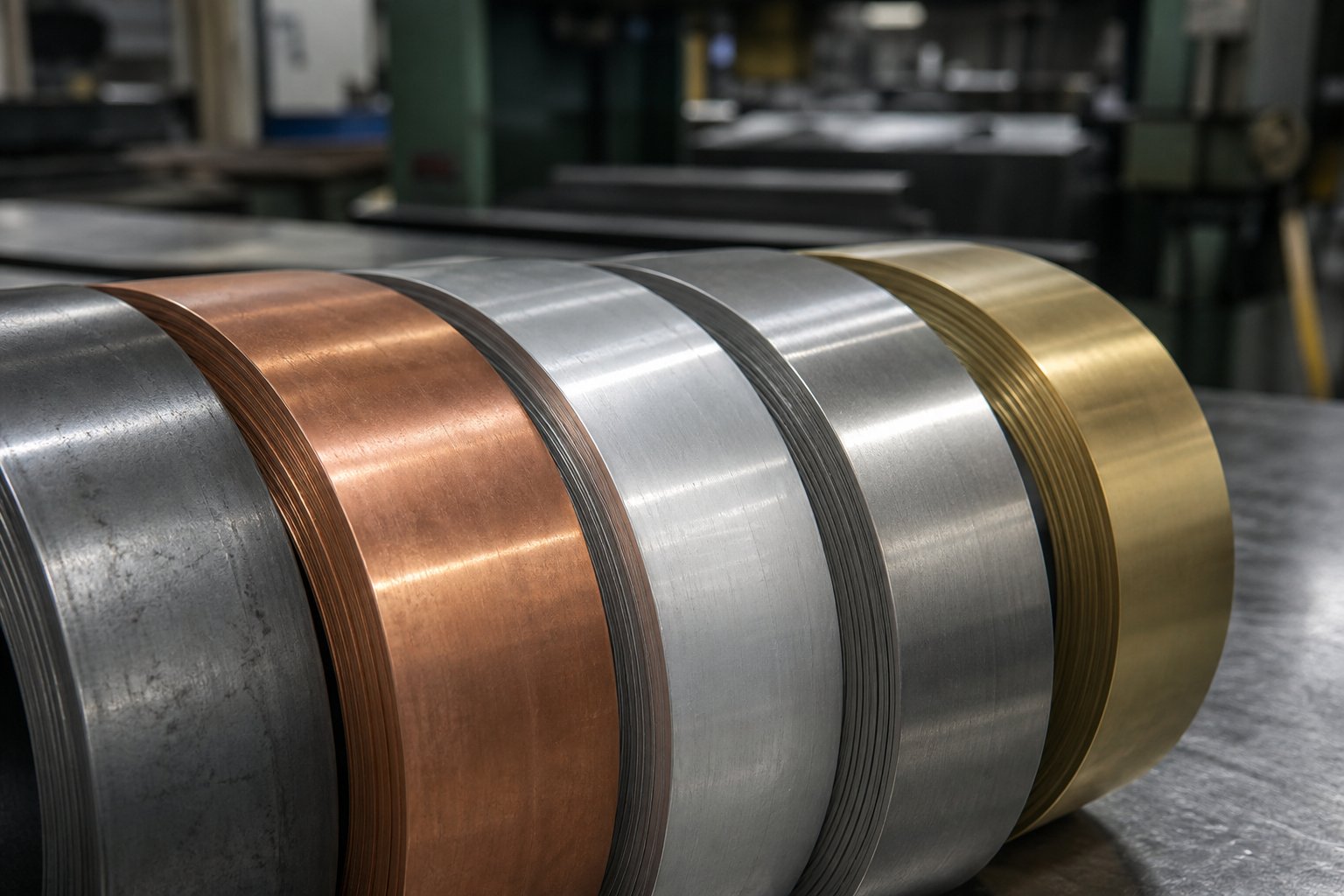
Five material families cover the vast majority of progressive die work. Each brings a distinct balance of formability, strength, and cost that makes it suitable for specific applications. Here's how they compare when fed through a multi-station die at production speed:
| Material | Typical Applications | Relative Cost | Formability | Die Wear Impact |
|---|---|---|---|---|
| Carbon Steel | Brackets, housings, structural components | Low | High | Low to moderate |
| Stainless Steel | Medical devices, food equipment, appliances | High | Medium | High |
| Aluminum | Enclosures, heat sinks, lightweight assemblies | Medium | Very high | Low |
| Copper | Electrical connectors, terminals, bus bars | Medium-high | High | Low |
| Brass | Electrical contacts, decorative hardware, valves | Medium-high | High | Low |
Carbon steel progressive stamping dominates structural and general-purpose parts because it pairs low raw material cost with excellent formability and predictable behavior through forming stations. Stainless steel, by contrast, resists deformation - great for corrosion resistance, but it demands more forming force and harder tooling. Copper progressive stamping and brass share a reputation for stable strip feeding and gentle tool contact, which is why they're standard in precision electrical components. Aluminum progressive stamping excels in lightweight applications and supports high-speed cycles, though its tendency toward springback requires careful die compensation in tight-tolerance parts.
How Material Choice Affects Production Economics
Here's where the wholesale cost picture gets interesting. Softer, more ductile materials - copper, aluminum, and low-carbon steel - allow faster stroke rates because they flow through forming stations with less resistance. Less resistance means less stress on punches and die sections, which translates directly to longer tool life between maintenance intervals. A die running aluminum might last two to three times longer between sharpening cycles compared to the same tool forming stainless steel.
Harder materials flip that equation. Steel progressive stamping with high-strength or stainless alloys increases forming force at every station, accelerates punch wear, and often requires carbide or coated tooling to maintain acceptable die life. Suppliers compensate by running slower press speeds and scheduling more frequent maintenance - both of which increase your quoted per-part cost.
Material thickness adds another layer. Thicker stock requires more tonnage per stroke and limits how fast the press can cycle. Most progressive stamping runs efficiently in the 0.010" to 0.250" thickness range, though each material has its own sweet spot. Pushing beyond a material's comfortable thickness window doesn't just slow production - it can compromise dimensional accuracy across stations and increase scrap.
Material Specifications That Buyers Should Request
When you issue an RFQ for a progressive stamping program, vague material callouts invite variation. Variation in the incoming coil translates to variation in your finished parts, higher scrap rates, and potential reject lots. Procurement teams should specify these details upfront:
- Alloy grade - the exact designation (e.g., C26000 brass, 304 stainless, 5052-H32 aluminum) rather than generic family names
- Temper or hardness condition - which controls formability and springback behavior through the die
- Thickness tolerance - tighter bands reduce station-to-station variation but may limit sourcing to specialty mills
- Surface finish - mill finish, polished, or pre-coated, depending on whether secondary finishing is planned
- Coil width and edge condition - slit width tolerance and edge type (slit edge vs. deburred) affect strip feeding stability
Tighter incoming material specs reduce variation in your finished parts and minimize scrap, but they come at a premium. The tradeoff is straightforward: paying slightly more for consistent coil stock often costs less overall than dealing with rejects, die adjustments, and production interruptions caused by out-of-spec material. Work with your supplier to find the specification level that balances raw material cost against process stability for your specific annual volumes.
Material selection sets the boundaries, but how you design the part within those boundaries determines whether you're extracting full value from the progressive die - or leaving efficiency gains untapped in an over-complex strip layout.
How Part Design Drives Progressive Die Tooling Cost and Efficiency
Every feature you draw on a part print has a direct price consequence inside the progressive die. A hole moved two millimeters closer to an edge, a bend radius tightened beyond necessity, a tolerance called out at +/-0.001" when +/-0.005" would function perfectly - each decision adds stations, shortens tool life, or forces slower press speeds. For wholesale buyers, this means progressive die design choices made at the CAD stage can account for up to 80% of total production cost, according to Manor Tool's engineering analysis. Understanding design-for-manufacturability gives procurement teams real leverage during quoting - not just price negotiation, but cost prevention.
Feature Spacing and Strip Layout Optimization
Imagine your part as one small piece of a long metal strip advancing through a prog die. That strip needs to hold together - strong enough to be pushed and pulled through a dozen or more stations without buckling, tearing, or misaligning. The material between features (called the bridge or web) is what maintains that structural integrity.
When features sit too close together, the web between them becomes dangerously thin. Thin webs deform under feeding forces, causing misregistration at downstream stations and producing out-of-tolerance parts. Designers compensate by either adding idle stations to redistribute stress or slowing press speed - both of which increase your per-part cost.
The general engineering rule for minimum bridge thickness is 1.25 to 1.5 times the material thickness. For a 1.5mm sheet, that means leaving at least 1.875mm to 2.25mm of material between punched features and between features and the strip edge. Hole-to-edge distances follow a similar principle: hole centers should sit a minimum of two times the material thickness away from any edge or formed feature to prevent distortion during punching.
Why does this matter for wholesale pricing? Optimized spacing directly improves material utilization - the percentage of coil stock that becomes finished parts rather than scrap skeleton. Industry benchmarks target at least 75% material utilization for a well-designed strip layout. When you're purchasing millions of parts annually, even a 3-5% improvement in utilization translates to meaningful raw material savings that flow into your quoted piece price.
Geometric Complexity and Station Count
Here's the relationship that governs progressive stamping die design economics: every distinct forming operation your part requires translates to at least one die station. Simple flat parts - a washer with two holes, for instance - might need only three or four stations. A multi-bend bracket with embossed features, drawn recesses, and tight positional tolerances could demand twelve stations or more.
Each additional station increases the physical length of the die, requires more precision-ground tooling components, and adds engineering time during design and build. Progressive carbide stamping dies used for high-wear stations add further cost but extend maintenance intervals significantly - a worthwhile tradeoff on long-run programs. The result is a higher upfront tooling investment.
The counterpoint, though, is that station count doesn't penalize per-part efficiency the way you might expect. Whether your die has six stations or sixteen, the press still produces one finished part per stroke at the same cycle rate. More stations mean each individual operation stays simple and gradual - reducing material stress, minimizing springback, and improving yield rates. This is why increasing station count raises tooling cost but maintains or even improves per-part production economics at wholesale volumes.
The practical question for buyers becomes: is the geometric complexity in our part design actually necessary for function, or has it crept in through design choices that a DFM review could simplify?
Design Changes That Reduce Wholesale Costs
Working with the die designer early in product development is the single highest-return activity a procurement team can pursue. DFM changes made at the drawing stage cost nothing. The same changes after a hardened progressive die is built can cost tens of thousands of dollars in rework - or require a completely new tool.
Here are the practical DFM recommendations that consistently reduce tooling complexity and wholesale part cost:
- Maintain uniform material thickness - designing features that require localized thinning or thickening forces additional coining stations and complicates strip behavior across the die.
- Avoid features that require secondary operations - if a tap, a weld, or a machined surface can be eliminated or replaced with an in-die alternative (such as extruded holes or coined threads), you remove post-press handling and its associated cost.
- Design with strip progression in mind - orient bends and forms so they work with the strip's travel direction rather than against it. Features that require the strip to be lifted or deformed vertically need stretch web carriers, adding complexity.
- Specify tolerances only as tight as function requires - calling out +/-0.001" everywhere when only one critical interface demands it forces the entire die to be built and maintained to that standard. Selective tolerancing lets the die builder optimize where precision matters most.
- Respect minimum bend radii - internal bend radii should equal or exceed material thickness. Sharper bends increase cracking risk, accelerate punch wear, and may require additional forming stations to achieve gradually.
- Consolidate parts where possible - if an assembly uses three separate stampings that could become one progressive die part, the tooling investment often pays back through eliminated handling, packaging, and assembly labor.
You'll notice a pattern: every recommendation reduces station count, eliminates secondary handling, or extends tool life. These aren't abstract engineering preferences - they're direct cost levers. A supplier offering Early Supplier Involvement or a formal DFM review before quoting tooling is signaling that they think in terms of total program cost, not just die price.
Part geometry determines what the die must do. But how much that die costs - and how those dollars amortize across your production volumes - depends on understanding the economics of tooling investment at scale.
Understanding Progressive Die Stamping Cost Economics at Wholesale Volume
Tooling cost is the number that dominates every initial conversation about progressive metal stamping - and the number most misunderstood by buyers evaluating it for the first time. A six-figure die investment looks enormous in isolation. Spread across a multi-year production program running hundreds of thousands or millions of parts, that same investment becomes a rounding error on your unit cost. The difference between a good wholesale program and a margin-draining one often comes down to how well buyers understand this amortization math.
Upfront Tooling Investment vs Per-Part Cost
Progressive dies represent significant capital investment. Tooling typically ranges from $30,000 to over $250,000, depending on station count, tolerance requirements, material type, and part complexity. Simple carbon steel geometries with few forming stations sit at the lower end. High-tolerance stainless steel parts with twelve-plus stations, carbide inserts, and in-die sensing push toward the upper range.
Here's the framework that matters for wholesale buyers: that tooling cost divides across every part the die produces over its lifetime. A $50,000 die producing 500,000 parts adds just $0.10 per piece in tooling amortization. The same die producing only 5,000 parts adds $10.00 per piece - a hundred-fold difference in tooling burden from volume alone. This is why progressive die metal stamping becomes economically dominant at higher quantities, and why suppliers ask about annual volume commitments before quoting.
Economic viability for long run progressive stamping generally begins around 50,000 to 100,000 annual units, though very simple parts may justify tooling at lower thresholds. The critical question isn't just this year's volume - it's total lifetime program quantity. A die warranted for one million or more strokes can serve a five-year program, and the amortization calculation should reflect that full horizon. Buyers who evaluate tooling investment against a single year's production often reject progressive die stampings prematurely, missing the cost advantage that emerges when the math accounts for the complete production program.
What Drives Progressive Stamping Wholesale Pricing
When you receive a quote for wholesale stamped parts, the unit price bundles several underlying cost drivers together. Industry breakdowns typically show material consuming 45-55% of per-piece cost, labor at 15-25%, overhead at 10-20%, quality systems at 2-8%, and packaging at 2-5%. But those percentages shift depending on your specific program parameters. Here's what moves the needle most:
| Cost Factor | What It Influences | Impact on Unit Price |
|---|---|---|
| Die complexity (station count, tolerances) | Tooling amortization per part, maintenance frequency | High - more stations and tighter tolerances increase both tooling cost and upkeep intervals |
| Material type and thickness | Raw material cost, stroke rate capability, die wear rate | High - harder or thicker materials slow production and shorten tool life |
| Part geometry | Scrap rate, material utilization, number of forming operations | Medium to high - complex shapes reduce utilization and increase station count |
| Annual volume commitment | Tooling amortization rate, setup cost spread, material buying power | High - higher committed volumes reduce per-unit fixed cost allocation |
| Secondary operations required | Post-press handling, additional process steps, labor | Medium - plating, tapping, or assembly adds direct cost per piece |
| Quality and inspection requirements | Measurement frequency, documentation, certification overhead | Low to medium - automotive or aerospace specs add 2-8% to per-piece cost |
Each of these factors interacts with the others. A part made from stainless steel with tight tolerances and low annual volume will carry a dramatically different unit price than the same geometry in mild steel at ten times the quantity. When quotes seem wildly different between suppliers, it's often because each supplier is making different assumptions about one or more of these variables - which is why your RFQ needs to nail down every parameter clearly.
Total Program Cost Beyond Part Price
Unit price is the number buyers fixate on. Total landed cost is the number that actually determines your margins. Progressive stamping wholesale programs frequently involve secondary operations bundled into the quoted price - or, more dangerously, excluded from it. Common post-press processes include:
- Surface treatments - zinc plating, nickel plating, anodizing, e-coating, or passivation depending on material and end-use environment
- Heat treatment - hardening or stress-relief annealing for parts requiring specific mechanical properties
- Deburring and finishing - tumbling, vibratory finishing, or manual deburring to remove sharp edges from punched features
- Assembly operations - PEM fastener insertion, welding sub-assemblies, or integrating stamped parts with other components
- Packaging and labeling - export-grade packaging, kitting, lot separation, or custom packaging to protect finished surfaces
A stamped part quoted at $2.00 can realistically land closer to $2.85 once surface treatment, packaging, and freight forwarding are added. Those line items quietly shift total program economics if you don't account for them during quote comparison.
Beyond direct production costs, wholesale buyers should factor in logistics expense (especially for international sourcing), quality costs (incoming inspection, reject management, warranty exposure), and inventory carrying costs tied to minimum order quantities or blanket release schedules. The supplier quoting the lowest piece price may not deliver the lowest total program cost once you account for longer lead times, higher reject rates, or the need for safety stock.
Comparing quotes on total landed cost rather than unit price alone separates strategic procurement from transactional purchasing - and it's the framework that protects wholesale margins over the life of a multi-year progressive stamping program.
Cost economics tell you what you'll spend. But they don't answer a more fundamental question: is progressive die stamping actually the right manufacturing method for your specific application, or would a different forming approach serve you better?
Deciding When Progressive Die Stamping Fits Your Requirements
Progressive dies deliver unmatched per-part economics at scale - but scale isn't every program. Choosing the wrong forming method for your volume, part size, or design stability can lock you into tooling costs you'll never recover or production speeds you'll never need. An honest assessment of alternatives often saves wholesale buyers more money than aggressive price negotiation ever could.
Progressive Die vs Transfer Die vs Compound Die
Four primary stamping methods compete for your production dollars. Each occupies a distinct niche defined by volume, complexity, and part geometry. Here's how they compare across the criteria that matter most to procurement decisions:
| Criteria | Progressive Die | Transfer Die | Compound Die | Single-Station Stamping |
|---|---|---|---|---|
| Ideal Volume Range | 100,000+ annually | 25,000–500,000 annually | 10,000–250,000 annually | 500–25,000 annually |
| Part Size Limitations | Small to medium (limited by press bed and strip width) | Medium to large (parts handled individually) | Small to medium (flat geometry only) | Any size the press can accommodate |
| Complexity Capability | High - multi-bend, multi-feature parts in sequence | Very high - deep draws, free-state manipulation, cutouts, threading | Low - single-plane operations (cut + form in one stroke) | Low - one operation per stroke |
| Tooling Cost | High ($30K–$250K+) | High ($40K–$300K+) | Medium ($10K–$60K) | Low ($2K–$20K) |
| Per-Part Cost at Volume | Lowest | Low to medium | Medium | Highest |
| Changeover Flexibility | Low - die is project-specific | Moderate - individual stations can be modified | Low to moderate | High - quick die changes between runs |
A progressive die press excels when you need complex parts at high volume with minimal operator involvement. The strip stays connected throughout, giving you speed and registration accuracy that other methods can't match. Transfer dies shine when parts need free-state manipulation - rotation, deep drawing, or operations that require access to multiple faces of the workpiece. They also reduce material waste by eliminating the carrier strip, which matters when raw material costs are high. Compound dies handle simpler flat parts efficiently, performing cut and form in a single press stroke with high precision for single-plane geometry. Single-station stamping makes sense for prototyping, low-volume runs, or parts so large that only one operation fits in the die stamping press at a time.
When Progressive Die Stamping Is Not the Right Choice
Recognizing where progressive dies don't fit saves you from the most expensive mistake in stamping procurement: paying for tooling that never reaches its breakeven volume. Here are the scenarios where alternatives serve you better:
Low annual volumes. If your projected demand sits below 50,000 parts per year with no growth path, the tooling amortization math rarely works. You're paying for a progressive machine die built to run millions of cycles, then using a fraction of its capacity. Single-station or compound dies - or even laser cutting and CNC forming - may deliver lower total program cost.
Frequent design changes. Progressive dies are essentially frozen geometry. Once hardened tool steel is cut, modifications mean rework or complete rebuild. If your product is still evolving, or if you expect engineering changes every six months, the permanence of a progressive die setup becomes a liability rather than an asset. Transfer dies offer more modularity for parts in flux.
Extremely thick materials. Most progressive stamping presses operate efficiently on stock ranging from 0.010" to around 0.250". Beyond that, forming forces per station escalate, strip feeding becomes problematic, and the economics shift toward hydraulic press operations or transfer die processes designed to handle heavy-gauge work.
Very large parts. A progressive stamping press advances material through sequential stations - which means the die length must accommodate every station plus the strip width. Large parts like structural panels, shells, or frames often exceed practical die dimensions. Transfer dies handle these by moving individual blanks between independent stations, removing the strip-size constraint entirely.
Volume Thresholds and Decision Criteria
Choosing the right forming method isn't a single-variable decision. It's a matrix where volume, geometry, stability, and timeline all intersect. Before committing to a progressive die investment, answer these questions honestly:
- What is your projected annual volume? - Below 50,000 units, scrutinize whether tooling amortization makes progressive stamping cost-competitive. Above 100,000, it almost certainly does.
- How stable is your part design? - If the design is finalized and validated, progressive tooling is safe. If revisions are likely within the first year, consider more flexible methods until the design freezes.
- What tolerances are required? - Progressive dies hold tight, repeatable tolerances across millions of parts. If your application doesn't demand that consistency, you may be over-investing in capability.
- Are secondary operations needed? - Features like threading, deep cutouts, or multi-axis forming that can't happen inside a progressive die add post-press cost. Transfer dies can sometimes perform these in-line.
- How long is the production program expected to run? - A five-year program at 75,000 parts per year totals 375,000 units - well within progressive die territory. A one-year project at the same annual rate may not justify the lead time for die build alone.
When answers cluster toward high volume, stable design, and long program life, progressive dies deliver the best economics by a wide margin. When they scatter - low volume here, design instability there, large part size elsewhere - the decision framework points toward transfer, compound, or hybrid approaches. The right answer isn't always the fastest or cheapest forming method. It's the one that matches your commercial reality.
Once you've confirmed that progressive die stamping aligns with your volume and design requirements, the next challenge becomes equally critical: finding a supplier capable of delivering on those requirements consistently, year after year.
How to Evaluate and Select a Wholesale Progressive Stamping Supplier
A progressive die is only as reliable as the shop running it. You can specify the perfect material, optimize every feature for manufacturability, and commit the volume that makes tooling math work - but if your supplier lacks the equipment, quality systems, or commercial discipline to execute consistently, none of that groundwork protects your margins. Supplier qualification for OEM progressive stamping programs demands more rigor than collecting a few quotes and picking the lowest number. Here's a structured framework for separating genuine progressive tool and die partners from shops that simply own a press.
Certifications and Quality Standards to Verify
Certifications aren't just wall plaques. They represent audited, documented systems that govern how a supplier manages quality, traceability, and continuous improvement. For wholesale buyers managing supply chain risk across thousands or millions of parts, these credentials serve as the first filter.
ISO 9001:2015 establishes the baseline. This standard confirms that a supplier operates a formal quality management system covering process documentation, corrective action procedures, and management review. Any progressive stamping and fabrication shop quoting wholesale programs should hold this as a minimum. If they don't, you're relying entirely on informal controls that may or may not survive personnel changes or production pressure.
IATF 16949:2016 matters significantly for automotive components progressive stamping. This automotive-specific extension of ISO 9001 adds requirements for defect prevention, Production Part Approval Process (PPAP), Advanced Product Quality Planning (APQP), and customer-specific requirements from major OEMs. As the Fabcon supplier evaluation framework emphasizes, ISO 9001 alone does not include automotive-specific PPAP and APQP requirements - so for any Tier-1 or Tier-2 automotive program, IATF 16949 scope covering stamping and tooling operations is the baseline expectation, not a differentiator.
Industry-specific certifications add another layer depending on your end market. AS9100D governs aerospace supply chains. ISO 13485 applies to medical device component suppliers. NADCAP covers special processes like heat treatment or plating. When evaluating a potential partner, verify that the certification scope explicitly includes the operations relevant to your program - a supplier certified for assembly work but not stamping hasn't proven their press operations meet the standard.
Why does this matter commercially? Certified suppliers carry lower risk of quality escapes, which means fewer reject lots, less incoming inspection labor on your end, and reduced warranty exposure downstream. For wholesale programs running over multiple years, that risk reduction compounds into real margin protection.
Technical Capabilities to Evaluate
Certifications tell you how a supplier manages quality. Technical capabilities tell you whether they can actually make your part efficiently at the volumes you need. When you tour a facility or review a capabilities presentation, here's what to assess:
- Press tonnage range - does the supplier's fleet cover the forming forces your part geometry and material require? A shop with only light-duty presses can't efficiently run thick stainless steel parts, while a heavy-tonnage facility may not be optimized for delicate high-speed work on thin copper strip.
- Bed size and feed length - larger parts and dies with more stations need longer press beds. Confirm the supplier can physically accommodate your die dimensions without running at the edge of their equipment envelope.
- Stroke speed capability - high-speed progressive die presses running 400+ strokes per minute deliver different economics than slower mechanical presses at 60-100 SPM. Match supplier speed capability to your volume requirements.
- In-house die design and build capacity - suppliers who design, build, and maintain progressive dies under one roof retain full control over tooling quality and change turnaround. Outsourced tooling rooms add lead time risk, reduce accountability, and slow engineering changes.
- Material handling systems - coil handling equipment (decoilers, straighteners, servo feeds) must match your material type, thickness, and coil weight. Inadequate material handling creates strip feeding inconsistencies that show up as dimensional variation in finished parts.
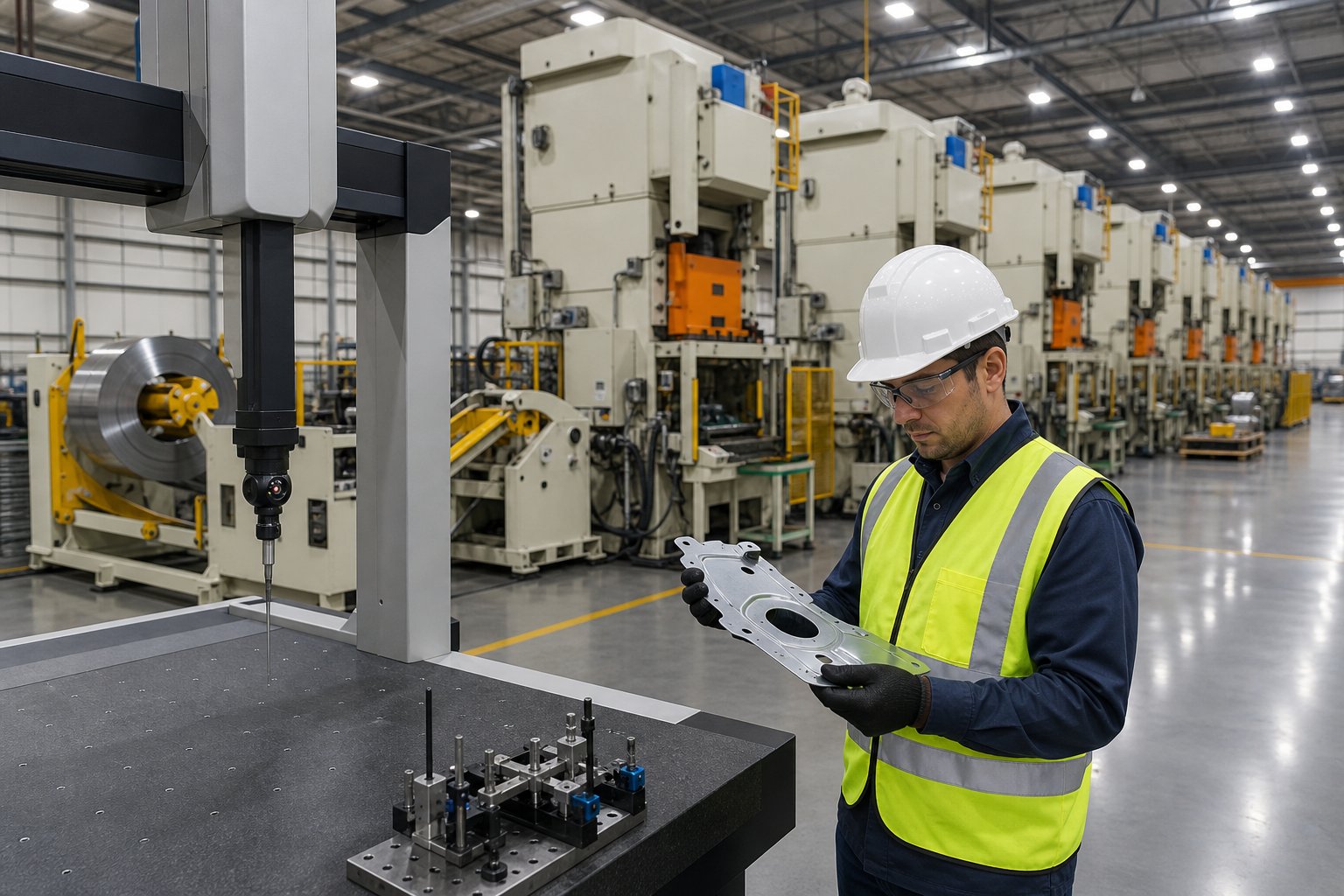
- Inspection equipment - coordinate measuring machines (CMM), optical comparators, vision systems, surface profilometers, and active SPC monitoring all indicate a supplier that verifies rather than assumes quality. Ask whether inspection is integrated into production flow or performed only as a post-run audit.
A practical tip: request a facility tour that includes the toolroom and active press lines, not just a conference room presentation. Seeing die maintenance logs, active SPC charts on press lines, and calibrated gauges with current stickers tells you more about day-to-day capability than any brochure. Suppliers confident in their operation welcome this level of scrutiny.
Relationship and Commercial Factors
Technical capability gets you qualified parts. Commercial structure determines whether those parts arrive when you need them, at the price you agreed on, without consuming your procurement team's bandwidth managing exceptions. The wholesale relationship lifecycle extends well beyond the first purchase order.
Blanket orders and scheduled releases form the backbone of most progressive stamping wholesale programs. A blanket order lets you commit annual volume at negotiated pricing while scheduling deliveries in smaller increments matched to your production consumption. This structure gives the supplier planning visibility to buy material efficiently and schedule press time, while giving you flexibility on delivery timing without renegotiating terms for each shipment.
Kanban and JIT delivery options take that flexibility further. Suppliers offering just-in-time delivery programs maintain finished goods inventory on your behalf and ship against pull signals rather than fixed schedules. This reduces your inventory carrying costs and obsolescence risk - particularly valuable for automotive components progressive stamping where demand can shift with OEM build schedules. The tradeoff is that JIT capability requires the supplier to carry buffer stock, which may be reflected in slightly higher unit pricing or minimum commitment thresholds.
Lead time transparency separates dependable partners from optimistic quoters. Ask explicitly: what is the lead time for initial die build? For first production run after tool approval? For repeat orders on existing tooling? A supplier who gives you clear, realistic timelines - and then meets them - is worth more than one quoting two weeks faster but consistently delivering late. Transparency on both tooling and production lead times is one of the strongest indicators of operational maturity.
Engineering support during quoting reveals long-term partnership quality. Does the supplier review your drawings and flag DFM concerns before pricing, or do they simply quote what you sent and let problems surface during tryout? A progressive stamping partner that invests engineering time upfront - recommending tolerance adjustments, material alternatives, or strip layout optimizations - is thinking about your total program cost, not just winning the order. That early collaboration, as discussed in the DFM section earlier, prevents the most expensive surprises in any stamping program.
Evaluate all of these factors together using a weighted scorecard that reflects your program priorities. Certification and quality systems might carry 20% weight, tooling capability 25%, tolerance performance 20%, value-added services 15%, and commercial terms 20%. Scoring each candidate objectively against these criteria removes the bias that comes from a polished sales presentation or a single low quote that doesn't account for hidden risk.
Selecting the right supplier sets the foundation. But even the best partner relationship requires clear agreements on how quality will be measured, monitored, and maintained across the millions of cycles that define a wholesale production program.
Quality Assurance Methods That Maintain Consistency at Scale
A qualified supplier with the right certifications and equipment still needs a system that catches problems before they multiply across a production run. When a progressive stamping machine cycles at hundreds of strokes per minute, a single undetected tool wear event can generate thousands of nonconforming parts in minutes. Quality at wholesale volume isn't about inspecting defects out - it's about engineering them out through real-time monitoring, structured sampling, and documented agreements that leave nothing to assumption.
In-Process Quality Controls
Modern progressive dies integrate sensors directly into the tool. These systems monitor strip feed accuracy, forming force at critical stations, and punch condition in real time - detecting deviation before defective parts accumulate. Imagine a die producing progressive die stamped brackets for an automotive assembly. If a pilot pin wears slightly and strip registration drifts by even 0.05mm, downstream features shift out of tolerance. In-die sensors catch that drift within a few strokes, triggering an automatic press stop before hundreds of scrap parts pile up.
Force monitoring is equally critical. Each station in the die produces a characteristic force signature during normal operation. When a punch dulls, a slug pulls back, or material thickness varies, that signature changes. Statistical Process Control (SPC) charts track these force readings and key part dimensions continuously, plotting data points that reveal trends - like gradual tool wear or press drift - well before they cross tolerance boundaries. For hvac progressive stamping programs running millions of brackets or clips annually, SPC transforms quality from reactive sorting into predictive maintenance. You're fixing the cause before defects exist rather than discovering them after the production run ships.
Inspection Methods for High-Volume Runs
No single inspection technique covers every quality risk. Effective wholesale programs layer multiple methods together, each catching what the others might miss:
- First-article inspection (FAI) - comprehensive dimensional verification of initial production samples against the CAD model using CMM and functional gauges. This confirms the die is producing conforming parts before full-speed production begins.
- In-process sampling plans - periodic pulls from the running press at defined intervals (e.g., every 2,000 parts or every coil change) to verify critical dimensions remain within SPC control limits.
- Automated vision systems - cameras integrated at the die exit or on conveyors that inspect every part for missing features, burrs, cracks, or dimensional anomalies at full production speed. Particularly valuable for progressive stamping aluminum parts where surface cosmetics matter.
- CMM verification - coordinate measuring machine checks on sampled parts to validate complex geometric tolerances, positional relationships, and true-position features that hand gauges cannot capture.
- Final audit protocols - random sampling from finished lot quantities as a containment check before shipment, verifying that no quality drift occurred during the last portion of the run.
These methods form a layered defense. In-die sensors and SPC handle real-time prevention. Sampling plans and vision systems provide ongoing verification. Final audits act as the last gate before parts reach your receiving dock. When all five layers operate together, the likelihood of a nonconforming lot reaching your production line drops dramatically.
What Buyers Should Require in Quality Agreements
Quality expectations that exist only in conversation will eventually become quality disputes. Formalizing requirements before the first production stroke protects both parties - and the Production Part Approval Process (PPAP) provides the industry-standard framework for doing exactly that.
PPAP documentation verifies that the supplier understands all engineering specifications and that the production process is capable of consistently meeting them at the quoted production rate. The process includes up to 18 elements - design documentation, process flow diagrams, control plans, measurement system analysis, dimensional results, and initial process capability studies among them. For most wholesale progressive stamping programs, a Level 3 submission (part samples with complete supporting data) gives buyers sufficient evidence that the die, press, and process are validated before committing to full volume.
Three PPAP elements deserve particular attention from procurement teams:
- Control plans - these document exactly which characteristics get measured, how often, with what equipment, and what corrective action triggers when values drift. A control plan tied to your specific part ensures inspection isn't left to operator judgment.
- Measurement System Analysis (MSA) - Gage R&R studies verify that the gauges and fixtures used to inspect your parts produce repeatable, reproducible results. Without validated measurement systems, inspection data itself becomes unreliable.
- Process capability studies (Cpk) - initial production runs should demonstrate that critical dimensions achieve a Cpk of 1.33 or higher, confirming the process has enough margin to stay within tolerance even as normal variation occurs over time.
Establishing these expectations in a formal quality agreement before tooling build begins - not after the first shipment arrives with problems - prevents the most expensive disputes in wholesale stamping programs. Scrap rework, containment sorts, and line-down charges all trace back to ambiguity that a documented PPAP process eliminates upfront.
With quality systems defined and supplier capability confirmed, the remaining variable is execution - moving from initial inquiry through tooling approval and into the steady-state production cadence that delivers parts to your dock week after week.
From Inquiry to Full Production with the Right Progressive Die Partner
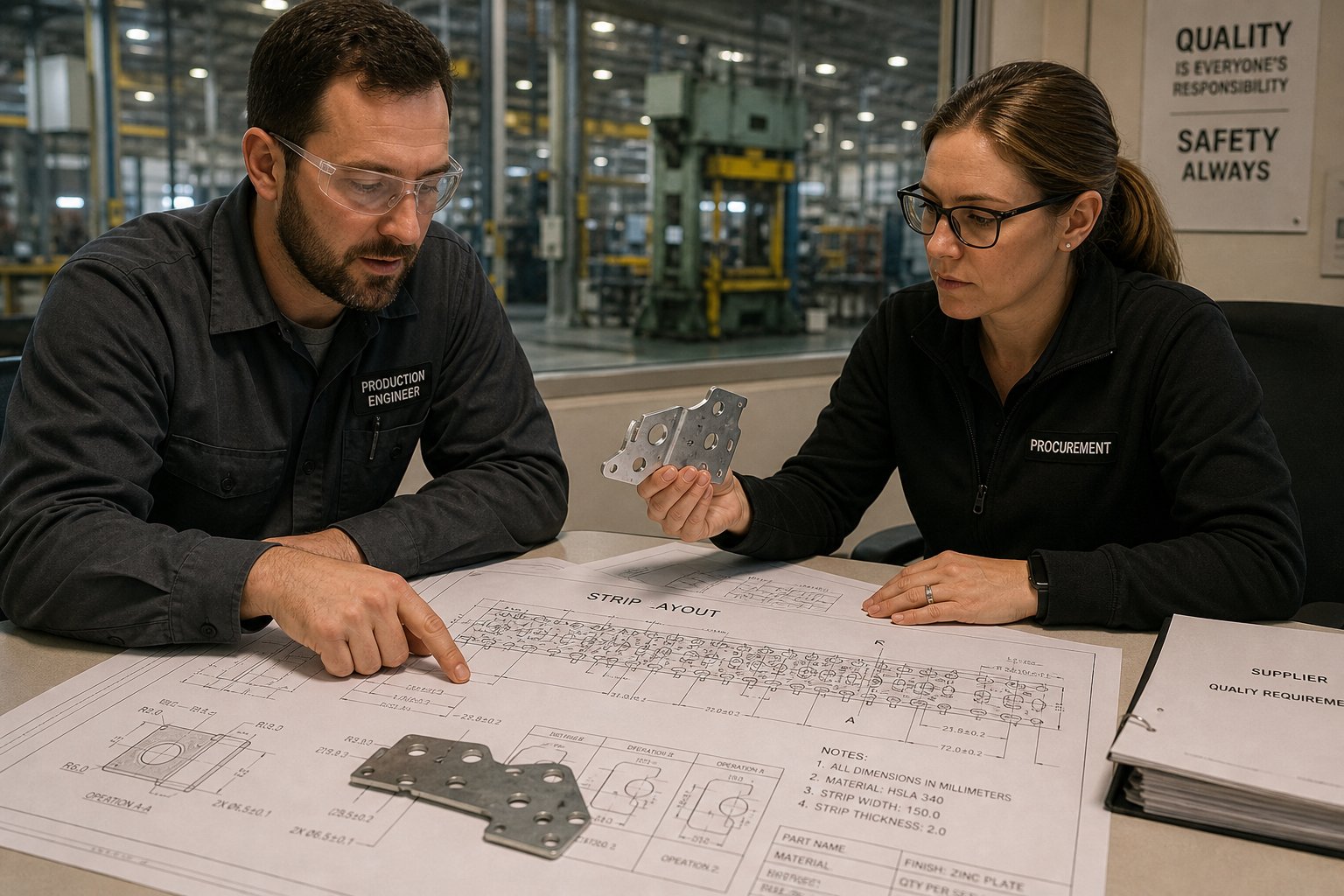
Every wholesale stamping program follows a predictable arc - from the first email with attached part drawings to the steady rhythm of scheduled shipments arriving at your dock. Knowing what each phase looks like helps you set realistic timelines, ask the right questions at the right moments, and avoid the delays that come from unclear expectations on either side.
The Wholesale Buyer Journey from Inquiry to Production
Whether you're sourcing progressive stamping dies for a new product launch or transitioning an existing part from a different forming method, the path from concept to full-volume production typically follows this sequence:
- Initial inquiry with part drawings - submit 2D prints or 3D CAD models along with material specs, annual volume projections, and target pricing. The more complete your package, the faster and more accurate the response.
- DFM review and strip layout proposal - the supplier's engineering team analyzes your part geometry, recommends design optimizations, and proposes a strip layout showing station sequencing and material utilization. Expect two to three iterations here.
- Progressive die tooling design approval - once the strip layout is finalized, detailed die design begins. You'll review and approve the tool concept before steel is cut, locking in station count, material flow, and critical forming strategies.
- Tooling build - precision machining, assembly, and internal tryout of the progressive stamping die. Timeline varies from 8 to 16 weeks depending on complexity and station count.
- First-article samples - initial production samples are submitted with dimensional data for your review. This is your opportunity to verify fit, function, and finish before committing to volume.
- PPAP approval - formal documentation package confirming process capability, measurement systems, and control plans meet your quality requirements.
- Production ramp-up to full volume - the press runs at production speed with scheduled releases against your blanket order. Ongoing SPC monitoring maintains consistency across the program life.
Each phase builds on the last. Rushing through DFM review to save a week often costs months in tooling rework later. The suppliers who guide you through this progression with clear milestones and honest timelines - rather than telling you what you want to hear - are the ones who deliver reliable progressive die stamping services over multi-year programs.
Taking the Next Step with a Qualified Die Supplier
For production engineers and procurement teams ready to move from research into action, the priority is finding a partner equipped to support the full journey described above - from early DFM collaboration through scalable wholesale production. That means a supplier with demonstrated capability in multi-station progressive stamping dies, proven repeatability across high-volume runs, and the engineering depth to optimize your program before tooling begins.
YICHEN's progressive stamping die capabilities are built around exactly this model: helping buyers source progressive die tooling for high-volume metal parts that demand efficient multi-station forming, tight cycle-to-cycle repeatability, and production systems designed to scale with your program growth. If your volumes justify progressive tooling and your design is approaching stability, reaching out with your part data starts the clock on a process that - when managed well - delivers the lowest sustainable per-part cost available in metal forming.
Frequently Asked Questions About Progressive Die and Stamping Wholesale
1. What is the minimum order volume for progressive die stamping to be cost-effective?
Progressive die stamping generally becomes economically viable at 50,000 to 100,000 annual units, though very simple parts may justify tooling at lower thresholds. The key calculation involves spreading the upfront die investment (typically $30,000 to $250,000+) across total lifetime program quantity rather than a single year's production. A five-year program running 75,000 parts per year totals 375,000 units, which comfortably justifies progressive tooling even if any single year's volume seems borderline. Buyers should evaluate the full production horizon, including projected growth, when making this determination.
2. How does progressive die stamping differ from transfer die stamping for wholesale buyers?
Progressive die stamping keeps the metal strip connected throughout all forming stations, enabling the highest production speeds (hundreds of strokes per minute) and lowest per-part costs for small-to-medium parts at volumes above 100,000 annually. Transfer die stamping separates individual blanks and moves them between independent stations, making it better suited for larger parts, deep-drawn geometries, or components requiring free-state manipulation. Transfer dies also reduce material waste by eliminating the carrier strip but typically run at slower cycle rates. The choice depends on part size, geometric complexity, and whether the strip-connected approach can physically accommodate your part dimensions.
3. What materials work best for high-volume progressive stamping?
Carbon steel, aluminum, copper, brass, and stainless steel cover the majority of progressive stamping applications. Softer materials like copper and aluminum allow faster stroke rates and longer die life between maintenance intervals, translating to lower per-part costs. Carbon steel offers the best balance of low raw material cost and high formability for structural parts. Stainless steel provides corrosion resistance but demands harder tooling, slower speeds, and more frequent maintenance. Buyers should specify exact alloy grades, temper conditions, thickness tolerances, and surface finish requirements in their RFQs to minimize production variation and scrap.
4. How long does it take to go from initial inquiry to full production with a progressive die supplier?
The typical timeline from first inquiry to production ramp-up spans 14 to 28 weeks depending on part complexity. This includes DFM review and strip layout iterations (2-4 weeks), die design approval (2-3 weeks), tooling build (8-16 weeks), first-article sample submission and review (1-2 weeks), and PPAP approval (1-3 weeks). Complex parts with twelve or more stations, tight tolerances, or carbide inserts push toward the longer end. Buyers can shorten timelines by providing complete part data upfront, responding quickly during approval phases, and selecting suppliers with in-house die design and build capabilities rather than those who outsource tooling.
5. What quality certifications should a progressive stamping wholesale supplier have?
ISO 9001:2015 is the minimum baseline, confirming formal quality management systems are in place. For automotive supply chain programs, IATF 16949:2016 is essential because it adds requirements for PPAP, APQP, and defect prevention that ISO 9001 alone does not cover. Aerospace programs require AS9100D, while medical device components call for ISO 13485. Beyond certifications, buyers should verify that the supplier's certified scope explicitly covers stamping and tooling operations, and that they maintain validated measurement systems (confirmed through Gage R&R studies), documented control plans, and demonstrated process capability (Cpk of 1.33 or higher) on critical dimensions.


