


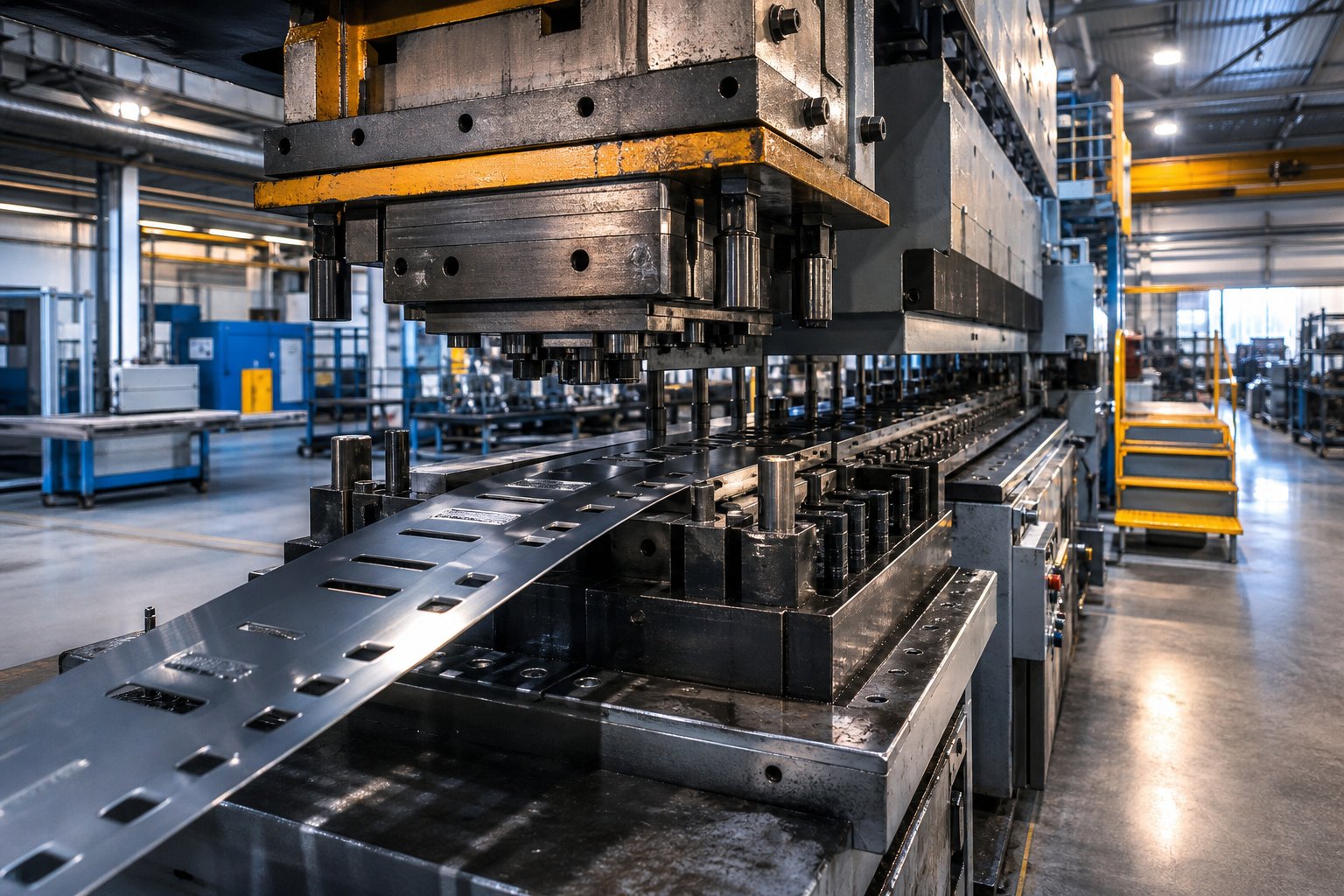
Understanding Progressive Die Stamping in Wholesale Manufacturing
When you're sourcing thousands or millions of identical metal components, the manufacturing method you choose determines your per-part cost, lead time, and quality floor. Progressive die & stamping wholesale is the production approach that dominates high-volume metal part manufacturing, yet many procurement teams negotiate contracts without fully understanding how the process works or why it costs what it does.
Progressive die stamping is a metal forming process where a continuous strip of material advances through a series of stations within a single die, with each station performing a distinct operation such as cutting, bending, or forming, until the finished part is separated at the final stage.
What Progressive Die Stamping Means at Wholesale Scale
What separates progressive metal stamping from other methods is its ability to combine multiple forming operations into one uninterrupted, automated cycle. A single stroke of the press produces a completed part, and presses typically run anywhere from 25 to over 200 strokes per minute. At wholesale volumes, this translates into millions of parts per year from a single prog die setup with minimal labor intervention.
Compare that to single-die stamping, where each operation requires a separate tool and a separate handling step. Or transfer die stamping, where parts are physically moved between stations. Progressive dies keep the strip intact throughout the process, eliminating part handling between operations and dramatically reducing cycle time. That mechanical efficiency is what makes progressive dies the default choice for buyers ordering at scale.
Why Wholesale Buyers Need Process Literacy
Imagine negotiating a tooling quote without knowing whether an 8-station die is overkill for your part geometry, or whether your material choice will halve the die's service life. These are expensive blind spots. Buyers who understand the fundamentals of progressive die design, material behavior, and production economics consistently make sharper sourcing decisions and avoid paying for complexity they don't need.
This guide covers the full decision-making journey, from how progressive dies function mechanically, through strip layout economics and material selection, to supplier evaluation frameworks and quality certification requirements. The goal is straightforward: give you the process literacy to assess feasibility, challenge quotes intelligently, and manage production relationships with confidence.
How the Progressive Die Stamping Process Works Step by Step
Knowing that progressive dies combine multiple operations into one cycle is useful at a conceptual level, but the real sourcing advantage comes from understanding exactly how metal moves through the tool. When you can visualize the progressive die stamping process mechanically, you're equipped to question station counts, challenge cycle time claims, and spot inefficiencies in a supplier's proposed strip layout.
How Strip Stock Moves Through Multiple Stations
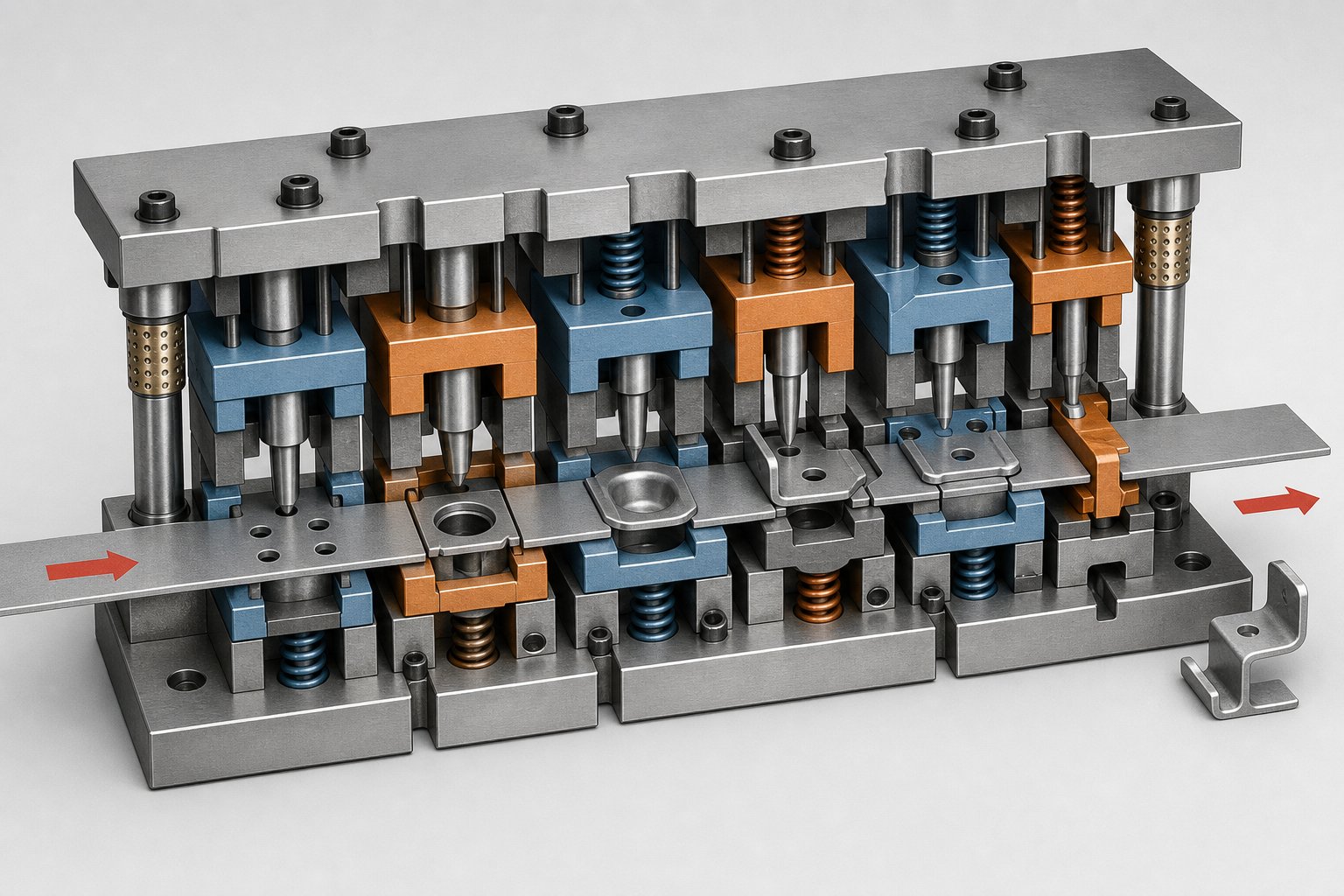
The process starts with a coil of flat metal strip stock mounted on an uncoiler. A straightener removes any curvature from the material, and a servo or pneumatic feeder advances the strip into the progressive stamping die at a precise, repeating distance called the pitch. Each time the press ram cycles, the strip indexes forward by exactly one pitch length, positioning fresh material at every station simultaneously.
Here's the key concept: the strip never leaves the die until the final part is cut free. A carrier strip, the skeleton of material connecting each partially formed part, holds everything in alignment as it moves through the progressive stamping machine. Pilot pins drop into pre-punched holes at each station to register the strip with sub-thousandth accuracy before the ram closes. This registration system is what allows high speed progressive die stamping to maintain tight tolerances even at 200 to 600 strokes per minute.
Core Operations Performed in a Progressive Die
Each station inside the die performs one or more specific operations on the strip. While the exact sequence depends on part geometry, a typical progressive die metal stamping cycle follows this order:
- Pilot hole punching - The first station pierces small holes used solely for strip registration at downstream stations.
- Blanking and piercing - Interior features like holes, slots, and cutouts are punched. Material removed here becomes scrap slugs ejected below the die.
- Forming and bending - Stations with form punches create angles, ribs, louvers, or embossed features by plastically deforming the strip without cutting it.
- Coining - Where tighter dimensional control or specific surface finishes are required, coining stations apply high compressive force to precise areas.
- Cutoff or separation - The final station severs the finished part from the carrier strip, and the completed component is ejected from the progressive machine die into a bin or conveyor.
All of these operations happen simultaneously across different parts on the strip during a single press stroke. So while station one is punching pilot holes in fresh material, station five might be separating a finished part that entered the die four strokes earlier.
For wholesale buyers, this understanding has direct practical value. When a supplier quotes a 12-station die for a part that seems geometrically simple, you can ask which operations occupy those stations and whether any could be combined. Conversely, if a quote proposes too few stations for a complex geometry, you'll recognize the risk of tool failure or quality issues before committing capital to tooling.
The relationship between what happens at each station and what the tooling costs to build leads directly into the economics of strip layout design, where pitch distance, scrap ratios, and station count converge to determine your per-part price at volume.
Strip Layout and Die Design Principles That Affect Wholesale Pricing
Every station in a progressive die costs money to engineer, machine, and harden. Every millimeter of pitch distance consumes raw material. These two variables, station count and strip layout geometry, interact to define the total economics of your wholesale stamping program. Understanding how they work together gives you leverage when evaluating tooling quotes and negotiating per-part pricing.
How Station Count Drives Tooling Investment and Part Cost
Think of station count as the primary cost multiplier in progressive stamping die design. Each station requires its own set of punches, die inserts, and backing plates, all precision-ground from tool steel or, for abrasive materials, progressive carbide stamping dies. A 6-station die doesn't cost twice as much as a 3-station die; the relationship is closer to 1.5x to 1.8x because of shared components like die shoes, guide systems, and strip lifters. But the cost still compounds meaningfully as station count rises.
Here's the trade-off wholesale buyers need to internalize: more stations raise the tooling investment but can lower per-part cost at volume by enabling faster cycle times and reducing secondary operations. Fewer stations reduce the upfront spend but may require slower press speeds or additional post-stamping work that erodes unit savings.
The amortization math shifts dramatically depending on your annual volume. A $150,000 die amortized over 100,000 parts adds $1.50 per piece. Spread that same investment across 2,000,000 parts and the tooling contribution drops to $0.075. This is why progressive dies built with steel stamping dies and hardened tool steel inserts are designed to survive millions of cycles; the longer the die runs, the lower its per-part burden becomes.
| Station Count | Relative Tooling Cost | Per-Part Cost at 50K Units | Per-Part Cost at 500K Units | Per-Part Cost at 2M Units |
|---|---|---|---|---|
| 4-6 stations | $25K - $60K | $0.50 - $1.20 tooling contribution | $0.05 - $0.12 | $0.013 - $0.03 |
| 8-12 stations | $60K - $150K | $1.20 - $3.00 tooling contribution | $0.12 - $0.30 | $0.03 - $0.075 |
| 14-20+ stations | $150K - $350K | $3.00 - $7.00 tooling contribution | $0.30 - $0.70 | $0.075 - $0.175 |
The pattern is clear: complex tooling only makes economic sense when volume is high enough to dilute the investment. Buyers ordering 50,000 parts annually should question whether a 16-station die is truly necessary, while buyers at 2 million parts can justify additional stations that shave fractions of a second off cycle time.
Strip Layout Optimization for Wholesale Volumes
Strip layout is where material cost gets decided, and material typically represents 40% to 60% of total part cost at wholesale volumes. The layout determines three things: pitch distance (how far the strip advances per stroke), strip width, and scrap percentage.
Pitch distance is the sum of the part's length in the feed direction plus the bridge, the thin web of material separating consecutive parts. A common engineering rule sets bridge thickness at 1.25 to 1.5 times material thickness. Sounds insignificant, but at 300 strokes per minute over a million-part run, every extra millimeter of pitch translates to hundreds of kilograms of additional raw material consumed.
Carrier strip design also influences waste. A solid carrier provides maximum stability for flat parts requiring only cutting and simple bends. A stretch web carrier, engineered with relief cuts that allow flexing, is necessary for parts with forming or drawing operations. The carrier must be strong enough to transport the part through all stations without buckling, yet minimal enough to avoid wasting material on skeleton scrap.
Well-optimized layouts target material utilization above 75%. Techniques that push utilization higher include:
- Angular nesting - tilting parts on the strip so irregular geometries interlock like puzzle pieces, reducing dead space between parts.
- Multiple-out layouts - stamping two or more parts per stroke across the strip width, which improves material use and doubles throughput without doubling press time.
- Scrap reclamation - designing slug shapes from piercing operations that can serve as small secondary parts, turning waste into product.
For wholesale buyers, the practical takeaway is this: when reviewing a supplier's strip layout proposal, ask for the projected material utilization percentage and the scrap weight per thousand parts. These numbers directly affect your quoted piece price. A layout running at 65% utilization versus one optimized to 80% means you're paying for 15% more raw material on every single part, compounded across your entire order volume.
Buyers who grasp these relationships between station count, tooling amortization, and strip efficiency don't just accept quotes at face value. They ask the right questions, recognize when tooling is over-engineered for their volumes, and identify where layout optimization could shave meaningful cost from their program. That knowledge becomes especially valuable when evaluating how different materials behave under these same forming conditions and what that means for die longevity and total project cost.
Materials Used in Progressive Stamping and Their Impact on Wholesale Orders
Strip layout and station count define how efficiently your die runs, but the material feeding through that die determines how long the tooling lasts, how fast the press can cycle, and what your true total cost looks like over a multi-year production program. Choosing progressive stamping materials isn't just a design engineering decision; it's a commercial one that ripples through tooling quotes, maintenance schedules, and per-part pricing at volume.
Material Properties That Influence Die Design Decisions
Every material responds differently to the cutting, bending, and forming forces inside a progressive die. Two properties matter most for wholesale buyers: formability and hardness. Formability dictates how aggressively the material can be shaped without cracking or tearing. Hardness determines how quickly it wears down the precision tool steel surfaces that give your parts their dimensional accuracy.
A soft, ductile material like copper forms easily and generates minimal tool wear, which means longer intervals between die maintenance and lower lifecycle costs. A harder material like stainless steel requires higher press tonnage, causes faster wear on punch and die inserts, and often demands progressive carbide stamping dies at critical stations to maintain edge quality over long runs. These aren't abstract engineering details. They directly affect your quoted maintenance intervals, spare insert costs, and ultimately your per-part price at scale.
Thickness plays a role too. Most progressive stamping operates efficiently with materials between 0.005" (0.127 mm) and 0.250" (6.35 mm) thick. Thinner gauges form with less force but are prone to wrinkling and strip buckling during feeding. Thicker stock demands higher tonnage presses and accelerates tool wear. Your material spec needs to balance functional requirements with what the process handles economically.
Matching Material Choice to Application Requirements
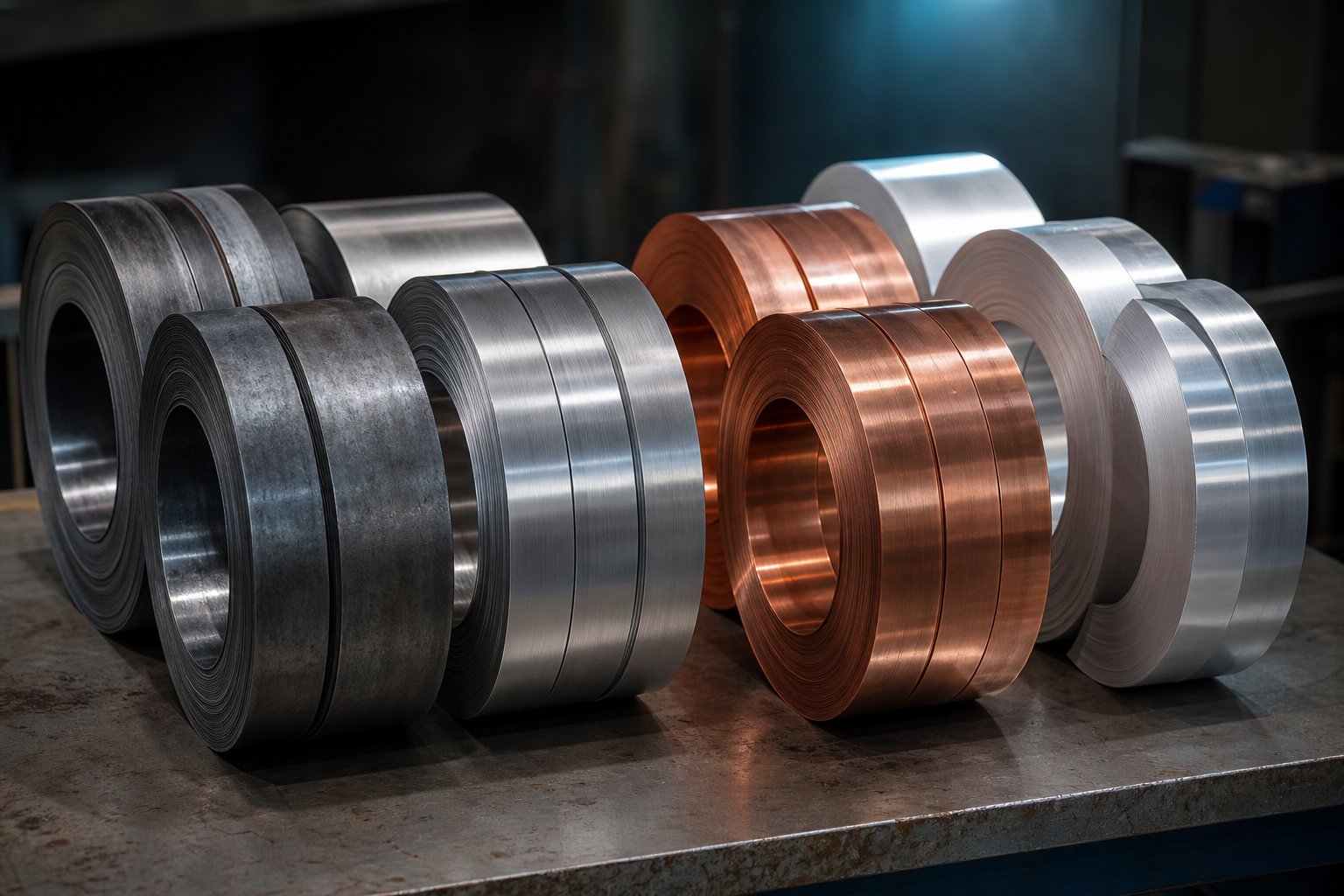
Each material family brings a distinct profile of cost, performance, and manufacturability. Here's how the four primary families compare for wholesale progressive stamping programs:
| Material | Typical Applications | Formability Rating | Tool Wear Impact | Relative Material Cost |
|---|---|---|---|---|
| Carbon Steel (CRS/HRS) | Brackets, structural components, automotive clips, enclosures | Excellent | Low to moderate | Low (baseline) |
| Stainless Steel (300/400 series) | Medical devices, food processing, HVAC components, corrosion-critical parts | Good (high springback) | High; requires carbide inserts | 3x - 5x carbon steel |
| Copper and Brass | Electrical connectors, terminals, bus bars, thermal conductors | Excellent | Low | 4x - 7x carbon steel |
| Aluminum (5052, 6061, 1100) | Lightweight enclosures, heat sinks, EV components, consumer electronics | Very good | Low to moderate (galling risk) | 2x - 3x carbon steel |
Carbon steel progressive stamping remains the workhorse choice for wholesale buyers who need structural strength at the lowest material cost. Cold-rolled grades offer excellent surface finish and tight thickness tolerances right off the coil, while hot-rolled stock works for non-cosmetic structural parts where slight scale is acceptable. Carbon steel's predictable forming behavior means fewer die adjustments and more consistent parts across long production runs.
Stainless steel progressive stamping introduces complexity. The material work-hardens rapidly during forming, meaning each bend or draw makes the surrounding area harder and more resistant to the next operation. Die designers account for this by spacing forming stations farther apart or incorporating annealing steps. The higher press forces also demand heavier die construction and more frequent sharpening cycles, which adds to your maintenance cost per million parts.
Copper progressive stamping and brass alloys are the go-to for electrical and thermal applications. Their excellent ductility and low work-hardening rate make them forgiving during complex multi-station forming. The trade-off is raw material cost; copper pricing volatility means wholesale buyers often negotiate material cost escalation clauses into long-term contracts to protect against commodity swings.
Aluminum progressive stamping serves the growing demand for lightweight components in automotive, EV, and consumer electronics applications. Aluminum forms well at moderate press speeds, but it's prone to galling, where material transfers and builds up on die surfaces. Suppliers counter this with specialized coatings on punch and die inserts, proper lubrication, and sometimes chrome or DLC (diamond-like carbon) surface treatments. Buyers should verify that their supplier has experience managing galling in long aluminum runs, not just forming capability.
One critical point for procurement teams: communicate your exact material specification early, including alloy, temper, thickness tolerance, and surface finish requirements. A die designed for 0.032" CRS will not perform correctly if production shifts to 0.036" stainless halfway through a contract. Material changes after tooling is built almost always trigger die rework charges, sometimes adding weeks to your timeline and thousands to your project cost. Locking material specs before die design begins is one of the simplest ways to avoid costly revisions downstream.
With material behavior defining tool life and forming limits, the natural question becomes how progressive stamping stacks up against alternative methods when your part geometry, volume tier, or tolerance requirements push beyond what a standard progressive die handles efficiently.
Progressive Die Stamping Compared to Alternative Wholesale Methods
Not every metal part belongs in a progressive die. Some geometries require deeper draws than a strip-connected process can accommodate. Some volumes don't justify the tooling investment. And some tolerance requirements demand specialized equipment that conventional progressive stamping and fabrication setups simply can't deliver. Knowing where progressive die stampings excel and where they don't saves you from committing capital to the wrong process.
Progressive Die vs Transfer Die for Wholesale Production
The most common point of confusion for wholesale buyers is the boundary between progressive and transfer die stamping. Both use multi-station tooling and both handle high volumes, but they diverge on one fundamental point: how the part moves through the die.
In progressive die metal stamping, the part stays attached to the carrier strip throughout the entire forming sequence. That connection keeps cycle times extremely fast, often 100 to 600+ strokes per minute, because there's no mechanical handoff between stations. The trade-off is geometric limitation. Parts that need deep draws, large three-dimensional forms, or operations on all sides of the workpiece can't remain tethered to a strip.
Transfer die stamping solves this by separating the blank from the strip early and mechanically transporting it between stations. This allows deeper forming, more complex shapes like tubes or shells, and operations that require access to both sides of the part. The penalty is speed. Transfer presses typically run at 10 to 40 strokes per minute, and the mechanical transfer system adds tooling complexity and maintenance demands. For large parts requiring deep draws, transfer remains the more practical choice despite slower throughput.
When Compound Dies or Fine Blanking Are Better Alternatives
Compound dies perform multiple cutting operations in a single stroke without sequential stations. They produce flat parts like washers, shims, and simple blanks at high speed with less expensive tooling than progressive setups. If your part geometry is essentially two-dimensional with no bending or forming, a compound die delivers lower tooling cost and comparable per-part economics at moderate volumes. The limitation is clear: the moment your design needs a bend, a form, or a multi-step sequence, compound dies can't help.
Fine blanking occupies the opposite end of the precision spectrum. It uses specialized triple-action presses to produce parts with fully sheared, smooth edges and tolerances in the +/-0.02 to 0.05 mm range. Gears, sprockets, seatbelt mechanisms, and brake system components are typical applications. The per-part cost runs significantly higher than progressive precision metal stampings due to specialized equipment and slower cycle times, but it eliminates secondary grinding and deburring operations that would otherwise be needed to achieve equivalent edge quality.
The comparison table below maps each method against the decision factors that matter most at wholesale scale:
| Method | Best-Fit Part Complexity | Volume Sweet Spot | Achievable Tolerances | Relative Tooling Cost | Per-Part Cost at Scale |
|---|---|---|---|---|---|
| Progressive Die | Flat to moderately formed; bends, piercing, shallow draws | 100K - 10M+ annually | +/-0.05 - 0.10 mm | High ($25K - $350K) | Lowest at high volume |
| Transfer Die | Deep draws, large 3D forms, tubes, shells | 50K - 1M+ annually | +/-0.05 - 0.15 mm | High ($40K - $300K) | Moderate; slower cycle times |
| Compound Die | Flat parts only; washers, blanks, simple cutouts | 10K - 500K annually | +/-0.05 - 0.10 mm | Low to moderate ($8K - $40K) | Low for simple geometries |
| Fine Blanking | Precision flat parts needing smooth edges and tight tolerances | 50K - 500K+ annually | +/-0.02 - 0.05 mm | Very high ($50K - $200K+) | Higher; offsets secondary ops |
| Deep Draw | Cylindrical, box-shaped, or deeply recessed forms | 25K - 500K annually | +/-0.10 - 0.25 mm | Moderate ($15K - $100K) | Moderate; material-dependent |
The pattern that emerges is straightforward. Progressive die stampings dominate when part geometry stays relatively flat or involves moderate forming, and when annual volumes push into six or seven figures. Transfer dies take over when depth or three-dimensional complexity exceeds what a strip-connected process allows. Compound dies serve the simplest geometries at lower investment. Fine blanking justifies its premium when edge quality or tolerance requirements would otherwise demand expensive secondary machining.
For wholesale buyers, the practical decision framework comes down to three questions: Can my part stay attached to a carrier strip throughout forming? Do I need tolerances tighter than +/-0.05 mm on cut edges? And does my annual volume justify the tooling tier each method demands? Answering these honestly, often in collaboration with a capable die metal stamping supplier, prevents over-investment in the wrong process and points you toward the method that delivers the best total economics for your specific program.
Choosing the right process category is the first major decision. The second, equally consequential, is choosing the right supplier to execute it, which requires evaluating capabilities, integration depth, and operational credibility in ways most RFQ processes overlook.
How to Evaluate and Select a Wholesale Progressive Stamping Supplier
You've identified the right process and material for your program. The tooling economics make sense at your volume tier. But none of that matters if the progressive die manufacturer executing your project lacks the capability, communication discipline, or quality infrastructure to deliver consistently. Supplier selection is where wholesale stamping programs either lock in long-term value or begin a slow, expensive slide into missed deadlines, dimensional drift, and finger-pointing over tooling ownership.
The challenge is that most RFQ processes focus almost entirely on quoted price. Price matters, but it's a lagging indicator. The factors that actually predict program success, things like DFM responsiveness, press fleet depth, and in-house tooling control, rarely appear on a standard bid comparison spreadsheet. Here's a structured framework to evaluate progressive die stampings suppliers on the criteria that determine real-world outcomes.
Critical Questions to Ask Before Selecting a Supplier
Before shortlisting any progressive stamping company, you need answers to questions that reveal operational depth rather than just sales polish. These aren't casual inquiries; each one maps to a specific risk factor in high-volume progressive die stamping services:
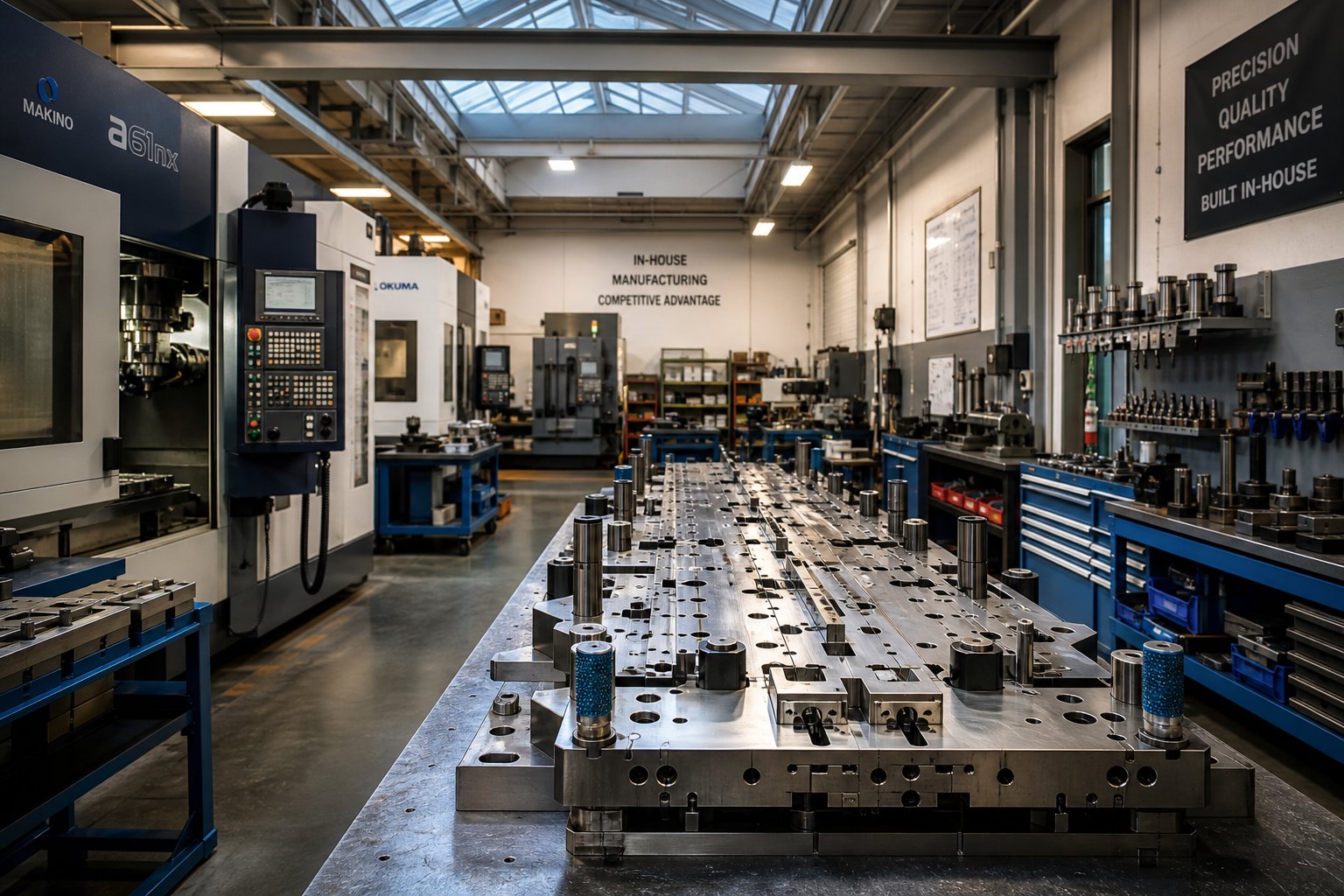
- In-house die design and build capability - Does the supplier design, engineer, and fabricate progressive dies internally, or do they outsource tooling to third-party shops? In-house toolrooms provide faster engineering changes, tighter accountability, and shorter debug cycles. Suppliers who outsource tooling add lead time risk and create accountability gaps when issues arise during tryout. Industry frameworks recommend verifying that the supplier employs dedicated die designers and toolmakers rather than relying solely on contract labor.
- Press tonnage range and strip width capacity - Match the supplier's press fleet to your part's force requirements and strip dimensions. A supplier running 45-ton presses can't serve your 200-ton part, and a maximum strip width of 12 inches won't accommodate your 16-inch layout. Ask for the full press schedule, not just the largest machine in the building.
- DFM feedback during quoting - Progressive die manufacturers who provide design-for-manufacturability input before you award the program demonstrate engineering depth. If a supplier quotes your drawing without any feedback on formability risks, tolerance stack-ups, or material flow concerns, that silence is a red flag. It typically signals they'll discover those issues after tooling is built, when corrections cost 10x more.
- Tooling ownership and storage terms - Who owns the die at program end? What are the storage conditions for inactive tooling? Will the supplier commit to maintenance throughout the program life? Vague "lifetime support" language without defined maintenance obligations creates disputes when volumes shift or programs wind down. Get ownership, maintenance, and transfer terms in writing before placing the order.
- Documented quality system with SPC capability - High-volume progressive stamping generates thousands of parts per hour. Without statistical process control actively monitoring critical dimensions, drift goes undetected until you receive a shipment of out-of-spec parts. Ask for sample SPC charts from current production, not just a quality manual PDF.
- Scalability and redundancy - Can the supplier ramp volume if your demand increases? Do they have backup press capacity, or does a single machine breakdown halt your entire supply? Metal stamping die manufacturers who serve wholesale programs should demonstrate contingency planning, not just peak capacity claims.
Evaluating Vertical Integration and Secondary Operations
A stamped part is rarely a finished part. Most wholesale components require deburring, heat treatment, plating, or assembly before they reach your production line. Every time a part ships to a separate vendor for secondary operations, you add transit time, handling damage risk, dimensional variation from re-fixturing, and a coordination burden on your procurement team.
Vertically integrated suppliers who perform stamping, finishing, and assembly under one roof collapse those handoffs into a single purchase order and a single point of accountability. When evaluating progressive die stamping services, ask specifically which secondary operations are performed in-house versus subcontracted:
- Deburring and edge conditioning - Tumble, vibratory, or precision deburring eliminates sharp edges without a separate supplier.
- Surface treatment and plating - Zinc, nickel, tin, or anodizing performed on-site reduces lead time by days or weeks.
- Heat treatment - Hardening, tempering, or stress relief performed internally avoids the quality risk of third-party thermal processing.
- Sub-assembly and packaging - Inserting fasteners, riveting sub-components, or packaging in customer-specific configurations adds value without adding vendors.
For procurement teams evaluating suppliers that combine die design expertise with scalable mass production, YICHEN's progressive stamping die capabilities illustrate the integrated model: in-house die engineering paired with high-volume multi-station forming and tight repeatability targets, all managed within a single manufacturing operation. This type of vertical integration is worth benchmarking against when comparing how different progressive die manufacturers structure their service offerings.
The total cost impact of integration versus fragmentation becomes clear when you calculate true landed cost. A supplier quoting $0.02 less per part but requiring three external vendors for plating, heat treatment, and packaging often ends up more expensive once you factor in shipping, inspection at each handoff, and the procurement hours spent managing multiple purchase orders. Always compare total program cost, not just the stamping line item.
Supplier capability answers the "who" question. But even the most capable partner needs guardrails, and that's where quality certifications, tolerance standards, and inspection protocols establish the measurable boundaries that keep your wholesale program on track over millions of cycles.
Quality Standards and Certifications for Wholesale Stamping Orders
A capable supplier with the right presses and in-house tooling still needs a measurable quality framework. Without one, you're trusting that millions of parts will come out right based on reputation alone. Certifications, tolerance agreements, and inspection protocols are the guardrails that translate capability into consistent, documented results across every shipment.
Certifications That Signal Supplier Reliability
Not all quality certifications carry equal weight for every buyer. The relevant standard depends on your end market, your customer's audit requirements, and the regulatory environment your finished product enters. Here's how the major certifications map to industry needs:
- ISO 9001:2015 - The baseline quality management system for any serious progressive stamping operation. It confirms that the supplier has documented processes, internal auditing, corrective action systems, and management review cycles. If a supplier lacks ISO 9001, treat that as a disqualifying gap for wholesale volumes regardless of industry.
- IATF 16949 - Required for automotive components progressive stamping. This standard builds on ISO 9001 with automotive-specific requirements including APQP (Advanced Product Quality Planning), PPAP, control plans, and FMEA (Failure Mode and Effects Analysis). Suppliers building automotive dies and stamping safety-critical parts like brackets, connectors, or seat mechanisms need this certification to even bid on Tier 1 programs.
- ISO 13485 - The quality management standard for medical progressive stamping. It addresses traceability, risk management, and design controls specific to medical devices. If your stamped parts go into surgical instruments, implantable devices, or drug delivery systems, your supplier must demonstrate compliance with this standard.
- ISO 14001 - Environmental management certification increasingly required by OEM progressive stamping buyers with sustainability mandates. Not directly quality-related, but often a prerequisite for preferred supplier lists at major corporations.
- ITAR/EAR compliance - Relevant for defense and aerospace stampings where controlled technical data must be protected. Not a quality certification per se, but a regulatory requirement that limits your supplier pool.
- UL/CSA recognition - For electrical and electronic components where stamped parts serve as contacts, terminals, or shielding. Suppliers producing hvac progressive stamping components or electrical enclosures often need UL listing on their production processes.
Beyond certifications, ask whether the supplier has completed PPAP packages for other customers in your industry. A Production Part Approval Process package typically includes dimensional results, material certifications, process flow diagrams, control plans, and capability studies. Suppliers who routinely produce Level 3 PPAP submissions demonstrate the documentation discipline that wholesale buyers depend on for incoming quality assurance.
Tolerances and Inspection Standards for Wholesale Parts
Progressive stamping achieves general tolerances of +/-0.05 to +/-0.10 mm on most features, with tighter positional tolerances down to +/-0.005 mm achievable on critical dimensions when die design and press monitoring support it. Those numbers sound impressive, but here's the nuance buyers often miss: every tolerance you specify has a cost attached.
Tighter tolerances demand harder tool steel or carbide inserts, more precise wire-EDM machining during die fabrication, closer press monitoring, and more frequent inspection sampling. A dimension toleranced at +/-0.025 mm might require a dedicated coining station that a +/-0.10 mm call-out would not. That single station addition can add $15,000 to $30,000 in tooling cost. Multiply that across several over-toleranced features and you've inflated your die investment by 20% or more for precision your application doesn't actually need.
The practical rule: specify tight tolerances only on dimensions that are critical to function, assembly fit, or downstream process requirements. Everything else should carry standard progressive stamping tolerances. Your supplier's DFM review should flag any call-outs that drive disproportionate tooling cost relative to their functional importance.
For high-volume runs, Statistical Process Control becomes the primary tool for ensuring consistency across millions of cycles. SPC tracks critical dimensions over time using control charts, detecting drift or trends before parts actually go out of tolerance. Effective SPC programs include defined sampling intervals, Cpk targets of 1.33 or higher for critical characteristics, and automatic alerts when process capability degrades. Buyers should request Cpk data in regular quality reports rather than relying solely on pass/fail inspection results.
The inspection documentation you should expect from any credible OEM progressive stamping supplier includes:
- First Article Inspection Reports (FAIR) at program launch and after any die modification
- In-process SPC charts on critical-to-quality dimensions
- Material certifications traceable to each production lot
- Final inspection reports with measured values, not just conformance statements
- Gauge R&R studies confirming measurement system adequacy
Hvac progressive metal stamping orders, for instance, may not require the same inspection rigor as automotive dies destined for safety-critical assemblies, but even lower-risk applications benefit from documented evidence that the process is stable and repeatable. The cost of over-inspection is trivial compared to the cost of a quality escape that reaches your assembly line.
With quality systems defining what "good" looks like, the remaining variables are time and money: how long the entire tooling-to-production pipeline takes, what minimum order quantities look like, and how per-part economics shift as you scale volume or weigh domestic versus overseas sourcing options.
Lead Times and Cost Economics for Wholesale Progressive Stamping
Quality frameworks tell you what acceptable looks like. But two questions keep procurement teams up at night long after supplier audits wrap up: How soon can we get parts? And what's the real cost per piece once every line item hits the ledger? The answers depend on where you are in the tooling-to-production pipeline, how your volumes stack up against minimum order thresholds, and whether you're sourcing domestically or overseas.
Typical Lead Times from Die Design Through Production Delivery
A wholesale progressive stamping program doesn't start producing parts the week you sign a purchase order. The timeline from initial die concept to stable, full-rate production typically spans 14 to 28 weeks, sometimes longer for complex tooling with tight tolerances. Each phase has its own duration range and its own risk of delays if inputs arrive late or design changes surface mid-stream.
| Phase | Typical Duration | Key Activities | Common Delay Triggers |
|---|---|---|---|
| Die Design and Engineering | 3 - 6 weeks | Strip layout, 3D modeling, DFM review, simulation, design approval | Incomplete part data, late material spec decisions, design revisions after review |
| Tooling Fabrication | 8 - 14 weeks | CNC machining, wire EDM, heat treatment, grinding, assembly | Specialty steel lead times, complex geometry requiring additional stations |
| Die Tryout and Sampling | 1 - 3 weeks | First-off samples, dimensional verification, die adjustments, PPAP preparation | Out-of-tolerance features requiring die rework, material behavior deviations |
| Sample Approval | 1 - 3 weeks | Customer dimensional review, FAIR approval, PPAP submission and sign-off | Internal approval bottlenecks, requests for additional capability data |
| Production Ramp-Up | 1 - 2 weeks | Rate validation, SPC baseline establishment, packaging and logistics confirmation | Press scheduling conflicts, material supply issues at volume |
The tooling fabrication phase dominates the timeline. A high-quality progressive die typically requires 12 to 20 weeks to design, machine, heat treat, grind, assemble, and commission. Rushing this phase to recover time lost during design approval almost always backfires. Corners cut during fabrication, whether in heat treatment soak times or finish grinding precision, show up as premature wear, dimensional drift, or outright tool failure once production starts running at full speed.
The single biggest controllable risk in your timeline? Late design changes. A modification requested after die steel has been roughed can cost 30% to 50% of the original tooling price in rework and add 4 to 8 weeks of delay. Locking your part design, material specification, and tolerance scheme before die fabrication begins isn't just good practice; it's the most effective schedule protection you have.
MOQ Thresholds and Cost-Per-Part Economics at Volume
Minimum order quantities in progressive die metal stamping services aren't arbitrary numbers pulled from a pricing spreadsheet. They're rooted in the amortization math that makes the entire process economically rational. Every progressive die represents a substantial capital investment, typically $25,000 to $350,000 depending on station count and complexity. That investment only delivers competitive per-part pricing when spread across enough units.
Most stamping die suppliers set MOQ thresholds based on the point where tooling amortization drops below a tolerable percentage of total part cost. For a $60,000 die, here's how the economics shift:
- 10,000 parts - Tooling adds $6.00 per part. At this volume, long-run progressive stamping offers no economic advantage over laser cutting or CNC turret punching.
- 50,000 parts - Tooling contribution drops to $1.20 per part. Borderline viable for simple geometries with low material cost.
- 250,000 parts - Tooling adds just $0.24 per part. Progressive stamping's speed advantage starts generating meaningful savings.
- 1,000,000+ parts - Tooling contribution falls to $0.06 or less. At this tier, the per-part cost is dominated by raw material and press time, and progressive stamping delivers its lowest possible unit economics.
Buyers can structure orders strategically to optimize these economics. Blanket purchase orders covering 12 to 24 months of demand, with scheduled releases, let you amortize tooling across the full program volume rather than individual purchase orders. This approach also gives your metal stamping die manufacturer better production planning visibility, which often translates into priority scheduling and more consistent lead times on releases.
Another lever: negotiate tooling amortization terms separately from piece price. Some suppliers bundle tooling cost into the per-part quote, which obscures the true economics and makes it harder to compare bids. Requesting itemized tooling and piece-price quotes from every bidder forces transparency and lets you evaluate which supplier offers better long-term value as volumes grow.
For production engineers and procurement teams managing the full tooling-to-production pipeline, working with an established manufacturer that controls both die engineering and high-volume stamping in-house reduces handoff risk at every phase. YICHEN's progressive stamping die operation exemplifies this integrated model, combining die design, fabrication, and scalable mass production under one roof to maintain tight repeatability and compress timelines that fragment when tooling and production are split across separate vendors.
Domestic vs. Overseas Sourcing: The Full Cost Picture
The quoted piece price from an overseas stamping die supplier can look dramatically lower than a domestic bid. Chinese metal stamping quotes, for example, often run 30-50% lower for tooling and 60-80% lower for per-piece pricing compared to Western equivalents. Those numbers are real, but they don't represent your landed cost.
Imagine you're comparing a domestic supplier quoting $0.18 per part against an overseas supplier at $0.07. The gap looks enormous. Then you start layering in the costs that the overseas quote typically omits:
- Ocean freight and customs duties - Shipping stamped metal parts internationally adds $0.03 to $0.08 per piece depending on part weight, packaging density, and container utilization. Tariffs on Chinese metal imports can add another 7.5% to 25% depending on the HTS classification and current trade policy.
- Extended lead times - International shipping, customs clearance, and port delays stretch delivery timelines to 8 to 12 weeks or more beyond production completion. That lag forces you to carry larger safety stock, tying up working capital and warehouse space.
- Quality risk and rejection costs - Distance complicates inspection. Defective parts discovered upon arrival can't be quickly replaced without another full shipping cycle. The cost of a quality escape, including sorting, rework, line-down events, and air freight for emergency replacements, can erase months of per-part savings in a single incident.
- Communication friction - Time zone gaps and language barriers slow issue resolution. A dimensional question that takes 30 minutes to resolve with a domestic supplier can take 2 to 3 days through asynchronous email chains with an overseas partner. Across a multi-year program, that friction compounds into meaningful schedule drag.
- IP protection - Tooling designs and proprietary part geometries face weaker intellectual property enforcement in some overseas jurisdictions. If your stamped components are competitively sensitive, this risk deserves explicit contractual mitigation, including non-disclosure agreements, tooling ownership clauses with repatriation terms, and restricted access to die drawings.
The realistic savings from overseas sourcing, once all hidden costs are included, typically narrow to 15-30% total savings rather than the 60-80% that raw piece-price comparisons suggest. For some high-volume, cost-sensitive programs, that margin still justifies overseas sourcing. For others, especially those requiring tight delivery windows, frequent engineering changes, or strict IP controls, domestic progressive die metal stamping services deliver better total value despite higher quoted piece prices.
The smartest wholesale buyers don't default to one sourcing strategy. They evaluate each program individually, weighing volume, part criticality, delivery flexibility requirements, and total landed cost. Some split production, keeping initial tooling and first-article validation domestic for speed and IP control, then transitioning high-volume steady-state runs to a qualified overseas partner once the process is locked. Others maintain dual-source strategies, keeping a domestic supplier qualified as backup to hedge against international supply chain disruptions.
Whichever path you choose, the principles covered throughout this guide apply equally: understand your process, specify your requirements precisely, verify supplier capability beyond the quote sheet, and always calculate total program cost rather than fixating on the stamping line item alone. Progressive die & stamping wholesale programs reward buyers who invest in process literacy upfront. That knowledge compounds across every tooling decision, every supplier negotiation, and every production release for the life of your program.
Frequently Asked Questions About Progressive Die & Stamping Wholesale
1. What is progressive die stamping and how does it work for wholesale orders?
Progressive die stamping feeds a continuous metal strip through a series of stations inside a single die, with each station performing a specific operation like piercing, bending, or forming. The strip advances one pitch length per press stroke, and all stations operate simultaneously, producing a finished part with every cycle. At wholesale scale, presses run 100 to 600+ strokes per minute, enabling output of millions of identical parts per year with minimal labor. This makes it the most cost-effective stamping method for flat or moderately formed parts at annual volumes above 100,000 units.
2. How much does progressive die tooling cost and what affects the price?
Progressive die tooling typically ranges from $25,000 for simple 4-6 station dies to $350,000 or more for complex 20+ station configurations. The primary cost drivers are station count, material hardness requiring carbide inserts, tolerance tightness demanding precision wire-EDM work, and strip width. Tooling cost becomes economically viable when amortized across high volumes. For example, a $60,000 die adds $1.20 per part at 50,000 units but only $0.06 at 1,000,000 units. Suppliers like YICHEN offer integrated die design and fabrication that can streamline engineering costs by keeping the entire tooling process in-house.
3. What materials can be used in progressive die stamping?
The four primary material families for progressive stamping are carbon steel, stainless steel, copper alloys, and aluminum. Carbon steel offers the lowest cost and best formability for structural components. Stainless steel suits corrosion-critical applications but causes faster tool wear and requires carbide inserts. Copper and brass excel in electrical and thermal applications with excellent ductility. Aluminum serves lightweight applications but requires special coatings to prevent galling. Most progressive stamping handles material thickness from 0.005 inches to 0.250 inches, with each material requiring specific die design considerations that affect tooling longevity and per-part pricing.
4. How long does it take to get parts from a progressive stamping supplier?
The full timeline from die design through production delivery typically spans 14 to 28 weeks. Die design and engineering takes 3 to 6 weeks, tooling fabrication requires 8 to 14 weeks, die tryout and sampling adds 1 to 3 weeks, customer sample approval takes another 1 to 3 weeks, and production ramp-up needs 1 to 2 weeks. The biggest schedule risk is late design changes after fabrication begins, which can add 4 to 8 weeks and 30-50% additional tooling cost. Working with vertically integrated manufacturers who control both die engineering and production under one roof helps compress handoff delays between phases.
5. Should I source progressive stamping domestically or overseas?
Overseas suppliers may quote 30-50% lower tooling costs and 60-80% lower piece prices, but realistic savings narrow to 15-30% after accounting for ocean freight, customs duties, extended lead times, larger safety stock requirements, quality risk, and communication friction. Domestic sourcing delivers faster delivery, easier engineering changes, stronger IP protection, and lower quality escape risk. The best approach depends on your specific program: high-volume, cost-sensitive parts with stable designs may justify overseas production, while programs requiring frequent changes, tight delivery windows, or IP sensitivity often achieve better total value domestically.


