


Understanding Metal Stamping Dies and Their Role in Manufacturing
When you source a stamped component, the tooling behind it determines everything: dimensional accuracy, surface finish, cycle time, and per-part cost. Yet many buyers treat die selection as a procurement checkbox rather than a strategic decision. The manufacturer you choose shapes your production reality for years to come.
What Are Metal Stamping Dies and Why They Matter
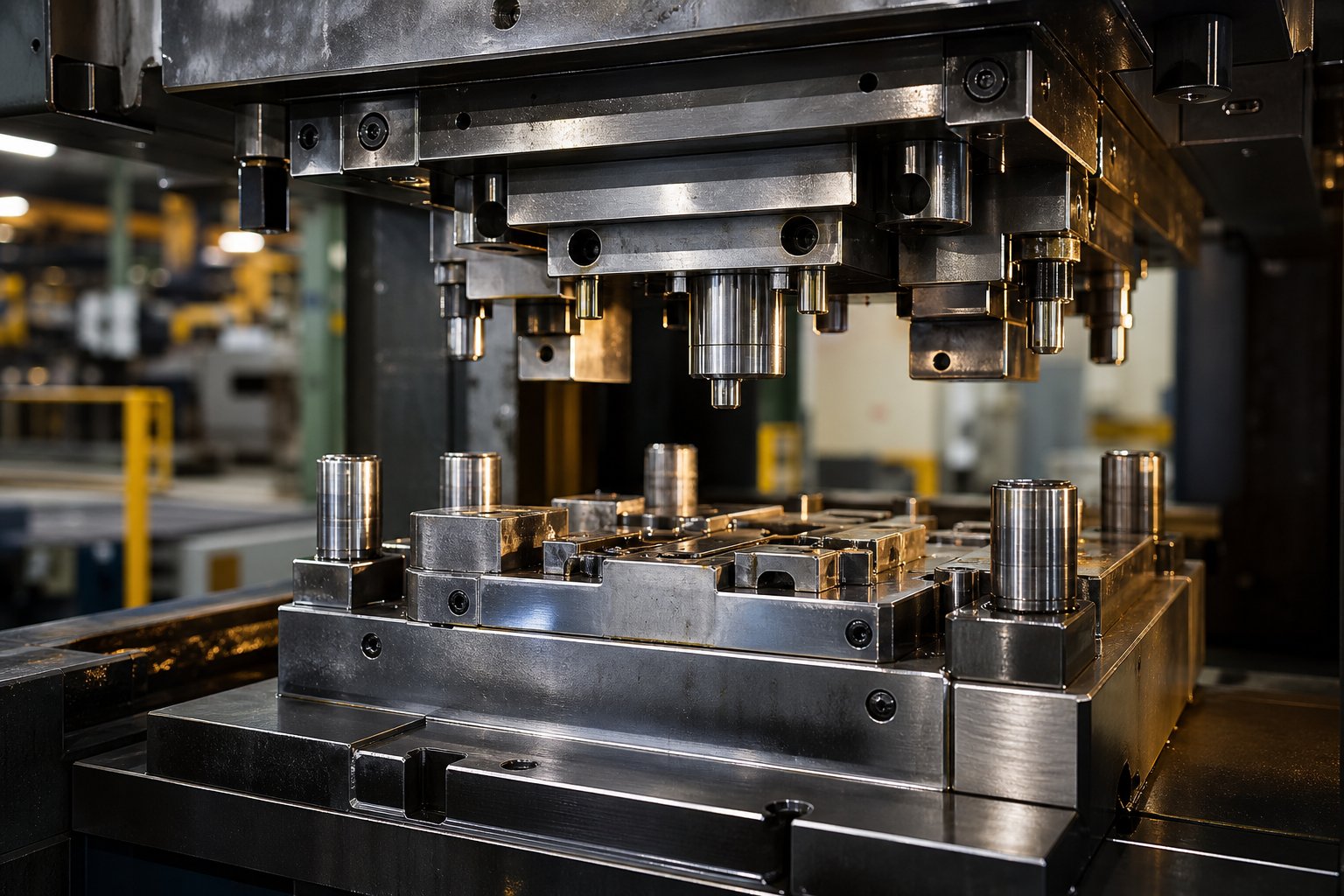
A metal stamping die is a precision-engineered tool that cuts, bends, or forms flat sheet metal into a finished component using force applied by a stamping press.
That single definition answers a question many engineers encounter early in their careers: what is dies in manufacturing? In simple terms, a stamping die is a custom-built assembly of hardened tool steel sections mounted inside a press. The upper half (punch) and lower half (die block) work together to shear or deform metal with each press stroke. Dies and stamping presses can cycle hundreds of times per minute, producing identical parts across millions of repetitions.
The precision of the die directly controls the precision of every part it produces. A well-built die holds tight tolerances over long runs, minimizes scrap, and keeps your press running without unplanned downtime. A poorly constructed one causes burrs, dimensional drift, and frequent maintenance stops that cascade into missed delivery dates.
Who Needs a Stamping Die Manufacturer
If you are a sourcing manager evaluating suppliers, a tooling engineer specifying new dies, or a product designer preparing for volume production, your choice of metal stamping die manufacturers sets the ceiling on what your production line can achieve. The decision involves more than comparing quotes. It requires understanding die types, materials, engineering processes, and shop capabilities well enough to ask the right questions.
This guide builds that framework step by step. You will learn how different metal stamping dies serve different applications, what construction details affect longevity, and which capabilities separate a competent shop from a true tooling partner. The goal is straightforward: give you enough technical grounding to evaluate any stamping die manufacturer with confidence and issue an RFQ that gets you the right tool, not just the cheapest one.
Types of Stamping Dies and When to Use Each
Knowing that die quality matters is one thing. Knowing which type of die your project actually requires is what separates a productive RFQ conversation from a frustrating one. The types of stamping dies available each solve different production problems, and choosing incorrectly leads to overspending on tooling or underperforming on cycle time.
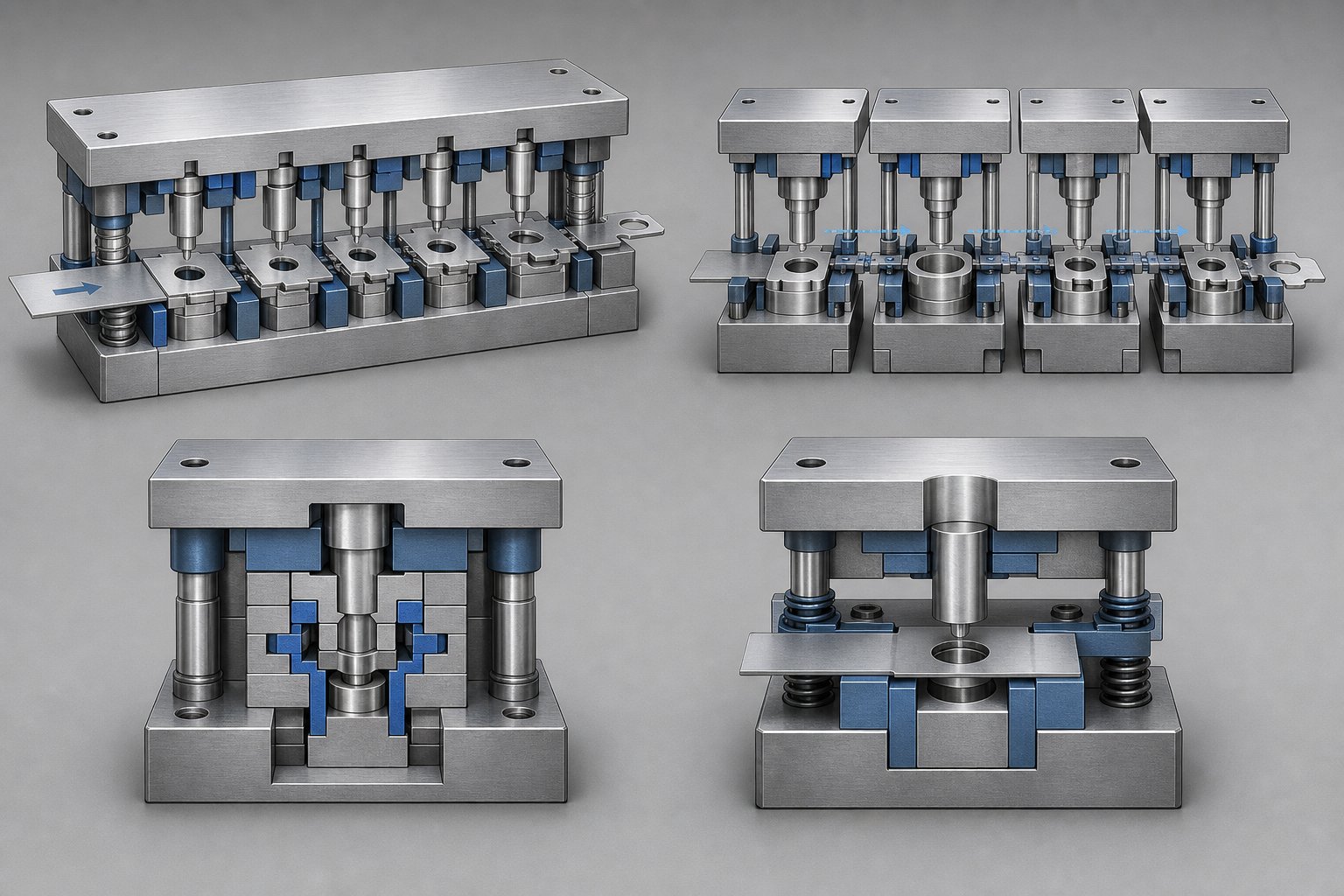
Four primary categories cover nearly every sheet metal stamping application: progressive, transfer, compound, and single-stage. Each one balances speed, complexity, and cost differently. Understanding how they work helps you speak the same language as your die builder and communicate requirements without ambiguity.
Progressive Dies for High-Volume Runs
Imagine a metal coil feeding continuously through a series of stations inside a single die set. At each station, a different operation happens-punching, bending, coining, trimming-until a finished part separates at the final stage. That is a progressive die in action.
Progressive die manufacturers build these tools for speed. A well-designed progressive die can cycle at 200 to 1,500 strokes per minute, producing complex parts with minimal material handling. The trade-off? High upfront tooling cost and limited flexibility for design changes once the tool is hardened. For automotive stamping dies and high-volume consumer electronics components, progressive tooling delivers the lowest per-part cost over long production runs.
Transfer and Compound Dies for Complex Geometries
When parts are too large or geometrically complex for a progressive strip, transfer dies step in. A blank is cut first, then mechanically moved between independent stations where forming, drawing, and trimming operations happen sequentially. Transfer die stampings suppliers typically serve industries producing deeper draws or larger structural components-think automotive brackets, appliance housings, or enclosure panels.
Compound dies take a different approach. They execute multiple cutting and forming operations in a single press stroke at one station. This makes them exceptionally precise for flat parts requiring tight dimensional alignment, like washers, electrical laminations, or shims. The limitation is depth: compound stamp dies handle single-plane geometries well but cannot manage multi-axis bending or deep forming.
Single-Stage Dies for Low-Volume or Prototyping
A single-stage die performs one operation per stroke-one bend, one pierce, one blank. The tooling is simple, inexpensive, and fast to build. For prototyping, pilot runs, or low-volume production where design iterations are expected, single-stage stamping dies offer the flexibility that progressive or transfer tooling cannot. You trade cycle speed for adaptability.
Many shops use single-stage dies during validation before committing to a full progressive tool, reducing risk if the part design changes during development.
| Die Type | Best Application | Volume Suitability | Complexity Level | Relative Tooling Cost |
|---|---|---|---|---|
| Progressive | High-speed production of multi-feature parts (automotive stamping die components, connectors, brackets) | High volume (100K+ parts) | Moderate to high | High |
| Transfer | Large or deep-drawn parts requiring multiple forming stages | Medium to high volume | High | High |
| Compound | Flat, precision parts needing multiple cuts in one stroke (laminations, washers) | Low to medium volume | Low to moderate | Medium |
| Single-Stage | Prototypes, pilot runs, simple operations (one bend or one pierce) | Low volume | Low | Low |
When you approach a manufacturer with a clear understanding of which die type fits your part geometry, volume, and budget, you eliminate a common source of miscommunication. You also make it easier to evaluate whether a shop's capabilities align with your actual needs-a question that depends heavily on the materials and construction methods behind the tooling itself.
Die Materials and Construction That Affect Longevity
The type of die gets you the right process. The material inside that die determines how long it lasts, how consistently it performs, and what your total cost of ownership looks like over hundreds of thousands-or millions-of strokes. Two identically designed steel stamping dies built from different tool steels can deliver wildly different service lives, and most buyers never think to ask why.
Stamping die steel selection is a balancing act between three competing properties: hardness, toughness, and wear resistance. Push one too far and you compromise the others. A sheet metal die built for a 5-million-stroke automotive program demands a completely different material strategy than one running 20,000 aluminum stampings for a prototype appliance bracket.
Tool Steel Grades and Their Performance Characteristics
Most metal stamping die sets rely on a handful of proven tool steel grades. Each occupies a different spot on the hardness-versus-toughness spectrum, and knowing where they sit helps you evaluate whether a manufacturer is specifying the right material for your application.
- D2 (High-Carbon, High-Chromium): The wear-resistance specialist. With carbon content around 1.4-1.6% and chromium at 11-13%, D2 achieves hardness between 54-61 HRC. Its dense chromium carbide structure resists abrasive wear exceptionally well, making it a standard for blanking dies, stamping dies, punches, and trim dies. The trade-off: D2 is relatively brittle and vulnerable to chipping under heavy shock loads.
- A2 (Air-Hardening, Medium Alloy): The balanced all-rounder. A2 delivers significantly better toughness than D2 while maintaining strong wear resistance and excellent dimensional stability during heat treatment. Popular hardness ranges run 57-62 HRC. It suits medium-to-high volume production where impact loads make D2 risky-think piercing, bending, and forming operations with intricate die geometry.
- S7 (Shock-Resistant): Built for impact. S7 contains lower carbon (0.45-0.55%) and less chromium (3.0-3.5%), achieving a working hardness of 48-58 HRC. What it sacrifices in wear resistance, it gains in exceptional shock absorption. S7 is the go-to choice for riveting, notching, and cold-forming dies where repeated impact is the primary failure risk.
- M2 (High-Speed Steel): When speed and heat resistance matter. M2 retains hardness at elevated temperatures, making it well-suited for high-speed punching stations where friction generates significant heat. It delivers an excellent balance of toughness, wear resistance, and red-hardness for precision cutting inserts.
Here is a practical rule: as your expected production volume increases, you generally move toward harder, more wear-resistant grades. Aluminum stamping dies running short production cycles may perform well with A2 or even lower-alloy steels. A progressive die punching high-strength steel at 800 strokes per minute for an automotive program will likely need D2 or a powder metallurgy upgrade to survive.
Carbide Inserts and Surface Treatments for Extended Die Life
Even premium tool steels eventually wear. For stations inside a die that experience extreme abrasion-cutting edges on high-strength steel blanking stations, for example-manufacturers install tungsten carbide inserts. Carbide stamping dies, or more precisely dies with carbide-tipped components at high-wear stations, can deliver service lives five to ten times longer than tool steel alone in abrasive applications. The downside is cost and brittleness: carbide is expensive, requires specialized diamond grinding, and cracks under heavy impact if not properly supported by the surrounding die structure.
Surface treatments add another layer of protection without changing the base material. The most common options include:
- Nitriding (Gas or Ion/Plasma): Nitrogen atoms diffuse into the steel surface at relatively low temperatures (~500 degrees C), creating a hard, wear-resistant layer with minimal distortion. Ion nitriding is faster and produces a thinner brittle "white layer" than gas nitriding. Research on advanced high-strength steel forming shows that ion nitrided tool steel with a PVD coating produced over 1.2 million parts, compared to just 50,000 for chrome-plated tooling.
- TiN (Titanium Nitride) Coating: Applied via PVD, this gold-toned coating boosts surface hardness and lowers friction, reducing galling risk. TiN works well on uncoated sheet metals but may cause zinc buildup when stamping galvanized steels.
- TiAlN / AlCrN Coatings: Superior thermal stability for high-speed stamping or operations generating significant heat at the tool-workpiece interface.
The key insight for buyers: surface treatment selection should follow the base material choice, not replace it. If a die is cracking or chipping, the substrate toughness is insufficient and no coating will fix that. Coatings solve surface wear and galling problems on dies that already have adequate core strength.
When evaluating any manufacturer, ask what stamping die steel grades they recommend for your specific material, thickness, and volume. Ask whether they specify surface treatments based on failure-mode analysis or simply default to one option for every job. The answers reveal whether you are working with a shop that engineers longevity into the tool-or one that builds the cheapest die that passes initial tryout and leaves you managing premature wear downstream.
Material and treatment decisions also connect directly to what happens next in the process: how the die is designed, simulated, and validated before any steel gets cut. The engineering workflow determines whether those material choices translate into a tool that performs as intended from the first production stroke.
The Die Design and Engineering Process from Concept to Production
A die built from the right steel still fails if the engineering behind it is flawed. Metal stamping die design is where material selection meets geometry, where production intent translates into machining instructions, and where costly mistakes either get caught digitally or discovered the hard way on a tryout press. The process follows a structured sequence, and each stage exists specifically to reduce the risk and expense of the stages that follow.
For buyers, understanding this workflow does two things. It helps you evaluate whether a manufacturer has a mature engineering process or is cutting corners. And it reveals where your own involvement-early, collaborative, technically informed-can prevent expensive rework later.
CAD Modeling and Stamping Simulation in Die Development
The journey from part concept to validated tool follows a defined sequence. Skipping steps or compressing the timeline without proper justification almost always results in rework after tool hardening, when changes cost ten times more than they would have during the digital phase.
- Part Feasibility and DFM Review: Engineers analyze the part geometry, tolerances, material type, and production volume to determine whether the stamping process can deliver the required outcome. Features like tight bend radii, hole proximity to edges, and deep draws get flagged early. This is the communication loop where buyer engineering teams and die manufacturers align on what is achievable versus what needs redesign. Experienced shops with 15+ years of tooling history can identify problematic features immediately-a chamfer that requires special tooling, a tolerance that drives unnecessary cost, or a geometry prone to cracking.
- Strip Layout and Process Planning: For progressive and transfer dies, engineers develop the strip layout-the sequential arrangement of operations the metal undergoes as it moves through the die. This includes nesting parts for material efficiency, sequencing piercing before forming to prevent feature distortion, designing carrier strips strong enough to advance the part reliably, and establishing pilot hole locations for station-to-station accuracy. The purpose of bypass notches in stamping dies becomes relevant here: these relief features allow the strip to advance smoothly past forming stations without interference, preventing buckling or misfeeds that would halt production.
- 3D CAD Modeling and Component Detailing: Using platforms like SolidWorks, Siemens NX, or CATIA, designers build detailed models of every die component-punches, die blocks, strippers, guide assemblies, and the die set itself. Specialized add-ins such as Logopress3 or NX Progressive Die Design automate strip layout generation, unbending calculations, and standard component selection. Each cutting clearance, forming radius, and springback compensation value gets built into the geometry at this stage.
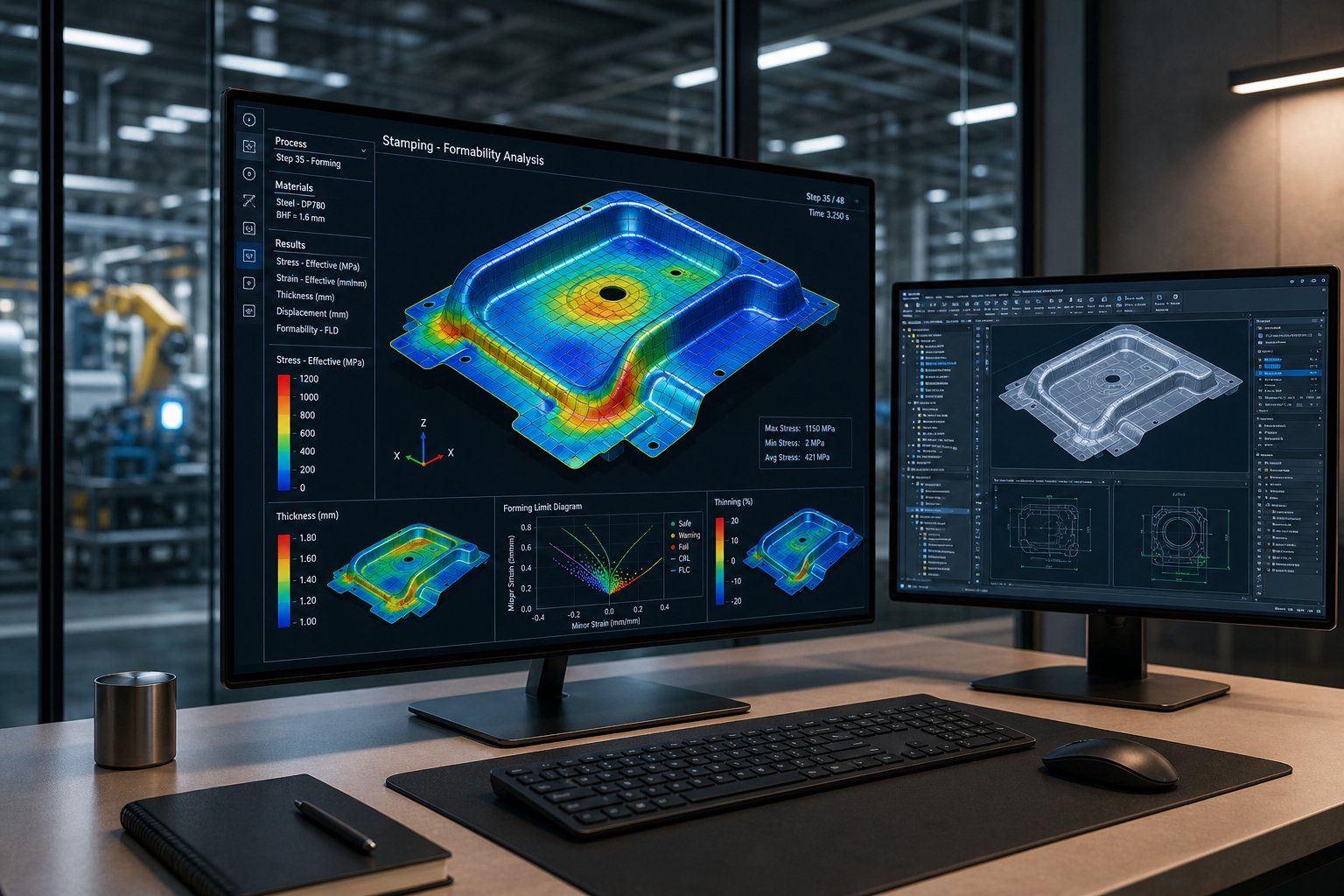
- FEA and Stamping Simulation: This is where modern die development separates capable shops from outdated ones. Using CAE platforms like AutoForm or DYNAFORM, engineers simulate the entire sheet metal stamping process digitally. They predict material flow into die cavities, identify failure points like wrinkling, splitting, or excessive thinning, calculate springback and build compensation into tool geometry, and optimize blank shapes to minimize material waste. A University of Michigan survey of OEM and Tier-1 stamping organizations found that rework iterations typically cost $25,000 to $125,000 per cycle depending on panel complexity. Respondents identified advancements in die forming simulation software as their highest-priority need for reducing these costs.
- CAM Programming and Machining: Once the design passes virtual validation, CAM software generates toolpaths for CNC mills, wire EDM, and grinding equipment. The digital model translates directly into G-code that machines each component to specification.
The simulation step deserves emphasis. It is far cheaper to iterate on a digital model than to re-machine hardened tool steel. Every hour spent in simulation saves days on the tryout press and thousands in rework costs. When evaluating custom metal stamping dies suppliers, ask specifically what simulation platforms they use, how many virtual iterations they typically run before cutting steel, and whether they share simulation results with your engineering team for review.
From Prototype Trials to Final Validation
Digital validation reduces risk dramatically, but it does not eliminate the need for physical confirmation. A sheet metal stamping die must prove itself under real press conditions before entering production.
During prototype trials, the die runs sample parts on a tryout press matching production tonnage and speed. Engineers measure first-article dimensions against print specifications, evaluate surface finish quality, check for burrs or edge conditions outside tolerance, and verify that the stamping process produces consistent results across multiple strokes. Any deviation triggers a root-cause analysis: is it a simulation assumption that did not match real material behavior? A machining error? A springback compensation that needs adjustment?
The best manufacturers treat tryout as a controlled engineering exercise, not a trial-and-error session. They instrument the die with sensors, record press parameters, and correlate measured results against simulation predictions. This closed-loop approach-where physical data feeds back into the simulation model-shortens the path from first tryout to approved production tool.
For custom stamping dies serving automotive or aerospace programs, validation extends beyond dimensional checks. It includes capability studies (Cpk analysis), PPAP documentation, and sometimes accelerated wear testing to confirm that the die will maintain tolerances across the contracted production volume.
The entire workflow-from feasibility review through final validation-typically spans 8 to 16 weeks depending on complexity. Compressing that timeline without adequate simulation and DFM collaboration is the single most common source of budget overruns in die programs. Buyers who engage early, provide complete part data, and participate actively in DFM discussions consistently experience fewer engineering changes, shorter tryout cycles, and faster time to production.
Design and simulation define what the die should be. The next question is whether the shop building it has the machining capabilities to execute that design at the precision levels the engineering demands.
Manufacturing Capabilities That Separate Top Die Shops
A brilliant die design means nothing if the shop executing it lacks the equipment to hold the tolerances that design demands. When you evaluate die manufacturers, you are really asking one question: can this facility translate a CAD model into hardened, assembled stamping tooling without farming out critical operations that introduce delays and quality risk?
Every process sent to an outside vendor adds transit time, communication gaps, and a handoff where dimensional responsibility gets murky. The most capable shops in tool & die manufacturing keep precision-critical operations under one roof, and that consolidation shows up directly in your lead times and part quality.
Critical Machining Capabilities for Precision Die Building
Not every machine in a die shop carries equal weight. Some operations define whether a finished tool hits spec or requires rework. Here is what to look for and why each capability matters:
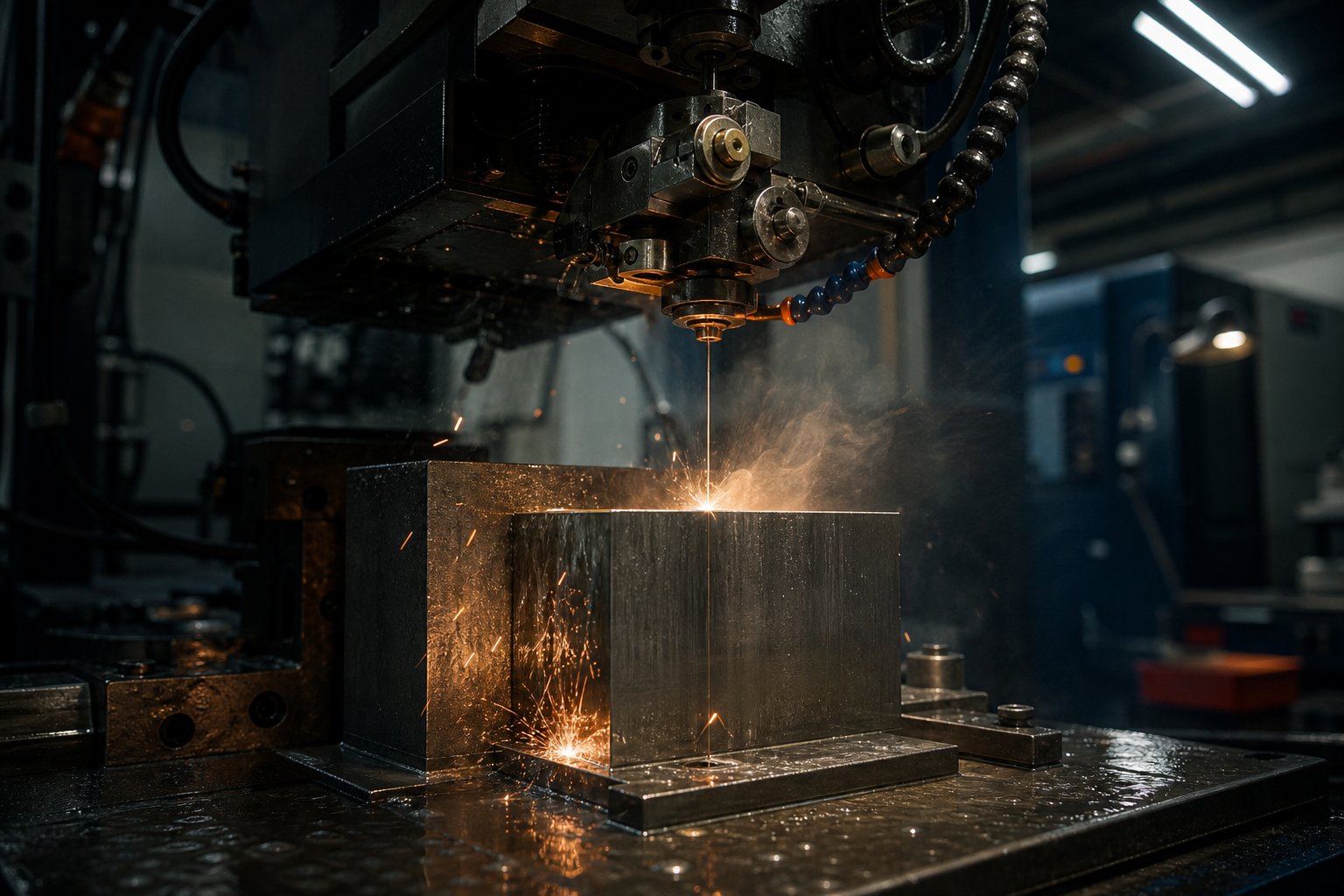
- Wire EDM: Uses a fine electrically charged wire to cut hardened tool steel profiles with tolerances as tight as ±0.002 mm. Wire EDM handles complex internal geometries that conventional milling cannot reach. Without it, intricate punch profiles and tight-clearance die openings must be outsourced-adding days to the schedule and introducing measurement uncertainty between shops.
- CNC Milling (3-Axis and 5-Axis): The backbone of die block and punch roughing through semi-finishing. Five-axis capability allows complex forming surfaces to be machined in a single setup, eliminating cumulative repositioning errors. A shop limited to three-axis work will struggle with contoured die surfaces and require more manual fitting during assembly.
- Jig Grinding: Achieves hole position accuracy and profile geometry within microns on hardened components. This is the operation that guarantees your guide pin bores, dowel holes, and critical locating features align precisely. Shops without jig grinding rely on wire EDM for hole finishing-workable, but slower and less suited to blind-hole geometries.
- Surface Grinding: Delivers flatness and parallelism on die plates and wear surfaces. Proper surface grinding ensures even contact across shut faces, preventing uneven loading that accelerates wear on one side of the die. It also establishes the datum surfaces that every other machined feature references.
- CNC Turning: Produces cylindrical components-guide pins, bushings, and round punches-to precise diameters and surface finishes. In-house turning means these components match the specific design rather than relying on off-the-shelf approximations.
When any of these capabilities is missing, lead times stretch. More critically, each external handoff introduces a tolerance stack-up risk. A punch profile cut by one shop, hardened by another, and ground by a third accumulates positional errors that only reveal themselves during die assembly-exactly when fixes become expensive.
In-House Heat Treatment and Tryout Press Advantages
Two capabilities often overlooked during supplier evaluations have outsized impact on both schedule and quality: heat treatment and tryout presses.
In-house heat treatment gives a stamping die factory direct control over the hardening process. According to Lucifer Furnaces, bringing heat treatment in-house eliminates shipping delays, removes the wait for external queue scheduling, and allows real-time process adjustments that outsourcing simply cannot match. For manufacturing dies with tight dimensional requirements, this matters because heat treatment introduces distortion. A shop that hardens its own components can measure distortion immediately after quenching and adjust finish-grinding strategies the same day-rather than waiting a week for parts to return from an outside heat treater only to discover unexpected dimensional shift.
In-house tryout presses close the loop between machining and validation. Once the die is assembled, it mounts directly onto a press matching production tonnage. Engineers run first-article parts, measure results, and make adjustments without shipping a multi-ton die to an external facility. This capability compresses the tryout-to-approval cycle from weeks to days. It also means the people who built the die are the same people debugging it on the die stamping machine-eliminating the communication gap between builder and user.
For buyers, the practical takeaway is straightforward: request an equipment list during your evaluation. A capable metal stamping tooling partner will show you CNC mills, wire EDM, jig grinders, surface grinders, heat treatment furnaces, and tryout presses under one roof. Gaps in that list translate directly into longer timelines, higher coordination overhead, and quality risk at every handoff point. The shops that keep these processes internal are not just faster-they maintain unbroken accountability from raw steel to validated tool, which is exactly what matters when your production launch date is fixed.
How to Evaluate and Select a Stamping Die Manufacturer
Equipment lists tell you what a shop can do. Certifications, capacity planning, and communication patterns tell you whether they will do it reliably, consistently, and on your timeline. Choosing a metal stamping die manufacturer requires a structured evaluation that goes beyond tour impressions and sales presentations. You need a framework that surfaces the differences between die manufacturing companies before you commit tooling dollars.
Certifications and Quality Systems to Verify
Certifications are not just wall decorations. They represent audited, documented proof that a shop maintains specific process disciplines. The two certifications you will encounter most often when evaluating stamping die manufacturers are ISO 9001 and IATF 16949.
ISO 9001:2015 is the baseline. It confirms a metal tool and die shop has established documented quality management processes, calibration schedules, internal audits, and corrective action procedures. Any reputable stamping dies manufacturer should hold this as a minimum. However, ISO 9001 does not require statistical process control, formal PPAP submissions, or defect-prevention methodologies like FMEA. It ensures process discipline but not the rigor needed for safety-critical applications.
IATF 16949:2016 builds on ISO 9001 and adds automotive-specific requirements: Advanced Product Quality Planning (APQP), Production Part Approval Process (PPAP), statistical process control for critical dimensions, and error-proofing mandates. If your stamped parts enter an automotive OEM supply chain, IATF 16949 is not optional-virtually all Tier 1 and Tier 2 buyers require it. The certification also demands surveillance audits every 6 to 12 months, including potential unannounced visits, which keeps shops accountable between your own supplier audits.
When reviewing certificates, verify three things: the certification body is accredited, the scope explicitly covers metal stamping or die manufacturing processes, and the site address matches where your tooling will actually be built. A company certified for assembly at one facility does not carry that certification to a stamping operation at another location.
Capacity Planning and Lead Time Assessment
A stamping die supplier with outstanding technical capability but an overloaded schedule will still miss your launch date. Capacity assessment requires specific questions: How many active die programs are running simultaneously? What percentage of machine hours are committed over the next 90 days? Do they maintain dedicated tryout press time, or do tryouts compete with production scheduling?
Lead time reliability matters more than lead time promises. Ask for delivery performance data from the last 12 months. A die manufacturer quoting 10-week delivery with 95% on-time history is a far safer bet than one quoting 8 weeks with no data to back it up. Also probe their contingency approach-what happens when a material order is delayed or a design change arrives mid-build? Shops with mature project management adjust schedules proactively rather than delivering surprises at the last minute.
Industry-Specific Selection Criteria
Your industry shifts what matters most. An automotive program demands PPAP documentation, Cpk capability studies, and full material traceability linking raw steel coils to finished die components. Aerospace applications require AS9100 certification and first-article inspection reports per AS9102, with traceability extending through every heat lot and machining operation. Electronics programs-especially connectors and micro-components-prioritize micro-tolerance capability, often requiring punch-to-die clearances held within ±0.002 mm and verified by CMM.
Consumer goods and appliance programs tend to weigh cost optimization and speed more heavily, where ISO 9001 is typically sufficient and the focus shifts toward material yield, design-for-manufacturability collaboration, and fast turnaround on engineering changes.
The following table provides a structured framework for evaluating any stamping die supplier against the criteria that matter most for your application:
| Evaluation Criteria | What to Verify | Key Questions to Ask |
|---|---|---|
| Quality Certifications | ISO 9001, IATF 16949, AS9100 (as applicable) | Is the certification scope specific to stamping/die building? When was the last surveillance audit? |
| Production Capacity | Number of concurrent programs, machine utilization rate | How many active die builds are in progress? What is your on-time delivery rate over the past year? |
| Material Expertise | Experience with your specific part material and thickness range | What tool steel grades do you recommend for our application, and why? Do you have experience stamping our material at this thickness? |
| Lead Time Reliability | Historical delivery performance, project scheduling process | Can you share delivery metrics from recent programs? How do you handle schedule impacts from mid-build design changes? |
| Communication Quality | DFM feedback speed, engineering change responsiveness, single point of contact | Who is our primary technical contact? How quickly do you typically turn around DFM feedback on new part submissions? |
| Tryout and Validation | In-house tryout press, first-article reporting, PPAP capability | Do you run tryouts in-house? What documentation accompanies first-article submissions? |
| Maintenance Support | Post-delivery die service, spare parts inventory, regrind programs | Do you offer die maintenance agreements? What is your typical turnaround for sharpening or repair? |
Use this framework as a scoring tool during supplier visits and RFQ evaluations. Weight each criterion according to your industry requirements-automotive buyers will score PPAP capability and SPC infrastructure heavily, while electronics buyers may prioritize tolerance capability and engineering responsiveness above all else. The goal is not finding a perfect score across every row, but identifying which stamping die manufacturers align most closely with the specific demands your program places on tooling quality, delivery, and long-term support.
Essential Questions to Ask Potential Die Manufacturers
An evaluation framework gives you the criteria. Actual vendor conversations give you the answers. The gap between the two is knowing exactly what to ask-and what the responses reveal about a shop's real capabilities versus its sales pitch. Procurement professionals and tooling engineers often face tight timelines during RFQ cycles, which means the questions you choose to ask need to deliver maximum signal in minimum time.
Think of this section as a reference you can pull up during your next call or facility visit with a stamping tool and die supplier. The questions are organized by category so you can focus on whatever matters most for your specific program, whether that is technical depth, schedule reliability, or long-term stamping die maintenance support.
Technical and Engineering Questions
These questions expose whether a shop is genuinely engineering your die or simply machining to a drawing without understanding the production context behind it. A strong metal stamping tool and die partner should answer these with specifics, not generalities.
- What simulation platforms do you use, and will you share forming analysis results with our engineering team? Shops using AutoForm, DYNAFORM, or equivalent CAE tools can predict material thinning, springback, and wrinkling before cutting steel. If they cannot name specific software or hesitate to share results, their design process likely relies on trial and error-which means your tryout costs go up.
- What DFM feedback do you provide on submitted part geometries, and how quickly? A capable manufacturer spots producibility issues within days of receiving your CAD file. Ask for examples of DFM recommendations they have made on previous programs. Shops that respond with "we build to your print" are telling you they will not help you avoid costly design problems.
- What tool steel grades and surface treatments do you recommend for our material, thickness, and volume? Listen for specific reasoning-D2 for abrasive blanking, S7 for impact-heavy forming, carbide inserts for ultra-high-volume stations. Vague answers like "we use high-quality steel" indicate limited material science depth.
- What is your standard punch-to-die clearance tolerance, and how do you verify it? Elite shops hold ±0.002 mm and verify with CMM or optical measurement. This question separates precision tool stamping metal operations from general machining shops that drift into die work without the metrology to support it.
- What stamping die parts do you manufacture in-house versus outsource? Critical components like punches, die blocks, and strippers should be machined internally. Heavy outsourcing of core elements signals capacity constraints or missing equipment that will affect your timeline and quality accountability.
Project Management and Communication Questions
Technical capability means little if the shop cannot manage timelines, communicate changes, or keep you informed without constant follow-up. These questions reveal operational maturity.
- Who is the single point of contact for our program, and what is their engineering background? You want a project manager who understands tool and die stamping processes, not just scheduling. Technical literacy in your primary contact eliminates the telephone game between you, a coordinator, and the actual engineers building your die.
- How do you handle engineering changes after design approval? Design changes happen. The question is whether the shop has a formal revision control process-tracking current versus previous versions, quoting impact within days, and preventing the wrong revision from reaching the machine. Shops without documented change control processes will eventually build to an outdated drawing.
- What is your on-time delivery rate over the past 12 months, and how do you define "on-time"? Some shops measure against original commit dates. Others reset the clock every time a schedule changes. Ask for the metric and the definition. A rate above 90% against original commits indicates strong planning discipline.
- How do you communicate schedule risks or delays before they impact delivery? Proactive shops flag risks the moment they identify them-a material delay, an unexpected machining issue, a simulation result that requires design iteration. Reactive shops wait until the delivery date passes and then explain what went wrong.
- What documentation accompanies the completed die? Expect design files, a bill of materials for stamping die parts and wear components, first-article inspection reports, material certifications for tool steels, and a maintenance manual. Missing documentation creates long-term headaches when you need stamping tool repair or spare components years after delivery.
Maintenance and Long-Term Partnership Questions
A die is not a one-time purchase-it is a production asset that requires ongoing care. These questions determine whether your supplier disappears after invoicing or stays engaged through the die's entire service life.
- Do you offer scheduled stamping die maintenance programs, and what do they include? Look for specifics: regrinding frequency recommendations, inspection intervals, preventive replacement schedules for wear components, and turnaround time commitments. A structured maintenance program extends die life by 30-50% compared to running until failure.
- What is your typical turnaround for stamping tool repair-both planned sharpening and emergency breakdowns? Planned maintenance should turn around within days. Emergency repairs within a week. If a manufacturer quotes multiple weeks for basic regrinding, their capacity or prioritization will not support your production uptime needs.
- Do you stock or quickly source replacement die components for tools you have built? Shops that retain digital models and material records from original builds can reproduce wear items-punches, inserts, springs, guide pins-without starting from scratch. This dramatically reduces downtime when components wear out mid-production.
- Can your tooling scale to higher volumes if our demand increases? A die built for 500,000 parts per year may need station reinforcement, material upgrades, or additional cavities to handle 2 million. Ask whether the original design accommodates future volume growth or whether scaling requires a new tool entirely.
- What does your post-delivery engineering support look like if we encounter production issues? The best partnerships include troubleshooting support for issues like burr formation, dimensional drift, or feed problems-even months after delivery. Ask whether support is included, billable, or unavailable.
Bookmark these questions for your next RFQ cycle. The responses you receive will reveal more about a manufacturer's actual capability than any brochure or website ever will. Suppliers who answer with confidence, specifics, and transparency are signaling exactly the kind of partnership that produces reliable tooling over the long term. Those who deflect, generalize, or avoid detail are telling you something equally valuable-just in the opposite direction.
The quality of these conversations also signals something broader: how the die manufacturing industry itself is evolving. The shops investing in simulation, automation, and lifecycle support are pulling ahead of those still operating on handshake promises and reactive service models.
Trends Reshaping How Manufacturers Build and Deliver Dies
The answers you get from die manufacturers today sound different than they did five years ago. Shops that once competed primarily on machining capacity now differentiate through engineering services, digital infrastructure, and the breadth of support they provide across a die's entire lifespan. Several converging forces are driving this shift in metal stamping manufacturing, and buyers who understand them will make sharper sourcing decisions.
Advanced Simulation and Automation in Die Building
CAE simulation has moved from a competitive advantage to a baseline expectation. The global CAE market was valued at nearly $11 billion in 2024 and is projected to reach $25 billion by 2032, reflecting how deeply embedded simulation has become in the manufacturing stamping process. In precision die stamping applications, AI-assisted simulation has already compressed die validation timelines by 31 percent in leading automotive operations. That means fewer physical tryout iterations, less rework on hardened steel, and faster time to production approval.
Simulation-driven die development does not replace physical validation-it eliminates the majority of failures before steel is ever cut, reducing tryout iterations from weeks of trial-and-error to days of targeted refinement.
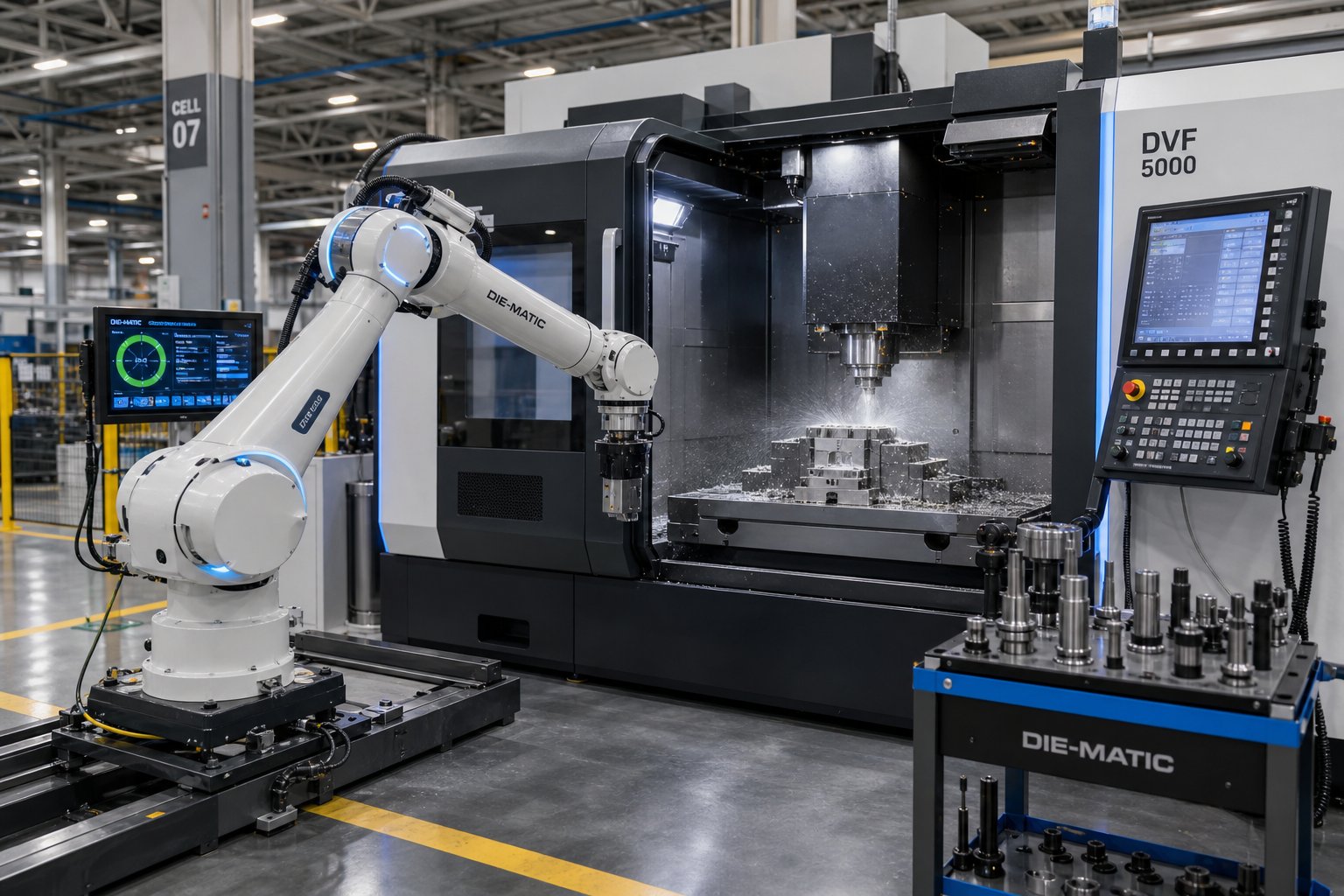
Automation is reshaping the shop floor in parallel. Robotic machine tending enables CNC mills and wire EDM equipment to run unattended overnight, pushing machine utilization from a typical 30 percent on a single shift toward 80 percent or higher. For the stamping manufacturing process, this translates into shorter lead times without sacrificing precision. In-process probing and automated inspection cells verify critical dimensions during machining rather than after-catching deviations before they compound into assembly problems. These automation tool & die investments particularly benefit electrical metal stamping applications where micro-connectors and shielding components demand tolerances measured in single-digit microns.
Full-Lifecycle Partnerships from Feasibility to Maintenance
The most significant industry shift is structural, not technological. Leading die shops no longer position themselves as machine-time vendors. They offer integrated partnerships spanning feasibility assessment, CAE forming analysis, detailed die design, precision machining, instrumented tryout, dimensional inspection, and ongoing maintenance support. This lifecycle model changes the buyer-supplier dynamic from transactional to collaborative.
Why does this matter? Because a manufacturer involved from feasibility through production understands why specific design decisions were made. When a custom precision stamping die needs sharpening at 500,000 strokes, the team that simulated material flow, selected the tool steel grade, and validated the first article is the same team performing maintenance-no knowledge gaps, no re-learning curve.
YICHEN exemplifies this lifecycle approach, offering a workflow that moves from initial feasibility assessment and CAE simulation through CNC machining, trial runs, and final inspection under one operational umbrella. For buyers ready to transition from research to RFQ, their stamping die page provides a concrete example of how full-service manufacturers structure their engagement from first contact through production validation.
This evolution toward integrated partnerships also reframes how buyers should think about the final step: building a long-term relationship that sustains die performance across millions of production cycles, not just approving a tool at delivery.
Building a Successful Die Manufacturing Partnership
Every section of this guide has built toward one outcome: giving you the technical grounding to match your production requirements with a manufacturer who can deliver reliably across the life of the tool. The difference between a successful die program and a costly one rarely comes down to a single factor. It comes down to how well you align die type, material strategy, shop capabilities, and communication quality before committing tooling dollars.
Matching Your Requirements to the Right Manufacturer
You have evaluated die types, materials, engineering workflows, machining capabilities, certifications, and vendor questions. Distilling all of that into a repeatable decision process keeps your evaluation consistent whether you are sourcing a custom metal stamping die for an automotive bracket or a custom metal die for a consumer electronics enclosure. Here is the condensed checklist:
- Define your die type requirement first. Progressive, transfer, compound, or single-stage? Your part geometry, annual volume, and material thickness dictate this choice. Communicating it upfront filters out shops that lack the relevant experience.
- Verify machining and heat treatment capabilities in-house. Wire EDM, jig grinding, 5-axis CNC, and on-site hardening under one roof mean shorter lead times and unbroken dimensional accountability.
- Confirm certifications match your industry. ISO 9001 as a minimum. IATF 16949 for automotive. AS9100 for aerospace. Check scope, site address, and last audit date.
- Assess engineering depth, not just machining capacity. Ask about simulation platforms, DFM turnaround speed, and whether they share forming analysis results. Shops that engineer your die-not just machine it-catch problems before steel gets cut.
- Evaluate communication patterns early. How quickly do they respond to technical questions? Do they assign a single point of contact with engineering literacy? Responsiveness during the quoting phase predicts responsiveness during the build.
- Plan for maintenance from day one. Ask about regrind programs, spare component availability, and emergency repair turnaround. A custom die stamp is a long-term production asset, not a one-time purchase. The manufacturer who builds it should support it across its entire service life.
- Request delivery performance data. On-time history over the past 12 months tells you more than any promised lead time. Weight reliability over speed.
This checklist works whether you are evaluating a local tool and die shop or a global supplier producing sheet metal stampings at scale. Weight individual criteria based on your industry demands-automotive programs lean heavily on PPAP capability and SPC infrastructure, while electronics applications prioritize micro-tolerance precision and rapid engineering iteration.
Moving from Research to RFQ with Confidence
The best die partnerships do not start with a purchase order. They start with a technically clear conversation where both sides understand the part requirements, production intent, and long-term volume expectations. Your RFQ should include a complete 3D model, a dimensioned 2D drawing, material and tolerance specifications, annual volume projections, and any secondary operation requirements. The more complete your initial submission, the more accurate and comparable the quotes you receive-eliminating the back-and-forth that adds days to every quoting cycle.
If you have followed this guide, you now understand enough about custom metal stampings, die construction, and shop capabilities to evaluate any manufacturer's response with confidence. You know what questions to ask, what answers reveal genuine capability, and what red flags signal a shop that will underperform when deadlines tighten.
For buyers ready to move from research into an active RFQ conversation, YICHEN's stamping die page offers a practical starting point-covering the full-service workflow from feasibility assessment and CAE simulation through machining, trial runs, and inspection that this article has outlined as the standard for modern die manufacturing partnerships.
Clear technical communication from the first interaction sets the trajectory for the entire program. Start there, and the tooling that follows will reflect the precision and intent you brought to the partnership from day one.
Frequently Asked Questions About Metal Stamping Die Manufacturers
1. What is dies in manufacturing and how do they work?
A die in manufacturing is a precision-engineered tool installed in a stamping press that uses force to cut, bend, or form flat sheet metal into finished components. The die consists of an upper half (punch) and lower half (die block) that work together during each press stroke. Dies can cycle hundreds of times per minute, producing identical parts across millions of repetitions. The quality of the die directly controls part accuracy, surface finish, and production consistency over the tool's entire lifespan.
2. How do I choose between progressive, transfer, and compound stamping dies?
The choice depends on three factors: part geometry, production volume, and budget. Progressive dies suit high-volume runs (100K+ parts) of multi-feature components, delivering the lowest per-part cost but requiring significant upfront tooling investment. Transfer dies handle large or deep-drawn parts too complex for a progressive strip. Compound dies excel at flat, precision parts needing multiple cuts in one stroke, like laminations or washers. Single-stage dies work best for prototyping or low-volume production where design flexibility matters more than cycle speed.
3. What certifications should a stamping die manufacturer have?
At minimum, look for ISO 9001:2015 certification, which confirms documented quality management processes. For automotive supply chains, IATF 16949:2016 is essential as it adds APQP, PPAP, statistical process control, and error-proofing requirements. Aerospace applications require AS9100 with full traceability. When reviewing certificates, verify the certification body is accredited, the scope covers die manufacturing specifically, and the certified site address matches where your tooling will be built. Surveillance audits every 6-12 months help maintain ongoing accountability.
4. What tool steel is best for stamping dies?
The best tool steel depends on your part material, production volume, and failure mode risks. D2 (high-carbon, high-chromium) offers superior wear resistance for blanking and high-volume applications at 54-61 HRC. A2 provides a balanced combination of toughness and wear resistance for medium-to-high volume forming operations. S7 delivers exceptional shock absorption for impact-heavy cold-forming dies. M2 high-speed steel retains hardness at elevated temperatures for high-speed punching stations. As production volume increases, manufacturers generally move toward harder, more wear-resistant grades or add carbide inserts at high-wear stations.
5. How long does it take to build a custom stamping die?
A typical custom stamping die program spans 8 to 16 weeks from feasibility review through final validation, depending on complexity. The timeline includes DFM review, strip layout planning, 3D CAD modeling, FEA simulation, CAM programming, machining, heat treatment, assembly, and tryout. Compressing this timeline without adequate simulation and DFM collaboration is the most common source of budget overruns. Buyers who provide complete part data early, engage in DFM discussions, and choose manufacturers with in-house capabilities like heat treatment and tryout presses consistently achieve shorter, more predictable delivery schedules.


