


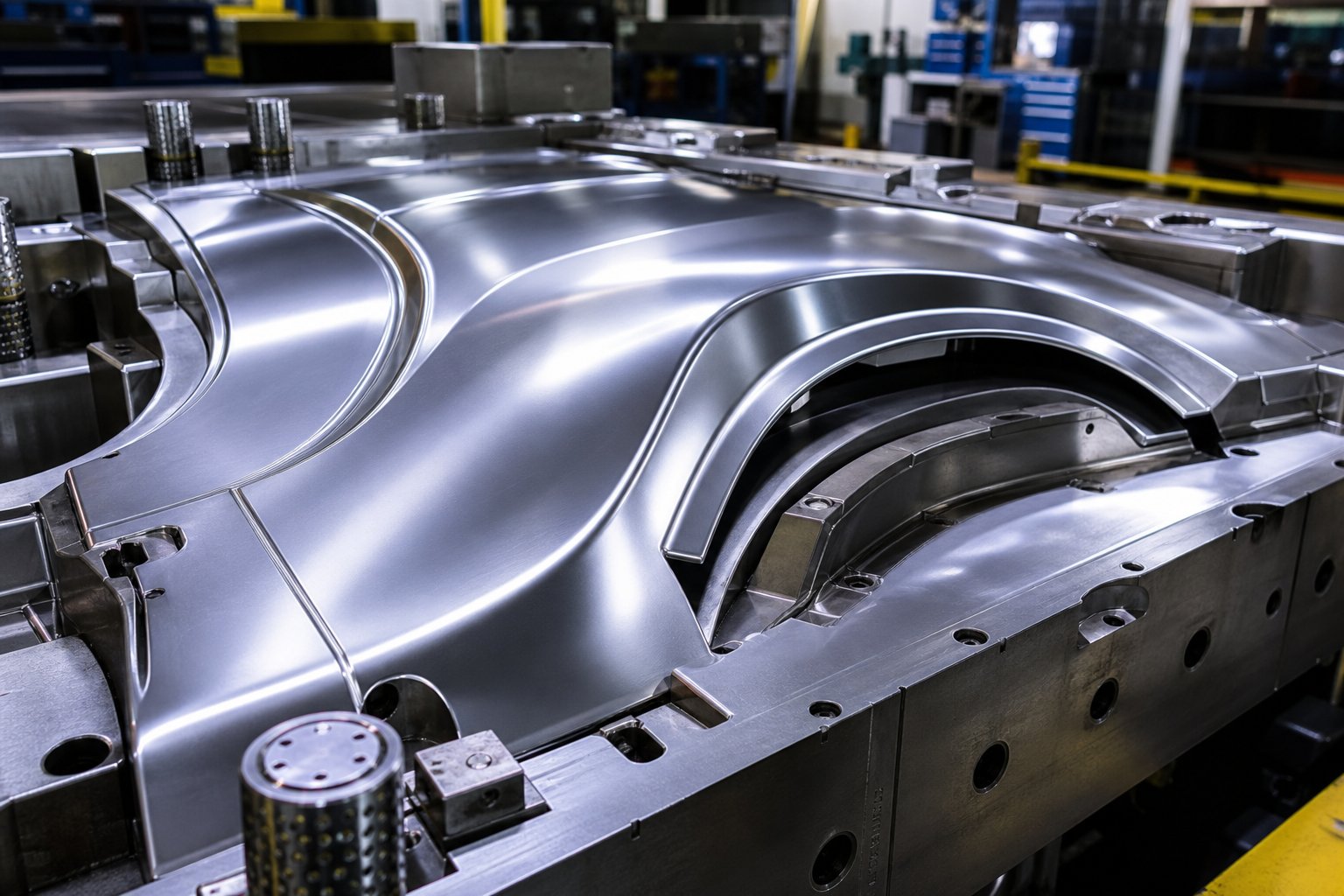
What Is a Car Wing Stamping Die and Why It Matters
When you look at the side of any vehicle, the wing panel (also called the fender) is one of the first surfaces your eye catches. It sweeps from the headlamp housing back toward the door, wrapping around the wheel arch in a compound curve that blends aerodynamics with design language. Forming that shape from a flat sheet of metal requires a very specific type of precision tool, and not just any stamping die will do.
A car wing stamping die is a Class A precision tool engineered to draw, trim, and form automotive fender panels from sheet metal, producing exterior surfaces that meet strict dimensional tolerances and flawless visual finish standards required for painted body panels.
That definition sounds straightforward, but it hides an enormous amount of engineering complexity. Wing panels sit in a category of automotive parts that use die cutting and forming processes pushed to their geometric limits. Unlike a flat bracket or a structural crossmember, a fender must look perfect under showroom lighting while surviving the stresses of high-speed stamping production.
What Makes Wing Panel Stamping Dies Unique
Imagine pressing a flat sheet of steel into a shape that curves in multiple directions simultaneously, dives deep around a wheel arch, and transitions into crisp feature lines along the body side. That is essentially what automotive stamping dies for wing panels must achieve in a single press stroke or a tightly sequenced series of stations.
Several characteristics set wing panel tooling apart from generic body panel dies:
- Deep draw ratios around the wheel arch area, where the metal must flow significantly into the die cavity without tearing or thinning excessively
- Compound curvature that changes direction across the panel surface, requiring carefully calibrated draw beads and blank holder pressures
- Tight integration with adjacent panels (doors, hood, bumper fascia) demanding dimensional repeatability within fractions of a millimeter
- Large panel size relative to forming depth, which amplifies springback and wrinkling risks
These challenges mean that automotive metal stamping for wing panels occupies a specialized niche. A die builder experienced with structural stampings or interior brackets may lack the surface-quality expertise that fender tooling demands.
Class A Surface Requirements and Deep Draw Challenges
In the stamping industry, tooling is classified into tiers. Class A stamping dies represent the highest quality level, engineered for extreme reliability, built from the toughest tool steels, and capable of producing millions of defect-free parts. Within that tier, Type 1 tooling is specifically designated for stretching and drawing exterior panels, including automotive body panels where every stamped surface must be entirely smooth and free of defects.
For wing panels, Class A surface requirements are non-negotiable. Any waviness, sink mark, or orange-peel texture will show through the paint. Automotive dies used in fender production must maintain mirror-polish quality on forming surfaces throughout their operational life, often spanning hundreds of thousands of press cycles. The deep draw around the wheel opening compounds this difficulty because the metal undergoes severe plastic deformation in zones immediately adjacent to visible Class A surfaces.
This intersection of deep forming and flawless finish is precisely why car wing stamping die brands matter so much to engineering and procurement teams. Not every toolmaker can deliver both, and the gap between adequate and excellent becomes visible on every vehicle rolling off the assembly line.
How Wing Panel Dies Differ From Other Automotive Stamping Dies
Stamping a structural rail or a small mounting bracket is a fundamentally different engineering problem than forming an exterior fender. Both fall under the umbrella of dies and stamping, yet the tooling strategy, press configuration, and failure modes diverge sharply once you move into large, visible body panels. Understanding where those differences lie helps explain why evaluating car wing stamping die brands requires a more targeted lens than a generic supplier shortlist.
Wing panels introduce a unique combination of forming challenges that rarely appear together in other automotive stamping parts:
- Large unsupported surface areas prone to wrinkling and surface deflection under uneven blank holder pressure
- Severe springback driven by residual stresses across sweeping compound curves
- Deep draw transitions around the wheel arch adjacent to Class A visible surfaces
- Tight dimensional coupling with neighboring panels (hood, door, bumper) requiring repeatable gap-and-flush tolerances
- Sensitivity to material batch variation, where even slight differences in yield strength shift forming behavior
A bracket die might tolerate a degree or two of angular deviation. A wing panel die cannot, because that deviation translates directly into visible body line misalignment at final assembly.
Springback Control on Large Curved Panels
Springback is the elastic recovery that occurs the moment a stamped part leaves the die. Every stamped metal part springs back to some degree, but on a wing panel the effect is amplified by the panel's size and gentle curvature. Small, heavily formed parts dissipate most residual stress through plastic deformation. Large, gently curved surfaces retain significant elastic energy that releases as soon as press tonnage is removed.
Research published in the International Journal of Computer Integrated Manufacturing demonstrates why predicting springback through trial-and-error methods is both difficult and labor intensive for body panels. The study compared single-operation and multi-operational die shape compensation methods using FEM software, confirming that virtual compensation techniques deliver more precise geometry correction in significantly less time than physical tryout iterations. For wing panels specifically, the compound curvature means springback does not occur in a single predictable direction. Different zones of the panel spring differently, creating twist and surface waviness that must be pre-compensated into the die geometry during design.
This is where automotive stamping expertise separates capable brands from marginal ones. Die builders with advanced simulation capabilities can predict and compensate springback digitally before cutting steel, reducing costly die rework loops. Brands that rely primarily on physical tryout for springback correction may add weeks of lead time and significant cost to wing panel programs.
How Material Selection Shapes Die Design
The material you stamp fundamentally changes how the die must be engineered. Wing panels today are formed from mild steel, Advanced High-Strength Steel (AHSS), or aluminum, and each material demands a different die design philosophy.
Mild steel remains the most forgiving option. It offers good elongation and relatively low springback, making draw die development more predictable. However, lightweight targets are pushing OEMs toward alternatives.
AHSS grades present considerably greater challenges for auto metal stamping operations. A comprehensive review in the journal Metals highlights that AHSS multi-phase microstructures accentuate forming difficulties including higher required press forces, increased springback, greater wrinkling tendency, and batch-to-batch property inconsistencies. The significant yield strength of AHSS leads to higher stresses on tooling surfaces, accelerating wear. For wing panel applications, AHSS also intensifies the risk of surface fracture modes not captured by traditional forming limit diagrams, meaning die engineers need more sophisticated simulation and validation approaches.
Aluminum introduces yet another set of variables. Lower formability compared to mild steel, a tendency toward galling (material transfer to the die surface), and different friction characteristics all require specialized die surface treatments and modified draw bead designs. Wing panel dies for aluminum programs often need PVD coatings or polished inserts in draw-critical zones to prevent surface scoring.
The takeaway for procurement teams: a brand's documented experience with your specific material class matters as much as their general stamping capability. Not every die builder has validated processes for AHSS or aluminum wing panel production.
Progressive vs Transfer Die Approaches for Wing Panels
Wing panels are too large and geometrically complex for single-station stamping. They require multi-station die setups, and the choice between progressive and transfer configurations has major implications for cost, quality, and production speed.
In progressive die stamping, a continuous strip of sheet metal moves through integrated stations within a single die block. Each station performs an incremental forming operation while the part remains attached to the carrier strip until the final cutoff. Progressive dies offer high speed and lower per-part costs, but they work best for smaller components where material utilization is acceptable.
Transfer die stamping separates the blank first, then moves individual pieces between independent die stations using a mechanical transfer system. For wing panels, transfer die setups are the dominant approach. The large blank size, deep draw requirements, and need for intermediate annealing or repositioning between forming stages make transfer configurations the practical choice. Transfer die stampings suppliers serving the automotive body panel segment typically engineer five to seven stations for a complete wing panel, covering draw, trim, restrike, flange, and pierce operations.
Progressive die manufacturers certainly play a role in automotive stamping, particularly for smaller components produced in very high volumes. But when sourcing wing panel tooling specifically, you want a brand whose core competency aligns with large-panel transfer die engineering, where blank handling precision and inter-station positioning directly impact final part quality.
These material and process distinctions explain why choosing a wing panel die partner based solely on price or general reputation carries real risk. The next logical question becomes: what specific criteria should you use to compare brands on a level playing field?
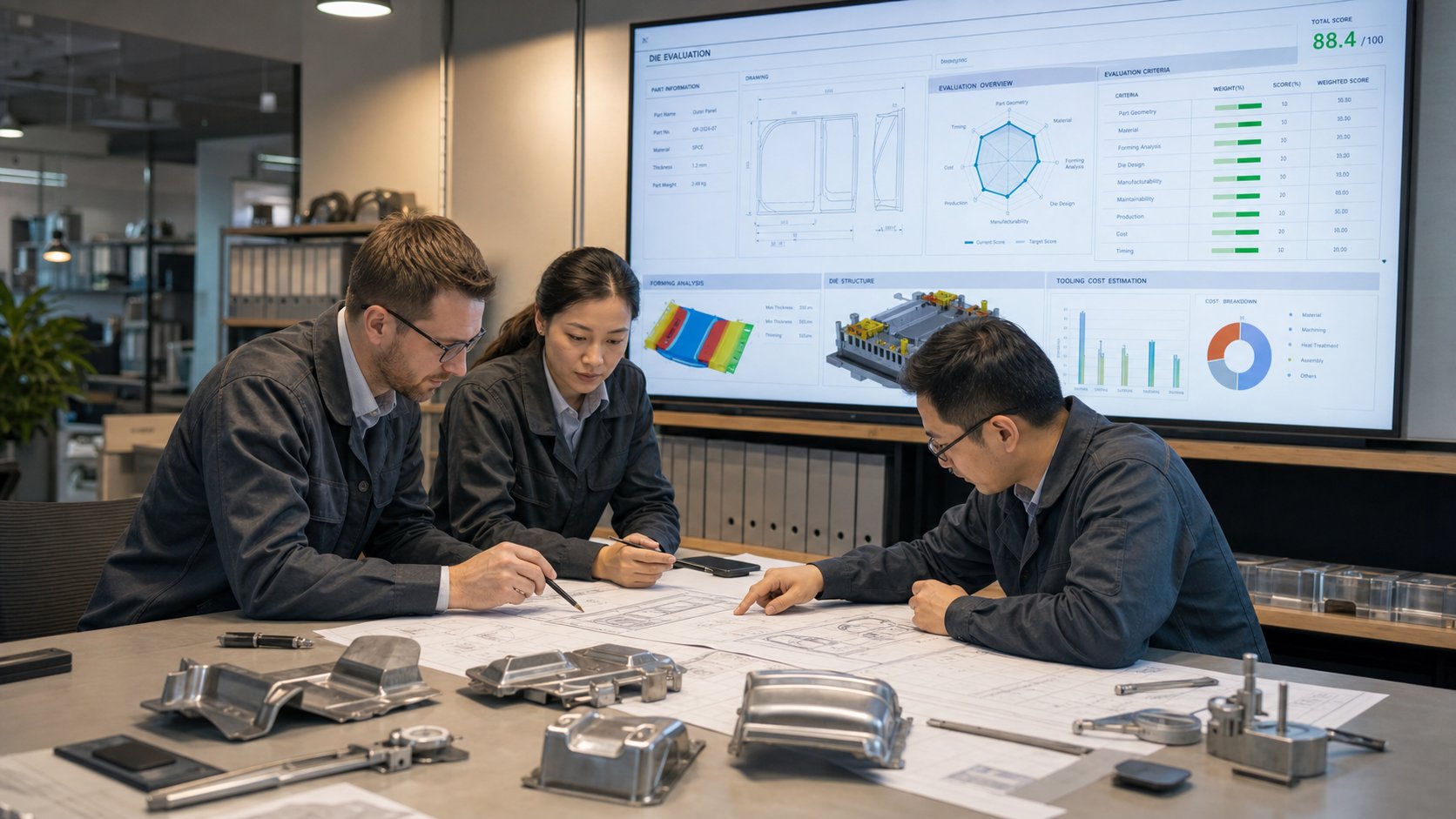
Essential Selection Criteria for Wing Stamping Die Brands
Comparing car wing stamping die brands without a structured framework is like evaluating sports cars based only on horsepower. You miss the variables that actually determine whether the tool performs reliably over millions of cycles while holding Class A surface quality. Engineers and procurement teams need a decision matrix tailored specifically to wing panel applications, not generic die-buying checklists borrowed from bracket or structural stamping.
The criteria that follow address the hidden gaps most buyers overlook. Each one carries disproportionate weight for fender tooling compared to other stamping die categories, and each reveals meaningful differences between stamping die manufacturers competing for your program.
Tonnage Capacity and Material Compatibility
Wing panels rank among the largest exterior body stampings on a vehicle. Forming those deep draws around the wheel arch while controlling material flow across the entire blank demands serious press tonnage, often in the 1,600 to 2,500 ton range depending on material grade and panel geometry. When you evaluate a metal stamping die manufacturer, their tonnage design envelope tells you whether they engineer tooling for the press capacities your production environment actually runs.
Material compatibility adds another layer. A die designed for mild steel fenders operates under fundamentally different load profiles than one built for AHSS or aluminum. Higher-strength materials generate greater forming forces, accelerate tool wear, and demand tighter clearance control. Aluminum introduces galling risk that requires specialized surface treatments on draw surfaces. You need to confirm that a supplier has validated tooling for your specific material, not just claimed general capability.
Questions worth asking: What is the maximum tonnage your die designs are validated for? Which material grades have you successfully produced wing panels from? Can you provide dimensional stability data across extended production runs for AHSS or aluminum programs?
Die Lifespan and Surface Finish Guarantees
Die life expectations for wing panel tooling differ significantly from those for hidden structural parts. A bracket die might be acceptable at 500,000 strokes before regrind. A fender die must maintain Class A surface quality across that same lifecycle, which is a far more demanding requirement. Surface degradation that would be invisible on a painted structural member shows immediately on an exterior panel under inspection lighting.
Leading die manufacturers specify expected tool life in terms of both total strokes before major refurbishment and strokes between maintenance intervals. For wing panel applications, you want clarity on two separate guarantees: dimensional life (how long the die holds geometric tolerances) and surface life (how long forming surfaces remain free of defects that transfer to the stamped panel).
A die that holds dimensions for a million strokes but develops micro-pitting on the draw surface at 300,000 strokes creates a costly maintenance burden for fender production. This distinction is frequently buried in supplier quotations unless you specifically request it. As precision die manufacturing research confirms, die longevity can range from thousands to millions of strokes depending on material selection, coating application, and process conditions. For wing panels, surface coatings and polishing schedules are not optional upgrades but baseline requirements.
Full Turnkey vs Specialized Service Models
Not every stamping dies manufacturer operates the same business model, and the differences matter more than most procurement teams realize. Three distinct service models exist in the market:
- Full turnkey providers handle everything from feasibility study through die design, manufacture, tryout, validation, and production support. They own the entire process chain and accept accountability for final part quality.
- Design-only firms deliver die engineering and simulation but outsource physical manufacturing. They bring deep CAE expertise but require you to manage a separate fabrication partner.
- Manufacture-only shops build dies from customer-supplied designs. They offer competitive machining rates but place design responsibility (and risk) squarely on your engineering team.
For wing panel programs, the full turnkey model generally reduces risk because the same organization that simulates springback compensation also machines the die surfaces and runs tryout validation. Any disconnection between design intent and manufacturing execution becomes their problem to solve internally rather than a finger-pointing exercise between separate vendors.
However, some OEM engineering teams prefer the design-only model when they maintain strong internal die engineering capabilities and want to leverage lower-cost regional fabrication. The key is matching the service model to your organization's internal competency and risk tolerance.
The table below consolidates these criteria into a structured evaluation framework you can adapt directly for RFQ scoring:
| Evaluation Criteria | Why It Matters for Wing Panels | What to Ask Suppliers |
|---|---|---|
| Tonnage design range | Wing panels require high-capacity dies (1,600-2,500+ tons) due to large blank sizes and deep draw geometry | What is your maximum validated tonnage for exterior panel tooling? Which press lines were used for tryout? |
| Material grade experience | Mild steel, AHSS, and aluminum each demand different die engineering approaches, coatings, and clearance strategies | Which specific material grades have you produced wing panels from? Provide part-quality data for AHSS or aluminum programs. |
| Surface finish guarantee | Class A panels show every imperfection through paint; surface life often degrades before dimensional life | What is your guaranteed stroke count before surface maintenance? What polishing or coating protocols maintain draw surface quality? |
| Die lifespan (total and between service) | Wing panel dies represent significant capital investment; lifecycle economics depend on both total life and maintenance intervals | What is the expected total die life? What are planned maintenance intervals, and what does each service include? |
| OEM certification status | Certified suppliers have passed process audits specific to body panel tooling, reducing qualification risk | Which OEM approved-supplier lists are you on? Can you share audit results relevant to exterior panel programs? |
| Springback compensation capability | Wing panels exhibit complex multi-directional springback that demands advanced simulation and iterative compensation | What simulation software and compensation methodology do you use? How many die rework loops are typical for wing panel programs? |
| Service model (turnkey / design / manufacture) | Disconnection between design and fabrication creates risk for complex Class A tooling | Do you own the full process from simulation through validated tryout? If not, who are your fabrication or design partners? |
| Tryout and validation process | Wing panel quality can only be confirmed through physical tryout on representative press equipment | What press equipment is used for tryout? Do you validate on production-equivalent tonnage and transfer systems? |
This framework gives you a scoring structure that goes far beyond the typical price-and-lead-time comparison. When metal stamping die manufacturers respond to your RFQ, their answers to these questions reveal whether they truly specialize in exterior body panel tooling or simply list it among dozens of general capabilities.
A structured evaluation only works, though, if you know which brands actually operate at this level. The global market for wing panel tooling spans dozens of companies across multiple continents, each positioned differently in terms of capability tier, regional strengths, and OEM relationships.
Leading Global Brands in Automotive Stamping Dies
Flat listicles ranking automotive stamping companies by revenue or employee count tell you almost nothing about who can actually deliver wing panel tooling at the quality level your program demands. A more useful metal stamping dies company overview segments the market by capability tier, because the services a full-turnkey OEM partner offers differ fundamentally from what a specialized die engineering shop or a high-volume production supplier brings to the table.
The landscape includes companies ranging from legacy toolmakers with seven decades of body panel experience to newer entrants leveraging advanced simulation and machining technology. What matters for wing panel procurement is not just size, but demonstrated competence in Class A exterior tooling, transfer die engineering for large panels, and validated OEM relationships.
Full-Service OEM Tooling Partners
At the top tier sit companies that manage the entire lifecycle from feasibility analysis through die design, build, tryout, and ongoing production support. These are the brands that major automakers like Ford, GM, Toyota, and Honda rely on for body-in-white exterior panel tooling programs.
Full-service partners typically maintain large-tonnage tryout presses on-site, run advanced forming simulation departments, and carry OEM-specific certifications that took years to earn. Companies such as Tooling Systems Group, based in Detroit, exemplify this tier with capabilities spanning progressive dies, stamping dies, and custom tooling for both automotive and aerospace applications. Walker Tool & Die, operating from Auburn Hills, Michigan since 1951, has documented experience developing stamping dies for automotive OEMs that improved part formability while reducing production costs. Their proximity to Detroit's OEM engineering centers provides the kind of embedded collaboration that complex wing panel programs require.
This tier also includes global players in precision die & stamping such as major Japanese and German tooling houses that supply body panel dies to Toyota, Honda, and European premium brands. These organizations invest heavily in die surface technology and springback simulation infrastructure specific to exterior panels.
Specialized Die Engineering Firms
The middle tier comprises automotive metal stamping companies that focus on engineering depth rather than full production-line scope. These firms often excel at solving the hardest forming problems, developing die compensation strategies for complex geometries, or providing engineering services that complement a customer's internal manufacturing capabilities.
Reich Tool & Design, Inc. in Rochester Hills, Michigan, represents this category well, offering CNC-equipped facilities and CAD/CAM-driven die development for automotive and aerospace applications since 1976. Weiss-Aug, founded in 1987, specializes in intricate progressive die solutions with documented cost savings for automotive component programs. Firms like Amity Die and Stamping have also carved positions in this space by focusing on specific panel categories or material specializations rather than competing on breadth alone.
Specialized firms frequently serve as the problem-solvers that OEMs or Tier-1 suppliers call when a standard approach fails. For wing panel applications involving new AHSS grades or unconventional geometries, these engineering-focused brands sometimes outperform larger competitors on technical outcomes.
High-Volume Production Die Suppliers
The third tier includes companies optimized for manufacturing stamping dies at competitive cost and lead time, often working from customer-supplied designs or established reference tooling. Players like Mohr Stamping and operations such as Keats Manufacturing Co. (established 1974, Chicago) deliver precision metal parts and stamping dies at volume, frequently serving programs where design ownership sits with the OEM or a Tier-1 integrator. Eigen Engineering, based in Cincinnati since 1997, straddles this tier with custom stamping die capabilities documented to improve manufacturing efficiency for automotive clients.
Names like Royal Die & Stamping also appear in this segment, providing production die services where the engineering framework is already locked and the primary value proposition centers on machining accuracy, delivery reliability, and cost competitiveness.
| Capability Tier | Typical Services Offered | Panel Types Served | Example Companies |
|---|---|---|---|
| Full-Service OEM Tooling Partners | Feasibility, simulation, die design, build, tryout, validation, production support, on-site large-tonnage tryout presses | Exterior body panels (fenders, doors, hoods), Class A surfaces, large transfer die assemblies | Tooling Systems Group, Walker Tool & Die, major Japanese/German tooling houses |
| Specialized Die Engineering Firms | Advanced CAE simulation, die compensation engineering, progressive die design, niche material expertise | Complex-geometry panels, AHSS/aluminum applications, high-precision automotive connectors and components | Reich Tool & Design, Weiss-Aug, Amity Die and Stamping |
| High-Volume Production Die Suppliers | CNC die manufacturing from supplied designs, progressive dies, precision metal parts, cost-optimized tooling builds | Structural components, brackets, production replacement dies, exterior panels (with supplied engineering) | Keats Manufacturing, Eigen Engineering, Mohr Stamping, Royal Die & Stamping |
This tiered view reveals something important: the brand that wins your wing panel program should not necessarily be the largest or cheapest. It should be the one whose capability tier aligns with how much engineering responsibility you need them to carry. A full-service partner makes sense when your internal tooling team is lean. A specialized firm fits when you need breakthrough forming solutions. A production-tier supplier works when your engineering is mature and you need reliable execution at competitive cost.
Geography adds another dimension to this picture. Where a brand operates shapes its strengths, its supply chain integration, and even its responsiveness to your engineering team during critical tryout phases.
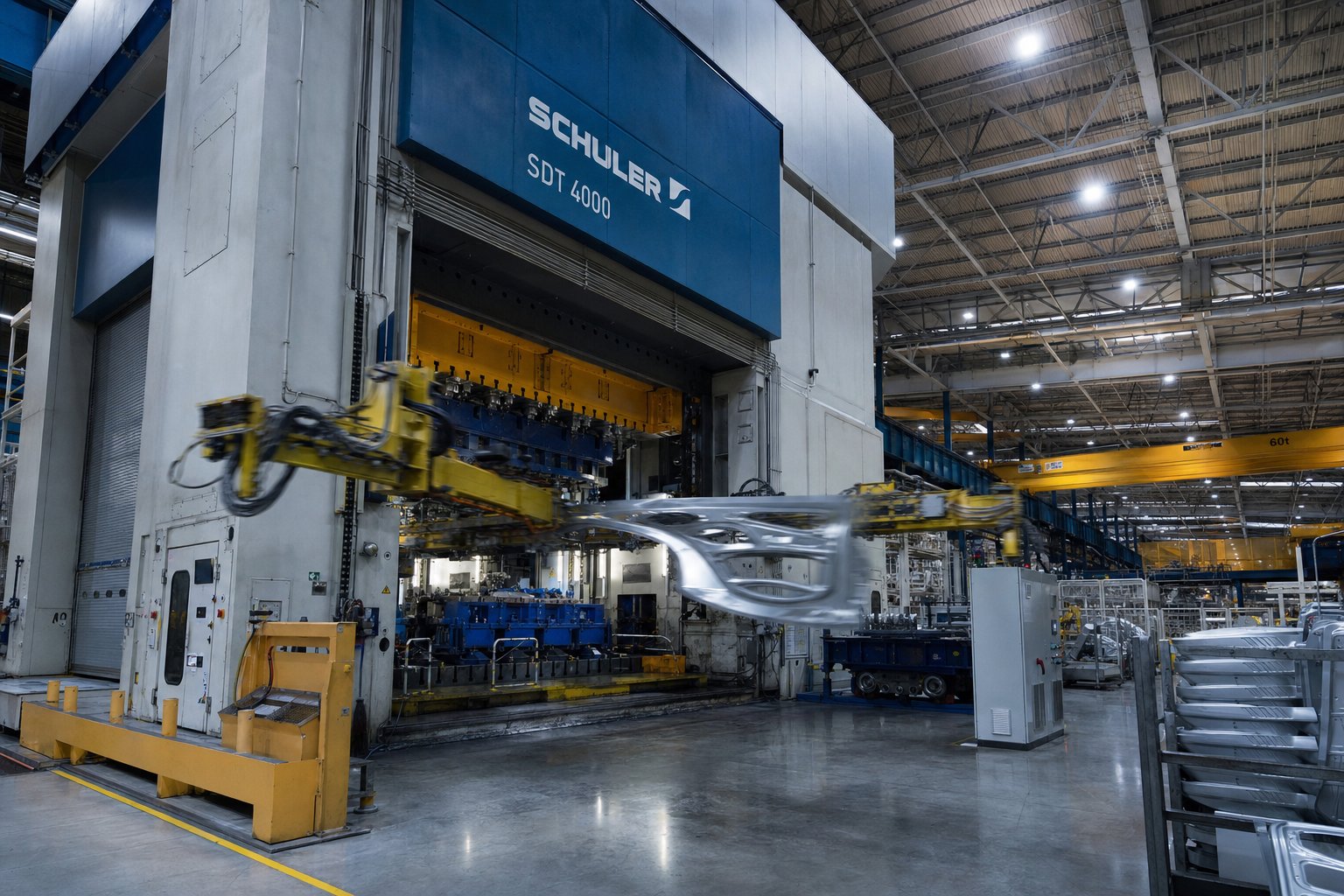
Regional Brand Landscape for Wing Panel Tooling
Geography is not just a logistics variable when sourcing wing panel dies. It shapes engineering culture, supply chain responsiveness, and even the tooling philosophy a brand brings to your program. A die builder embedded in Detroit's automotive corridor operates differently than one based in Stuttgart or Shanghai, and those differences surface quickly during tryout phases when your engineering team needs rapid iteration cycles.
The global automotive metal stamping market reflects this regional segmentation clearly. Asia-Pacific led with a 37.89% share in 2025, while North America maintains technology leadership through smart-factory upgrades, and Europe sustains an innovation edge in precision applications. For wing panel tooling specifically, each region brings distinct advantages that align differently depending on your production location, material strategy, and quality requirements.
North American Wing Panel Tooling Brands
The concentration of OEM engineering centers in Michigan, Ohio, and Ontario gives North American die builders a structural advantage for body panel programs: physical proximity. When a wing panel die needs adjustment during tryout, having your toolmaker within driving distance of your stamping plant saves weeks compared to shipping dies overseas for rework.
Auto parts manufacturers in USA markets tend to emphasize domestic supply chain compliance, Buy America provisions, and rapid engineering support. Many brands in this region built their reputations serving Ford, GM, and Stellantis body panel programs where just-in-time delivery and fast die maintenance response are contractual requirements. The reshoring trend has strengthened this advantage further, as OEMs increasingly prioritize supply chain resilience over pure cost optimization after post-pandemic disruptions exposed the risks of extended global tooling supply chains.
American auto parts manufacturers in the die-building segment also benefit from proximity to domestic steel mills and service centers, shortening the material procurement cycle for tryout blanks and production stock. For teams sourcing usa metal auto parts tooling, the ability to run collaborative tryouts with OEM die engineers physically present accelerates validation timelines significantly.
- Proximity to Detroit OEM engineering centers enables embedded collaboration during die development and tryout
- Domestic supply chain compliance (Buy America, USMCA content rules) simplifies procurement for North American production programs
- Faster die maintenance and emergency repair turnaround due to geographic closeness to stamping plants
- Strong talent pool of experienced tool-and-die makers, though an aging workforce creates medium-term supply constraints
European Precision Die Engineering Leaders
European die builders, particularly those based in Germany, Italy, and Spain, have historically set the benchmark for precision engineering on premium vehicle platforms. Brands like BMW, Mercedes-Benz, and Audi demand surface quality and dimensional tolerances that push tooling suppliers toward engineering excellence as a baseline rather than a premium option.
This ecosystem produces die brands with deep expertise in advanced simulation, multi-material forming (aluminum and AHSS), and surface coating technologies that extend die life on demanding exterior panel programs. European toolmakers often integrate IoT-driven process monitoring and AI-based predictive maintenance into their deliverables, reflecting the region's focus on Industry 4.0 capabilities.
However, the competitive landscape is shifting. As analysis from the Centre for European Reform highlights, China's rapid advancement into high-end manufacturing now challenges German engineering dominance across automotive supply chains, including tooling. European die brands maintain their edge in premium applications, but cost pressures and growing Asian capabilities are pushing some programs toward hybrid sourcing models where European engineering is paired with Asian fabrication.
- Deep expertise in aluminum and AHSS forming for premium vehicle platforms
- Advanced simulation and Industry 4.0 integration (digital twins, IoT monitoring) embedded in die programs
- Higher labor costs reflected in tooling prices, often justified by reduced rework cycles and longer die life
- Strong R&D heritage in surface treatment and coating technologies for Class A panel dies
Asian Brands and the Growing Quality Landscape
Asia-Pacific's dominance in automotive metal stamping volume translates into a large and rapidly maturing pool of die builders. Chinese, Japanese, and South Korean tooling brands serve distinctly different market positions. Japanese firms like those supplying Toyota and Honda body panels operate at world-class quality levels with decades of exterior panel expertise. Korean toolmakers have grown alongside Hyundai-Kia's global expansion, developing strong capabilities in high-strength steel forming.
Chinese die builders present the most dynamic picture. Competitive pricing, sometimes 50% below Western equivalents, draws attention from cost-sensitive programs. Quality certifications are growing rapidly, and investments like SMS group's galvanizing line installations in Guangzhou specifically target the surface quality standards required for Class A exterior panels. Car parts manufacturers in usa and European markets are increasingly encountering Chinese-built dies in competitive bids, particularly for programs where the OEM retains design ownership and outsources fabrication.
The trade-off remains real, though. Long-distance tooling supply introduces logistics risk, complicates tryout collaboration, and can extend modification lead times. Some procurement teams mitigate this by using Asian fabrication for initial die builds while maintaining domestic partners for ongoing maintenance, modification, and emergency support.
- Japanese and Korean brands offer proven OEM-level quality for exterior panels with strong process discipline
- Chinese suppliers provide significant cost advantages with rapidly improving quality certifications
- Distance complicates collaborative tryout and increases logistics risk for heavy die shipments
- Hybrid sourcing (Asian build, domestic maintenance) is emerging as a common risk-mitigation strategy
Reshoring trends and tariff policies continue to reshape these regional dynamics. Automotive parts manufacturers in usa are seeing renewed investment as OEMs hedge geopolitical risk by qualifying domestic and nearshore alternatives alongside Asian suppliers. The result for buyers evaluating wing panel die brands is a more complex but ultimately richer set of options, where the right choice depends on balancing cost, collaboration intensity, and supply chain risk tolerance against the specific demands of your fender program.
Regional strengths explain where brands are positioned. But what physically differentiates one wing panel die from another often comes down to something less visible: the materials and coatings used to build the die itself.
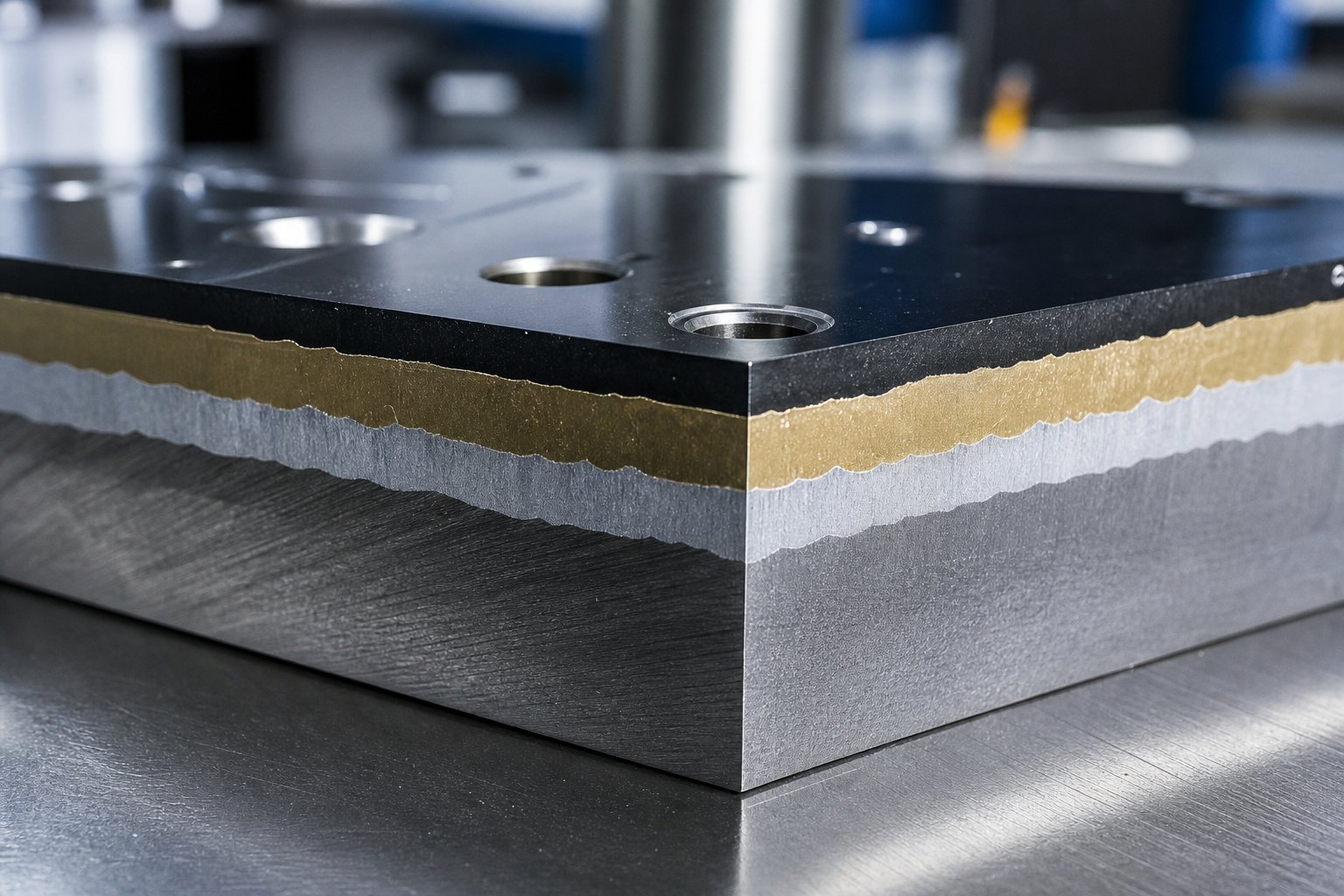
Die Materials and Coating Technologies That Set Brands Apart
Two wing panel dies can look identical on the outside and perform wildly differently over 500,000 press cycles. The difference is rarely visible until production problems surface: micro-pitting on draw radii, galling marks that telegraph through paint, or premature cracking at high-stress transitions. What separates long-lived steel stamping dies from tools that degrade early is the combination of base material selection and surface treatment engineering buried inside the tooling.
This is one area where car wing stamping die brands diverge sharply, yet buyers rarely dig into the specifics during supplier evaluation. The stamping die steel a manufacturer selects, combined with how they harden and coat forming surfaces, determines both die longevity and the quality of automotive metal stampings rolling off your press line.
Tool Steel Selection for Wing Panel Dies
Not all tool steels are interchangeable for exterior panel forming. Wing panel dies operate under high contact pressures across large surface areas, with draw radii experiencing severe friction and thermal cycling every stroke. The base material must balance three competing properties: hardness for wear resistance, toughness to prevent chipping and cracking, and machinability for achieving mirror-polish draw surfaces.
Common stamping die steel grades used in wing panel tooling include:
- AISI D2 (JIS SKD11) - A high-carbon, high-chromium cold work steel offering 58-62 HRC hardness and strong abrasive wear resistance. Widely used but increasingly limited for AHSS applications due to lower impact toughness.
- AISI A2 - An air-hardening steel with better toughness than D2, suitable for moderate production volumes under 1,000,000 strokes.
- AISI S7 - A shock-resistant grade (54-58 HRC) favored for forming operations where chipping resistance is critical, particularly at sharp draw radii.
- Powder metallurgy (PM) tool steels - Produced through atomization and hot isostatic pressing, PM grades offer finer, more evenly distributed carbides. This delivers a nearly 10x improvement in impact resistance over conventional D2 while maintaining equivalent hardness, making them the premium choice for wing panel dies processing high-strength materials.
Carbide inserts represent the extreme end of wear resistance, extending die life by 500-1000% compared to traditional tool steels in high-wear zones. For wing panels, carbide is typically used selectively at draw beads and wheel-arch radii rather than across entire forming surfaces, because its brittleness limits application in areas subject to complex loading.
Brands that differentiate on material technology often specify PM steels as standard for Class A panel tooling, while competitors default to conventional D2 and charge PM as an upcharge. That pricing model difference reflects a philosophical gap in how seriously a supplier treats metal stampings for automotive exterior surfaces.
Surface Coatings and Ion Nitriding Technologies
Even the best base steel benefits from surface enhancement. For wing panel dies producing automotive metal stamping parts at production volumes, surface treatments and coatings serve two functions: they reduce friction between die and sheet metal (preventing galling and surface scoring) and they dramatically extend the interval between maintenance polishing cycles.
The industry is shifting away from traditional chrome plating toward more durable alternatives. Ion nitriding has emerged as a preferred substrate treatment because it relies on diffusion of nitrogen into the steel surface, forming a metallurgical bond rather than a surface coating that can flake or microcrack. The process generates extreme hardness (above 58 HRC) at case depths ranging from 15 microns to 89 microns, depending on application requirements. Unlike chroming, ion nitriding preserves the ability to rework die surfaces during tryout without destroying the treatment.
At least one prominent stamping die brand has built competitive positioning around proprietary ion nitriding processes, optimizing temperature profiles and nitrogen atmospheres specifically for large-panel forming surfaces. This kind of process specialization is difficult to replicate and creates measurable performance differences in die life for wing panel applications.
Physical Vapor Deposition (PVD) coatings add another layer of protection on top of hardened or nitrided substrates. Common PVD chemistries include:
- Titanium nitride (TiN) - General-purpose wear coating
- Chromium nitride (CrN) - Low friction coefficient (0.5), good for aluminum forming
- Titanium aluminum nitride (TiAlN) - Superior heat resistance for high-speed production
PVD processing occurs at relatively low temperatures (around 750 degrees F), which avoids distortion of precision-machined die surfaces. This matters enormously for wing panel tooling where surface geometry is held to micron-level tolerances. Chemical Vapor Deposition (CVD) offers stronger metallurgical bonding but requires temperatures near 1925 degrees F, risking dimensional changes that can compromise Class A surface geometry. Several global automakers now specify PVD-only coating protocols for their exterior panel die programs precisely for this reason.
How Coating Choices Affect Die Longevity
The performance gap between coating strategies is not incremental. It is exponential. Research documented by AHSS Insights demonstrates that a chrome-plated tool steel failed after just 50,000 parts, while the same steel treated with ion nitriding and a PVD chromium nitride coating produced more than 1.2 million parts. That is a 24x difference in service life from the same substrate material.
For metal stampings for automotive components like wing panels, where each maintenance shutdown disrupts a high-volume production line, that difference translates directly into cost-per-part economics and plant uptime. The recommended practice for wing panel dies involves a layered approach: flame or induction hardening first to develop substrate strength, ion nitriding to create a hard diffusion layer, and then PVD coating as the final friction-reducing surface. This multi-step treatment maximizes both wear resistance and surface quality retention.
The table below compares common die material and coating combinations relevant to wing panel applications:
| Die Material / Coating | Typical Hardness | Impact on Die Lifespan | Surface Quality for Wing Panels | Best Application |
|---|---|---|---|---|
| D2 tool steel (uncoated) | 58-62 HRC | Baseline; may require regrind at 50,000-100,000 strokes with AHSS | Acceptable initially; degrades under high-contact-pressure zones | Low-volume or mild steel programs |
| D2 + ion nitriding | 58+ HRC surface | 2-5x improvement over uncoated; reduced friction and galling | Good; maintains polish longer between maintenance cycles | Medium-volume steel wing panels |
| D2 + ion nitriding + PVD (CrN) | 58+ HRC substrate, 70+ HRC coating | Up to 24x improvement over chrome plating; 1M+ strokes documented | Excellent; low friction preserves Class A draw surfaces | High-volume steel or galvanized programs |
| PM tool steel (uncoated) | 58-60 HRC | 10x impact resistance vs D2; resists chipping and cracking at sharp radii | Very good; fine carbide structure enables superior polishability | AHSS wing panels where chipping risk is high |
| PM tool steel + PVD (TiAlN) | 58-60 HRC substrate, high-hardness coating | Premium longevity; combines toughness with surface wear resistance | Excellent; best option for AHSS and aluminum fender production | High-volume AHSS or aluminum programs |
| Carbide inserts (selective) | 70+ HRC | 500-1000% improvement over tool steel in wear-critical zones | Excellent at draw beads; brittle, so limited to low-impact areas | Wheel-arch radii, draw beads on high-volume lines |
When you evaluate automotive metal stampings die suppliers, asking about their standard material and coating specification for Class A panel tooling reveals more about their capability than any marketing brochure. Brands that default to uncoated D2 for wing panel programs are engineering to a lower standard than those specifying nitrided PM steels with PVD as baseline. The upfront tooling cost difference is real, but it pales against the maintenance, downtime, and scrap costs that accumulate over a die's production life.
Material and coating choices ultimately tie back to economics. The upfront investment in advanced tool steels and multi-layer surface treatments only makes sense when evaluated against the total cost picture, which includes not just die purchase price but years of maintenance, refurbishment, and production uptime implications.
Quality Certifications and OEM Standards to Verify
Advanced tool steels and coatings mean little if a supplier's quality management system cannot maintain consistency across thousands of die builds. Certifications are the documented proof that a brand's internal processes, inspection protocols, and corrective action systems meet automotive-grade rigor. For wing panel tooling, where dimensional drift or surface degradation creates immediate visible defects, quality system discipline is not optional overhead. It is operational insurance.
Yet many buyers treat certifications as a checkbox exercise. They confirm the certificate exists, file it, and move on. That approach misses what certifications actually reveal about how a supplier controls variation in auto parts manufacturing processes, and whether their systems are structured for the specific demands of exterior body panel tooling.
IATF 16949 and ISO 9001 Certification Requirements
Two certifications form the foundation when evaluating automotive stamping press manufacturers and die builders:
- ISO 9001:2015 - The international baseline for quality management systems. It establishes requirements for documented processes, management responsibility, resource planning, and continuous improvement. Across the stamping die industry, ISO 9001:2015 functions as the minimum acceptable standard for any supplier claiming automotive capability.
- IATF 16949:2016 - Built on top of ISO 9001, this standard adds automotive-specific requirements including defect prevention, reduction of variation and waste in the supply chain, and customer-specific requirement management. IATF 16949 is maintained by the International Automotive Task Force and applies to any organization manufacturing components for supply to the automotive industry.
- ISO 14001:2015 - Environmental management certification increasingly required by European and Japanese OEMs as a supplier qualification criterion, particularly for programs involving aluminum processing or chemical surface treatments.
- Customer-Specific Requirements (CSRs) - Beyond standard certifications, individual OEMs layer additional requirements onto their approved suppliers. Ford, GM, Toyota, and others each maintain proprietary quality expectations that IATF 16949 alone does not cover.
The distinction between ISO 9001 and IATF 16949 matters more than most procurement teams appreciate. ISO 9001 confirms a supplier has a quality system. IATF 16949 confirms that system is designed for automotive parts manufacturing specifically, with emphasis on process capability tracking, FMEA discipline, and measurement system analysis that directly applies to maintaining Class A surface standards over extended production runs.
As PHB Corp's documentation of their IATF transition illustrates, IATF 16949 replaced the older ISO/TS 16949 standard and represents a more stringent quality framework emphasizing defect prevention and supply chain waste reduction. Suppliers that still reference TS 16949 rather than IATF 16949 may not have completed the mandatory transition, which is a red flag worth investigating.
What OEM Qualification Means for Die Brands
Holding IATF 16949 certification gets a die builder to the table. Earning OEM-qualified status is what puts them on the approved supplier list for exterior panel programs. These are different achievements, and the gap between them is significant.
OEM qualification means a brand has passed rigorous process audits conducted by the automaker's own quality and tooling engineers. For body panel tooling suppliers, these audits evaluate far more than paperwork. They examine tryout press capabilities, surface measurement equipment, dimensional inspection protocols, and the supplier's track record of delivering Class A dies that meet first-time-quality targets without excessive rework loops.
Why does this matter specifically for wing panel applications? Because exterior panels sit at the top of the quality pyramid in automotive metal stamping services. A supplier qualified to build structural or chassis dies has demonstrated process control for dimensional accuracy, but that alone does not prove they can maintain the surface-quality discipline required for painted fenders visible to every customer. OEM audits for exterior panel tooling suppliers typically include additional criteria around surface inspection methods, polishing capabilities, and coating process validation that lower-tier qualifications do not require.
When evaluating brands, ask specifically which OEM approved-supplier lists they appear on and for which panel categories. A supplier qualified for door inner panels is not automatically qualified for exterior wing panels. The distinction is granular but consequential, and it directly affects your program risk profile. Brands that have invested years building OEM-qualified status for automotive stamping press manufacturers and body panel programs carry significantly less qualification risk than those still working toward approval.
Certifications and OEM status tell you whether a brand's quality system can deliver consistency. They do not, however, tell you what the tooling will cost over its full production life, which requires a different kind of analysis entirely.
Total Cost of Ownership When Comparing Die Brands
A wing panel die quote showing a lower purchase price often hides costs that surface months or years into production. Stamping car parts at high volumes means the die operates under continuous stress, and any shortfall in design robustness, material selection, or engineering support translates into unplanned maintenance, scrap, and line downtime. The purchase order is just the opening chapter of a much longer cost story.
When you compare car wing stamping die brands on total cost of ownership rather than sticker price alone, the ranking can shift dramatically. A die costing 15-20% more upfront but delivering twice the maintenance interval and fewer tryout rework loops often wins on lifetime economics.
Beyond Purchase Price and Understanding Total Die Cost
Think of total die cost as a stack of expenses that accumulates from the moment you issue a purchase order through the final production stroke years later. Most RFQs capture only the top layer. Here are the cost components buyers should factor into every brand comparison:
- Initial die purchase price - Design, engineering, material, machining, assembly, and first tryout included in the supplier quote.
- Tryout and validation iterations - Additional rework loops beyond the contracted number, including press time, engineering hours, and blank material consumed.
- Transportation and logistics - Shipping heavy transfer dies internationally versus sourcing from a regional stamping die factory adds substantial freight and lead-time cost.
- Scheduled maintenance - Planned polishing, regrinding, insert replacement, and coating renewal at prescribed stroke intervals.
- Unplanned repairs - Reactive fixes for cracking, galling damage, or surface degradation that interrupt production schedules.
- Refurbishment and mid-life overhaul - Major rebuilds at the die's halfway point to restore original tolerances and surface quality.
- Production scrap attributable to die condition - Panels rejected for surface defects, dimensional drift, or burr caused by worn tooling.
- Downtime cost during maintenance events - Lost production time on the press line while the die is out of service.
- Engineering support during production - Ongoing technical assistance from the die brand for process optimization, ECN changes, or material grade transitions.
For custom automotive metal stamping programs producing metal stamping car parts at volumes exceeding 100,000 units annually, items four through eight often dwarf the initial purchase price over a die's full lifecycle.
Maintenance Programs and Refurbishment Services
How a brand supports die maintenance after delivery separates true partners from transactional suppliers. Industry analysis from MetalForming Magazine identifies four distinct maintenance tiers: reactive (firefighting after failure), preventive (time-based scheduled service), predictive (data-driven condition monitoring), and proactive (root-cause elimination before problems occur). Most organizations unknowingly operate at the reactive level, where actual costs remain hidden because repair work gets lumped together with planned maintenance in cost tracking.
The financial logic is counterintuitive: management should expect die maintenance costs to increase over time if the program is working correctly. Higher investment in preventive and predictive maintenance reduces catastrophic failures and unplanned downtime, which carry far greater cost. Brands that offer structured maintenance programs, predictive monitoring integration, or refurbishment services aligned to specific stroke milestones help you shift from reactive firefighting to planned upkeep, cutting total lifecycle cost even as maintenance spend rises.
For wing panel dies specifically, scheduled surface polishing and coating renewal at defined intervals preserve Class A quality without waiting for reject panels to signal that the die has degraded. Ask prospective suppliers whether they offer maintenance contracts, recommended service intervals, and on-site refurbishment support.
Tryout Validation and Engineering Support Value
The tryout phase is where total cost of ownership either locks in or spirals. Every additional rework loop during die validation adds engineering hours, press time, blank material, and weeks of schedule delay. As MetalForming Magazine's analysis of die-design validation emphasizes, stamping processes succeed or fail based on the suitability of the die design, and validating that design only after the tool is built does not represent sound engineering practice. Brands that invest in upfront simulation and virtual tryout catch design shortfalls before cutting steel, compressing physical tryout to one or two loops rather than five or six.
Engineering support during tryout directly affects how quickly a wing panel die reaches production-ready status. Full-service brands embed their engineers at your tryout press, making real-time adjustments to draw beads, blank holder pressures, and binder geometry. Transactional suppliers ship the die and wait for you to report problems. The difference in time-to-production for a custom automotive metal stamping program can be four to eight weeks, which translates into delayed launch revenue and overtime costs at downstream assembly operations.
Ongoing engineering support after production launch carries similar value. When material batches shift, ECN changes alter panel geometry, or production rates increase, having your die brand available for rapid process consultation prevents small issues from compounding into costly line stoppages. This sustained partnership dimension rarely appears in RFQ pricing but frequently determines which brands deliver the best long-term ROI on wing panel tooling investments.
Cost analysis tells you what a die brand will demand from your budget over time. The remaining question is more practical: how do you structure your evaluation process to surface these differences before signing a purchase order?
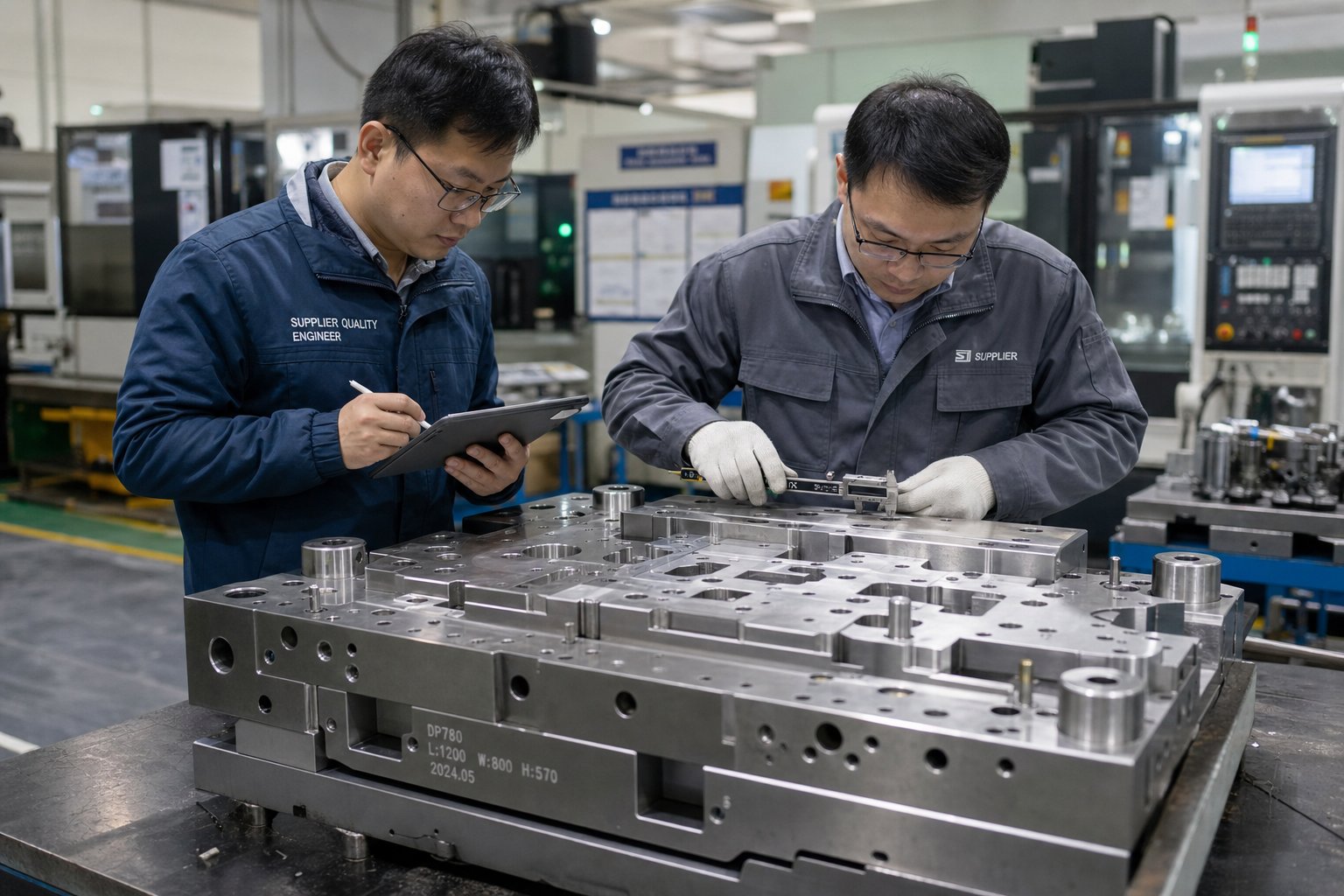
How to Evaluate and Partner With the Right Die Brand
You have the selection criteria, the regional landscape, and the cost framework. The remaining challenge is execution: turning that knowledge into a repeatable evaluation process that surfaces the right stamping die supplier before you commit capital to a wing panel program. Procurement teams that skip structured evaluation often discover capability gaps only during tryout, when the cost of switching is highest.
The steps below give you a practical sequence from initial RFQ through long-term partnership development. Each step builds on the previous one, narrowing your shortlist based on evidence rather than assumptions.
Structuring Your RFQ for Wing Panel Die Projects
A vague RFQ produces vague quotes. For wing panel tooling, your request package needs to communicate the full scope of forming complexity so that each car parts manufacturer responding can price realistically rather than optimistically. Industry best practice confirms that incomplete documentation is the most common cause of inaccurate quotes and downstream cost surprises.
- Include complete technical documentation - Provide 3D CAD data, 2D drawings with GD&T callouts, material specifications, surface finish requirements, and any OEM-specific quality standards. For wing panels, explicitly define which surfaces are Class A and specify acceptable waviness thresholds.
- Define production volumes and ramp expectations - State prototype quantities, initial production volumes, estimated annual usage, and long-term forecasts. A die engineered for 50,000 annual parts differs fundamentally from one targeting 300,000, and pricing reflects that gap.
- Specify material grade and supplier - Identify the exact steel or aluminum grade, thickness, and whether you mandate a specific coil supplier. Material batch variation directly affects wing panel forming, so this detail shapes die engineering decisions.
- Communicate timeline milestones - Include target dates for design review, first tryout, final validation, and production start. Realistic timelines help suppliers plan resources and flag scheduling conflicts early.
- Request detailed maintenance and support terms - Ask each auto parts manufacturer to specify recommended service intervals, maintenance scope, refurbishment pricing, and engineering support availability after delivery.
- Define die ownership and storage terms clearly - Confirm in writing who owns the tooling at program end, what storage conditions apply for inactive dies, and whether the supplier commits to supporting engineering changes throughout the program lifecycle.
Capability Audits and Sample Part Trials
Quotes tell you what a supplier claims. Site audits and sample trials show you what they can actually deliver. Structured evaluation frameworks recommend conducting on-site audits before program award, verifying quality systems, equipment condition, traceability practices, and tooling infrastructure firsthand.
During a capability audit for wing panel die suppliers, focus on these areas:
- Tryout press tonnage and transfer system compatibility with your production setup
- In-house toolroom with active die maintenance logs and dedicated toolmakers (not contract labor)
- Surface measurement and inspection equipment (CMM, optical scanners, surface roughness testers)
- Active SPC on press lines and documented corrective action history
- Forming simulation software and evidence of virtual tryout integration into their standard workflow
Sample part trials add another layer of verification. Request that shortlisted suppliers produce trial panels from representative material using their tryout press. Evaluate surface quality under inspection lighting, measure dimensional conformance against GD&T requirements, and assess how many tryout iterations were needed to reach acceptable quality. A supplier that reaches Class A surface standards in two loops demonstrates fundamentally different capability than one requiring five.
For teams evaluating wing panel stamping capabilities across multiple candidates, reviewing real-world automotive stamping case studies helps contextualize supplier claims. YICHEN, for example, supports OEM, Tier-1, and Tier-2 engineering teams with stamping and sheet metal fabrication process case studies covering structural, interior, chassis, and truck-related metal parts, providing a useful reference point when benchmarking supplier experience across panel categories.
Building Long-Term Stamping Die Partnerships
Wing panel die programs are not one-time transactions. They span years of production, model-year updates, material changes, and volume fluctuations. The best outcomes come from treating your die brand as a long-term partner rather than a commodity vendor. Car parts manufacturers and aftermarket auto parts manufacturers alike benefit from this partnership approach because it builds institutional knowledge that compounds across programs.
Characteristics of strong long-term die partnerships include:
- Dedicated engineering contacts assigned to your account who understand your press environment and quality expectations
- Early DFM collaboration on new programs before designs are frozen, allowing the die builder to flag formability risks and suggest geometry refinements
- Transparent maintenance data sharing so both parties can track die condition trends and plan interventions proactively
- Flexible capacity allocation that accommodates volume changes without forcing complete re-quoting
- Continuous improvement initiatives where the supplier actively proposes process optimizations based on production data
Automotive aftermarket parts manufacturers increasingly adopt the same partnership model for replacement panel tooling, recognizing that die quality directly impacts their ability to match OEM fit-and-finish standards in a competitive aftermarket.
The evaluation process outlined here moves you from general market awareness to a defensible supplier decision backed by documented evidence. Apply the structured criteria from earlier sections as your scoring framework, weight categories based on your program's specific priorities, and let audit findings and trial results drive the final selection rather than price alone. That discipline is what separates procurement teams that consistently land reliable wing panel tooling partners from those that discover capability gaps only after the purchase order is signed.
Frequently Asked Questions About Car Wing Stamping Die Brands
1. What is a car wing stamping die and how does it differ from other automotive stamping dies?
A car wing stamping die is a Class A precision tool specifically engineered to draw, trim, and form automotive fender panels from flat sheet metal. Unlike dies used for brackets or structural members, wing panel dies must handle deep draw ratios around the wheel arch, compound curvature that changes direction across the surface, and strict Class A finish requirements where any surface imperfection shows through paint. These combined challenges make wing panel tooling a specialized segment requiring brands with proven exterior body panel expertise rather than general stamping capability.
2. What certifications should a car wing stamping die supplier have?
At minimum, suppliers should hold ISO 9001:2015 certification as the baseline quality management standard. For automotive-specific programs, IATF 16949:2016 is essential because it adds defect prevention, variation reduction, and customer-specific requirement management tailored to automotive supply chains. Beyond certifications, OEM-qualified status matters most for wing panels. This means the supplier has passed rigorous process audits by automakers evaluating tryout press capabilities, surface measurement equipment, and Class A polishing protocols. Always verify which specific OEM approved-supplier lists a brand appears on and for which panel categories.
3. How do die materials and coatings affect wing panel stamping die performance?
Base material and surface treatment choices create exponential differences in die lifespan and part quality. Conventional D2 tool steel with chrome plating may fail after 50,000 parts, while the same steel treated with ion nitriding plus PVD chromium nitride coating can produce over 1.2 million parts. Powder metallurgy tool steels offer roughly 10x better impact resistance than conventional D2, reducing chipping at sharp draw radii. For wing panels processing AHSS or aluminum, layered treatments combining flame hardening, ion nitriding, and PVD coating maximize both wear resistance and Class A surface retention across high-volume production runs.
4. What is the total cost of ownership for a wing panel stamping die?
Total cost extends far beyond the purchase price and includes tryout validation iterations, scheduled maintenance such as polishing and coating renewal, unplanned repairs, mid-life refurbishment, production scrap from die degradation, press line downtime during service events, and ongoing engineering support. For programs exceeding 100,000 annual units, maintenance and downtime costs often dwarf the initial purchase price over the die's lifecycle. A die costing 15-20% more upfront but delivering twice the maintenance interval and fewer tryout rework loops typically wins on lifetime economics when all cost layers are factored in.
5. Should I choose a regional or overseas supplier for wing panel stamping dies?
The decision depends on balancing cost, collaboration intensity, and supply chain risk. North American suppliers offer proximity to OEM engineering centers, faster tryout iteration, and domestic compliance advantages. European brands excel in precision engineering for premium platforms and advanced AHSS and aluminum forming. Asian suppliers provide significant cost advantages with Japanese and Korean firms operating at world-class quality, while Chinese builders offer competitive pricing with rapidly improving certifications. Many teams now use hybrid sourcing with overseas fabrication for initial builds and domestic partners for maintenance and emergency support to balance cost with responsiveness.


