


What Is a Car Wing Stamping Die and Why It Costs What It Does
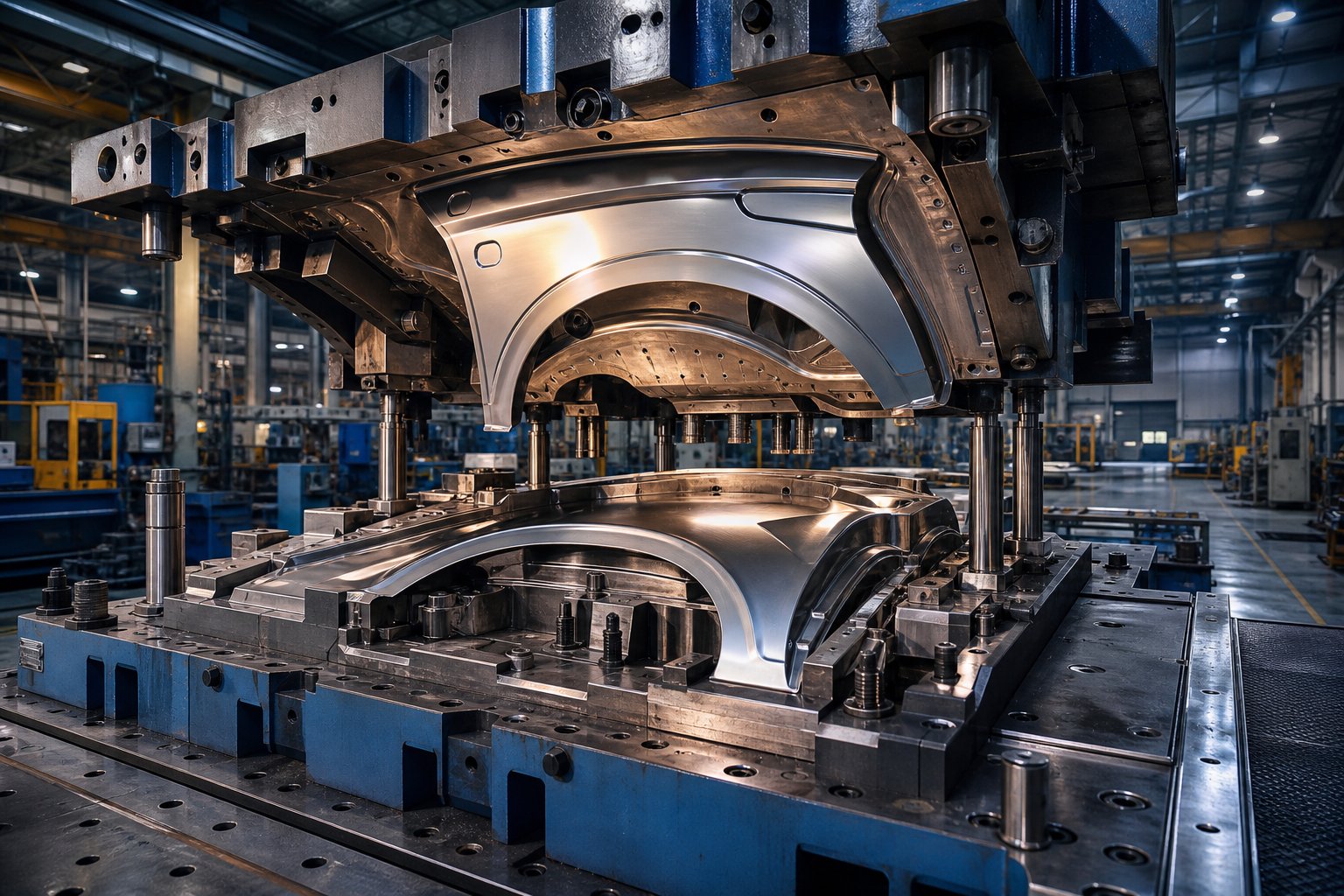
When you search for a discount car wing stamping die, you need to know exactly what you are buying before you can evaluate whether the price is fair. A car wing, called a fender in North American English, is the body panel that arches over the front or rear wheel. Forming that panel from flat sheet metal requires a specialized metal stamping die capable of producing compound curves, sharp feature lines, and precise edge flanges in a single press stroke or a tightly sequenced set of operations.
A car wing stamping die is a precision tool consisting of matched upper and lower steel components that cut, draw, and form flat sheet metal into the three-dimensional fender panel of a vehicle, meeting Class A surface finish and body-gap dimensional standards.
What Makes a Car Wing Stamping Die Unique
Unlike stamping dies used for flat brackets or structural reinforcements, a fender die must manage deep draw depths, stretch forming over convex surfaces, and tight radii transitions all at once. The complex geometry means the die stamp surfaces require mirror-quality machining, and even minor deviations produce visible waviness on the finished panel. This is why automotive stamping dies for body panels cost significantly more than stamper dies built for hidden structural parts.
Key Functions in Automotive Body Panel Production
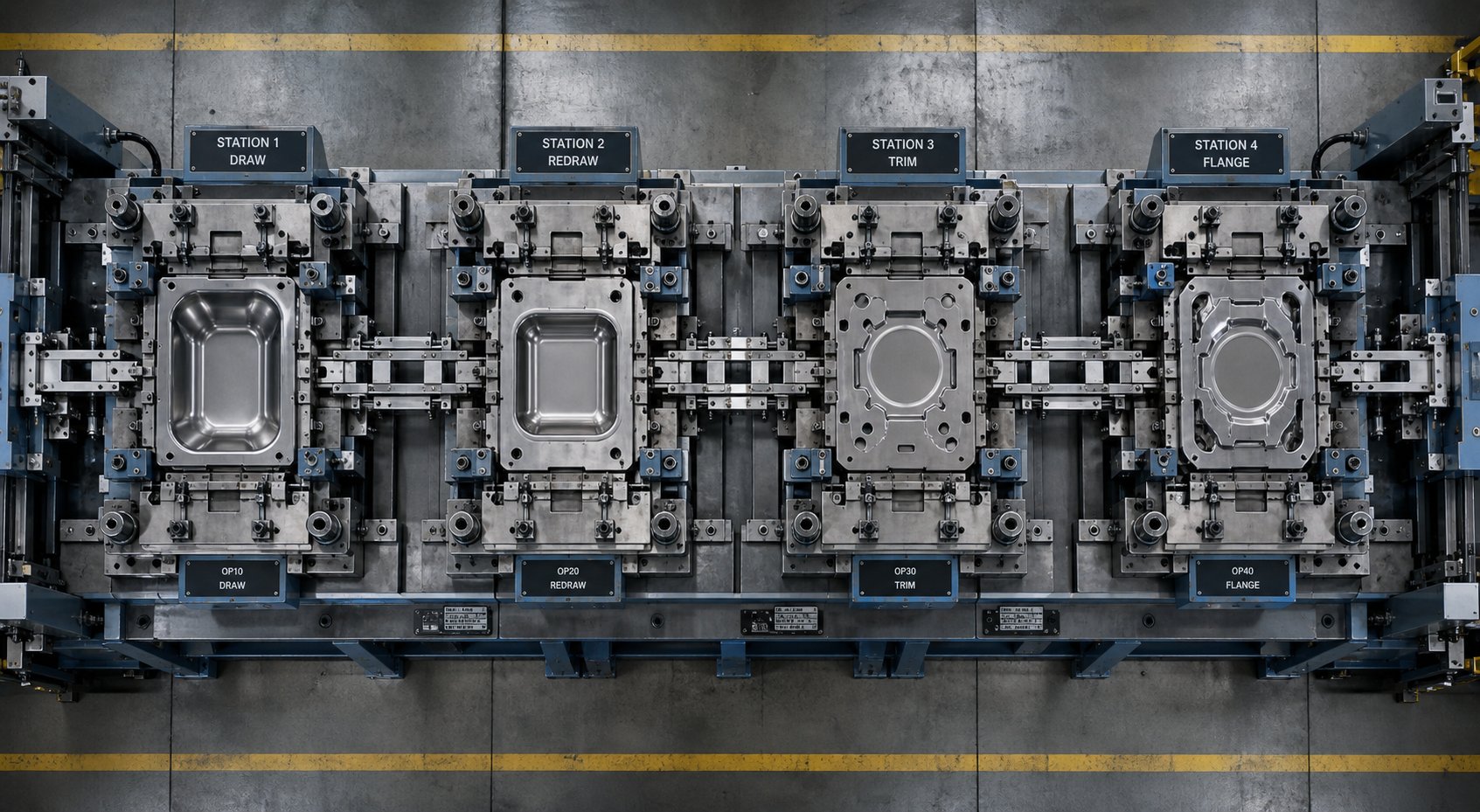
A complete wing die set typically performs drawing, trimming, flanging, and restrike operations. Drawing forms the basic shape, trimming removes excess material, and flanging bends edges to create attachment surfaces where the panel bolts to the vehicle body. Each station in the process adds cost to the overall tooling package.
A quick terminology note: in industry literature you will see the terms stamping molds, die stamps, and even injection molds used loosely. Stamping molds and stamping dies refer to the same sheet metal tooling. A mold, strictly speaking, shapes liquid or molten material, while a metal stamping die shapes solid sheet metal under press force. Knowing this distinction helps you avoid confusion when comparing quotes from different suppliers offering discount tooling.
The technical demands behind these dies, from draw depth to surface finish tolerances, are what build up the price tag and determine where legitimate savings can be found.
Technical Requirements That Drive Car Wing Die Pricing
Every discount on metal stamping dies has a floor, a point below which the tooling simply cannot produce an acceptable car wing panel. Understanding where that floor sits helps you separate real savings from corners being cut. Three technical demands set the baseline: draw depth, surface finish grade, and dimensional tolerance for body fitment.
Draw Depth and Forming Complexity for Fender Geometry
Imagine pulling a flat steel blank over a punch that forces it into a cavity shaped like a wheel arch. The metal stretches, compresses, and flows simultaneously across compound curves. A typical car wing panel requires draw depths between 150 mm and 250 mm, with some sculpted designs pushing past 300 mm. That depth, combined with tight radii at the wheel opening and feature lines running along the body side, means the sheet metal stamping dies must control material flow precisely at every point.
For context, a simple structural bracket might only need 20 to 40 mm of draw depth with minimal curvature. The forming forces, blank holder pressure calibration, and number of draw stations all scale with depth. A deeper draw requires more robust custom metal stamping dies with larger press tonnage, tighter radii control, and often additional restrike operations to hit final geometry. Each of those factors adds cost to the metal stamping tool.
Surface Finish and Dimensional Standards for Body Panels
Car wing panels are Class A surfaces, meaning they are visible to the customer after painting. According to metrology standards for automotive manufacturing, Class A surfaces must be flawlessly smooth, continuous, and free of any imperfection detectable by the naked eye. They also serve structural and aerodynamic roles, so the quality requirement is non-negotiable regardless of price point.
Dimensional tolerances for body panels are equally strict. A J.D. Power survey found that 41% of automotive quality issues trace back to geometric quality defects. Panel-to-panel gaps on a finished vehicle typically hold to +/- 0.5 mm, which means the stamped fender itself must be accurate to tighter values to account for assembly stack-up. Non-visible parts like brackets or reinforcements can run at +/- 1.0 mm or wider without consequence.
| Parameter | Car Wing (Fender) Panel | Structural Bracket / Reinforcement |
|---|---|---|
| Draw Depth | 150 - 300 mm | 20 - 40 mm |
| Surface Finish Grade | Class A (visible, paint-ready) | Class C / D (hidden, functional only) |
| Dimensional Tolerance | +/- 0.3 to +/- 0.5 mm | +/- 0.8 to +/- 1.5 mm |
| Typical Number of Die Stations | 4 - 6 (draw, trim, flange, restrike) | 1 - 3 (blank, form, pierce) |
| Surface Roughness (Ra) | 0.4 - 0.8 micrometers | 1.6 - 3.2 micrometers |
Here is what this comparison tells you as a buyer: draw depth, surface finish, and core dimensional tolerances on mating edges are non-negotiable specs. Any discount car wing stamping die still has to hit these numbers or the panel will show waviness after painting, gaps will look uneven at assembly, or the part will not bolt up correctly. The negotiable areas tend to be tolerances on hidden flanges, internal stiffener geometries, and areas covered by trim pieces or adjacent panels. Knowing which specs you can relax and which you cannot is the first step toward working with a die supplier on a cost-reduced quotation that still produces production-worthy parts.
The type of die configuration you choose, whether progressive, transfer, or tandem line, multiplies or moderates these cost drivers significantly.
Die Types Used in Car Wing Panel Stamping
Die configuration is one of the first cost commitments you make, often before a single block of steel is cut. The choice between a progressive die, a transfer die, or a tandem line setup determines how many stations you need, how complex each stamp and die pair becomes, and ultimately how much room exists to pursue a discount path. For car wing panels specifically, part size and forming depth narrow the options quickly.
Progressive Dies for Smaller Wing Panel Variants
Progressive dies feed a coil strip through multiple stations mounted on a single common stamping die set. Each press stroke advances the strip one pitch distance, performing a different operation at each station, from blanking die cuts through forming and trimming. They run fast, often 60 to 100-plus strokes per minute, and need minimal labor since the coil feeder automates material handling.
Sounds ideal, right? The catch is size. Progressive dies work best for small-to-medium parts that remain attached to the strip carrier throughout forming. A full-size front fender panel is simply too large and too deep-drawn to stay connected to a coil strip through multiple stations. However, smaller wing panel variants, like quarter panel extensions or partial wheel arch sections used in aftermarket kits, can sometimes fit a progressive configuration. When they do, the die stamping cost drops substantially because everything lives in one tool on one press.
Transfer and Tandem Line Dies for Full-Size Fenders
Full-size car wing panels almost always require transfer dies or tandem line dies. In a transfer die setup, individual blanks move between stations within a single press via mechanical rails or servo-driven fingers. Each station handles one operation: draw, trim, flange, or pierce. The part travels freely, which allows deep drawing and rotation between stations, both critical for fender geometry.
Tandem line dies take a different approach. Each operation sits in its own dedicated press, and parts transfer between presses by robot or conveyor. This arrangement offers flexibility since you can maintain one station without pulling the entire custom metal stamping die package offline. However, it requires multiple presses and more floor space.
From a dies and stamping cost perspective, transfer and tandem line configurations typically start around $100,000 for a single station and can push a complete fender line well past $500,000 to $1,000,000 when all draw, trim, and flange operations are included. The table below puts these differences side by side.
| Die Type | Typical Stations | Relative Cost Range | Best-Fit Volume | Discount Sourcing Viability |
|---|---|---|---|---|
| Progressive Die | 5 - 15 | $15,000 - $60,000 | 50,000+ parts/year | High (simpler build, single tool) |
| Transfer Die | 4 - 6 | $250,000 - $750,000+ | 20,000 - 500,000+ parts/year | Moderate (savings via station reduction or material grade) |
| Tandem Line Dies | 4 - 7 (separate presses) | $500,000 - $1,000,000+ | 100,000+ parts/year | Lower (high baseline complexity) |
The key takeaway for procurement teams: if your part geometry allows a progressive stamping die set, you are already on the most cost-effective path. For full-size fender panels that demand transfer or tandem line dies, discount opportunities shift away from configuration choice and toward material selection, station count reduction, and sourcing strategy. Those levers operate within the die lifecycle itself, from initial CAD design through final tryout approval.
Die Lifecycle Stages and Where Cost Savings Originate
Every dollar in a die quotation traces back to a specific stage in the build process. Yet most suppliers hand you a lump-sum price without breaking down where the money goes. When you understand how cost accumulates step by step, you can pinpoint exactly where a discount car wing stamping die sheds expense, and whether those reductions threaten part quality or simply reflect smarter process choices.
From CAD Design Through Final Tryout Approval
A car wing die moves through a predictable sequence. Each phase consumes engineering hours, machine time, or material, and each one offers a different degree of flexibility on price. Here is the full lifecycle laid out sequentially with notes on how each stage impacts total cost:
- Product data and DFM review - Engineers analyze the fender CAD model for manufacturability. Cost impact is low in absolute dollars (typically 3 to 5 percent of the total), but decisions made here cascade through every downstream stage. A geometry change at this point costs almost nothing; the same change after machining can cost tens of thousands.
- Die face design and process planning - Stamping die components are laid out: draw ring geometry, trim steel profiles, blank holder contours, and flange station tooling. This stage determines the number of operations and press requirements. It represents roughly 10 to 15 percent of tooling cost.
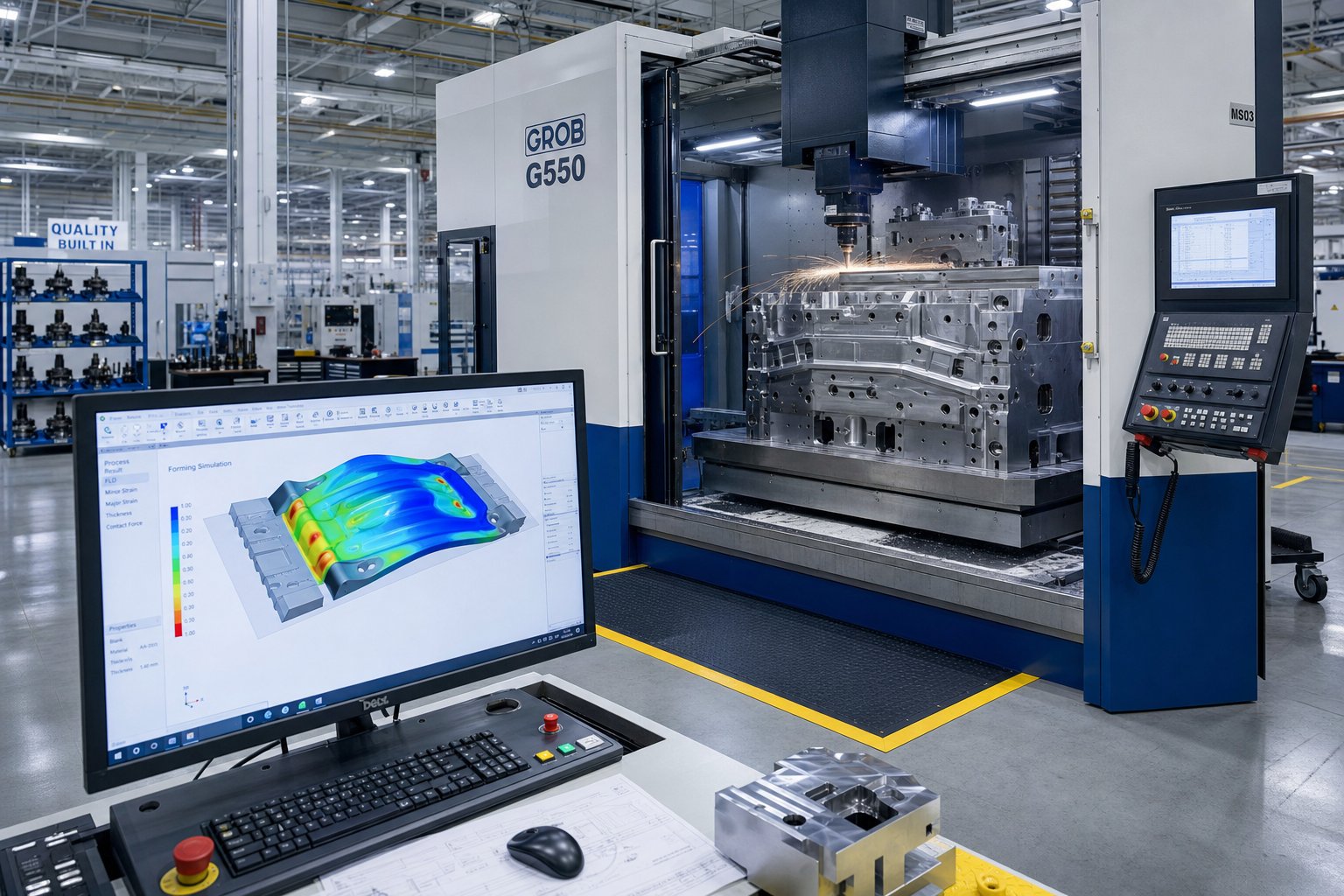
- CAE simulation and virtual tryout - Forming simulation software predicts cracks, wrinkles, thinning, and springback before any metal is cut. Keysight's stamping simulation research shows that each physical tryout iteration can cost upward of $30,000 to correct. Reducing these loops through simulation directly lowers final price.
- Casting or rough machining of die blocks - Raw die blocks are either cast from iron alloys or rough-machined from forged steel billets. Material cost at this stage can range from 20 to 30 percent of the total die and stamping investment, making it a primary target for discount strategies through grade substitution.
- Precision CNC machining and EDM - Die surfaces are finish-machined to final geometry. Labor and machine-hour rates here are the single largest cost driver, often 30 to 40 percent of the total. Sourcing this work from regions with lower machining labor rates is a common path to reduced pricing.
- Heat treatment and surface finishing - Critical wear surfaces on punches, trim steels, and draw rings undergo hardening and coating. Cost is moderate (5 to 10 percent) but directly affects die life.
- Physical tryout and correction loops - The finished die runs on a press with production-grade sheet metal. Engineers measure panel accuracy, springback, and surface quality, then hand-correct or re-machine problem areas. Each correction loop adds cost. Well-simulated dies often pass in one or two loops; poorly planned tools may need four or five.
- Final approval and production release - Dimensional reports, CPK validation, and sign-off documentation close the project. Administrative cost is small, but delays here hold up production start dates.
Where Discount Opportunities Actually Emerge
With the lifecycle mapped, you can see that legitimate discounts on metal stamping tooling do not appear from thin air. They originate in four specific areas:
- Design simplification (stages 1-2) - Reducing forming stations from five to four, or combining a trim and flange operation into one station, cuts machining volume and die steel weight. For a custom metal stamp die serving an aftermarket fender, relaxing hidden-flange tolerances can eliminate an entire restrike station.
- Material substitution (stage 4) - Choosing a cast iron die block over a forged tool steel block for low-wear areas like blank holders saves 15 to 25 percent on raw material. The die metal stamping surface still performs, especially when paired with targeted surface treatments at stage 6.
- Simulation-driven tryout reduction (stages 3 and 7) - Investing more in virtual validation upfront cuts physical tryout loops. Since each loop can run $30,000 or more in press time, labor, and re-machining, dropping from four iterations to two represents a $60,000 saving on a complex fender die.
- Regional labor cost advantage (stage 5) - CNC machining is the most labor-intensive stage. Sourcing finish machining in regions where skilled die maker rates are 40 to 60 percent lower directly reduces the largest single cost block without changing design or material specs.
The critical insight here is that none of these strategies require you to accept a worse part. They shift cost out of the process without dropping below the quality floor defined by your Class A surface and dimensional tolerance requirements. A supplier quoting die metal stamping work at a discount should be able to point to one or more of these mechanisms. If they cannot explain where the savings come from, that is a red flag worth investigating.
Among these levers, material choice deserves deeper attention. The tool steel grade selected for each stamping die component, from the draw punch to the trim edges, creates the widest cost variation that buyers can directly influence at the quoting stage.
Tool Steel Grades and How Material Choice Creates Discounts
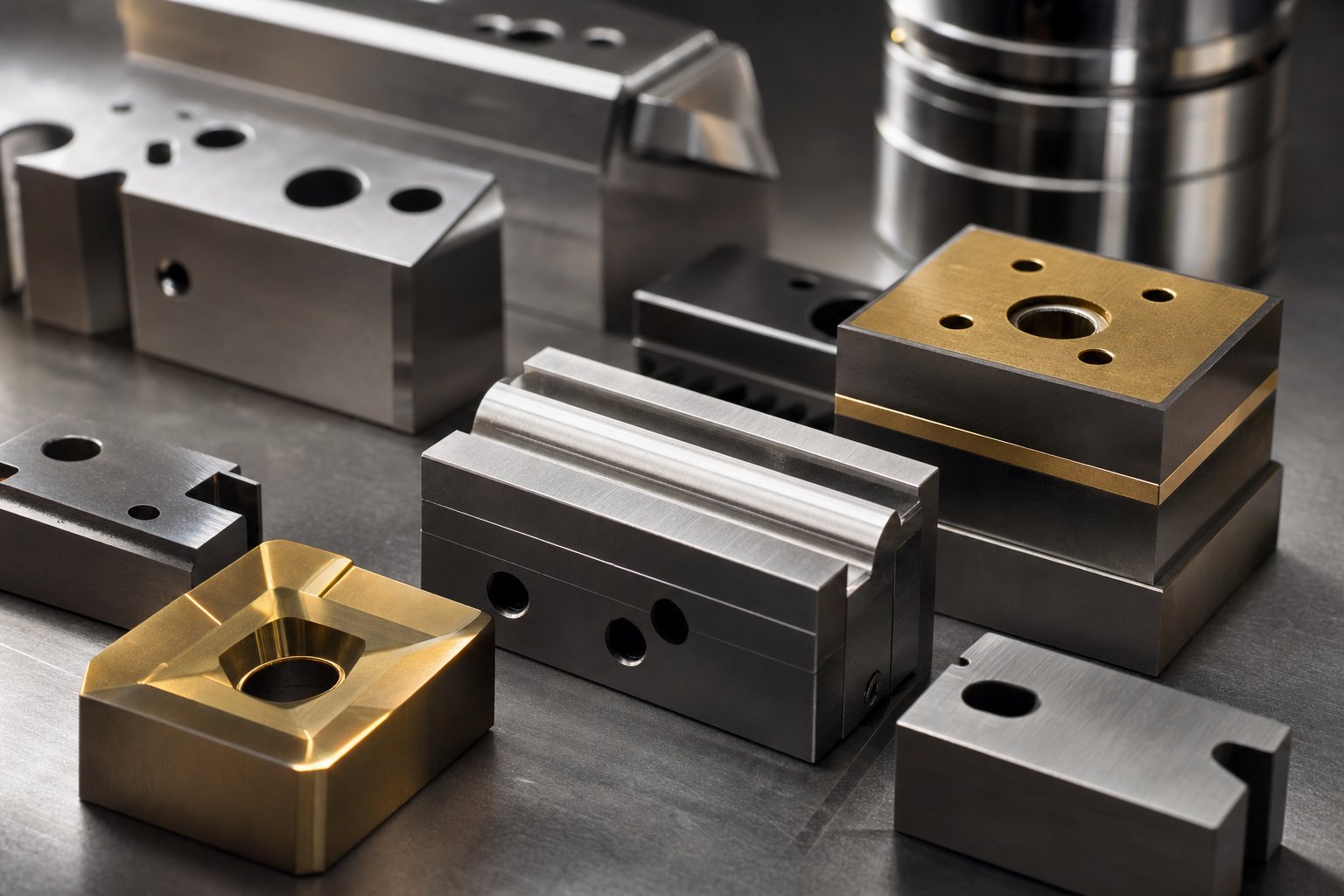
Tool steel can account for 20 to 30 percent of a complete metal die set cost, and different grades carry price tags that vary by a factor of three or more. That spread is where many legitimate discount car wing stamping die offerings originate. A supplier choosing one grade over another is not necessarily cutting corners. They may be matching the steel to the actual wear conditions at each station rather than specifying a premium alloy everywhere out of habit.
Common Tool Steel Grades for Automotive Fender Dies
Steel stamping dies for automotive body panels typically draw from a well-established family of cold work and high-speed tool steels. Each grade balances three competing properties: toughness, wear resistance, and compressive strength. Increasing one often reduces another, so grade selection depends on where the steel sits inside the die.
Draw stations need toughness above all else. The draw punch and ring endure repeated high-tonnage impacts as they form the fender's compound curves. Grades like D2 (high carbon, high chromium at roughly 61 HRC) offer good wear resistance with moderate toughness, making them a common baseline for stamping die steel in automotive work. For higher-impact draw rings, S7 at approximately 57 HRC delivers superior shock resistance, which matters when forming deep wheel-arch geometry.
Trim and flange stations face a different challenge. Cutting edges contact the sheet metal at high velocity and must resist abrasive wear without chipping. Here, M2 high-speed steel (62 HRC) or powder metallurgy grades like PM M4 provide excellent edge retention. Carbide stamping dies, using tungsten carbide inserts at the most severe wear points, push die life even further but at a premium price point.
The table below compares the grades you will commonly see quoted in steel stamping tools for fender dies:
| Steel Grade | Typical Hardness (HRC) | Relative Material Cost | Expected Die Life (Hits) | Best Application in Wing Die |
|---|---|---|---|---|
| S7 | 54 - 57 | Low | 200,000 - 400,000 | Draw punch, draw ring (high impact) |
| A2 | 58 - 62 | Low - Medium | 300,000 - 500,000 | Blank holders, moderate-wear forming |
| D2 | 58 - 61 | Medium | 400,000 - 700,000 | Trim steels, flanging inserts |
| M2 | 60 - 62 | Medium - High | 600,000 - 1,000,000 | High-wear trim edges, pierce punches |
| PM M4 (PS4) | 60 - 62 | High | 800,000 - 1,500,000 | Severe-wear trim and flange inserts |
| Tungsten Carbide (inserts) | 75+ (HRA scale) | Very High | 1,500,000 - 3,000,000+ | High-volume trim edges, pierce punches |
Notice the pattern: as you move up the table, cost rises and die life extends. A buyer seeking a discount car wing stamping die can target the lower-cost grades for stations where wear rates are manageable, reserving premium steels only for critical trim edges. This selective approach to a metal die set can reduce material cost by 30 to 50 percent versus specifying D2 or M2 across the board.
Surface Treatments That Offset Lower Material Costs
Here is where the economics get interesting. A lower-cost base steel paired with the right surface treatment can approach the die life of a more expensive untreated grade at a fraction of the price.
Three coating families dominate automotive stamping die steel applications:
- PVD coatings (TiN, TiAlN, CrN) - Applied at relatively low temperatures (around 200 to 500 degrees C), PVD avoids distortion risk. Research from AHSS Insights shows that a PVD-applied TiAlN coating on cutting steel produces significantly cleaner edges after 200,000 parts compared to uncoated tools. Several global automakers specify PVD exclusively because it preserves dimensional accuracy.
- Ion nitriding - Creates a hard diffusion layer directly in the tool surface. Ion nitriding at lower temperatures than gas nitriding minimizes the brittle white layer and avoids distortion. Combining nitriding with a PVD topcoat, a process called duplex coating, delivered more than 1.2 million parts in documented production trials versus only 50,000 for chrome-plated tooling.
- TD (thermal diffusion) coatings - Extremely hard vanadium carbide layers bonded metallurgically to the substrate. Effective but applied at high temperatures, requiring rehardening and careful dimensional management.
The practical impact for discount tooling buyers: specifying S7 or A2 steel with a duplex nitriding-plus-PVD treatment can deliver 500,000 or more hits on a draw station, performance that overlaps with untreated D2 or M2 at roughly half the combined material and treatment cost. This is not a theoretical exercise. It is the mechanism behind many competitive quotations from experienced steel stamping tools suppliers.
The remaining question is not just whether the steel and coating will hold up, but whether the economics make sense for your particular production volume and panel application. That decision depends on matching tooling investment to your actual run quantities and end-use requirements.
When Discount Tooling Makes Economic Sense for Wing Panels
Knowing what goes into a die and which steel grades save money is useful, but the real decision comes down to this: does your particular project actually justify a discount car wing stamping die, or will you end up spending more in rework and replacements than you saved upfront? The answer depends on three variables, production volume, how visible the finished panel is to the end customer, and what rework rate your operation can absorb without losing money.
Volume Thresholds That Justify Budget Tooling
The stamping industry operates on a well-established economic principle. Below roughly 5,000 parts, soft tooling or CNC-based fabrication typically costs less overall because tooling amortization crushes your per-part economics at low quantities. Above 50,000 parts annually, hard stamping tooling pays itself back quickly, and premium dies become the obvious investment because longevity matters at that volume.
Discount tooling for car wing panels sits in the band between these extremes, roughly 10,000 to 50,000 parts per year. In this range, you need stamping to hit acceptable per-part costs, but your total volume does not demand a die rated for millions of hits. A sheet metal stamping die built with S7 or A2 steel rather than M2, or one with four stations instead of five, delivers enough life for this production window at a significantly lower upfront investment.
Think about it this way. A full-price fender die line running $500,000 or more makes sense when you are producing 200,000 panels a year for a major OEM platform. That same investment for a 15,000-unit annual run means you are paying over $33 per part just in tooling amortization before material, press time, or labor even enter the equation. A budget die at half the cost cuts that amortization to $16 or less and brings your per-part economics into competitive territory.
Aftermarket and Replacement Panel Scenarios
Volume bands tell only half the story. The end-use application determines how tight your quality envelope needs to be and how much tolerance you have for minor imperfections. Several market segments are natural fits for custom stamping dies built on a budget path:
- Aftermarket replacement fenders - These panels compete on price, and buyers expect functional fit rather than OEM-identical Class A perfection. Slightly relaxed surface standards and wider gap tolerances are acceptable, which means fewer tryout loops and lower-grade steels are viable.
- Classic car restoration panels - Production runs are small, often 2,000 to 10,000 units total. Panels are typically hand-finished with body filler and paint correction anyway, so minor surface waviness from budget tooling gets corrected downstream at low marginal cost.
- Small-batch OEM alternatives - Regional vehicle programs, low-volume electric vehicle startups, or limited-edition models that will never exceed 20,000 to 30,000 lifetime units. Here, aluminum stamping dies or reduced-station transfer tooling keeps investment proportional to revenue.
- Prototype and pre-production validation - When you need 500 to 5,000 stamped panels to validate assembly fit, paint processes, or crash performance before committing to production-grade tooling. Metal stamping dies for sale on the secondary market sometimes serve this purpose as well.
Contrast those scenarios with situations where premium tooling is the only rational choice:
- High-volume OEM production - Platforms producing 100,000-plus panels annually need dies rated for millions of hits. Downtime from premature die failure at this scale is catastrophically expensive.
- Flagship visible panels - Luxury or premium brand fenders where any surface defect triggers warranty claims. The cost of customer returns far exceeds tooling savings.
- Multi-model shared dies - Tooling designed to run multiple vehicle variants over a decade-long platform life. Longevity and dimensional stability over millions of cycles are non-negotiable.
- Safety-adjacent geometry - Wing panels that integrate pedestrian impact absorption structures or sensor mounting features where dimensional accuracy directly affects regulatory compliance.
The decision is not binary. It is a spectrum, and most procurement teams find their project sitting somewhere between pure budget and pure premium. What tips the balance is not just die price but the total cost picture across the entire production life of the panel, including maintenance, downtime, and per-part amortization.
Total Cost of Ownership for Budget Stamping Dies
A lower purchase price on a car wing die feels like a win on paper. But the invoice amount and the true cost of owning that tooling are two very different numbers. Metal stamping die sets carry ongoing expenses that accumulate quietly over production life, and for budget tooling those expenses tend to arrive sooner and more frequently. If you do not account for maintenance cycles, die life limits, modification costs, and press downtime, a discount purchase can end up costing more per stamped fender than a full-price die would have.
The die that costs least per part produced, not per dollar spent at purchase, is the actual best deal in automotive stamping.
Maintenance Intervals and Resharpening Costs
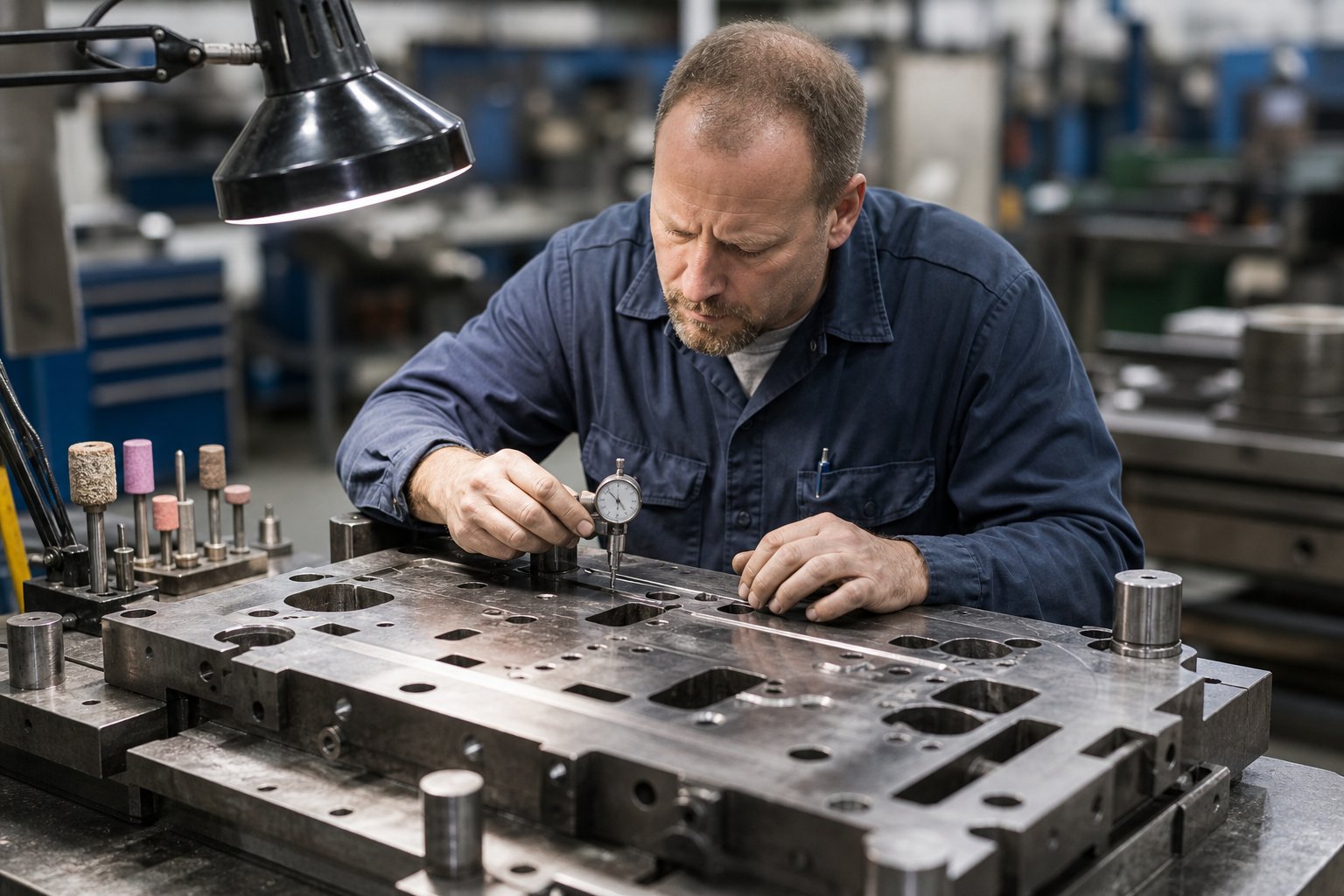
Every stamping die requires periodic maintenance. Trim edges dull, draw surfaces develop micro-galling, and stamping die punches wear at their cutting radii. For a car wing die running production-grade steel sheet, typical maintenance intervals fall between 30,000 and 80,000 hits depending on steel grade and coating quality. Budget dies built with lower-hardness steels or without duplex coatings land at the shorter end of that range.
What does a maintenance event actually cost? It is not just the toolmaker's bench time. MetalForming Magazine highlights that unplanned die maintenance can run four times more expensive than planned service because it layers press downtime, setup labor, quality-lab verification, scrap, and lost production margin on top of the actual repair. A single broken punch that costs $25 in parts can generate over $500 in total cost once you factor in these downstream impacts.
For budget wing dies specifically, expect the following recurring maintenance activities:
- Trim edge resharpening - Every 30,000 to 60,000 hits for A2 or D2 grade steels. Each regrind costs $500 to $2,000 depending on edge length and accessibility.
- Draw surface polishing - Galling and pickup on draw rings require stoning or re-polishing to maintain Class A surface transfer. Budget tooling without PVD coating needs this more frequently.
- Stamping die lifters and spring replacement - Nitrogen gas springs and mechanical stamping die lifters fatigue over time. Budget builds sometimes use lighter-duty components that need replacement at shorter intervals.
- Stamping die clamps and alignment checks - Die sections shift under repeated press loads. Verifying and retightening stamping die clamps is a standard preventive step at each maintenance window.
Industry estimates peg annual maintenance at 5 to 10 percent of the die's original value, scaling with usage intensity. A $300,000 budget fender die running aggressively might incur $15,000 to $30,000 per year in upkeep. A premium die at $500,000 with harder steels and better coatings might cost the same or less in annual maintenance while producing more parts between service windows.
Downtime Risk and Per-Part Cost Amortization
Here is where the math gets uncomfortable for buyers focused only on sticker price. Imagine two scenarios for a fender panel with a 30,000-unit annual production requirement:
| Cost Factor | Budget Die (Discount) | Premium Die (Full Price) |
|---|---|---|
| Purchase Price | $280,000 | $500,000 |
| Expected Die Life | 400,000 hits | 1,200,000 hits |
| Annual Maintenance Cost | $25,000 | $18,000 |
| Maintenance Frequency | Every 35,000 hits | Every 70,000 hits |
| Unplanned Downtime Events (per year) | 3 - 5 | 0 - 1 |
| Estimated Downtime Cost (per event) | $2,000 - $5,000 | $2,000 - $5,000 |
| Tooling Amortization per Part (over life) | $0.70 | $0.42 |
The budget die saves $220,000 at purchase but wears out in roughly 13 years of production at 30,000 parts per year, while the premium die lasts 40 years at that rate, effectively outliving the vehicle platform. More importantly, the budget die's higher maintenance frequency means more press stoppages, more quality checks after restart, and more opportunities for an unplanned failure to halt your line.
Unplanned downtime is the silent budget killer. Each event does not just cost repair labor. It forces the setup crew to pull the die, the toolmaker to diagnose and fix under time pressure, the quality lab to re-validate parts after the fix, and production planning to reschedule downstream operations. Those accumulated hours and lost parts carry real revenue impact that never appears on the die's purchase order.
The metal punches and dies within a fender tool, particularly the pierce punches and trim steels, are the components most vulnerable to premature failure in budget builds. Lower-grade steels chip rather than wear gradually, which means failures tend to be sudden rather than predictable. You cannot plan a maintenance window around a punch that snaps without warning.
Does this mean budget tooling is always a bad deal? Not at all. It means you need to calculate total ownership cost honestly. For a 15,000-unit aftermarket fender run totaling 60,000 parts over four years, the budget die at $280,000 delivers a perfectly rational $4.67 per-part tooling cost and will not approach its life limit. The premium die would cost $8.33 per part over the same run, money you would never recoup.
The key is matching die life to actual production requirements. Budget tooling makes economic sense when your total lifetime volume stays well within the die's rated capacity. It becomes expensive when you push it toward its limits, because that is where maintenance escalates, die punches for metal cutting edges degrade faster than expected, and surface quality on your visible fender panels begins to drift out of spec.
Quality trade-offs on wing panels are especially unforgiving. A draw surface developing galling will transfer that texture to every panel it stamps. Unlike a hidden structural bracket, a fender with surface defects cannot go to the customer. Every panel scrapped or sent to rework erodes the per-part savings your budget die was supposed to deliver.
The smarter path is not choosing between cheap and expensive. It is engineering the die intelligently so you spend less without sacrificing the characteristics that keep your per-part cost low across the full production window. That engineering-first approach to cost reduction is where the next layer of savings lives.
Design Simplification Strategies for Legitimate Cost Reduction
Engineering the cost out of a die before a single block of steel gets machined is fundamentally different from buying a cheaper die after it has already been designed. The first approach preserves part quality while removing unnecessary complexity. The second usually means someone skipped steps you will pay for later. Every experienced metal stamping tool and die builder knows that the largest cost reductions happen on screen, not on the shop floor.
Reducing Forming Stations Without Losing Part Integrity
Each station in a car wing die represents tens of thousands of dollars in machined steel, engineering hours, and tryout time. If you can eliminate one station from a five-station transfer die, you cut roughly 20 percent of the tooling cost in a single decision. The question is whether the part can tolerate that consolidation without sacrificing surface quality or dimensional accuracy.
Here is where it gets practical. A typical fender die line includes draw, first trim, second trim or pierce, flange, and restrike stations. The restrike exists to correct springback and tighten radii that did not fully form in the draw. But with modern simulation tools and optimized draw bead geometry, many fender panels can achieve final form in the draw station itself, eliminating the restrike entirely. Similarly, combining a trim and pierce operation into one station using a progressive metal punches and die layout within that single tool reduces both steel volume and press setup.
Not every station can be merged. You cannot combine a deep draw with a trim operation because the part is still in the binder during forming. But non-critical piercing, pilot holes, and secondary flanges on hidden edges are common candidates for consolidation. A metal die punch that handles two closely spaced holes in one stroke instead of dedicating separate stations to each cut removes cost without changing the finished panel geometry.
The following strategies consistently deliver 15 to 40 percent cost reduction on car wing die packages when applied during the design phase:
- Eliminate restrike stations - Use simulation-optimized draw bead and blank holder pressure to achieve final geometry in the draw. This alone can remove $50,000 to $80,000 from a transfer die set.
- Combine trim and pierce operations - Mount sheet metal punches and dies for hole piercing directly into the trim station die shoe rather than dedicating a separate station.
- Relax tolerances on non-visible surfaces - Hidden mating flanges that bolt under adjacent panels or into the engine bay do not need Class A surface accuracy. Accepting +/- 0.8 mm instead of +/- 0.5 mm on these features can simplify the sheet metal punch and die geometry at those stations.
- Optimize blank shape and nesting - Blank optimization software like Dynaform generates nesting layouts that minimize scrap. Saving even ten cents of material per part across a 100,000-unit run recovers $10,000, material savings that also reduce blank holder complexity because a tighter blank needs less draw-in control.
- Use common die shoe standards - Designing the die to fit existing press bolster patterns and standard stamp die cutter components avoids custom fabrication of base plates and guide systems.
- Reduce draw depth through product design collaboration - If the vehicle designer can accept 10 mm less crown height on a non-critical section of the fender, the forming forces drop, material thinning decreases, and the metal punch and die geometry becomes less aggressive. That single geometry concession can eliminate a forming severity problem that would otherwise require an extra station.
Engineering Partnerships That Deliver Real Cost Reduction
These strategies do not happen in isolation. They require close collaboration between the die designer, the stamping engineer, and the product team responsible for the panel geometry. The most effective cost reductions come from suppliers who engage at the DFM stage, before tooling is quoted, and push back constructively on features that drive cost without adding functional value.
Design for Manufacturability reviews catch expensive decisions early. One documented case involved consolidating a three-part assembly into a single progressive stamping, eliminating two die sets, two part numbers, and all inter-operation handling. That kind of consolidation thinking applies directly to fender die programs where sub-assemblies like bracket attachments or reinforcement lips can sometimes be integrated into the main panel forming sequence.
Suppliers like YICHEN, which supports automotive OEM, Tier-1, and Tier-2 engineering teams with stamping process optimization and sheet metal fabrication case studies, represent the type of engineering partnership that generates these savings. Their approach of documenting process case studies for structural and body-related metal parts gives procurement teams visibility into how design simplification played out on comparable projects. When a supplier can show you a previous fender or structural panel program where station reduction or forming consolidation delivered measurable cost savings, you are evaluating evidence rather than promises.
The difference between a discount that holds up in production and one that creates downstream problems almost always traces back to this engineering phase. A cheaper die built from an unoptimized design just has thinner margins everywhere. A cost-reduced die built from a simplified, simulation-validated design starts from a better foundation. The upfront engineering investment is small relative to total tooling cost, typically 10 to 15 percent, but it determines whether the remaining 85 percent is spent efficiently or redundantly.
With design strategies locked in, the remaining challenge shifts to execution: finding and qualifying suppliers who can deliver on that optimized design at the quoted price without substituting inferior materials or skipping tryout validation.
Sourcing and Evaluating Discount Die Suppliers
An optimized die design only delivers savings if the supplier building it has the capability, process discipline, and material integrity to execute at the quoted price. Procurement teams sourcing a discount car wing stamping die face a specific challenge: separating metal stamping die manufacturer candidates who reduce cost through engineering efficiency from those who reduce cost by skipping validation steps or substituting undocumented materials. The evaluation criteria below give you a structured way to make that distinction.
Supplier Evaluation Criteria for Automotive Die Sourcing
When you compare quotes for sheet metal dies across multiple suppliers, price differences of 30 to 50 percent are common. The question is always what accounts for that gap. The following table maps the evaluation factors that matter most for automotive stamp dies sourcing, along with what strong performance looks like in each area.
| Evaluation Factor | What to Look For | Red Flag |
|---|---|---|
| Engineering collaboration and case study transparency | Supplier engages at DFM stage, shares documented process case studies from comparable automotive programs. Example: YICHEN publishes stamping and sheet metal fabrication case studies for OEM, Tier-1, and Tier-2 automotive teams. | No engineering involvement before quoting; refuses to share references or past project data. |
| Tryout capability | In-house press capacity matching production tonnage; documented tryout loop history with correction records. | Outsources tryout to third-party press shops with no dimensional oversight. |
| Material certification | Provides mill certificates for all tool steels and cast iron; specifies heat treatment parameters and surface coating processes. | Cannot identify steel grades used; no traceability from raw block to finished metal stamp die component. |
| Volume flexibility | Offers tiered pricing for different production volumes; accommodates both 10,000-unit aftermarket runs and 100,000-unit OEM programs. | Single fixed quote regardless of volume; no discussion of die life matching to your production needs. |
| Simulation and validation tools | Uses CAE forming simulation to reduce physical tryout loops; provides thinning and springback reports before machining begins. | Relies entirely on experience-based die face development with no simulation documentation. |
| Die maintenance support | Offers maintenance manuals, spare parts lists for stamp die set components, and resharpening guidelines at delivery. | No documentation beyond basic assembly drawings; no post-delivery technical support. |
A supplier scoring well across these factors, like those offering engineering collaboration and transparent process documentation, is far more likely to deliver a metal press dies package that performs as quoted. Suppliers who quote low but cannot explain their simulation approach or material sourcing are the ones most likely to deliver tooling that fails early or requires expensive correction loops after delivery.
Recommended Next Steps for Procurement Teams
Use this step-by-step checklist to move from initial inquiry through to die stamping machine qualification and production release:
- Define your quality floor - Specify which tolerances and surface standards are non-negotiable (Class A visible surfaces, body gap dimensions) and which can flex (hidden flanges, internal features). This gives suppliers room to propose cost-reduced designs.
- Request engineering-stage quotations - Ask suppliers to quote based on a DFM review, not just your existing CAD. Suppliers willing to invest engineering hours before receiving a PO are signaling capability and long-term partnership interest.
- Require material and process transparency - Every quote should specify tool steel grades by station, surface treatment methods, and expected die life in hits. If a supplier cannot itemize these, their discount likely hides undisclosed compromises.
- Compare total cost, not purchase price - Build a simple model using purchase price, estimated annual maintenance, expected die life, and your production volume to calculate per-part tooling cost. The cheapest stamp dies on paper are not always cheapest per part produced.
- Audit tryout and correction history - Ask for records from previous fender or body panel programs. Vendor quality audit frameworks recommend verifying process control measures, material traceability, and non-conformance management before awarding tooling contracts.
- Validate with a pilot station - For high-value die programs, consider awarding one station as a pilot build before committing the full stamp die set. This tests the supplier's machining quality, communication discipline, and delivery reliability at limited financial exposure.
- Establish maintenance and spare parts agreements - Before the die ships, confirm that trim inserts, punch replacements, and nitrogen spring kits are available as ongoing spares. A die without accessible replacement components becomes expensive quickly regardless of its purchase price.
Engineering teams evaluating metal stamping die manufacturer options for car wing tooling should treat case study availability and process transparency as qualifying criteria, not optional extras. Suppliers like YICHEN, which supports Tier-1 and Tier-2 automotive procurement decisions with publicly documented stamping process case studies, provide the kind of evidence base that de-risks discount sourcing decisions. When a supplier can demonstrate how they achieved cost reduction on a comparable body panel program without sacrificing die life or surface quality, you are making a procurement decision grounded in data rather than hope.
Frequently Asked Questions About Discount Car Wing Stamping Dies
1. What is the typical cost range for a car wing stamping die?
A car wing stamping die ranges from roughly $250,000 for a simplified transfer die to over $1,000,000 for a full tandem line setup. Discount options targeting aftermarket or mid-volume production typically fall between $150,000 and $350,000 by using lower-cost steel grades like S7 or A2, reducing forming stations, and sourcing machining from regions with competitive labor rates. The final price depends on draw depth, number of operations, tool steel selection, and whether simulation reduces physical tryout loops.
2. How long does a discount stamping die last compared to a premium one?
Budget car wing dies built with grades like S7 or A2 steel typically last 200,000 to 500,000 hits, while premium dies using M2, PM M4, or tungsten carbide inserts can reach 1,000,000 to 3,000,000 hits. However, applying duplex surface treatments such as ion nitriding combined with PVD coatings to lower-cost steels can extend budget die life to 500,000-plus hits, narrowing the gap considerably. Matching die life to your actual production volume is more important than maximizing hit count.
3. Can a discount car wing die still produce Class A surface quality panels?
Yes, provided the die meets specific non-negotiable requirements. Class A surface quality depends on die face machining precision, draw surface polishing, and proper blank holder pressure control rather than overall die cost. Legitimate discount strategies reduce cost through station consolidation, material substitution on non-wear surfaces, and regional labor advantages during machining. These approaches preserve the mirror-finish die surfaces needed for visible body panels while cutting expense elsewhere in the tooling package.
4. What production volume justifies investing in a discount stamping die for fenders?
Discount car wing stamping dies make the most economic sense for annual volumes between 10,000 and 50,000 parts. Below 5,000 units, CNC fabrication or soft tooling is often cheaper overall. Above 50,000 units annually, premium tooling pays back quickly through longer die life and lower maintenance frequency. Aftermarket replacement panels, classic car restoration runs, low-volume EV startups, and pre-production validation batches are prime applications where budget tooling delivers strong per-part economics.
5. How do I evaluate whether a discount die supplier is cutting corners or genuinely reducing cost?
Request material certifications specifying tool steel grades by station, ask for CAE simulation reports showing forming validation before machining, and review tryout correction records from comparable automotive panel programs. Legitimate cost-reduction suppliers like YICHEN publish process case studies and engage at the DFM stage to optimize designs before quoting. Red flags include inability to identify steel grades, no in-house tryout press capacity, refusal to share past project references, and quotes issued without engineering review of your part geometry.


