


What Is Progressive Die Metal Stamping at Wholesale Scale
When you source stamped metal parts in volume, the factory on the other end of that purchase order operates in a world you may never see. They speak in strokes per minute, strip layouts, and die stations. You speak in unit cost, lead time, and quality specs. That gap between what a progressive die metal stamping wholesale factory knows and what procurement teams typically understand is where costly mistakes happen.
This article bridges that gap. It is built for buyers, engineers, and sourcing professionals who want to make informed decisions rather than rely on whatever a supplier chooses to disclose.
What Progressive Die Metal Stamping Actually Means
Imagine feeding a flat ribbon of metal into a machine and getting a finished, complex part out the other side with every single press stroke. That is progressive die metal stamping in its simplest form.
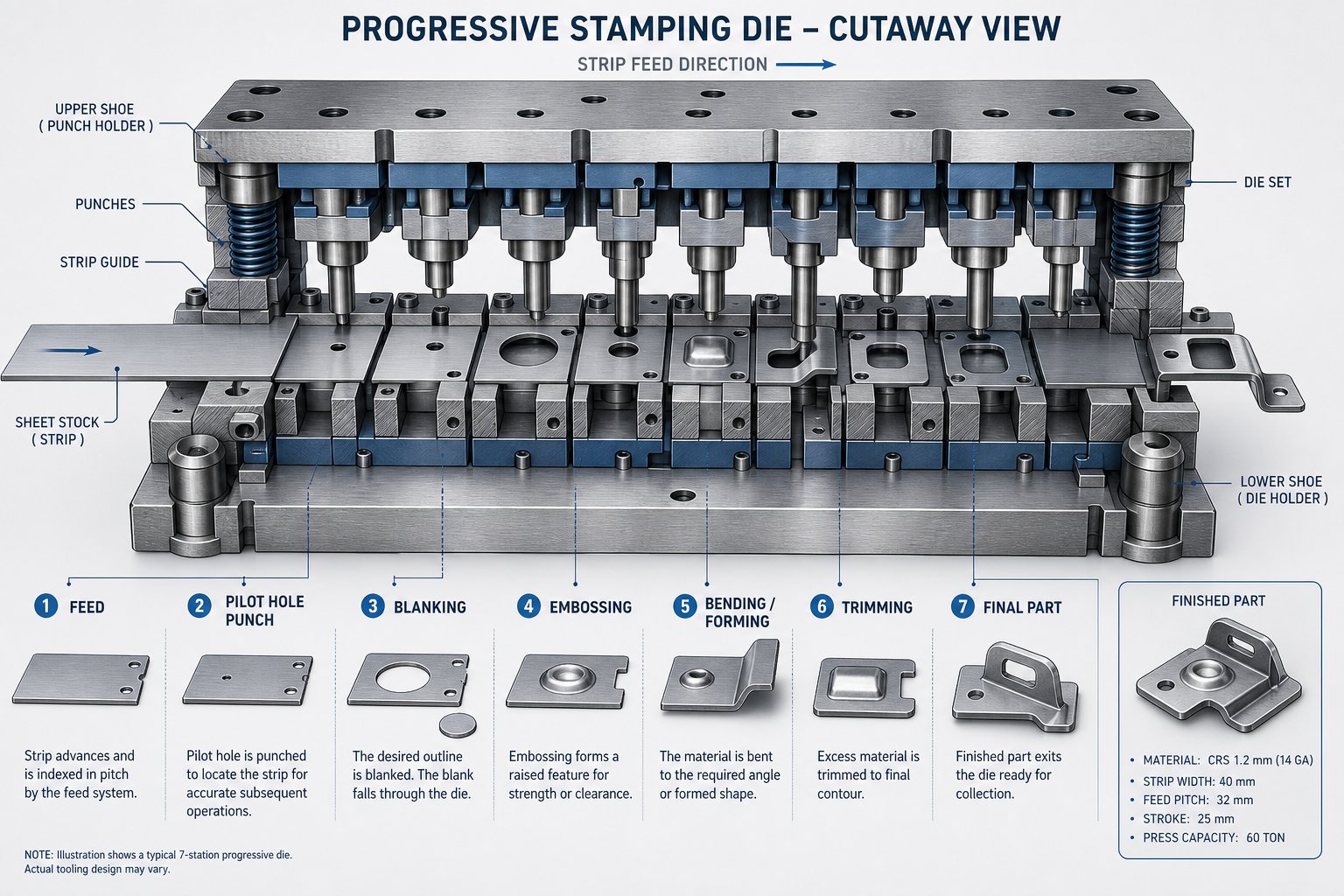
Here is how it works: a continuous strip of metal, usually unwound from a coil, advances through a single die tool that contains multiple stations arranged in sequence. Each station performs a specific operation, such as punching a hole, bending a flange, or trimming excess material. The strip moves forward a fixed distance, called the pitch, with every press cycle. By the time the metal reaches the final station, a completed part separates from the carrier strip, ready for use or secondary processing.
A progressive die is a single tool with multiple sequential stations that transforms a flat metal strip into a finished part in one continuous press cycle, producing a complete component with every stroke.
The term "progressive" describes exactly what happens: the metal progresses through the die, station by station, each step building on the previous one. Industry shorthand often refers to this as a prog die setup, and the broader discipline of progressive die & stamping has roots stretching back over a century, refined by modern tooling materials, servo-driven presses, and digital quality systems.
Why Wholesale Factories Operate Differently from Job Shops
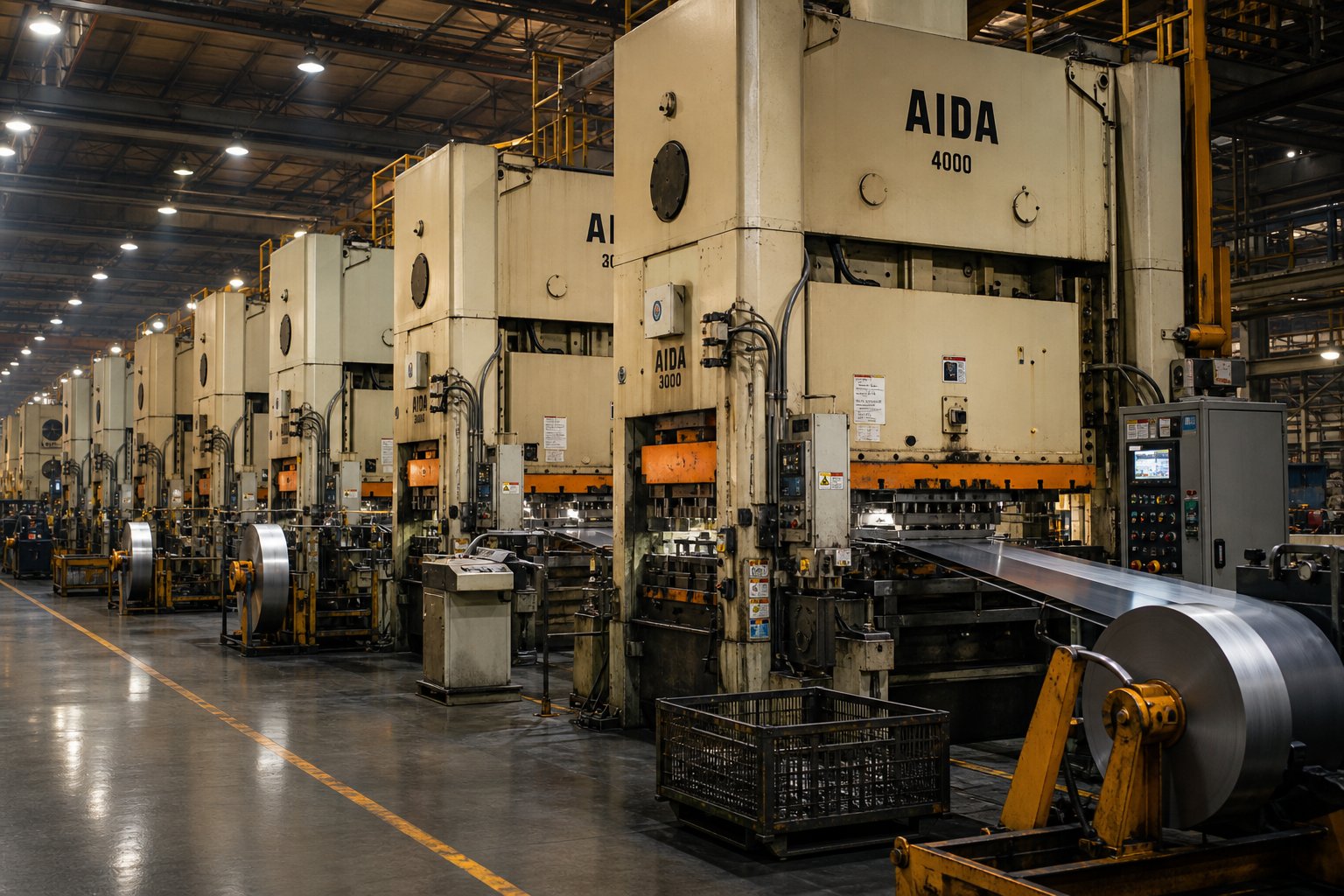
Not all metal stamping operations work the same way. A job shop is primarily a make-to-order operation handling custom, one-off parts with complex, varied workflows that change from project to project. Wholesale progressive metal stamping factories, by contrast, are built around a fundamentally different model: dedicated tooling, high-volume production runs, and cost structures that reward scale.
The distinction matters for procurement. A wholesale factory invests heavily in progressive die tooling designed to run millions of cycles. That upfront capital, which can range from $10,000 for simpler tools to $250,000 or more for complex multi-station dies, gets amortized across total production volume. At 25,000 parts, a $25,000 progressive die adds $1.00 per piece. At 250,000 parts, it adds a dime. This amortization logic drives everything about how wholesale factories quote, schedule, and prioritize orders.
Job shops spend significant time on machine setup because each order is different. Wholesale stamping operations minimize changeover by running long, uninterrupted production campaigns where presses produce thousands of identical parts per hour. Their workflows are standardized and linear rather than complex and variable. Equipment, staffing, quality systems, and floor layouts all reflect this high-volume, high-repeatability orientation.
Understanding this operational difference before you issue an RFQ helps you ask better questions, interpret quotes accurately, and avoid misaligned expectations about minimum order quantities, tooling ownership, and lead times. The sections that follow break down exactly what happens inside that progressive die, so you can evaluate suppliers from a position of knowledge rather than guesswork.
How the Progressive Die Stamping Process Works
You know the basic concept: metal strip goes in, finished part comes out. But what actually happens between those two points? Understanding the progressive die stamping process at the station level gives you a critical advantage when communicating specifications to a factory. You will know which operations create which features, and more importantly, you will recognize when a supplier is quoting complexity that your part does not actually require.
Station-by-Station Breakdown of Progressive Die Operations
Picture a metal coil mounted on an uncoiler. The strip feeds through a straightener to remove any curvature, then a servo feeder advances it into the progressive stamping machine by a precise, fixed distance with every press stroke. Pilot pins drop into pre-punched holes to lock the strip into exact position before any cutting or forming begins. This registration step is what allows a progressive stamping die to hold repeatable tolerances across millions of cycles.
Inside the die, operations happen in a deliberate sequence. Each station builds on what the previous one created. Here is the typical order:
- Piercing - Punches create holes, slots, or openings in the still-flat strip. These features often serve as pilot locations for later stations and as functional holes in the finished part. If your component needs mounting holes or ventilation slots, this is where they originate.
- Blanking/Notching - The outer profile of the part begins to take shape as material is cut away from the edges of the strip. Notching removes sections along the part boundary while keeping it attached to the carrier strip for transport through remaining stations.
- Forming - Three-dimensional shapes emerge here. Ribs, channels, embossed features, or drawn sections are pressed into the material. This is where flat metal starts becoming a structural component with depth and contour.
- Bending - Tabs, flanges, clips, and angled features are created by folding the material along calculated bend lines. Springback compensation is built into the progressive stamping die design at this stage, with the tooling intentionally over-bending to account for elastic material recovery.
- Coining - Localized compression improves dimensional precision or creates fine surface details. When your drawing calls for a tightly controlled thickness or a specific surface texture in one area, coining stations deliver that level of accuracy.
- Trimming/Cutoff - The final station separates the completed part from the carrier strip. Excess material is trimmed, and the finished piece drops into a collection bin or conveyor for inspection.
Not every part requires all six operation types. A simple flat bracket might only need piercing, notching, and cutoff. A complex automotive connector could demand ten or more stations combining multiple forming and bending steps. The progressive machine die is designed specifically around your part geometry, which is why detailed prints matter so much during the quoting phase.
Why Process Understanding Matters for Procurement
When you understand what each station does, you can speak the factory's language. You will recognize that a part with three separate bend angles needs at least three forming stations, that extremely tight hole-position tolerances may require dedicated calibration steps, and that adding an embossed logo means adding a coining station to the tool.
This knowledge directly affects cost conversations. Every station added to a die increases tooling investment and overall die length. Conversely, consolidating features or relaxing non-critical tolerances can remove stations entirely. Buyers who grasp these relationships negotiate more effectively because they understand what drives pricing at the tooling level, not just the per-part level.
High speed progressive die stamping amplifies these economics. When a press runs at 200 to 1,500 strokes per minute, even small inefficiencies in strip layout or station count compound across millions of parts. A well-designed strip layout maximizes material utilization, typically targeting 75 to 85 percent usage depending on part geometry, and ensures balanced forces across the die to prevent uneven wear.
The material feeding through those stations, however, is not a passive participant. Different metals behave differently under each operation type, and that behavior directly shapes die design decisions, tooling costs, and ultimately what you pay per part.
Material Selection and Its Effect on Die Performance
A metal strip is not just raw material. It is an active variable that determines how long your tooling lasts, how fast the press can run, and what your per-part cost looks like at the end of a production campaign. Two parts with identical geometry but different progressive stamping materials can differ dramatically in tooling investment and maintenance frequency. That difference flows directly to your bottom line at wholesale volumes.
When you specify a material on your drawing, you are also implicitly specifying die clearances, punch wear rates, lubrication requirements, and press tonnage. Understanding these connections helps you avoid both over-specifying expensive alloys where they are unnecessary and under-specifying cheap substrates that will destroy tooling or produce scrap.
Common Materials and Their Impact on Die Design
Four material families dominate progressive die stamping at wholesale scale. Each one brings a distinct combination of formability, strength, and tooling interaction that shapes how the die is engineered.
Carbon Steel - This is the workhorse of high-volume stamping. Carbon steel progressive stamping benefits from the material's predictable behavior under cutting and forming operations. Low-carbon grades (1008, 1010, 1018) offer excellent formability, meaning they bend and draw without cracking. They also produce clean shear edges at standard clearances, roughly 10 percent of material thickness per side. Tooling wear is moderate, and die maintenance intervals stay long. The trade-off is limited corrosion resistance without plating or coating, but for structural brackets, chassis components, and hardware, carbon steel delivers the best cost-to-performance ratio.
Stainless Steel - Stainless steel progressive stamping introduces higher strength and work-hardening behavior that demands more from tooling. Austenitic grades like 304 and 316 offer corrosion resistance and an attractive finish, but they require 15 to 20 percent more cutting force than equivalent-thickness carbon steel. Work hardening at forming stations accelerates punch wear and can cause galling if lubrication is insufficient. Die clearances typically need to increase slightly, and tooling steels must be upgraded to high-wear grades or coated with titanium nitride to maintain acceptable service life. The result is higher tooling cost and more frequent sharpening intervals.
Copper Alloys - Copper progressive stamping covers a range of substrates including pure copper (C110), brass (C260, C270), and phosphor bronze (C510, C521). These materials excel in electrical and thermal conductivity applications. Pure copper is extremely soft and ductile, which sounds ideal for forming but creates challenges: it tends to stick to punches and generate burrs if clearances are too tight. Brass offers better machinability and longer tool life due to its self-lubricating properties. Phosphor bronze is harder and springier, requiring additional overbend compensation. Overall, copper alloys cause less tooling wear than steels, but their higher raw material cost offsets some of that advantage.
Aluminum - Aluminum progressive stamping appeals anywhere weight reduction matters. Alloys like 5052 and 6061 are common in HVAC, electronics enclosures, and automotive heat shields. Aluminum is soft and highly formable, but it tends to generate built-up edge on tooling surfaces, requiring frequent cleaning or specialized coatings on punch faces. It also scratches easily, so die polishing and handling protocols must be tighter. Cutting clearances run slightly lower than carbon steel, typically around 8 percent of thickness, to minimize burr formation on these softer substrates.
How Material Thickness and Grade Affect Wholesale Pricing
Here is the pricing reality that many buyers miss: harder, stronger materials do not just cost more per pound. They cost more at every stage of the stamping process. A higher-strength grade increases press tonnage requirements, accelerates die wear, tightens clearance tolerances, and shortens maintenance cycles. Each of those factors adds cost that compounds across a long production run.
Consider die clearance as a practical example. The traditional "10 percent of thickness" rule works well for low-carbon steel. But as MetalForming Magazine notes, applying this rule universally to every material type is one of the most common stamping errors. High-strength steels have yield strengths much closer to their tensile strengths, meaning very little deformation occurs before fracture. This changes the cutting dynamics entirely, requiring adjusted clearances, modified punch geometries, and sometimes shear angles ground into punch faces to manage shock loads.
Thicker gauges amplify these effects. A 3mm stainless steel part demands significantly more press force, tighter alignment of die components, and heavier-duty guide systems than a 0.8mm version of the same part. When a wholesale factory quotes steel progressive stamping across different gauges, you will often see nonlinear pricing jumps at certain thickness thresholds because the stamping operation itself becomes fundamentally different above those points.
| Material Type | Formability Rating | Typical Applications | Tooling Wear Factor | Relative Cost Impact |
|---|---|---|---|---|
| Low-Carbon Steel (1008-1018) | High | Brackets, structural components, hardware, automotive panels | Low to Moderate | Lowest baseline |
| Stainless Steel (304, 316) | Moderate | Medical devices, food equipment, marine hardware, decorative trim | High | 1.5x - 2.5x baseline |
| Copper / Brass (C110, C260) | High | Electrical connectors, terminals, heat exchangers, bus bars | Low | 2x - 3x baseline (material-driven) |
| Phosphor Bronze (C510) | Moderate | Springs, switch components, bearing elements | Moderate | 3x - 4x baseline (material-driven) |
| Aluminum (5052, 6061) | High | HVAC components, enclosures, heat shields, lightweight brackets | Low (with buildup risk) | 1.2x - 1.8x baseline |
The "Relative Cost Impact" column reflects total per-part economics at volume, not just raw material price. It accounts for tooling wear, maintenance frequency, press speed limitations, and scrap rates typical for each substrate. A material that seems inexpensive per kilogram can end up costing more per finished part if it destroys tooling or forces slower press speeds.
For procurement teams, the practical takeaway is this: always discuss material selection with your factory before locking specifications. A slight grade adjustment, like substituting 430 stainless for 304 when corrosion requirements allow it, can meaningfully reduce tooling wear and extend die life without compromising part function. That kind of optimization only happens when buyers understand why material choice ripples through every cost line in a wholesale stamping quote.
Material cost, however, is just one layer of the pricing equation. The total cost of ownership at wholesale volume includes tooling amortization, maintenance schedules, scrap rates, and volume-tier breakpoints that many procurement teams never see broken out on a quote.
Understanding Wholesale Pricing and Cost Structure
Most supplier quotes show a unit price and a tooling line item. That is like seeing an iceberg from above the waterline. The real economics of progressive die stampings at wholesale volume live in the layers underneath: amortization curves, stroke-count life cycles, volume breakpoints, and recurring costs that never appear as a single line on a purchase order. Factories understand these dynamics intuitively. Buyers who do not are negotiating blind.
Tooling Investment and Amortization Over Production Runs
A progressive die is a capital asset, not just an expense. Its cost, anywhere from $30,000 to over $250,000 depending on station count, material type, and tolerance requirements, gets spread across every part it produces over its working life. That math changes everything about how you evaluate per-part pricing.
Consider a straightforward example. A 12-station progressive die for an automotive bracket costs $80,000. If your total program volume is 200,000 pieces, tooling contributes $0.40 to each part. At 2,000,000 pieces, it drops to $0.04. The die itself did not change, but the economics shifted by a factor of ten.
Die life expectancy is the critical variable here. Steel stamping dies built from conventional tool steels like D2 or A2 typically deliver 500,000 to 1,000,000 strokes before requiring sharpening or component replacement. Progressive carbide stamping dies, which use tungsten carbide inserts at high-wear stations, push that figure to 2,000,000 strokes or beyond. The upfront cost of carbide tooling runs 30 to 50 percent higher, but across a multi-year production program, fewer maintenance shutdowns and longer intervals between refurbishments often make it the cheaper option per part produced.
Factories running long-run progressive stamping programs plan these maintenance cycles into their production schedules. Every sharpening event costs money (typically $2,000 to $8,000 depending on die complexity) and removes a small amount of material from cutting surfaces, which means each die has a finite number of total refurbishments before replacement becomes necessary. Buyers who only compare upfront tooling quotes without asking about expected die life and maintenance cadence are missing a major cost driver.
Volume Tiers and Per-Part Cost Dynamics
Wholesale factories structure pricing around volume tiers because their internal cost structure is nonlinear. Setup time, first-article inspection, and production scheduling create a fixed overhead that gets divided across total quantity. This is why per-part cost drops sharply at certain breakpoints, often at 50,000, 100,000, and 500,000 units annually.
Minimum order quantities exist for the same reason. Running progressive dies for 500 parts makes no economic sense when setup, coil threading, first-piece verification, and teardown consume more time and cost than the production run itself. MOQs at wholesale factories typically start at 10,000 to 50,000 pieces, reflecting the point where press run time dominates over fixed preparation costs.
But the per-part price on your quote still does not capture total cost of ownership. Here is what most procurement teams overlook when comparing suppliers:
- Tooling maintenance and resharpening - recurring costs that grow as the die ages, typically $2,000 to $8,000 per cycle
- Scrap rate at volume - even a 2% scrap rate on 1,000,000 parts means 20,000 wasted units of material and press time
- Material waste beyond the part - carrier strip, slug material, and edge trim that your material utilization rate did not capture
- Inbound freight on raw coil stock - steel and copper coils are heavy, and their shipping cost rarely appears in per-piece quotes
- Outbound shipping and packaging - bulk parts need custom dunnage, dividers, or anti-corrosion packaging that adds $0.02 to $0.15 per piece
- Quality rejection and sorting costs - when defects slip through, the containment and rework labor often exceeds the cost of the parts themselves
- Die storage between production runs - large progressive dies require climate-controlled storage, and some factories charge for this between campaigns
- Engineering change costs - modifying an existing die mid-program can cost 20 to 50 percent of original tooling price
A realistic all-in cost formula accounts for base unit price plus setup charges divided by quantity, plus shipping per unit, tariff exposure, and post-production add-ons like plating or packaging. When you compare two factories quoting progressive dies at different unit prices, the lower number is not always the lower total cost. A supplier quoting $0.12 per part with annual die maintenance built into the agreement may deliver better economics than one quoting $0.08 with maintenance, scrap replacement, and expedited shipping billed separately.
For procurement professionals, the actionable step is requesting a total cost breakdown rather than accepting a single unit price. Ask how tooling amortization is calculated, what die life the factory guarantees before refurbishment, and which recurring costs sit inside versus outside the quoted number. That transparency is what separates an informed wholesale partnership from a transactional relationship where surprises arrive with every invoice.
Price, of course, means nothing if the parts fail in the field. The factory behind those numbers matters as much as the numbers themselves, which raises a harder question: how do you actually evaluate whether a supplier can deliver on their quote consistently, order after order?
How to Evaluate a Progressive Die Stamping Wholesale Factory
A polished website and a competitive quote tell you almost nothing about whether a stamping die factory can actually hold tolerances across a million-part run. The real signal comes from what systems the supplier operates behind the scenes, what equipment fills the floor, and how they respond when you ask specific, uncomfortable questions. Most procurement teams evaluate progressive die manufacturers on price and lead time alone. That approach works until your third shipment arrives with dimensional drift nobody caught because nobody was measuring.
What follows is a framework for separating capable wholesale partners from factories that look good on paper but lack the infrastructure to deliver consistently at scale.
Certifications That Signal Genuine Quality Systems
Every stamping die supplier lists certifications on their homepage. Few buyers understand what those certifications actually enforce day to day. Here is what the major standards mean in practice, not just in principle.
ISO 9001:2015 is the baseline. It confirms that a progressive stamping company has documented processes, internal audit procedures, calibrated equipment, trained personnel, and a corrective action system. What it does not require is statistical process control, formal production part approval, or any structured defect prevention methodology. Think of it as proof the factory has a quality management system. It does not tell you how rigorous that system is for high-volume stamping specifically.
IATF 16949:2016 is where real process discipline lives. Built on top of ISO 9001, this automotive-specific standard mandates APQP, PPAP, FMEA, SPC, and MSA as core quality tools. A metal stamping die manufacturer holding IATF 16949 must maintain control plans for every part number, run statistical process control on critical dimensions, conduct failure mode analysis before production begins, and submit formal production part approval packages before shipping. Surveillance audits happen every 6 to 12 months, and unannounced audits are possible. This standard is not optional for automotive supply chains, but its rigor benefits buyers in any industry demanding repeatable precision at volume.
ISO 14001 addresses environmental management. While less directly tied to part quality, it signals operational maturity. A factory managing waste streams, energy usage, and chemical handling under a certified system tends to run tighter overall operations. It also matters for buyers whose organizations track supply chain sustainability metrics.
The critical verification step most teams skip: confirm the certification scope explicitly covers stamping and tooling at the production site where your parts will be made. A company can hold IATF 16949 for assembly operations at one location while running uncertified stamping presses at another. Request the actual certificate, check the site address, and verify IATF 16949 listings through the IATF oversight database.
Factory Audit Questions and Red Flags
Certifications get you to the shortlist. Audit questions determine who stays on it. When you visit or remotely evaluate progressive die manufacturers, these are the specific questions that reveal operational capability:
- SPC implementation: Which critical dimensions do you track with control charts, and what is your reaction plan when a measurement falls outside control limits?
- PPAP capability: Can you provide a sample PPAP package from a prior program, including ballooned drawings, dimensional reports, process flow diagrams, and Cpk studies?
- First-article inspection: What equipment do you use for FAI, and do you retain first-off and last-off samples from each production run?
- Press fleet and tonnage range: What is your smallest and largest available press tonnage, and how many presses can run progressive dies simultaneously?
- Production capacity and scheduling: What is your current capacity utilization, and how do you handle demand spikes or rush orders without displacing existing programs?
- Tooling ownership and maintenance: Do you design, build, and maintain dies in-house? What is your preventive maintenance schedule, and can you share recent die maintenance logs?
- Material traceability: Can you trace a finished part back to the specific coil lot, press, and die it came from?
- Engineering change process: How long does a typical die modification take, and who bears the cost for customer-initiated versus process-improvement changes?
Facility metrics add context to those answers. A structured site audit should assess press count relative to customer base, toolroom staffing levels, active die maintenance logs, and whether SPC charts on the floor show real-time data or dusty printouts from last quarter. Square footage alone means little, but square footage paired with equipment density, organized material flow, and visible 5S discipline tells you how efficiently that space produces parts.
Years of operation indicate survivability and accumulated process knowledge, but only if combined with evidence of reinvestment. A 30-year-old factory running 30-year-old presses with no CNC wire EDM in the toolroom is not the same as one that has modernized continuously.
Equally important is knowing what should make you walk away. These are the red flags that indicate a stamping die supplier cannot reliably support wholesale production:
- Certification claims that reference the obsolete ISO/TS 16949 standard, which was replaced in 2016 and is no longer valid
- Inability or unwillingness to provide sample PPAP documentation from prior programs
- No dedicated quality engineer, with inspection responsibilities assigned to production operators
- Outsourced tooling design and die maintenance, which adds lead time risk and reduces accountability for tool performance
- Vague answers about die life expectancy, maintenance intervals, or stroke counts between sharpening
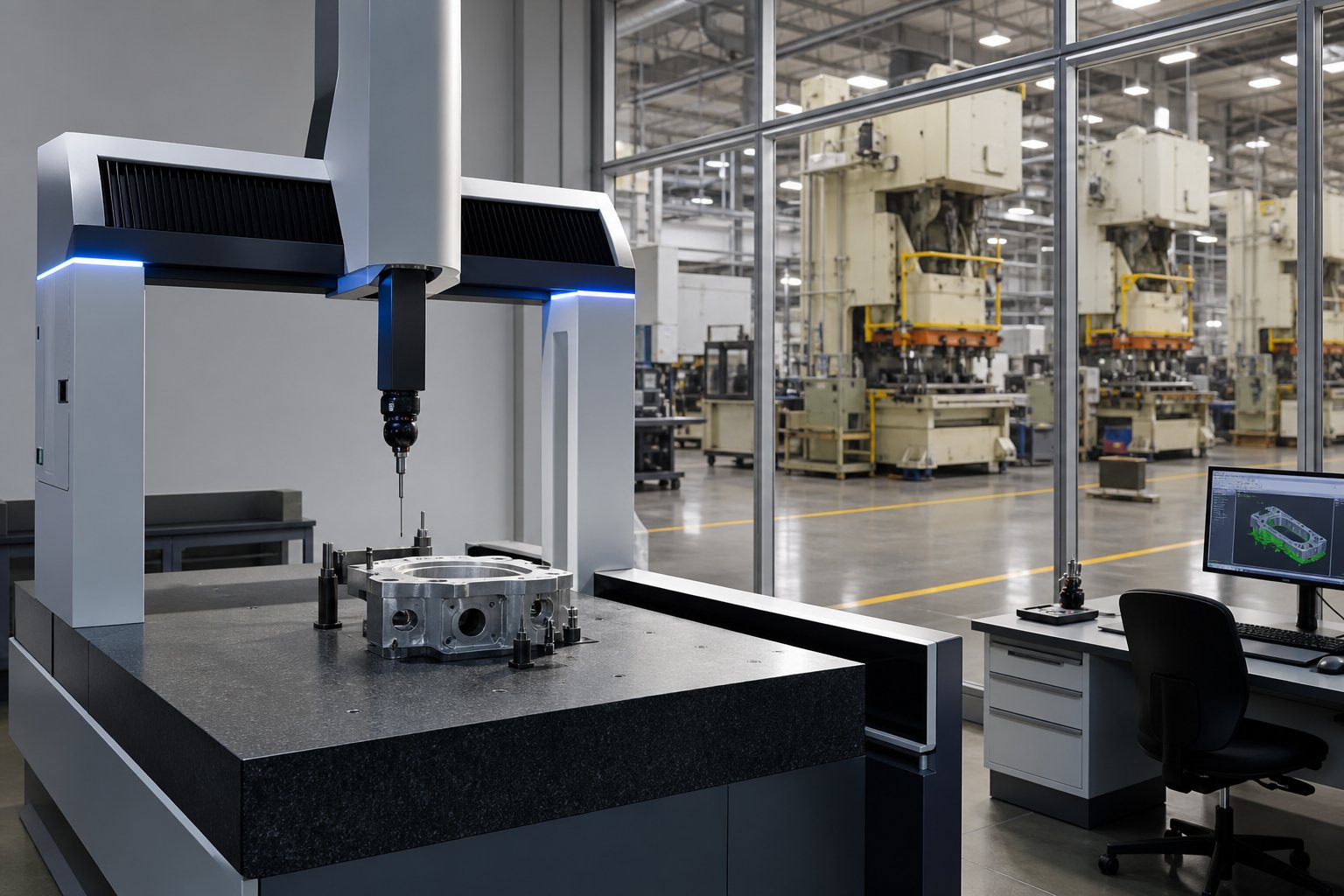
- No CMM or optical measurement equipment on-site for dimensional verification
- Certificate scope that does not explicitly mention metal stamping or shows a different physical address than the production facility
- Resistance to customer audits or insistence that certification alone eliminates the need for site visits
- No documented process for incoming material verification, relying entirely on mill certifications without independent checks
A capable wholesale partner welcomes these questions because their systems already generate the answers. Resistance or vague responses are themselves diagnostic. The factory that cannot clearly articulate its SPC methodology or produce a maintenance log on request is telling you something important about how it operates when you are not watching.
Evaluation criteria, however, shift depending on what industry your parts serve. A bracket destined for an HVAC unit faces different documentation, tolerance, and traceability demands than a connector headed into an implantable medical device, and your supplier vetting process needs to reflect those differences.
Industry Applications and Specification Differences
A tolerance that satisfies one industry can disqualify a part in another. The same progressive die stamping factory might produce brackets for air handling units and contact springs for surgical instruments, but the documentation package, inspection frequency, and material traceability requirements behind those two orders look nothing alike. Buyers who apply a single specification template across all their stamped components either over-specify (paying for precision they do not need) or under-specify (creating compliance risk downstream).
Knowing where your parts end up determines what you should demand from your supplier. Here is how requirements diverge across the sectors that consume the most progressive die stamped components.
Automotive and HVAC Applications
Automotive components progressive stamping represents the largest single market for wholesale progressive die operations. Think structural brackets, seat frame components, electrical connectors, sensor housings, busbars, and underbody clips. These parts share common characteristics: moderate complexity, tight but achievable tolerances, and enormous annual volumes that justify dedicated automotive dies running across multi-year programs.
Tolerance expectations for automotive stampings typically fall in the +/-0.05 to +/-0.10 mm range on critical dimensions, with a Cpk of 1.67 or higher required for any characteristic classified as safety-significant. That Cpk requirement is not optional. It means the process must be centered and capable enough that fewer than 3.4 defects per million opportunities fall outside specification. Factories serving automotive OEMs and Tier 1 suppliers must demonstrate this capability through initial process studies submitted as part of the PPAP package.
IATF 16949 certification is effectively mandatory for this sector. It enforces APQP planning before tool build, PFMEA for every production process, SPC monitoring on critical dimensions during runs, and formal PPAP submission before first shipment. A typical progressive die stamping PPAP takes 8 to 12 weeks from tool kick-off to approved Part Submission Warrant. If your supplier cannot walk you through these core tools fluently, they are not ready for automotive work regardless of what their quote says.
HVAC progressive metal stamping overlaps significantly with automotive in terms of process capability but diverges in documentation intensity. Brackets, mounting plates, fan motor housings, heat exchanger fins, and ductwork connectors are common HVAC progressive stamping applications. Volumes run high, materials tend toward carbon steel and aluminum, and tolerances are generally more relaxed, often +/-0.10 to +/-0.25 mm for non-critical features. ISO 9001 certification is typically sufficient here rather than IATF 16949, though some large HVAC OEMs are adopting automotive-style quality requirements for safety-related components like gas valve housings.
The practical difference for buyers sourcing across both sectors: automotive programs demand heavier documentation upfront and ongoing SPC reporting with every shipment. HVAC programs typically accept inspection reports and material certifications without requiring full PPAP rigor. Specifying automotive-level documentation for HVAC parts adds cost without adding value. Specifying HVAC-level documentation for automotive parts creates audit failures and potential line shutdowns.
Electronics and Medical Device Requirements
Electronics stamping shifts the conversation from structural strength to dimensional precision and material conductivity. Terminals, shielding cans, connector housings, lead frames, and EMI gaskets demand tolerances in the +/-0.025 to +/-0.05 mm range. Parts are smaller, thinner (often 0.1 to 0.5 mm material thickness), and frequently made from copper alloys chosen specifically for their electrical properties. Phosphor bronze provides spring characteristics for contact elements. Beryllium copper delivers fatigue resistance in high-cycle applications. Brass works for general-purpose terminals.
Quality documentation for electronics stampings varies by customer. Consumer electronics buyers may accept ISO 9001 with standard dimensional reports. Telecommunications and defense electronics often push closer to automotive rigor, requiring control plans and SPC data on critical features like contact spacing and spring force characteristics.
Medical progressive stamping introduces the highest documentation burden of any sector. ISO 13485 governs quality management systems for medical device components and requires manufacturers to maintain complete traceability from raw material lot through every production step to final distribution. This means your stamping supplier must track which specific coil produced which batch of parts, on which press, using which die, inspected by whom, and with what measurement results.
Material constraints tighten considerably. Surgical instruments and implantable device components require biocompatible alloys, typically 316L or 17-4 PH stainless steel, with full material certifications traceable to the mill. The FDA's Unique Device Identification system and EU Medical Device Regulation add further traceability mandates that flow down to component suppliers. A progressive die factory serving medical customers must maintain design history files, validated processes, and CAPA systems that meet regulatory scrutiny.
Tolerances for medical stampings vary widely by application. Surgical instrument components may require +/-0.01 to +/-0.025 mm on critical interfaces, approaching fine blanking territory. Diagnostic equipment housings might tolerate +/-0.05 mm. The key difference from other sectors is not just the tolerance band itself but the documentation proving process capability: validated measurement systems, documented capability studies, and lot-level inspection records retained for the device's entire market life.
| Industry Sector | Typical Tolerance Range | Required Certifications | Common Materials | Volume Characteristics |
|---|---|---|---|---|
| Automotive | +/-0.05 to +/-0.10 mm (Cpk >= 1.67) | IATF 16949 (mandatory) | Carbon steel, high-strength steel, copper alloys for connectors | 100K to multi-million annually; multi-year programs |
| HVAC | +/-0.10 to +/-0.25 mm | ISO 9001 (standard); IATF 16949 (emerging for safety parts) | Carbon steel, aluminum, galvanized steel | 50K to 500K+ annually; seasonal demand cycles |
| Electronics | +/-0.025 to +/-0.05 mm | ISO 9001; customer-specific requirements vary | Copper, brass, phosphor bronze, beryllium copper | 100K to millions; shorter product lifecycles |
| Medical Devices | +/-0.01 to +/-0.05 mm | ISO 13485 (mandatory); FDA/EU MDR compliance | 316L stainless, 17-4 PH, titanium, biocompatible alloys | 10K to 500K; long qualification cycles |
The table above highlights a pattern that matters for sourcing decisions: as you move from HVAC toward medical, tolerance bands tighten, documentation burden increases, and qualification timelines lengthen. A factory that excels at high-volume HVAC brackets is not automatically equipped for medical progressive stamping. The reverse is also true: paying medical-grade documentation rates for commodity HVAC parts wastes budget without improving outcomes.
For buyers managing a mixed portfolio of stamped components across sectors, the most efficient approach is matching each part to a supplier whose certification scope, measurement capability, and documentation systems align with that specific end-use requirement. Asking the right questions during evaluation, then pairing those answers against the sector-specific demands outlined here, prevents both over-engineering and compliance gaps.
Specification alignment, however, only covers what the part needs to be. What happens after it leaves the die, from burr removal through plating to final assembly, determines whether that part actually arrives ready for your production line without additional handling on your end.
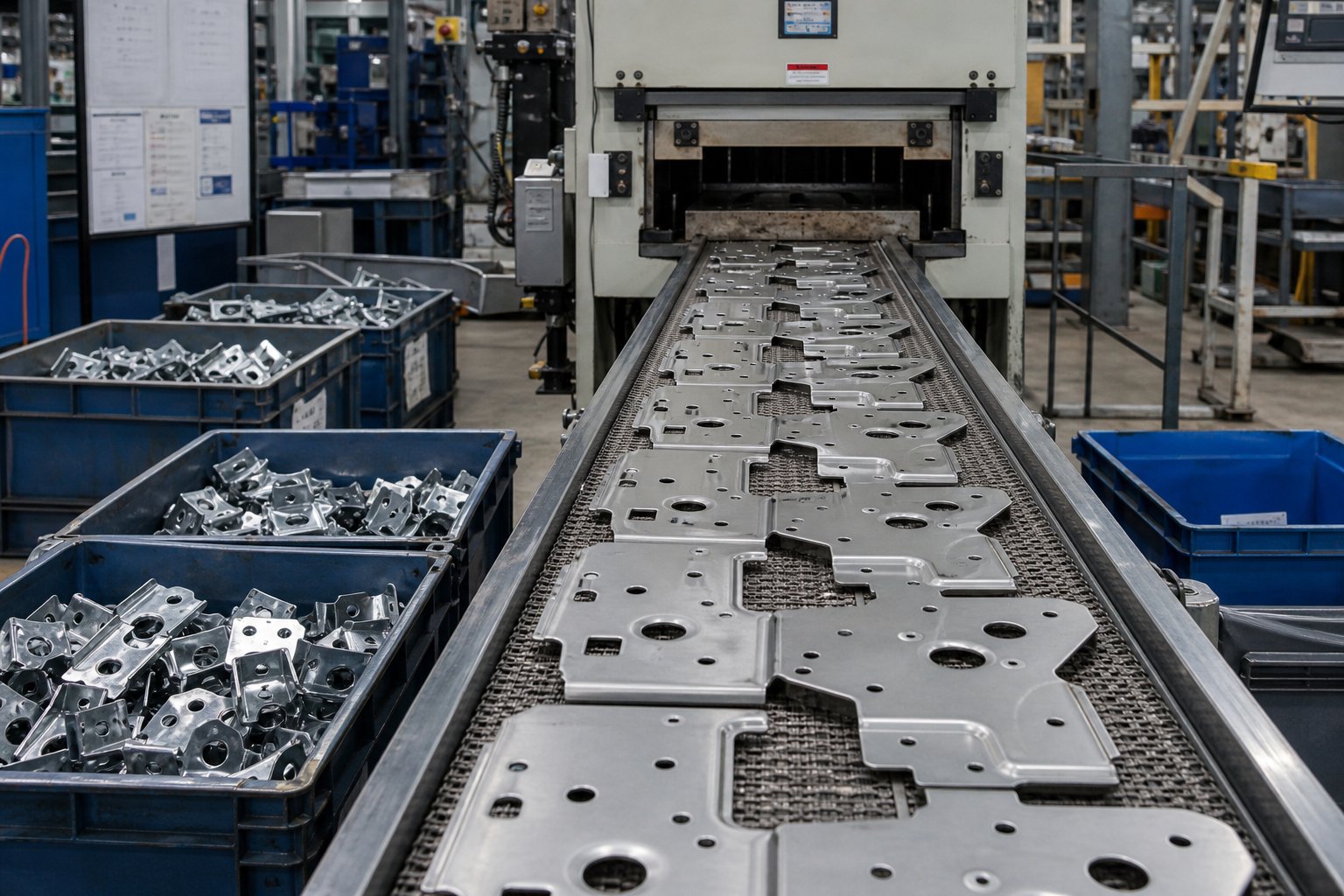
Quality Control and Secondary Operations in Wholesale Production
A stamped part that measures correctly on the first piece does not guarantee the millionth piece will be identical. Long production campaigns introduce variables that short runs never encounter: gradual punch wear that shifts hole diameters by microns per thousand strokes, lubricant breakdown that causes galling at forming stations, coil-to-coil material variation that subtly changes springback behavior. Progressive precision metal stampings demand monitoring systems that catch these drifts before they produce scrap, not after.
Equally overlooked by many procurement teams is what happens after the part leaves the die. Plating, heat treating, deburring, and sub-assembly steps can add days or weeks to lead time when outsourced to third parties. A wholesale factory that handles these operations under one roof compresses timelines and eliminates finger-pointing between vendors when something goes wrong.
Quality Monitoring from First Article to Mass Production
Quality at wholesale scale is not a final inspection gate. It is a continuous feedback loop that starts with the first article and runs uninterrupted through the last piece shipped. Here is how capable progressive stamping and fabrication operations structure that loop.
First-article inspection (FAI) establishes the baseline. Before a full production run begins, the factory produces a small batch, typically 30 to 50 pieces, measures every critical dimension against the control plan, and documents the results. This data set confirms that the die, press, material, and setup parameters together produce parts within specification. Any dimensional issues get corrected at this stage, where the cost of adjustment is minimal.
Statistical process control (SPC) then takes over during mass production. Rather than inspecting every part, which is impossible at 400 strokes per minute, operators sample at defined intervals and plot measurements on control charts. These charts track both the average value and the spread of critical dimensions over time. The power of SPC is in pattern recognition: a gradual upward trend in hole diameter signals punch wear before parts actually fall out of tolerance. A sudden shift in bend angle after a coil change flags material variation that needs compensation. Research into progressive stamping force monitoring confirms that the relationship between stamping force and part geometry is direct and measurable, making real-time force data a reliable proxy for dimensional conformance.
Real-time process monitoring adds another layer beyond manual sampling. Modern progressive die metal stamping services integrate load sensors into press columns that measure stamping force on every single stroke. When force signatures deviate from established baselines, the system flags the anomaly. A spike in tonnage might indicate a misfeed, where the strip did not advance the correct pitch and the die is attempting to punch through a double thickness. A gradual force increase across thousands of cycles signals die wear changing the cutting dynamics. These sensor-driven systems enable what the industry calls autonomous quality monitoring: the press itself alerts operators to problems before defective parts accumulate.
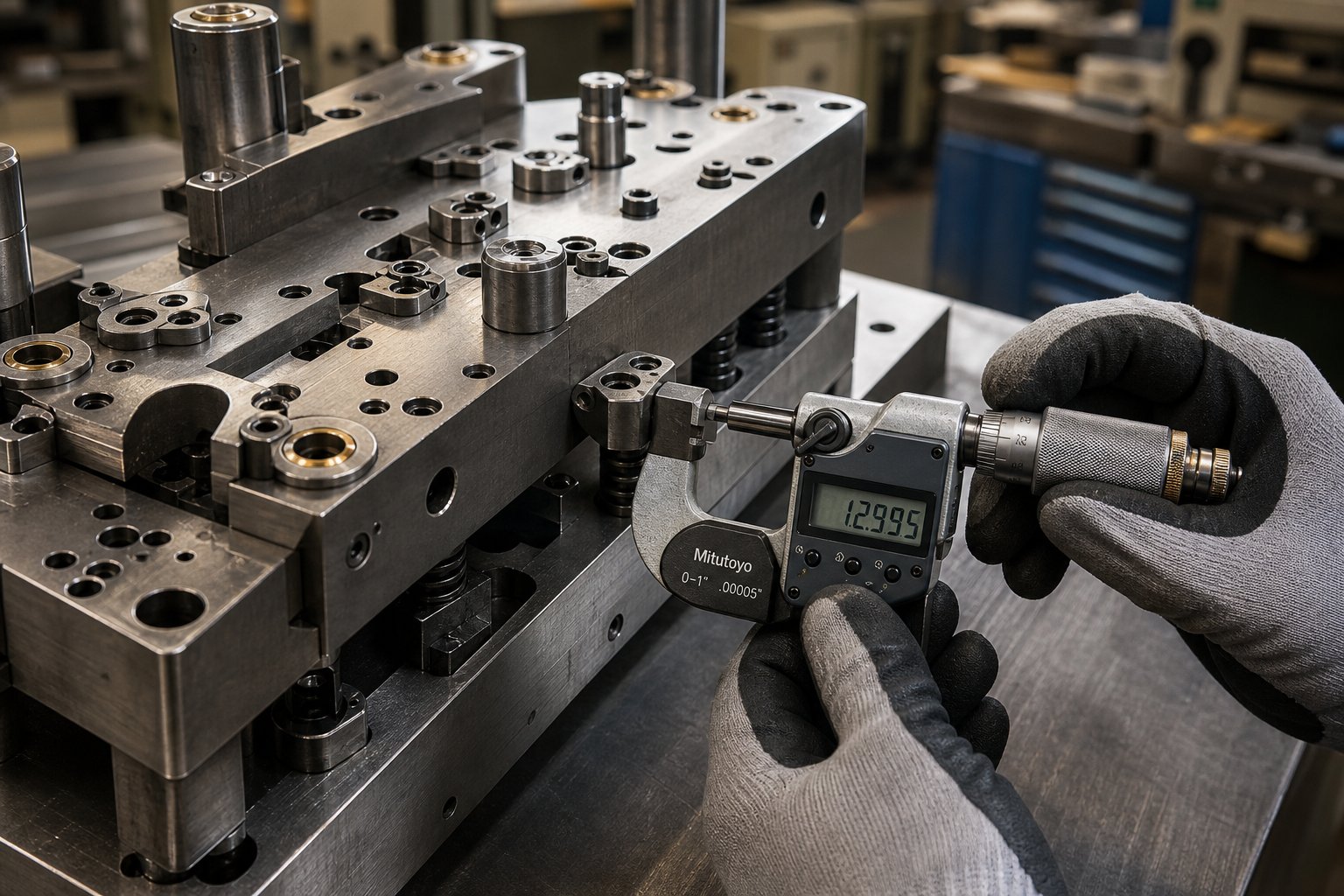
Die wear tracking deserves specific attention because it is the single largest source of dimensional drift in long-run production. Cutting edges dull progressively, and as they do, burr height increases, hole diameters open up slightly, and shear surfaces become rougher. Wholesale factories manage this through scheduled maintenance intervals based on stroke count rather than calendar time. A typical maintenance trigger might be every 200,000 to 500,000 strokes depending on material hardness and die construction. Between maintenance events, SPC data confirms whether the die remains within acceptable wear limits.
Burring specifically warrants its own control protocol. High-volume production amplifies small issues: a burr that measures 0.05 mm on the first shift might grow to 0.15 mm by third shift as punch edges degrade. Control plans define maximum allowable burr height for each feature, and inspection frequency increases as the die approaches its maintenance interval. For progressive precision metal stampings destined for electrical or medical applications, burr height limits can be as tight as 0.05 mm, requiring more aggressive monitoring and shorter sharpening cycles.
Misfeed detection rounds out the monitoring picture. When the strip fails to advance correctly, the die punches features in the wrong location, producing scrap and potentially damaging tooling. Sensor systems detect misfeeds within a single stroke by comparing pilot pin engagement force or strip position against expected values, stopping the press before the next cycle compounds the problem. At 600 strokes per minute, a one-second detection delay could mean 10 damaged parts rather than one.
Secondary Operations and In-House Integration
A stamped part is rarely a finished part. Most components need at least one post-stamping operation before they are ready for assembly. When those operations happen under the same roof as the press, you gain shorter lead times, simpler logistics, and clearer accountability. When they are outsourced, you gain scheduling uncertainty and additional shipping cycles.
Here are the most common secondary operations and why integration matters:
Deburring and surface finishing - Nearly all stamped parts carry some burr from cutting operations. Tumble deburring, vibratory finishing, or belt sanding removes sharp edges and prepares surfaces for coating. When handled in-house, parts move from press to deburring within hours. Outsourcing adds 3 to 7 days of transport and queue time at a minimum.
Plating and coating - Zinc plating, nickel plating, tin plating, powder coating, and e-coating all protect stamped parts from corrosion or provide specific surface properties. An integrated turnkey operation with in-house coating capability eliminates the most common source of lead time variability in stamped part programs. External plating vendors operate on their own schedules, batch parts from multiple customers together, and introduce handling that can damage delicate features. In-house plating gives the stamping factory direct control over rack design, bath chemistry, and process sequence.
Heat treatment - Carbon steel parts requiring specific hardness ranges, spring temper components needing stress relief, or stainless steel parts requiring passivation all benefit from on-site thermal processing. Heat treatment after forming locks in dimensional stability and removes residual stresses from bending operations. When outsourced, parts travel to a heat treater, sit in queue, get processed in batch furnaces alongside unrelated work, and return days later. Dimensional checks must be repeated after heat treatment because thermal cycling can cause warping, meaning outsourcing this step doubles inspection effort.
Assembly and sub-assembly - Some progressive die operations integrate fastener insertion, welding, riveting, or component assembly directly in-die or immediately downstream. In-die operations like nut insertion or contact welding happen while the part is still fixtured in the strip, guaranteeing positional accuracy that post-process assembly cannot easily match. Downstream assembly cells fed directly from the press eliminate inter-facility shipping and reduce work-in-progress inventory.
The cost impact of integration is straightforward: every outsourced operation adds transport cost, queue time, handling damage risk, and a communication layer where defects can go undetected. A factory offering progressive die metal stamping services with integrated secondary operations typically delivers 15 to 30 percent shorter lead times compared to one that outsources finishing, simply by removing transit days and vendor scheduling dependencies from the timeline.
For procurement teams, the practical question during supplier evaluation is not just whether the factory stamps parts well, but whether it can deliver them finished. A supplier handling everything from coil stock through plated, deburred, and assembled components under one quality system gives you one point of accountability and one timeline to manage. That consolidation matters far more at wholesale volumes, where any delay multiplies across thousands of units waiting in queue at an outside processor.
Quality systems and secondary capabilities tell you what a factory can do. The remaining question is whether that factory is the right long-term partner for your specific production program, given your volume trajectory, material complexity, and timeline expectations.
Choosing a Wholesale Factory Partner for Your Production Needs
You have the evaluation criteria. You understand cost structures, material dynamics, quality systems, and what secondary operations look like under one roof. The remaining challenge is pulling all of that knowledge into a decision that matches your specific production reality. Choosing a progressive die manufacturer is not about finding the "best" factory in abstract terms. It is about finding the right fit for your volume trajectory, part complexity, and supply chain constraints.
Decision Framework for Choosing Your Production Partner
Every sourcing decision sits at the intersection of five variables. Weight them according to your program's priorities, and you will narrow a field of progressive die stampings suppliers down to the two or three that genuinely align with your needs.
Volume requirements - Your annual quantity determines whether you need a factory optimized for long-run progressive stamping or one comfortable with mid-volume flexibility. A program consuming 2,000,000 parts annually needs a partner with multiple high-tonnage presses, automated coil handling, and scheduling depth to guarantee uninterrupted supply. A 50,000-piece annual program needs a supplier willing to run shorter campaigns without burying your order behind larger customers. Ask directly: where does my volume sit relative to your typical order size?
Material complexity - If your parts use standard low-carbon steel, nearly any capable factory can handle them. But if you are specifying phosphor bronze with tight spring-force requirements, or 17-4 PH stainless with biocompatibility traceability, the field narrows quickly. Match your material to a supplier with documented experience running that substrate in progressive tooling, not one that says "we can try it."
Tolerance needs - A factory running HVAC brackets at +/-0.15 mm all day may not have the measurement infrastructure or die maintenance discipline to hold +/-0.025 mm on an electronics contact spring. Confirm that the supplier's demonstrated Cpk values on similar features align with what your drawing demands.
Secondary operations - If your parts need plating, heat treatment, or assembly before they are usable, a supplier with integrated post-processing eliminates scheduling risk and transit damage. If your parts ship as-stamped, this factor carries less weight.
Geographic considerations - Proximity affects freight cost, lead time flexibility, and your ability to conduct site visits or audits. Domestic sourcing offers shorter logistics chains and simpler IP protection. Offshore sourcing may offer lower per-part pricing but introduces tariff exposure, longer ocean transit, and communication complexity across time zones. Neither is universally better. The right choice depends on your tolerance for supply chain variability and your total landed cost calculation.
A structured evaluation approach scores potential suppliers across these dimensions rather than defaulting to whoever returns the lowest quote. Factories that demonstrate strong customization and design capabilities, in-house trial and validation facilities, and scalable production systems tend to perform reliably across multi-year OEM progressive stamping programs where consistency matters more than initial price.
Starting a Wholesale Partnership with Confidence
Imagine you have identified a supplier that checks the right boxes. What does the path from initial conversation to steady-state production actually look like? The lifecycle of a progressive die stamping services engagement follows a predictable sequence, and understanding it upfront helps you plan realistic timelines and avoid surprises.
- Initial inquiry and feasibility review - You provide 2D drawings or 3D CAD models, specify material, annual volume, and tolerance requirements. The factory assesses manufacturability, identifies potential design-for-stamping improvements, and determines whether your part geometry suits progressive tooling versus alternative methods.
- Quotation and tooling proposal - The supplier returns a detailed quote covering die cost, per-part pricing at your specified volume tiers, expected die life, and lead time for tool build. This is where you apply the total cost of ownership framework from earlier sections: ask about maintenance intervals, scrap assumptions, and what is included versus excluded.
- Design for manufacturability (DFM) collaboration - Engineers from both sides refine part geometry to optimize strip layout, reduce station count where possible, and resolve any features that create tooling risk. This step can save 10 to 30 percent on tooling cost if you are open to minor design adjustments that do not affect part function.
- Tooling design and build - The die is engineered in CAD, reviewed against the control plan, and manufactured. For a complex multi-station progressive die, this phase typically takes 6 to 12 weeks depending on station count and material. Metal stamping die manufacturers with in-house toolrooms control this timeline directly; those outsourcing die construction add vendor coordination risk.
- Tool trial and first-article approval - The completed die runs trial samples on the production press. First-article inspection verifies all critical dimensions against the drawing. Adjustments are made, retrial samples produced if needed, and a formal approval package (PPAP for automotive, or equivalent documentation for other sectors) is submitted for your sign-off.
- Pilot production run - A limited production batch, often 1,000 to 5,000 pieces, validates process stability at production speed rather than trial speed. SPC data from this run confirms Cpk values and establishes baseline control charts for ongoing monitoring.
- Mass production and ongoing supply - With approval secured, the factory schedules your program into regular production campaigns. Ongoing quality reporting, die maintenance per the agreed schedule, and periodic re-qualification keep the program running without degradation over time.
This lifecycle applies whether your program runs 50,000 pieces annually or 5,000,000. The difference is scale of tooling investment, number of backup dies, and scheduling frequency. For high-volume programs, some buyers commission duplicate dies upfront so production continues uninterrupted during maintenance cycles.
As a concrete example of a factory structured around this lifecycle, YICHEN's Progressive Stamping Die service supports production engineers and procurement teams through each stage, from feasibility assessment through scalable mass production. Their focus on multi-station forming with tight repeatability aligns with the evaluation criteria outlined in earlier sections: in-house tooling capability, high-volume progressive die infrastructure, and a process built around serving OEM progressive stamping programs at wholesale scale.
Whatever supplier you select, the partnership succeeds or fails based on communication quality during the DFM and trial phases. Factories that invest time in collaborative engineering upfront, asking questions about your end-use application, suggesting material alternatives, and flagging tolerance features that drive unnecessary cost, tend to deliver smoother production and fewer surprises downstream. A quote is just a number. The relationship behind it determines whether that number holds true across your program's full production life.
Frequently Asked Questions About Progressive Die Metal Stamping Wholesale Factories
1. What is the difference between a progressive die stamping wholesale factory and a job shop?
A wholesale factory invests in dedicated progressive tooling designed for millions of cycles, amortizing that cost across high-volume production runs. Job shops handle custom, low-volume orders with frequent machine changeovers. Wholesale operations run long, uninterrupted campaigns at hundreds or thousands of strokes per minute, delivering significantly lower per-part costs once minimum order quantities, typically 10,000 to 50,000 pieces, are met. Their equipment, staffing, and quality systems are all optimized for repeatability at scale rather than flexibility across varied projects.
2. How much does progressive die tooling cost, and how is it amortized?
Progressive die tooling ranges from $30,000 for simpler tools to over $250,000 for complex multi-station dies. The cost is amortized across total production volume. For example, an $80,000 die producing 200,000 parts adds $0.40 per piece, but at 2,000,000 parts it drops to $0.04. Die life depends on construction: conventional tool steel dies last 500,000 to 1,000,000 strokes before maintenance, while carbide-insert dies exceed 2,000,000 strokes. Buyers should ask about expected die life, maintenance intervals, and resharpening costs to understand true long-term unit economics.
3. What certifications should a progressive die stamping wholesale factory have?
ISO 9001 is the baseline, confirming documented processes and calibrated equipment. IATF 16949 is mandatory for automotive supply chains and enforces rigorous tools like SPC, PPAP, and FMEA. ISO 13485 applies to medical device component manufacturers, requiring full lot traceability. When verifying certifications, confirm the scope explicitly covers metal stamping at the specific production site where your parts will be made. Check IATF listings through the official oversight database rather than relying on supplier claims alone.
4. How do I calculate total cost of ownership for wholesale progressive die stamped parts?
Total cost extends well beyond the quoted unit price. Factor in tooling maintenance and resharpening ($2,000 to $8,000 per cycle), scrap rates at volume, carrier strip waste, inbound coil freight, outbound packaging ($0.02 to $0.15 per piece), quality rejection and sorting labor, die storage between runs, and potential engineering change costs (20 to 50 percent of original tooling price). A supplier quoting a higher unit price with maintenance included may deliver better total economics than one with a lower price that bills these items separately.
5. What materials work best for high-volume progressive die stamping?
Low-carbon steel (1008-1018) offers the best cost-to-performance ratio with high formability and moderate tooling wear, ideal for brackets and structural parts. Stainless steel (304, 316) provides corrosion resistance but increases cutting force by 15 to 20 percent and accelerates tool wear. Copper alloys suit electrical applications with low tooling wear but higher material cost. Aluminum works for lightweight components but causes built-up edge on tooling surfaces. Material choice directly impacts die clearances, press tonnage, maintenance cycles, and ultimately per-part cost at volume.


