


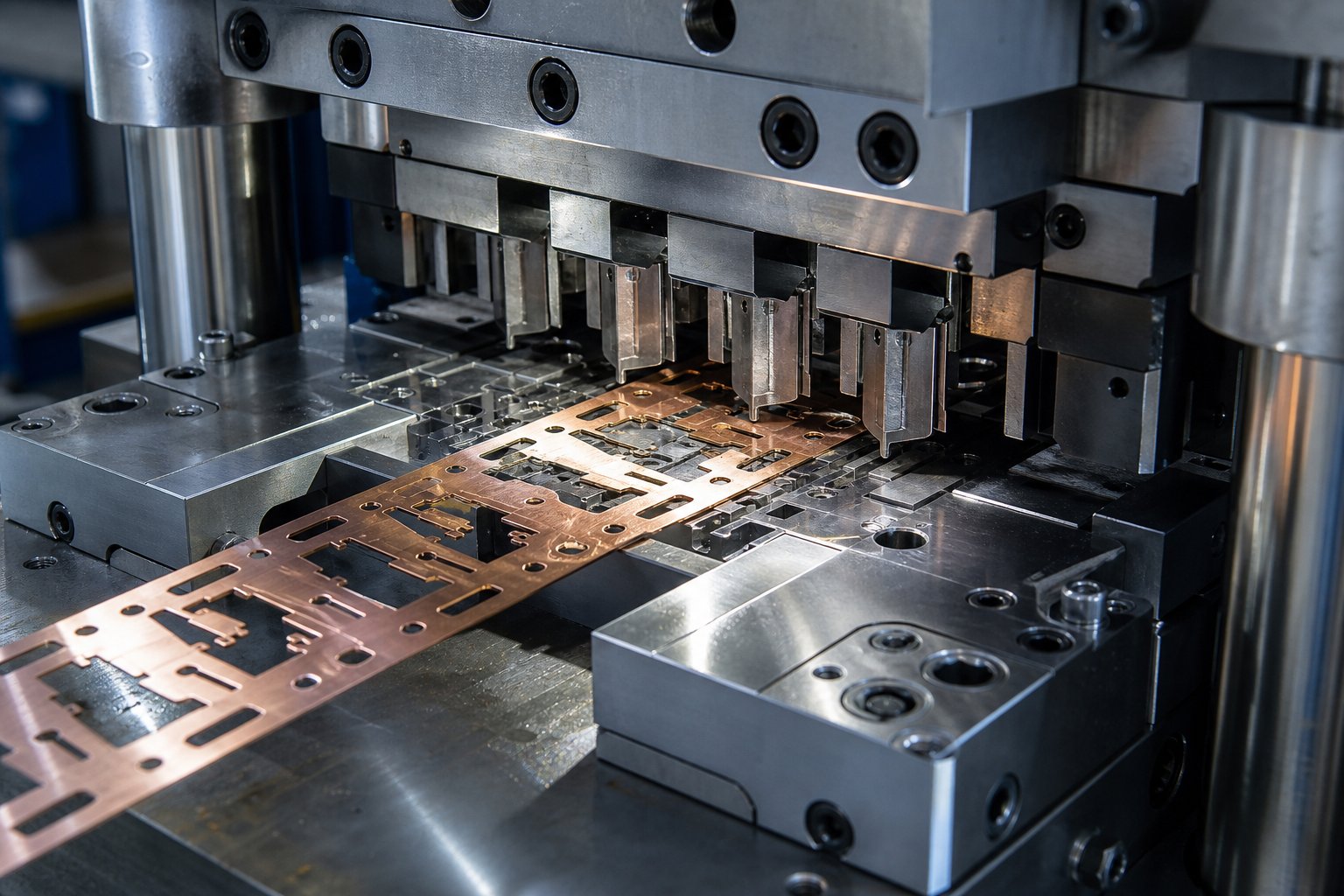
What Is Precision Die Stamping and Why Does It Matter
When you're designing components where a few thousandths of an inch determine whether a part fits or fails, standard metal stamping won't cut it. Precision die stamping exists specifically for these scenarios, where tolerances need to be tighter, tooling needs to be sharper, and every variable in the process is controlled to a degree that general fabrication shops simply don't offer.
Precision die stamping is a metal forming process that uses specially engineered dies and controlled press operations to produce parts with dimensional tolerances of ±0.001 inch (±0.025 mm) or better, achieved through tighter punch-to-die clearances, advanced tooling materials, and rigorous in-process monitoring.
What Precision Die Stamping Actually Means
The word "precision" isn't marketing language here. It refers to a measurable threshold. A precision die is engineered with punch-to-die clearances significantly smaller than those in general stamping, often reduced to 5-10% of material thickness instead of the typical 10-20%. This tighter clearance, combined with tooling built using wire EDM and precision grinding, produces cleaner edges, more accurate hole positions, and repeatable dimensions across millions of cycles.
For engineers designing small connectors, sensor housings, or medical device components, this level of control is the difference between parts that assemble reliably and parts that create downstream quality issues.
How It Differs from Standard Die Stamping
Standard die and stamping operations are well-suited for parts where tolerances of ±0.004 to ±0.008 inches are acceptable. The tooling is less costly, press controls are simpler, and inspection intervals are wider. Precision work raises the bar across every dimension:
- Tooling accuracy: Stamping die components are ground and finished to micron-level specs, with wear-resistant coatings extending usable life.
- Press controls: Servo-driven presses regulate speed and force on each stroke, reducing variation caused by mechanical inconsistency.
- Material handling: Strip stock is fed with positioning accuracy measured in microns, not tenths of millimeters.
- Inspection rigor: Statistical process control and real-time sensor feedback replace periodic spot checks.
The gap between standard and precision die and stamping capability shows up most clearly in rejection rates and Cpk values. Shops running precision operations typically maintain Cpk above 1.33 on critical dimensions, meaning the process is statistically centered well within tolerance boundaries.
These differences aren't just theoretical. They dictate what happens inside the press on every single stroke, from the moment the strip enters the die to the point where a finished part exits.
How the Precision Die Stamping Process Works Step by Step
A finished precision-stamped part might weigh a fraction of a gram, yet the process behind it involves a tightly coordinated sequence of engineering, machinery, and real-time control. Understanding how does a stamping press work in a precision environment means looking beyond the basic press cycle. Every phase, from the initial die design to the final inspection gate, contributes to whether those ±0.001-inch tolerances hold across a million-part production run.
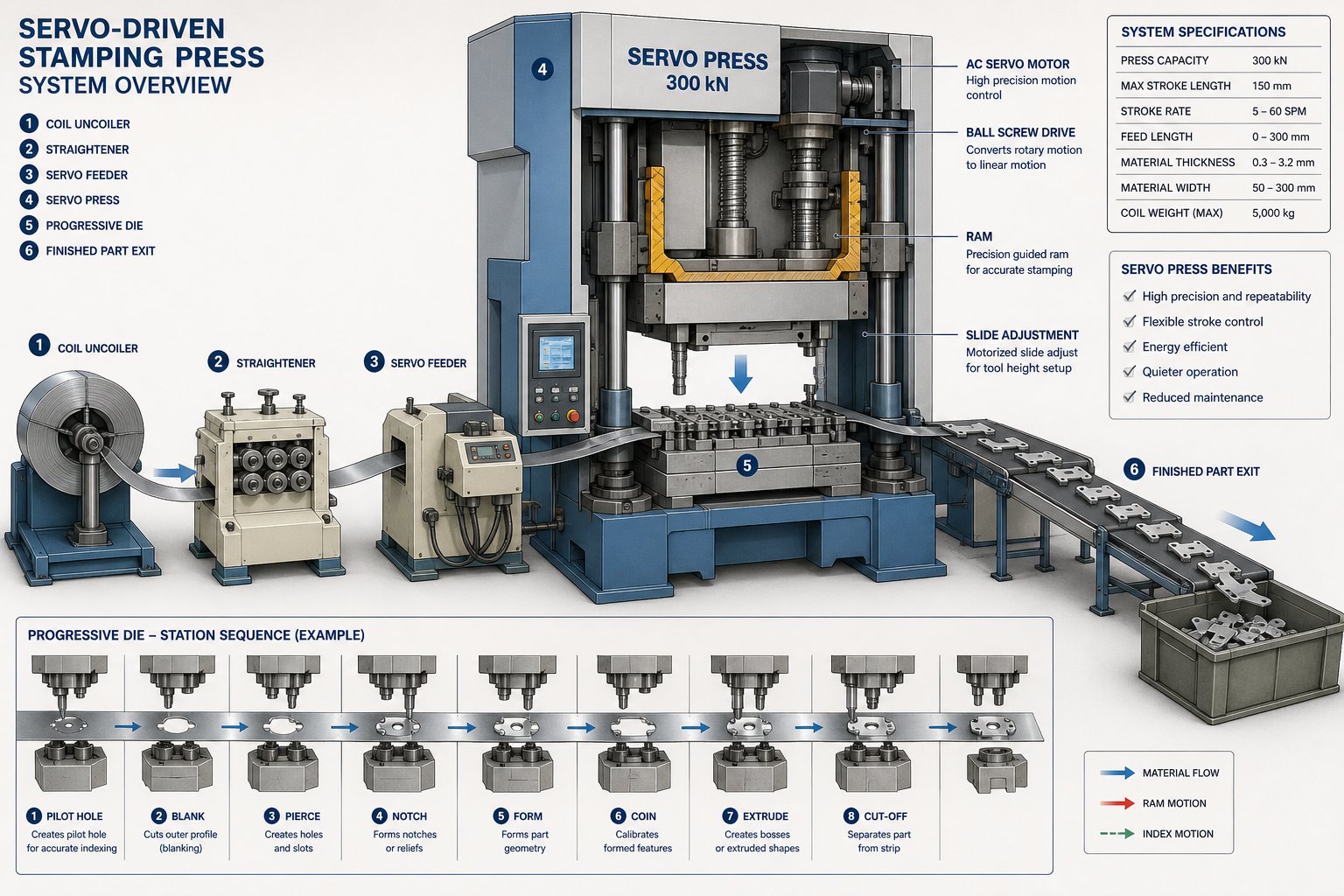
Here's how the progressive die stamping process unfolds from start to finish:
- Part and tooling design - Engineers model the die geometry using CAD/CAM software, defining station layouts, clearances, and material flow.
- Die fabrication - Precision grinding, wire EDM, and CNC machining produce die components to micron-level accuracy.
- Press setup and alignment - The die is mounted, the press stroke and tonnage are calibrated, and feed systems are synchronized.
- Material feeding - Strip stock advances through the die at controlled increments, positioned with micron-level accuracy.
- Stamping operations - Sequential stations blank, pierce, bend, and form the part progressively with each press stroke.
- In-process inspection - Sensors and SPC systems verify dimensions in real time, catching drift before it produces scrap.
- Part separation and collection - Finished components are cut from the carrier strip and sorted for packaging or secondary operations.
Tooling Design and Die Fabrication
Precision starts long before metal hits metal. The tooling design phase is where engineers translate part geometry into a functional die that can maintain tight tolerances at production speed. Using CAD software, designers lay out the progressive die stations, calculating punch-to-die clearances, strip layout, and pilot hole positions. CAM software then converts these designs into machining instructions for fabricating each die component.
Imagine a part with twelve features: holes, tabs, bends, and a final cutoff. Each feature gets its own station in the die, and the spacing between stations must account for material stretch, springback, and thermal expansion during operation. Even a small miscalculation in one station propagates downstream, compounding error across the finished part.
Die components are fabricated using wire EDM for intricate profiles, precision surface grinding for flatness and parallelism, and CNC milling for cavity work. Wire EDM is particularly critical here because it cuts hardened tool steel without introducing thermal distortion, achieving surface finishes and tolerances that conventional machining can't replicate. Punch and die inserts are typically made from carbide or high-speed tool steel, then finished to surface roughness values below Ra 0.2 micrometers.
Press Operation and Material Feed
The die stamping press is the engine of the operation, but in precision work, it's more like a finely tuned instrument. Servo-driven presses dominate this space because they offer programmable ram speed, position, and dwell time at any point in the stroke. Unlike mechanical presses locked into a fixed motion curve, servo presses can slow down during forming and speed up on the return, reducing material stress and improving dimensional consistency.
Feed accuracy is equally critical. The strip stock, typically supplied in coil form, passes through a straightener or leveler before entering the die. As MetalForming Magazine notes, servo presses demand dynamic feed systems with high acceleration and deceleration rates to match press speed within very small timing windows. If the feed advances even 0.05 mm too far or too short, pilot pins in the die can't properly register the strip, and every feature on that hit shifts out of tolerance.
Progressive stamping relies on this precise feed-and-advance cycle repeating hundreds or thousands of times per minute. The strip advances exactly one pitch length per stroke, pilots locate it in the die, and multiple stations perform their operations simultaneously. You'll notice that the die, press, and feed system function as a single integrated mechanism, not three separate machines.
In-Process Inspection and Controls
Holding tight tolerances across a long production run requires more than good tooling. Die wear, temperature drift, material variation, and feed inconsistencies all introduce gradual changes that can push parts out of spec. This is where real-time monitoring earns its value.
Modern precision progressive die stamping lines integrate several layers of in-process control:
- Force monitoring sensors - Detect abnormal tonnage spikes that indicate misfeeds, slug buildup, or die damage.
- In-die sensors - Measure part presence, strip position, and feature formation at individual stations.
- Statistical process control (SPC) - Tracks dimensional measurements over time, flagging trends before they reach tolerance limits.
- Vision systems - Optical cameras inspect finished parts at line speed, identifying burrs, cracks, or missing features.
- Feed-length verification - Confirms that each advance matches the programmed pitch within acceptable deviation.
These systems don't just catch bad parts. They provide the feedback loop that keeps the process centered. When SPC data shows a dimension trending toward its upper control limit, operators can adjust feed timing, replace a worn punch, or compensate for material property changes before a single reject is produced.
The combination of precision tooling, servo-controlled press operation, and closed-loop monitoring is what separates a true precision stamping operation from a shop that simply owns tight-tolerance dies. The die provides the geometry. The press provides the force. The controls provide the consistency. All three must work in concert, stroke after stroke, for the process to deliver on its promise.
Of course, the type of die used in the press determines much about what parts are feasible, what volumes make sense, and what geometries are achievable, which brings us to the decision between progressive, compound, and transfer die configurations.
Types of Stamping Dies Used in Precision Work
Not every part calls for the same die configuration. A tiny electrical contact running at 800 strokes per minute demands a fundamentally different tooling approach than a deep-drawn sensor housing produced at moderate volumes. The three major types of stamping dies used in precision applications, progressive, compound, and transfer, each address distinct combinations of part geometry, production volume, and tolerance requirements.
Progressive Dies for High-Volume Production
Progressive dies are the workhorse of high-volume precision stamping. The concept is straightforward: a continuous strip of metal feeds through a series of stations inside a single die, with each station performing a specific operation, blanking, piercing, bending, or forming. By the final station, a completed part is cut free from the carrier strip.
What makes progressive dies particularly suited to precision work is their ability to maintain tight positional relationships between features. Pilot pins register the strip at every station, so each operation references the same datum. For small parts with multiple features, like connectors, lead frames, or contact springs, this sequential approach produces complex geometries at speeds that other die types can't match.
The tradeoff? Higher upfront tooling cost and limited flexibility for design changes once the die is built. But for runs exceeding 100,000 parts, the per-piece economics are hard to beat.
Compound Dies for Flat Precision Parts
Compound die stamping takes a different approach. Instead of multiple sequential stations, a compound die performs blanking and piercing simultaneously in a single press stroke. The result is a flat part produced in one hit, with excellent dimensional accuracy and flatness.
This matters when your part is a washer, shim, lamination, or any component where flatness and concentricity between internal and external features are critical. Because all cutting operations happen in one stroke, there's no cumulative positioning error between stations. You get tighter relationships between holes and outer profiles than a progressive die can typically achieve on flat parts.
Compound stamping dies are generally less expensive to build and maintain, but they're limited to parts that don't require forming, bending, or multi-axis features.
Transfer Dies for Larger or Complex Geometries
Transfer die stamping handles parts that are too large or geometrically complex for progressive tooling. Instead of a connected strip carrying parts between stations, individual blanks are mechanically transferred from one station to the next using grippers or robotic arms.
This independence between stations allows deep draws, multi-axis forming, and operations that would be impossible while the part remains attached to a carrier strip. Automotive sensor housings, structural brackets, and shielding enclosures often rely on transfer die configurations. The elimination of the carrier web also reduces material waste, which offsets some of the higher tooling and setup costs.
Transfer systems run slower than progressive setups, making them better suited for medium-volume production where part complexity justifies the cycle time.
| Die Type | Best For | Typical Volume | Tolerance Capability | Relative Tooling Cost |
|---|---|---|---|---|
| Progressive Die | Small parts with multiple features | 100,000+ parts | ±0.001" achievable | High |
| Compound Die | Flat parts requiring concentricity | 10,000 - 500,000 parts | ±0.001" on flatness and hole position | Medium |
| Transfer Die | Large or deep-drawn geometries | 25,000 - 500,000 parts | ±0.002" - ±0.005" typical | High |
Choosing between these configurations isn't purely a technical decision. It's an economic one too. The right die type balances your part's geometric demands against production volume, material cost, and the tolerance window your application actually requires. And once that decision is made, the material you're stamping introduces its own set of constraints on what precision is realistically achievable.
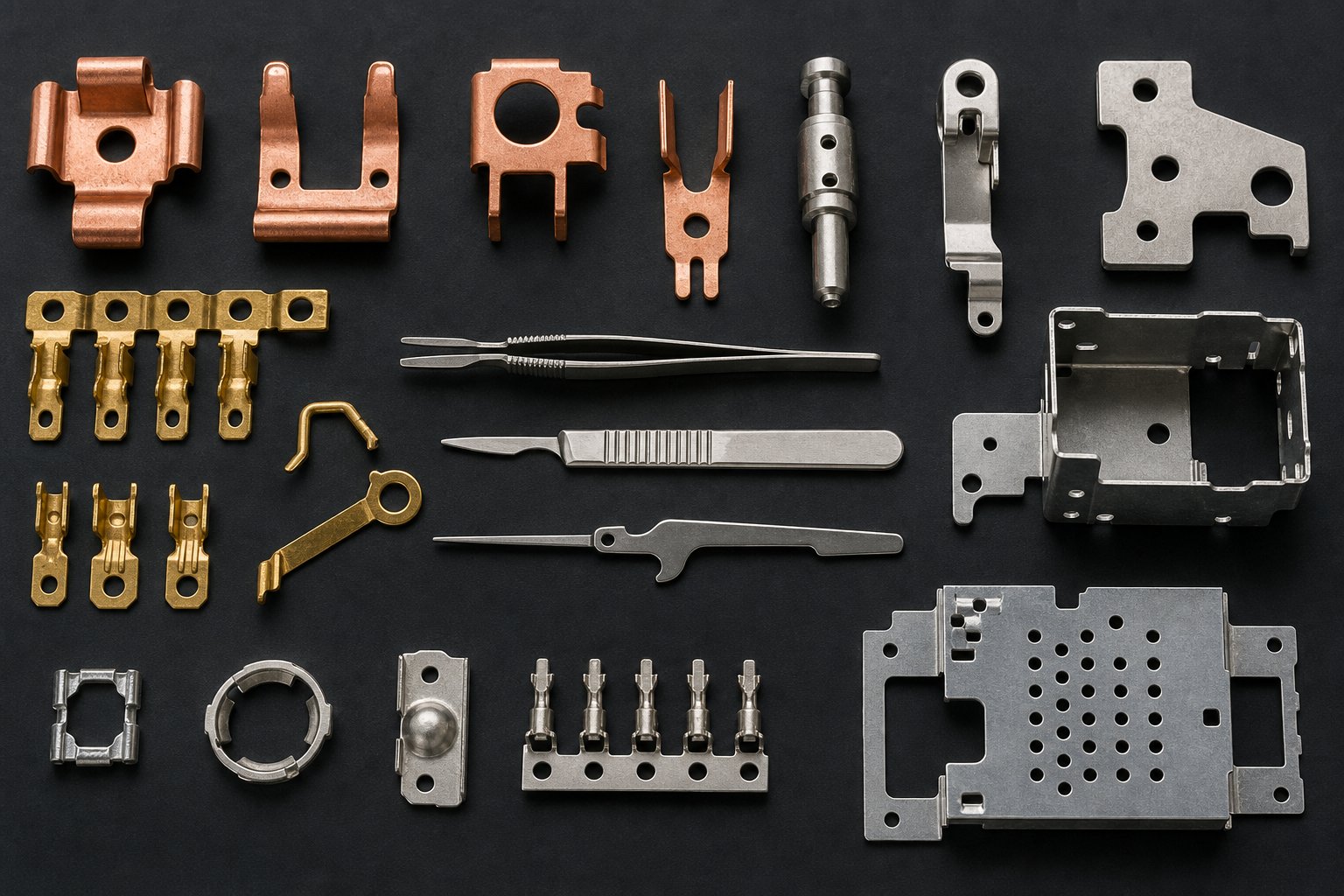
Materials and Tolerances in Precision Die Stamping
A die can be ground to micron-level accuracy and mounted in a servo press with perfect alignment, yet the finished part still drifts out of tolerance. Why? Because the material itself pushes back. Every alloy has a personality: it springs, stretches, work-hardens, and flows differently under the punch. Understanding how progressive stamping materials behave under precision conditions is what separates a realistic tolerance spec from one that drives up cost or invites rejections.
Common Materials and Their Stamping Characteristics
The metals most frequently processed in precision stamping share one trait: they're available in consistent, tightly-controlled strip form. Beyond that, each brings distinct advantages and challenges.
Carbon steel (mild steel) is the most forgiving material in the lineup. It offers high formability, predictable springback, and relatively low press forces. For brackets, structural clips, and general components, steel progressive stamping delivers reliable results at ±0.002" on pierced features without extraordinary measures. Its moderate work-hardening rate means dies wear evenly and parts behave consistently across long runs.
Stainless steel (primarily 300-series) demands more from the tooling. Higher yield strength translates to greater forming forces and more aggressive springback, particularly in half-hard and full-hard tempers. Precision work in stainless requires over-bending compensation built into the die geometry and tighter attention to lubrication. Tolerances of ±0.0025" are achievable on pierced holes, but formed features typically need wider allowances unless secondary sizing operations are added.
Copper alloys including C110, C194, and phosphor bronze are staples in electrical and electronic applications. Copper progressive stamping benefits from the material's excellent ductility and low springback, making it well-suited for intricate contact springs and lead frames where tight dimensional control on small features matters. The tradeoff is softness: copper galls easily against tooling surfaces, requiring polished die components or coatings to prevent buildup.
Aluminum (5052, 6061, 1100) offers very high formability and low density but introduces its own complications. It's more prone to galling than steel, tends to produce larger burrs at the same clearance percentage, and exhibits inconsistent springback behavior across different tempers. Precision aluminum stampings often call for slightly looser tolerances on formed dimensions, around ±0.003" to ±0.004", though flat pierced features hold ±0.002" without difficulty.
Brass (C260, C270) sits in a sweet spot for progressive precision metal stampings. It forms easily, springs back minimally, and cuts cleanly, producing excellent edge quality. Electrical terminals, decorative hardware, and instrument components frequently rely on brass for these reasons. The material's consistency makes it one of the most predictable alloys to stamp to tight tolerances.
| Material | Typical Thickness Range | Relative Formability | Common Applications |
|---|---|---|---|
| Carbon Steel (Mild) | 0.010" - 0.125" | High | Brackets, housings, clips, structural parts |
| Stainless Steel (304/316) | 0.005" - 0.080" | Medium | Medical devices, food equipment, corrosion-resistant components |
| Copper Alloys (C110, C194) | 0.004" - 0.040" | Very High | Connectors, lead frames, contact springs, bus bars |
| Aluminum (5052, 1100) | 0.008" - 0.100" | Very High | Enclosures, heat sinks, RF shields, automotive panels |
| Brass (C260) | 0.005" - 0.060" | High | Electrical terminals, decorative parts, instrument components |
Achievable Tolerances and What Affects Them
Sounds straightforward: tighter tooling means tighter parts. In reality, achievable tolerance depends on the interaction between material properties, part geometry, and process conditions. Here's what actually governs whether you can hold ±0.001" on a given feature:
Material thickness directly influences clearance behavior. Thinner materials (below 0.010") allow smaller absolute clearances, producing cleaner cuts and tighter hole-to-hole positioning. Industry design guides confirm that same-plane piercing between holes commonly holds ±0.002", and with precision tooling on thin stock, ±0.001" is realistic. Thicker materials amplify variation because the shear zone is larger and breakaway behavior becomes less predictable.
Springback is the single largest variable in formed features. Hard temper stainless or high-strength alloys can spring back 2-5 degrees after a 90-degree bend, requiring die compensation. Engineers experienced with precision stamping design the forming stations to over-bend by a calculated amount, but material lot-to-lot variation in yield strength introduces residual inconsistency. This is why formed angular tolerances (typically ±1 degree) are always wider than flat pierced dimensions.
Grain direction affects both formability and dimensional stability. Bends made perpendicular to the grain are stronger and less prone to cracking, but they also exhibit slightly different springback behavior than bends parallel to the grain. Precision strip layouts orient critical bends relative to the rolling direction to minimize these effects.
Die wear gradually opens punch-to-die clearances over the course of a production run, shifting dimensions in predictable ways. Experienced tooling engineers note that maintaining Cpk values above 1.33 on ±0.001" tolerances requires robust die frames, oversized guide systems, and scheduled maintenance intervals based on stroke counts rather than calendar time.
Feature size relative to material thickness creates practical limits. A hole diameter should be no smaller than the material thickness to prevent punch breakage. Features spaced closer than 1.5 times material thickness risk distortion from adjacent shear stresses. These constraints don't eliminate precision, but they define the boundary conditions that engineers must respect when specifying tolerances on their drawings.
For procurement teams and design engineers, the takeaway is practical: specify tight tolerances only where function requires them. A blanket ±0.001" callout across an entire part inflates tooling cost and slows production. Instead, identify the two or three critical datums and features that actually demand precision, and allow the remaining dimensions to float within standard stamping tolerances of ±0.005". This approach keeps tooling complexity manageable while still delivering the accuracy where it counts.
Material behavior and tolerance capability don't exist in a vacuum. They shape which industries can rely on precision stamping, and what specific components those industries trust this process to produce.
Industry Applications That Demand Precision Stamping
Some industries tolerate a few thousandths of variation without consequence. Others don't get that luxury. When a connector fails inside a vehicle's braking system or a medical implant housing leaks because a seal surface is 0.002" off, the consequences range from expensive recalls to patient harm. The industries that rely most heavily on precision die stamping share a common thread: their parts are small, produced in high volumes, and have zero room for dimensional ambiguity.
Automotive and Aerospace Components
Modern vehicles contain thousands of stamped metal parts, but not all of them require precision-grade tooling. The ones that do tend to cluster around electrical systems, sensor assemblies, and safety-critical mechanisms where tight fits and reliable contact are non-negotiable.
Automotive components progressive stamping produces at scale include:
- Electrical connectors and terminals - Pin sockets, blade terminals, and multi-pin headers for wiring harnesses that carry signals to airbag modules, ABS sensors, and engine management systems.
- Sensor housings - Stamped enclosures for proximity sensors, wheel speed sensors, and pressure transducers where dimensional accuracy ensures proper sealing and consistent sensor gap distances.
- Progressive die stamped brackets - Mounting components for electronic control units, cameras, and radar modules that must maintain positional accuracy across thermal cycles and vibration.
- Contact springs and battery clips - Small spring contacts inside key fobs, start buttons, and EV battery management connectors that require consistent contact force over millions of cycles.
The automotive sector's shift toward electric vehicles has intensified demand. A single EV battery pack may contain hundreds of precision-stamped bus bar connectors, cell spacers, and thermal interface brackets, all requiring tolerances that general stamping can't reliably hold at 500,000+ annual volumes.
Aerospace pushes even further. Aerospace stamping applications include structural brackets supporting avionics racks, relay housings for navigation and communication systems, precision frames for instrument clusters, and shielding enclosures that protect sensitive electronics from electromagnetic interference. These parts must perform in extreme temperature ranges, under vibration loads, and with full material traceability from raw stock to installed component. The volumes are lower than automotive, but the tolerance and documentation requirements are among the strictest in any manufacturing environment.
Medical Device and Electronics Applications
Imagine a pacemaker case stamped from titanium. It must be biocompatible, hermetically sealed, dimensionally perfect, and produced with complete traceability. That's the reality of medical device progressive stamping, where the stakes are measured in patient outcomes rather than warranty claims.
Medical progressive stamping produces components across several device categories:
- Implantable device enclosures - Titanium and 316L stainless steel cases for pacemakers, neurostimulators, cochlear implants, and drug infusion pumps, typically deep-drawn and finished to micron-level surface specifications.
- Surgical instrument components - Handles, jaws, and pivot housings that require smooth finishes for sterilization compatibility and precise dimensions for mechanical function.
- Diagnostic device elements - Stamped contacts, shielding, and structural frames inside blood analyzers, imaging equipment, and point-of-care testing devices.
- Battery cases and capacitor housings - Implantable battery enclosures that must withstand sterilization processes while maintaining dimensional integrity over decades inside the human body.
Biocompatibility requirements drive material selection toward specialized grades that the body won't reject, and surface finish specs often exceed anything found in other industries. A burr or rough edge isn't just a quality issue; it's a potential tissue irritation or bacterial harbor. This is why precision stamping, with its clean shear edges and repeatable surface conditions, is preferred over machining for many implant-scale components.
Electronics applications represent the highest-volume end of precision stamping. The electronics industry depends on stamped parts for conductivity, connectivity, and structural integrity across virtually every device category. Specific components include:
- RF and EMI shields - Thin-wall enclosures that isolate sensitive circuits from electromagnetic interference, requiring tight flatness and consistent wall thickness for proper grounding contact.
- Lead frames - The copper alloy carriers that connect semiconductor dies to external circuitry, stamped with feature widths measured in tenths of millimeters.
- Contact springs - Beryllium copper or phosphor bronze springs inside connectors, switches, and relays that must deliver consistent contact force across billions of mating cycles.
- Connector terminals - High-density pin arrays for USB, HDMI, and board-to-board interfaces where positional accuracy determines whether automated assembly succeeds or jams.
- Heat sinks and thermal spreaders - Stamped aluminum or copper components that manage thermal loads in LED lighting, power electronics, and mobile devices.
What these electronics applications share is a trend toward miniaturization. As devices shrink, the stamped components inside them get smaller and more densely featured. A connector terminal that was 2 mm wide five years ago may now be 0.8 mm, with proportionally tighter tolerances on every dimension. Progressive die stamping scales down effectively because the process fundamentals, controlled clearances, precise feed, and repeatable die geometry, work just as well at micro-scale as they do on larger parts.
Each of these industries chooses precision stamping over alternatives for the same core reasons: it delivers consistent accuracy at volumes where per-part cost matters, and it does so with the repeatability that safety-critical and performance-critical applications demand. But knowing that stamping fits your application is only half the equation. The other half is understanding how it stacks up against CNC machining, laser cutting, and other fabrication methods when your specific geometry, volume, and tolerance requirements are on the table.
Precision Die Stamping vs Alternative Fabrication Methods
Knowing your part needs tight tolerances doesn't automatically mean stamping is the answer. Engineers and procurement teams face a real decision matrix: CNC machining, laser cutting, fine blanking, chemical etching, and wire EDM all produce precise metal parts. The right choice depends on where your project sits across five variables: production volume, required tolerances, geometric complexity, material waste budget, and per-unit cost target.
Progressive metal stamping dominates certain regions of that matrix. But it's not universally superior, and pretending otherwise leads to expensive tooling decisions that never pay back. Here's where stamping wins, and where it doesn't.
When Precision Die Stamping Outperforms CNC and Laser
The economics of die metal stamping hinge on volume. A progressive die might cost $15,000 to $50,000 depending on complexity, but once it's running, per-part cost drops to pennies. CNC machining carries minimal setup cost, yet every part demands individual machine time. The crossover point, where stamping becomes cheaper per unit, typically falls between 1,000 and 5,000 units depending on part complexity. Beyond 10,000 parts, stamping's cost advantage becomes overwhelming.
Speed tells a similar story. A progressive die and stamping line producing 400 strokes per minute delivers parts faster in one hour than a CNC cell produces in a full shift. For programs requiring 100,000 or more annual units, no subtractive process competes on throughput.
Laser cutting appears flexible, but it introduces limitations that matter at precision scale. Laser-cut edges carry a heat-affected zone that alters material properties near the cut line. Edge quality degrades on thicker materials, and cutting speed drops dramatically below 0.020" thickness where precision-stamped components typically live. Laser also can't form, bend, or draw, meaning additional operations are always required to produce a three-dimensional part.
Material waste is another separator. Progressive stamping and fabrication operations consume only the material within the strip layout, with scrap limited to the carrier web and pilot slugs. CNC machining, by contrast, can waste 60-80% of the starting block as swarf. For expensive alloys like beryllium copper or phosphor bronze, that waste multiplier makes machining prohibitively costly at volume.
Where Alternative Methods May Be Better
Honest process selection means acknowledging where stamping isn't the right fit.
CNC machining wins when you need complex three-dimensional geometry from solid stock, quantities under 1,000, or tolerances tighter than ±0.0005" on mating surfaces. It also handles design changes without tooling rework, making it the default choice during prototyping and early development.
Chemical etching excels on extremely thin materials (below 0.005") where mechanical stamping forces would distort the part. It produces burr-free, stress-free edges without tooling investment, making it ideal for encoder disks, fine mesh screens, and flex circuit stiffeners. Design revisions cost almost nothing since geometry is defined by photo artwork rather than hardened steel.
Fine blanking occupies a niche between standard stamping and machining. It delivers fully sheared edges with near-zero breakaway zone, eliminating secondary grinding for parts like gears, sprockets, and cam plates that need functional edge surfaces. The tradeoff is slower cycle time and higher per-part cost than conventional progressive stamping.
Wire EDM produces the tightest tolerances of any cutting method, often ±0.0001", but at speeds measured in square inches per hour. It's a prototyping and tooling process, not a production method. If you need ten parts with extreme accuracy, wire EDM works. If you need ten thousand, it doesn't.
| Method | Best Volume Range | Tolerance | Geometric Limits | Per-Part Cost Trend |
|---|---|---|---|---|
| Precision Die Stamping | 5,000 - millions | ±0.001" | 2D profiles + formed 3D features; limited draw depth | Very low at volume; high tooling upfront |
| CNC Machining | 1 - 5,000 | ±0.0005" | Full 3D from solid; internal cavities; variable thickness | Flat per-part; no tooling amortization |
| Laser Cutting | 1 - 10,000 | ±0.005" | 2D profiles only; no forming; heat-affected edges | Moderate; scales poorly vs. stamping |
| Fine Blanking | 5,000 - 500,000 | ±0.001" | Flat profiles with full-shear edges; limited forming | Higher than progressive; lower than CNC |
| Chemical Etching | 100 - 50,000 | ±0.001" (material dependent) | 2D only; intricate patterns; no forming possible | Low setup; moderate per-part; no tooling risk |
The decision framework is straightforward. If your part is thin-gauge, needs forming or bending, demands tolerances at or below ±0.001", and runs above 5,000 units annually, precision die stamping is almost certainly your most economical path. Below that volume threshold, or when geometry demands full 3D machining or stress-free edges on ultra-thin stock, the alternatives earn their place.
Whichever process you choose, the part still needs to be designed for it. And in precision stamping specifically, the distance between a manufacturable design and an expensive headache often comes down to a handful of dimensional rules that many engineers don't encounter until their first tooling quote comes back with questions.
Design for Manufacturability in Precision Die Stamping
A part that looks clean in CAD can become a nightmare in tooling. Feature spacing that works on screen may crack under punch pressure. A bend radius that seems conservative might tear high-strength stainless at production speed. These aren't hypothetical problems. They're the reason progressive stamping die design demands a specific set of geometric rules that many engineers never encounter until a tooling quote comes back marked up in red.
Design for manufacturability (DFM) in precision stamping isn't about limiting creativity. It's about understanding what the die, the material, and the press can physically deliver, and then designing within those boundaries from the start. The payoff is fewer tooling iterations, lower reject rates, and stamping die parts that come off the press right the first time.
Critical Dimensions and Feature Spacing Rules
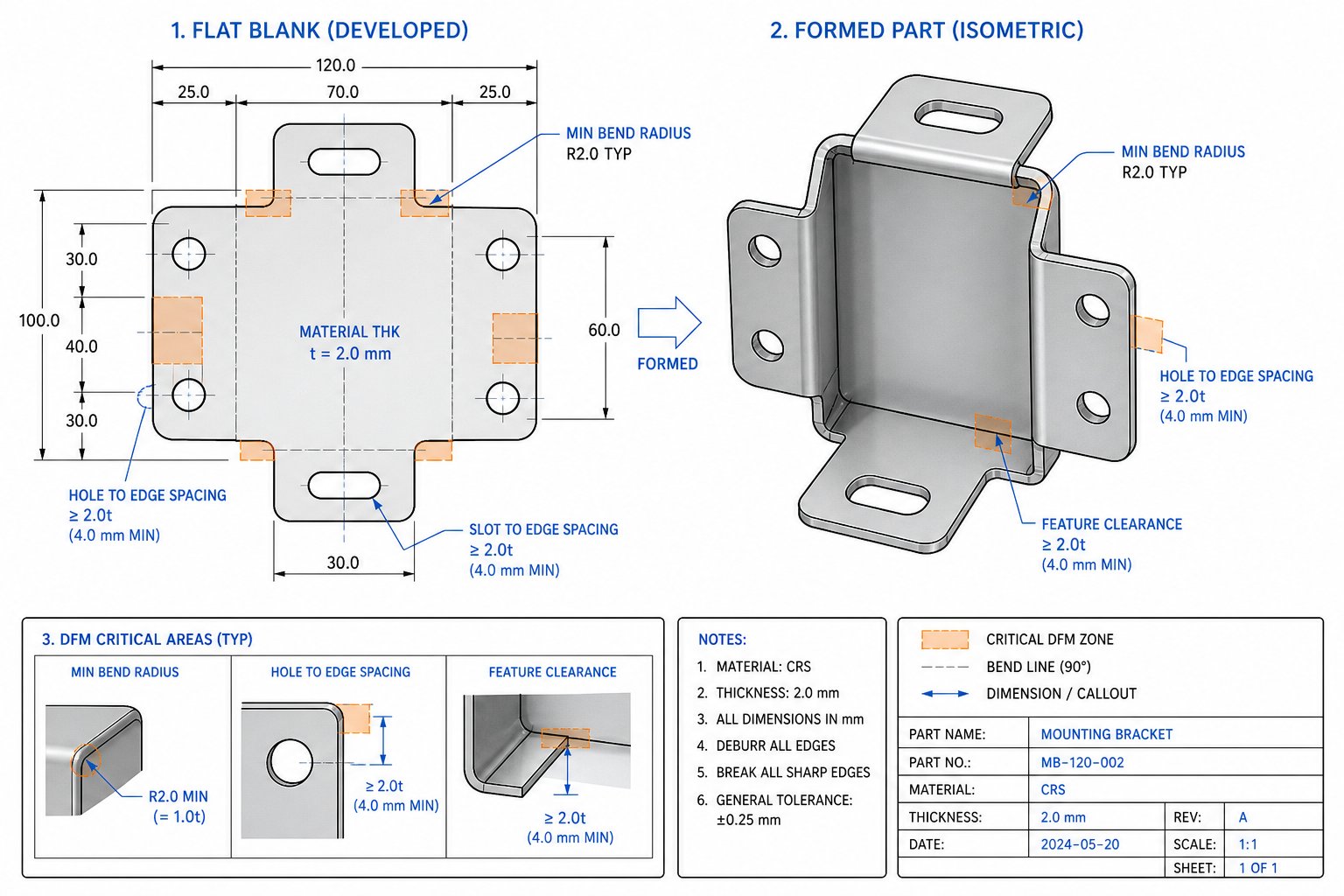
Every feature on a stamped part, holes, slots, tabs, edges, interacts with its neighbors through the material. Placing them too close together concentrates stress, weakens the material web, and causes distortion that cascades into adjacent features. Here's where the hard limits live:
Minimum hole diameter depends directly on material type and thickness. For ductile materials like aluminum or copper, the minimum hole diameter should be at least 1.2 times the material thickness (1.2T). For harder alloys like stainless steel, that minimum jumps to 1.5-2.0T because the punch absorbs greater lateral forces during shearing. Go smaller, and you're looking at frequent punch breakage and accelerated die wear.
Hole-to-edge distance is a common mistake area. Place a hole too close to the part edge, and the remaining material web bulges outward during the piercing stroke. The guideline is clear: maintain at least 2T between any hole or slot and the nearest edge. This keeps the material structurally intact during stamping and prevents deformation that no amount of secondary work can fully correct.
Hole-to-hole spacing follows the same logic. Minimum spacing between adjacent holes should be at least 2T to prevent the web between them from tearing or distorting under shear forces. For progressive die tooling, this constraint also protects pilot holes from being affected by adjacent piercing operations.
Minimum flange width for tabs and notches is 1.5T. Anything narrower puts extreme stress on the punch and creates features that are prone to bending or breaking during handling. When a tab's length exceeds five times its width, structural stability drops significantly and you risk damage during stamping and downstream assembly.
Bend, Draw, and Form Design Constraints
Forming operations introduce tensile stress on the outside of the bend and compression on the inside. If the geometry doesn't accommodate these forces, the material cracks, wrinkles, or springs back beyond acceptable limits.
Minimum bend radius is the most frequently violated rule. The inside bend radius must be at least 1.0 times the material thickness (1T) for most materials. For high-strength steels or tempered alloys, 1.5T is safer. Radii tighter than 1T concentrate stress at the bend apex and dramatically increase the probability of cracking, especially when the bend runs parallel to the grain direction. As established DFM references confirm, bends made perpendicular to the grain are far less susceptible to failure than bends aligned with it.
Minimum bend flange height must be at least 2.5T plus the bend radius. Shorter flanges can't be gripped properly by the forming punch, resulting in inconsistent angles and poor repeatability. When you try to form a flange that's too short, the material tends to slip rather than deform cleanly.
Feature placement near bends is another critical constraint. Holes or slots smaller than 0.100" in diameter should sit at least 2T plus the bend radius away from any bend line. Larger features need 2.5T plus the radius. Features placed closer than these minimums will distort, stretch, or shift during the forming operation because the material in the bend zone is actively flowing.
Draw depth ratios limit how deep a cup or shell feature can be formed in a single operation. A general rule is that the first draw should not exceed a depth equal to the blank diameter multiplied by 0.4-0.5. Deeper draws require multiple progressive stations with intermediate annealing or redraw operations, adding complexity to the progressive tool and die design.
Grain direction specification should appear on every drawing with formed features. Bending perpendicular to the rolling direction yields stronger bends and more predictable springback. Omitting this callout leaves the decision to the toolmaker, who may orient the strip layout for material efficiency rather than part performance.
Suppliers like YICHEN work with engineering teams early in the design phase to optimize part geometry for precision die stamping, reducing iterations and tooling costs before a single block of tool steel is cut. This kind of collaborative DFM review catches violations while changes are still free, on the screen rather than in hardened tooling.
Before requesting quotes, run your design through this checklist:
- Hole diameters are at least 1.2T (ductile) or 1.5-2.0T (hard alloys)
- Hole-to-edge and hole-to-hole spacing meets or exceeds 2T
- Internal bend radii are at least 1.0T (1.5T for high-strength materials)
- Bend flange heights are at least 2.5T plus the bend radius
- Features are placed at least 2T + bend radius from any bend line
- Tab and notch widths are at least 1.5T with length no more than 5x width
- All internal corners have a radius of at least 0.5T
- Grain direction is specified on the drawing for critical bends
- Burr direction is called out where orientation matters for assembly
- Draw depths do not exceed 40-50% of blank diameter per station
- Tolerances are applied selectively: tight only where function demands it
Every rule on this list exists because ignoring it leads to a specific, predictable failure mode: cracked bends, distorted holes, broken punches, or parts that measure differently on sample 1 versus sample 100,000. Following them doesn't guarantee a perfect die on the first build, but it eliminates the most common reasons for tooling rework and production scrap.
Design rules define what's feasible. But even a perfectly designed part can fall out of spec if the quality infrastructure behind the press isn't equally rigorous, which is why the inspection methods and certifications backing a precision stamping operation matter just as much as the tooling geometry itself.
Quality Control and Inspection in Precision Stamping
A well-designed die running on a capable progressive stamping press means nothing if the quality system behind it can't prove that parts are actually in spec. At production speeds of several hundred strokes per minute, even a brief process drift can produce thousands of nonconforming parts before anyone notices. That's why the inspection infrastructure, the measurement tools, process monitoring, and certifications underpinning a precision operation, matters as much as the tooling itself.
Inspection Methods and Measurement Tools
Precision stamping operations rely on a layered measurement approach. No single tool covers every feature, so capable suppliers deploy a combination of methods matched to the criticality and geometry of each dimension.
First-article inspection (FAI) validates a new setup before production begins. A sample part is measured against every drawing dimension using high-accuracy instruments, confirming that the die, press, and stamping feed system are producing conforming parts before committing to a full run. This step catches setup errors when they're cheapest to fix.
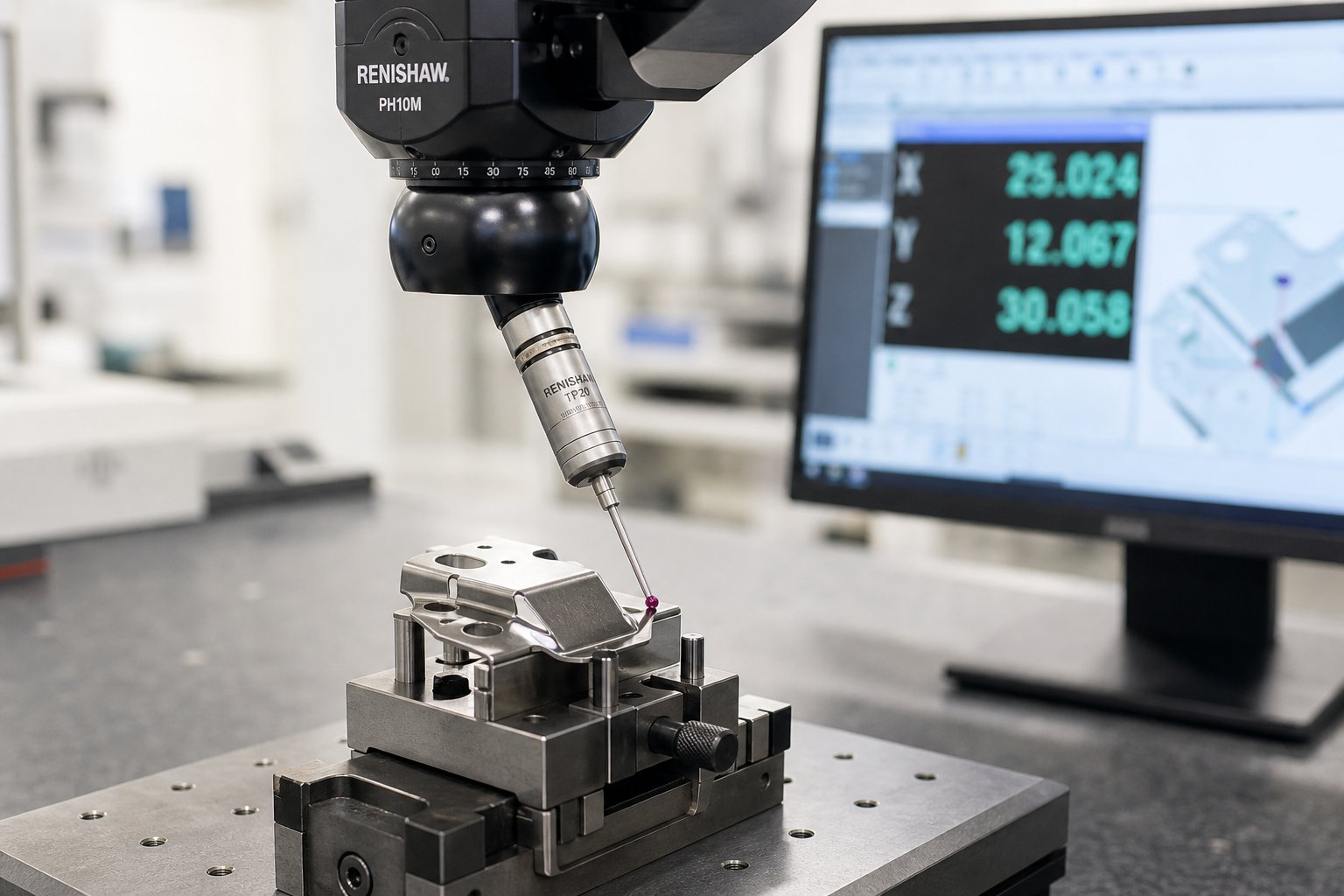
Coordinate Measuring Machines (CMM) handle complex geometries where multiple features must relate to shared datums. A CMM probe touches or scans part surfaces to build a three-dimensional measurement model, verifying hole positions, profile tolerances, and flatness to micron-level resolution. For parts running on a high speed progressive die stamping line, CMM data from periodic samples confirms that dimensional relationships remain stable across long runs.
Optical comparators and vision systems project a magnified part silhouette onto a screen or camera sensor, allowing operators to check profiles, radii, and edge conditions quickly. Automated vision inspection integrated into the progressive die press line can evaluate every part at production speed, flagging burrs, cracks, or missing features without slowing output.
Go/no-go gauges provide fast, binary confirmation of critical features. A pin gauge either fits a hole or it doesn't. A slot gauge either passes through or it stops. These tools excel at high-frequency production checks where speed matters more than recording exact values.
Statistical Process Control (SPC) ties all these measurements together over time. As The Fabricator details, load monitors on stamping presses can track force data for every stroke and express it in X-bar and sigma charts, detecting trends before parts drift out of tolerance. SPC doesn't just catch defects. It predicts them, giving operators time to adjust the process, replace a worn punch, or correct a feed deviation while parts are still conforming.
Certifications and Process Control Standards
Certifications tell you what quality system a supplier has built, what external auditors have verified, and which industries that supplier is qualified to serve. For engineers evaluating stamping partners, here's what each certification actually means:
- ISO 9001 - The baseline quality management system standard. It establishes documented processes, corrective action procedures, and continuous improvement frameworks. Necessary but not sufficient for high-criticality applications.
- IATF 16949 - The automotive-specific standard built on top of ISO 9001. It adds requirements for production part approval (PPAP), advanced product quality planning (APQP), and failure mode analysis (FMEA). Required by most major automotive OEMs and Tier 1 suppliers.
- ISO 13485 - The medical device quality management standard. NSF notes that ISO 13485 emphasizes regulatory compliance and risk management over continuous improvement, with prescriptive documentation requirements, enhanced traceability for implantable devices, and formal complaint handling processes. It's recognized by regulatory agencies worldwide, including the FDA, Health Canada, and EU MDR bodies.
- AS9100 - The aerospace quality standard. It adds requirements for configuration management, risk management at every process stage, and rigorous traceability from raw material through final delivery. Expect stricter first-article inspection protocols and counterfeit part prevention programs.
A supplier holding IATF 16949 or AS9100 has already demonstrated capability beyond basic quality management, including process control, measurement system analysis, and workforce competency verification. Adding ISO 13485 on top requires further investment in device-specific controls like contamination prevention, personnel hygiene procedures, and post-market surveillance systems.
When evaluating a precision stamping supplier, don't just ask whether they hold a certification. Ask what their Cpk targets are on critical dimensions, how frequently they sample during production, and what happens when SPC signals a trend. The certificate on the wall confirms a system exists. The answers to those questions tell you whether that system actually works at the point where metal meets die, stroke after stroke, across millions of parts.
Quality infrastructure keeps parts in tolerance. But tolerance is only one half of the value equation. The other half, cost, determines whether precision stamping makes financial sense for your program, and that calculation depends on variables most engineers don't see until they start requesting quotes.
Cost Factors and Economics of Precision Die Stamping
Tooling quotes for precision die stamping can cause sticker shock. A progressive die designed for tight-tolerance work might carry a price tag of $30,000 to $250,000 depending on station count, material, and complexity. But that number in isolation is misleading. What matters is how that investment translates into per-part cost across your production volume, and whether the total economics beat the alternatives over the life of the program.
Tooling Investment and Volume Economics
Think of die cost as a fixed tax spread across every part the tool produces. A $50,000 progressive die running 500,000 parts adds just $0.10 per piece in tooling amortization. That same die producing only 5,000 parts adds $10.00 per piece, a 100x difference that makes or breaks the business case for progressive die metal stamping.
Expected die life depends on material being stamped, tolerance requirements, and tool steel selection. A well-built precision die stamping carbide-insert tooling running copper alloys can deliver 10 million or more strokes before major refurbishment. Harder materials like stainless steel shorten that window to 1-5 million strokes, depending on feature complexity and maintenance discipline. Lower-tier tooling may only warrant 100,000 to 500,000 strokes before needing rework, which is why choosing a qualified progressive die manufacturer matters for long-term economics.
The volume threshold where stamping outperforms alternatives typically falls between 10,000 and 50,000 annual units for moderate-complexity parts. Below that range, CNC machining or laser cutting avoids the tooling investment entirely. Above it, long run progressive stamping delivers per-piece costs that no subtractive process can approach, often dropping below $0.05 for simple geometries in high volumes.
Factors That Drive Per-Part Cost Up or Down
Beyond tooling amortization, several variables shift your landed cost per piece. Understanding these drivers helps you optimize designs and negotiate quotes more effectively.
Cost drivers ranked by typical impact on per-part pricing:
- Material type and thickness - Raw material accounts for 45-55% of per-unit cost. Stainless steel and copper alloys cost 3-5x more than mild steel by weight, and harder materials accelerate die wear, increasing maintenance frequency.
- Part complexity and station count - Each forming station adds tooling cost, increases die maintenance needs, and slightly reduces production speed. A 12-station progressive die costs roughly twice what a 6-station tool does.
- Tolerance requirements - Tighter tolerances demand more frequent die sharpening, slower press speeds, and additional inspection. Moving from +/-0.005" to +/-0.001" on critical features can increase per-part cost by 20-40%.
- Secondary operations - Plating, heat treating, tapping, or assembly after stamping adds $0.10-$1.00+ per part depending on the operation. In-die operations (tapping, hardware insertion) cost more upfront in tooling but reduce handling and per-piece labor.
- Production volume and order frequency - Setup charges ($200-$1,000 per run) get spread across fewer parts in small batches. Blanket orders with scheduled releases reduce setup frequency and improve material purchasing leverage.
- Material waste (strip utilization) - Efficient strip layout design can achieve 70-85% material utilization. Poor nesting burns material, and for expensive alloys, that waste hits the bottom line hard.
- Quality and documentation requirements - Certifications like IATF 16949 or ISO 13485 add audit, documentation, and inspection overhead. Suppliers holding these certifications typically charge 20-40% more than non-certified shops, but they deliver the process control that critical applications demand.
Total cost of ownership extends beyond the initial quote. Factor in die maintenance intervals, expected refurbishment costs (typically 10-20% of original tooling price per cycle), spare component inventory, and the production downtime associated with scheduled maintenance. A progressive stamping company that provides transparent maintenance schedules and die life projections helps you budget accurately rather than absorbing surprise costs mid-program.
For teams evaluating tooling partners, YICHEN specializes in precision stamping dies engineered for repeatable mass production, helping teams balance tight tolerances with economical high-volume output. Their focus on small, high-accuracy progressive die stampings means tooling is designed from the start for the stroke counts and maintenance intervals that long production programs require.
The most effective cost optimization doesn't happen at the quoting stage. It happens during design. Relaxing non-critical tolerances, consolidating features to reduce station count, selecting materials that balance performance against die wear, and committing to volumes that justify the tooling investment are all decisions that compound into significant savings across a program's lifetime. Work with your progressive die manufacturers early, share your volume forecasts honestly, and design for the process rather than forcing the process to accommodate a design that was never built with stamping economics in mind.
Frequently Asked Questions About Precision Die Stamping
1. What tolerances can precision die stamping achieve?
Precision die stamping routinely holds dimensional tolerances of ±0.001 inch (±0.025 mm) on pierced features and flat-plane dimensions. Achievable precision depends on material type, thickness, and feature geometry. Thinner materials below 0.010 inch allow tighter hole positioning, while formed features like bends typically hold ±1 degree due to springback variables. Engineers should specify tight tolerances selectively on critical datums rather than applying blanket callouts across all dimensions, which inflates tooling cost without functional benefit.
2. What is the difference between progressive die stamping and compound die stamping?
Progressive dies feed a continuous metal strip through multiple stations, each performing a different operation such as blanking, piercing, or bending, producing a completed part at the final station. They excel at high-volume production of small parts with multiple features. Compound dies perform blanking and piercing simultaneously in a single press stroke, producing flat parts with superior concentricity between internal and external features. Compound dies cost less to build but cannot form three-dimensional features. The choice depends on whether your part requires forming operations and what volume levels justify progressive tooling investment.
3. How much does precision die stamping tooling cost?
Progressive die tooling for precision work typically ranges from $30,000 to $250,000 depending on station count, material hardness, and tolerance requirements. However, this upfront cost amortizes across production volume. A $50,000 die producing 500,000 parts adds only $0.10 per piece in tooling cost. Die life varies from 1 to 10+ million strokes based on the material being stamped and maintenance discipline. Carbide-insert tooling running soft alloys like copper lasts longest, while stainless steel applications shorten tool life significantly. Working with specialized suppliers like YICHEN, who engineer precision stamping dies for repeatable mass production, helps optimize tooling design for maximum service life and cost efficiency.
4. What materials work best for precision die stamping?
The most commonly stamped materials in precision applications include copper alloys (C110, C194, phosphor bronze), brass (C260), mild carbon steel, stainless steel (304/316), and aluminum (5052, 1100). Copper and brass offer the best combination of formability and dimensional predictability, making them ideal for electrical connectors and contact springs. Carbon steel provides high formability at lower cost for structural components. Stainless steel demands more die compensation for springback but serves medical and corrosion-resistant applications. Material selection directly impacts achievable tolerances, die wear rates, and per-part cost.
5. When should I choose precision die stamping over CNC machining?
Precision die stamping becomes more economical than CNC machining once annual volumes exceed approximately 5,000 to 10,000 units for moderate-complexity parts. Above this threshold, the tooling investment amortizes to pennies per piece while CNC carries a fixed per-part machine time cost. Stamping also wins on speed, producing hundreds of parts per minute versus individual machining cycles. However, CNC remains the better choice for quantities under 1,000 units, complex three-dimensional geometries machined from solid stock, or tolerances below ±0.0005 inch. CNC also handles design changes without tooling rework, making it preferable during prototyping phases.


