


What Automotive Stamping Dies Are and Why They Matter
When a flat coil of steel becomes a fender, a structural rail, or a bracket bolted deep inside your vehicle, the transformation happens inside a stamping press, driven by a purpose-built tool. That tool is the die, and getting it right determines whether a production program hits its cost, quality, and timing targets.
Defining Automotive Stamping Dies
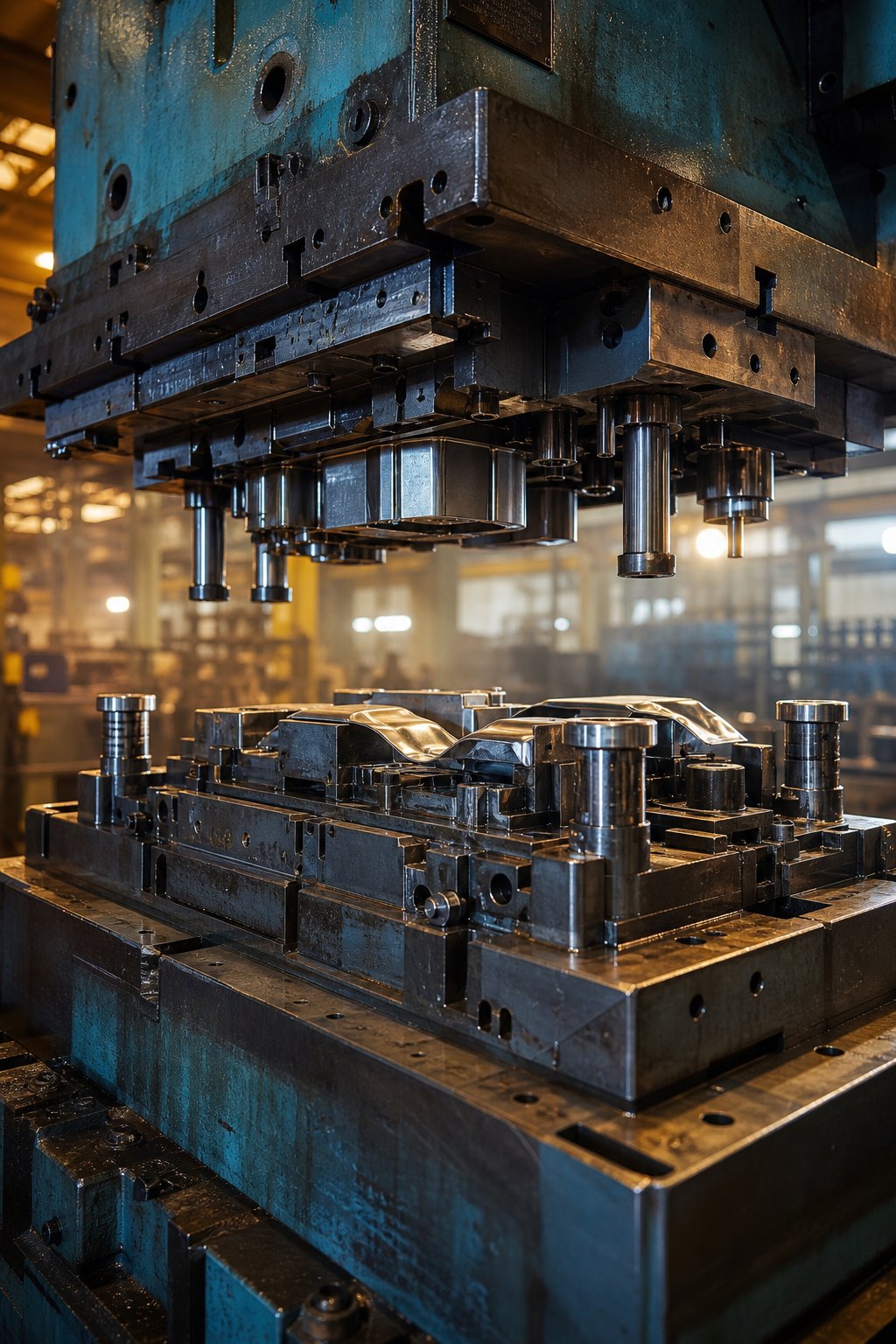
Automotive stamping dies are precision-engineered tool sets, typically made from hardened tool steel or carbide-inserted alloys, that cut, form, and shape sheet metal into vehicle components by applying controlled force through a high-tonnage press.
Each die set consists of matched upper and lower halves containing punches, die blocks, strippers, and guide systems that work together to produce repeatable parts at production speed. As the SME describes it, stamping dies are the tools that shape and cut sheet metal parts, developed using CAD software and analytical programs, then translated into physical tooling by skilled diemakers. In auto parts manufacturing, these tools form the backbone of every body panel, structural reinforcement, and interior metal component rolling off the line.
Why Die Selection Drives Manufacturing Success
Imagine specifying a die that produces clean parts but can't keep pace with your takt time, or one that runs fast but generates scrap rates that erode your margin. Die selection sits at the intersection of three competing pressures:
- Production cost - tooling investment, maintenance frequency, and material utilization all trace back to die type and design choices.
- Part quality - dimensional accuracy, surface finish, and burr control depend on correct clearances, material flow management, and die construction quality.
- Cycle time - the number of stations, press speed compatibility, and part transfer method directly govern strokes per minute.
For OEM engineers specifying automotive dies on a new platform, these trade-offs shape program feasibility from the earliest concept phase. For Tier 1 and Tier 2 teams investing in die assets to win production contracts, the wrong choice can lock in unfavorable economics for the life of the program. Automotive metal stamping operations demand that both groups align on die type, material, and build quality before steel is ever cut.
The decisions get nuanced quickly. Part geometry, annual volume, material grade, and press availability all interact, and each die type carries a distinct profile of strengths and limitations. The sections ahead break down those types side by side, walk through how dies are built, and map the technical trade-offs that separate a profitable stamping program from a troubled one.
Complete Comparison of Automotive Stamping Die Types
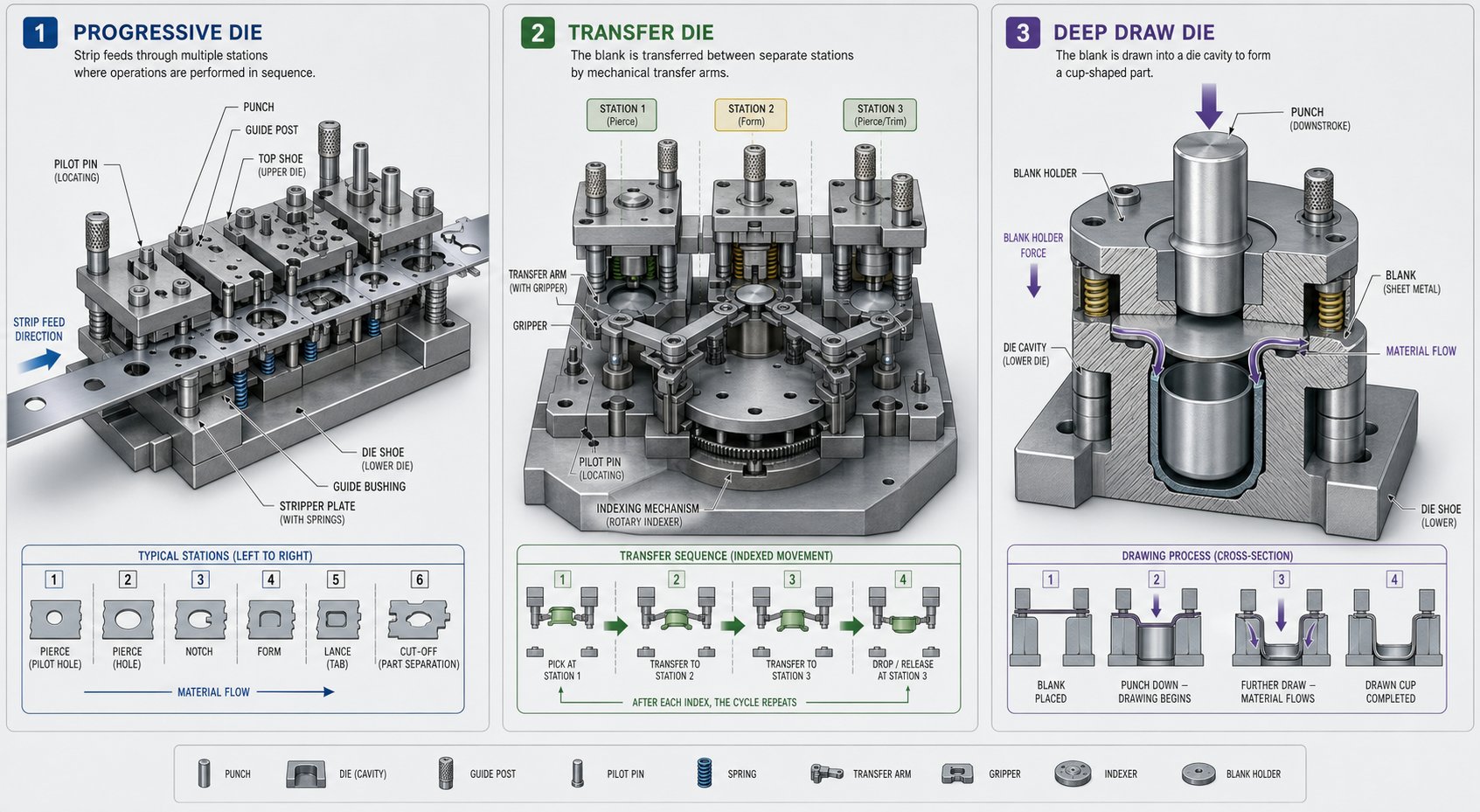
Each die type solves a different production problem. Part geometry, volume targets, and material grade steer the decision, but understanding how each configuration actually works is the foundation for making the right call. Below is a side-by-side breakdown of the major sheet metal stamping dies used across vehicle programs today.
| Die Type | Operating Principle | Best-Suited Automotive Parts | Production Volume Range | Complexity Level | Key Limitations |
|---|---|---|---|---|---|
| Progressive | Metal strip advances through multiple stations in a single die set; each stroke completes one operation per station | Brackets, seat belt anchors, electrical connectors, small structural reinforcements | High (100k+ annually) | Medium to High | Part size limited by strip width and press bed; deeper draws are difficult |
| Transfer | Individual blanks move mechanically or robotically between independent die stations | Structural cross members, suspension brackets, large body reinforcements | Medium to High (50k+) | High | Higher capital cost; slower cycle time than progressive; requires automation infrastructure |
| Tandem | Series of single-operation presses arranged in line; part transfers between presses | Large body-in-white panels (doors, hoods, fenders) | Medium to High | High | Large floor space; significant capital investment; complex logistics |
| Compound | Multiple cutting operations (blanking + piercing) executed simultaneously in one stroke | Flat precision parts, washer-like components, reinforcement plates | Medium to High | Medium | Limited to relatively flat geometries; higher tooling cost than single-operation dies |
| Combination | Cutting and forming operations combined in a single stroke | Formed brackets with holes, electrical terminals, powertrain shims | Medium to High | Medium to High | Complex die construction; tighter maintenance intervals |
| Deep Draw | Blank holder and punch draw material into a cavity to create hollow or cup-shaped geometry | Fuel tanks, structural housings, body panel sections, battery enclosures | Medium to High | High | Requires precise material flow control; prone to wrinkling and tearing |
| Trim/Pierce | Removes excess material and adds holes or slots after forming is complete | Final-stage processing on nearly all stamped body and structural parts | All volumes | Low to Medium | Secondary operation adds cycle time; cutting edges wear quickly on AHSS |
Progressive and Transfer Die Configurations
Progressive dies keep the metal strip connected throughout the process. Picture a coil feeding into the press: with each stroke, the strip indexes forward and a new operation, whether cutting, bending, coining, or embossing, happens at each station simultaneously. The finished part separates from the carrier strip only at the final station. This makes a progressive stamping die exceptionally efficient for smaller components produced in high volumes, such as mounting brackets, electrical housings, and connector terminals. In fact, copper progressive stamping is common for EV bus bars and high-conductivity terminals where tight tolerances and rapid throughput both matter.
Transfer dies take a different approach. The blank is cut free early, then mechanical fingers or robotic arms shuttle it between independent stations. Each station can be optimized for a single operation, including deep draws that would be impractical on a progressive strip. Transfer systems shine for larger, geometrically complex automotive parts like structural cross members and suspension components where the part simply won't fit within the constraints of a progressive strip.
Tandem die lines extend this logic further. Instead of stations within a single press, a series of individual presses are arranged in sequence with automated part transfer between them. You'll find tandem setups producing full-size body-in-white panels, hoods, and door outers where each forming step demands its own dedicated press tonnage and stroke profile.
Compound, Combination, and Deep Draw Dies
Compound dies execute multiple cutting actions in one stroke, think blanking the outer profile and piercing interior holes simultaneously. The payoff is tight concentricity between features, which matters for precision flat parts like reinforcement plates and powertrain shims. Compound dies are heavier on initial tooling cost but pay back quickly at volume by eliminating part handling between operations.
Combination dies go a step further by merging cutting and forming in a single stroke. A bracket that needs both a pierced hole and a formed flange can come off the press ready for assembly. This reduces secondary operations and part-handling costs, though die construction and maintenance grow more complex.
Deep draw dies handle the most demanding geometry in automotive stamping. A flat blank is pulled into a die cavity by the punch while a blank holder controls material flow to prevent wrinkling. Body panel sections, fuel tanks, and EV battery enclosure components all rely on deep drawing. The process demands careful attention to draw radii, blank holder pressure, and lubrication, especially as manufacturers shift toward aluminum panels that are less forgiving than mild steel.
Trim and Pierce Dies in Finishing Operations
Almost every formed automotive part requires a finishing pass. Trim and pierce dies remove the excess flange material left over from drawing operations, add mounting holes, and cut slots for assembly features. These dies sit downstream in the process, often as the final station in a transfer line or as standalone operations in a tandem setup.
While trim and pierce dies are simpler in concept, their cutting edges endure high wear rates, particularly when trimming advanced high-strength steels. Edge quality directly governs whether a part passes dimensional inspection, so tool steel selection and maintenance schedules for these dies deserve the same attention as the forming stages.
Matching the right die type to your part's geometry and volume is the first decision. The next challenge is understanding what happens when a borderline part could go either way, which is exactly where the progressive-versus-transfer trade-off becomes critical.
Progressive Die vs Transfer Die Decision Framework
Plenty of automotive parts fall into a gray zone where either a progressive die or a transfer die could technically work. A seat belt anchor is clearly progressive territory, and a full-size door inner clearly belongs on a transfer line. But what about a mid-size structural reinforcement with moderate draw depth and 200,000 annual volume? That's where the real engineering debate begins.
When Progressive Dies Outperform Transfer Dies
A progressive die & stamping setup wins on speed. Because the strip stays connected and indexes forward with every press stroke, you can run at high strokes per minute with minimal part-handling complexity. The entire operation lives in a single die set, which means one press, one setup, and consistent repeatability station to station.
Progressive dies are the stronger choice when your part is relatively small, features shallow draws or simple bends, and demands high annual volume. Think mounting brackets, electrical terminals, and small structural reinforcements. The integrated station design also lowers labor dependence since the coil feeder and press handle part movement automatically. For automotive components progressive stamping delivers its best ROI when parts stay within the strip width and don't require rotation or tipping between operations.
When Transfer Dies Are the Better Choice
Transfer dies earn their place once part size exceeds what a strip can carry, or when geometry demands operations that simply can't happen on a connected carrier. Deeper draws, part rotation for burr-direction control, and multi-axis forming all become accessible because each blank moves independently between stations.
Material utilization is another factor that tilts toward transfer. A progressive die generates carrier-strip scrap that goes straight to recycling, and for thicker or more expensive materials, that waste adds up fast. Transfer systems allow nested blanking layouts that squeeze more parts from each sheet, producing significant cost savings on high-strength steels and aluminum. Die maintenance also tends to be simpler because each station is an independent unit, easier to access and adjust than tightly packed prog die stations.
Decision Criteria for Medium-Complexity Parts
When a part sits between the two approaches, these factors tip the scale:
- Part size threshold - if the part envelope exceeds roughly 300-400 mm in any direction, strip feeding becomes impractical and transfer is the likely path.
- Draw depth - shallow forms (under 25-30 mm) work well in progressive stations; deeper cups or channels favor a transfer setup where blank holder pressure can be optimized per station.
- Material scrap rate - expensive or thick stock magnifies the cost penalty of carrier-strip waste, pushing the decision toward transfer with nested blanking.
- Press tonnage availability - progressive dies consolidate all forming forces into a single press stroke; if your available press is tonnage-limited, splitting operations across transfer stations distributes the load.
- Secondary operation needs - if the part requires rotation, tipping, or operations from multiple directions, a transfer system provides that flexibility without cam-mechanism constraints inside a progressive strip.
There's a third path worth noting. For large body panels like doors, hoods, and fender outers, neither a single progressive die nor a standard transfer setup is ideal. Tandem die lines use a series of individual presses arranged in sequence, each dedicated to one forming or trimming stage, with robotic transfer in between. The capital investment is substantial, but for high-volume exterior panels requiring tight surface-quality standards, tandem configurations remain the industry standard at major OEMs.
Choosing between these approaches locks in tooling cost, cycle time, and scrap economics for the life of the program. But the die type is only half the equation. How that die gets built, from raw tool steel block to a production-ready tool holding micron-level tolerances, defines whether it performs as designed or becomes a maintenance headache from day one.
How Stamping Dies Are Built From Blank to Production Tool
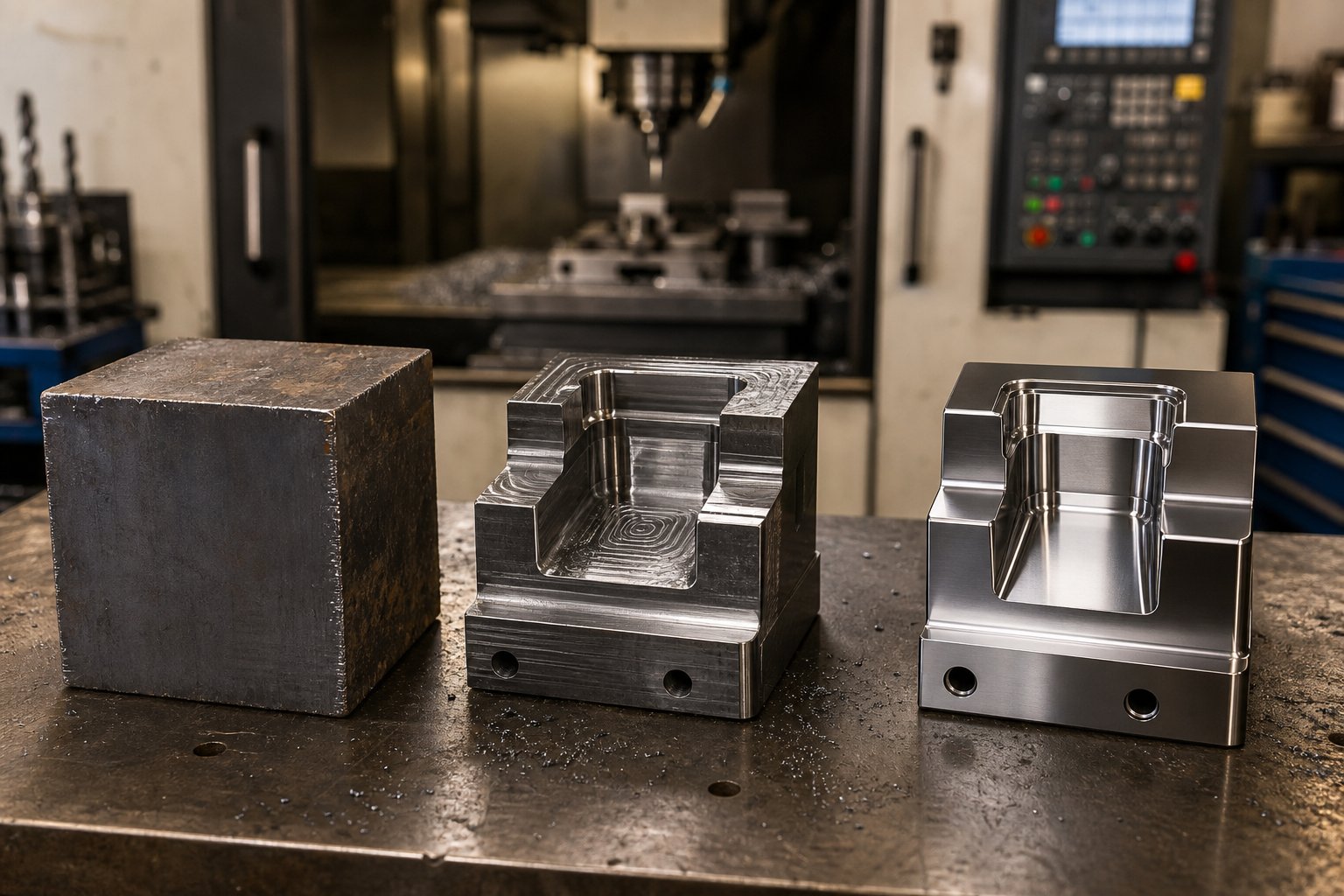
A stamping tool and die starts as a rough block of steel and ends as a precision instrument holding tolerances measured in microns. Every step in between either builds quality into the tool or introduces a weakness that will surface during production. Here's how the journey unfolds.
From Raw Block to Precision Machined Die
Die construction follows a deliberate sequence where each stage prepares the workpiece for the next. Skip a step or rush one, and the consequences compound downstream. A typical metal stamping dies manufacturer follows this general process flow:
- Material procurement and squaring - Die components begin as cast or forged blanks, selected by grade and sized to the design envelope. The material is squared on a CNC mill to establish reference surfaces for all subsequent machining.
- Rough CNC machining - The bulk of material removal happens here. CNC milling cuts the die shoe pockets, punch profiles, and cavity geometries to near-net shape, typically leaving a small stock allowance for finish operations.
- Wire EDM and sinker EDM - Complex profiles, tight internal radii, and intricate punch geometries that conventional milling can't reach are cut using electrical discharge machining. Wire EDM handles through-profiles with exceptional accuracy, while sinker EDM shapes cavities and 3D contours in hardened materials.
- Heat treatment - Working components are hardened to their target range to achieve the required wear resistance and toughness balance.
- Finish machining - After heat treatment, components are finish-ground, hard-milled, or jig-ground to final dimensions. Surface grinding achieves flatness on die plates, while jig grinding hits critical bore tolerances.
- Surface finishing and coating - Depending on application, components receive nitriding, PVD coatings, or polishing to reduce friction, prevent galling, and extend service life.
- Assembly and hand fitting - All components come together on the die shoe. Diemakers hand-fit cutting edges, verify clearances with bluing compound, and shim as needed to achieve proper alignment across the entire shut height.
- Tryout and validation - The assembled die goes into a press for initial stamping trials. Engineers evaluate part quality, identify areas needing adjustment, and refine the tool until production standards are met.
Heat Treatment and Surface Engineering
Heat treatment is the stage that transforms a machinable block into a wear-resistant production tool. The process elevates die components to critical temperature, holds them to achieve full transformation of the microstructure, then quenches and tempers them to balance hardness against toughness.
Why does this matter so much? A punch that's too hard will chip under impact loading. A forming surface that's too soft will deform plastically under repeated press cycles. The sweet spot depends on the component's function: cutting edges need peak hardness, while die shoes need shock-absorbing toughness. As The Fabricator notes, tool steels that lack adequate toughness fail through cracking and chipping, while those lacking wear resistance erode at the cutting interface.
Surface engineering adds another layer of performance. Vacuum heat treatment preserves core toughness without oxidation. Nitriding diffuses nitrogen into the surface to create a hard case. PVD and CVD coatings deposit thin carbide or nitride layers that dramatically reduce friction and adhesive wear, particularly important for forming aluminum or stainless steel panels.
Selecting Die Materials by Application
Not every die component faces the same demands, so blanket material selection wastes money or compromises performance. The guiding principle is matching material properties to the specific stresses each component endures:
| Die Component Function | Recommended Material Category | Why It Fits |
|---|---|---|
| Die shoes and structural plates | Medium carbon steel (e.g., S50C or 4140) | Absorbs shock and vibration; provides rigid support without brittleness |
| Backing and support plates | Cold work tool steel (e.g., D2/SKD11) | High compressive strength resists indentation under sustained forming loads |
| Forming surfaces and strippers | Modified cold work or low-alloy tool steel | Balances hardness with toughness to resist chipping during repeated impact |
| Cutting punches and inserts | High-speed steel (e.g., M2/SKH9) | Maintains edge integrity under frictional heat at production speeds |
| High-wear cutting edges (AHSS or long-run) | Carbide inserts or powdered metal tool steel | Maximum abrasive wear resistance for demanding materials or extreme volumes |
Carbide stamping dies, and particularly progressive carbide stamping dies running high-conductivity materials at speed, use tungsten carbide inserts at the cutting stations where abrasive wear is most severe. These inserts dramatically extend sharpening intervals, but they're brittle, so they're reserved for cutting edges rather than forming surfaces that absorb impact.
The decision tree is straightforward: production volume, stamped material hardness, and component function converge to point toward the right material. Low-volume soft-steel parts don't justify carbide. High-volume AHSS programs can't survive without it.
With the die built and materials selected for longevity, the next performance variable is geometry, specifically the clearances between punch and die that determine whether cut edges are clean or torn, and whether tool life meets expectations or falls short.
Die Clearance and Material Flow Fundamentals
You can build a die from the finest tool steel, machine it to micron-level accuracy, and apply the best surface coatings available. But if the clearance between punch and die is wrong for your material, you'll fight burrs, premature tool wear, and dimensional drift from the first hit. Clearance is one of the most searched technical questions in die design for good reason: it's the single variable that connects material science to edge quality on every stamped part.
Calculating Die Clearance for Different Materials
Die clearance is the gap between the cutting edge of the punch and the corresponding edge of the die opening, expressed as a percentage of the material thickness per side. If you're stamping 1.0 mm automobile sheet metal at 10% clearance per side, the gap between punch and die is 0.10 mm on each side of the punch.
Sounds simple, but here's where many shops get into trouble. The widely used 10% rule was established during an era when vehicles were made primarily from low-carbon steel. That blanket value works well for mild steel, producing the expected one-third shear, two-thirds fracture profile on the cut edge. But modern automotive programs stamp everything from dual-phase 980 to 6000-series aluminum, and these materials behave very differently under shear.
The core principle is straightforward: harder, higher-strength materials generally require greater clearance because their yield strength sits closer to their ultimate tensile strength. Very little plastic deformation occurs before fracture, so the material needs more room to fracture cleanly. Softer, more ductile materials tolerate tighter clearances because they undergo more deformation (the shiny burnished zone) before breaking.
| Material Category | Typical Examples | General Clearance Range (% per side) | Cut Edge Behavior |
|---|---|---|---|
| Low-carbon / mild steel | DC04, SPCC, 1008/1010 | ~10% | Balanced shear and fracture zones; clean edge at correct clearance |
| AHSS (DP, TRIP, CP grades) | DP590, DP780, DP980, TRIP780 | ~12-20% | Minimal burnish zone; fracture-dominant edge; higher cutting forces |
| Aluminum alloys | 5xxx, 6xxx series | ~8-12% | Prone to burr formation and edge tearing if clearance is excessive |
| Stainless steel | 304, 316, 430 | ~12-16% | Work hardens quickly at cut edge; higher stripping forces |
| High-strength low-alloy (HSLA) | HSLA 340, 420, 550 | ~11-15% | Less deformation before fracture than mild steel; moderate shock loads |
These ranges represent general industry guidance. Exact values should be validated against your specific alloy grade, sheet thickness, and tooling condition. As MISUMI's engineering reference notes, some modern tooling research suggests clearances of 11-20% can considerably reduce tooling strain and extend operational life, particularly for metal stamping automotive applications involving high-strength grades.
What happens when clearance is wrong? The consequences run in both directions:
- Insufficient clearance - cutting forces spike, shock loads increase, and punches chip or break prematurely. Stripping forces climb because the material clings to the punch. On steel stamping dies running AHSS, tight clearances can cause catastrophic punch failure after relatively few strokes.
- Excessive clearance - the material doesn't fracture cleanly. You'll see larger burrs on the part edge, roll-over increases on the punch side, and dimensional accuracy suffers. Parts fail inspection, and secondary deburring operations eat into your cycle time and cost.
The takeaway: clearance isn't a set-and-forget value. Each material grade in your automotive stamping press demands its own calculation, and the old 10% rule only covers one family of alloys.
Controlling Material Flow in Deep Draw Operations
Clearance governs cutting operations. But forming, especially deep drawing, introduces a completely different challenge: controlling how much material flows into the die cavity and at what rate. Too much flow causes wrinkles in the flange or sidewalls. Too little flow stretches the material past its limits, producing thinning and eventual tearing.
Three mechanisms work together to manage this balance on automotive panel dies:
Blank holders (binders). The blank holder clamps the periphery of the sheet while the punch draws material into the cavity. The force it applies, called blank holder force (BHF), is the primary lever for controlling draw-in. As research from Ohio State University's Center for Precision Forming explains, the BHF curve during the punch stroke determines whether you get a wrinkle-free, tear-free part. Too low, and excess material buckles into wrinkles. Too high, and the blank can't flow into the cavity, causing fracture at the punch nose radius.
Draw beads. These raised ridges machined into the binder surface locally increase the restraining force on the blank without requiring uniformly high blank holder pressure. Draw beads force the sheet to bend and unbend as it flows past them, absorbing energy and slowing draw-in in targeted areas. On automotive body panels where material flow varies dramatically around the part perimeter, draw bead geometry and positioning are tuned zone by zone during die tryout.
Nitrogen springs and hydraulic cushions. The force source behind the blank holder matters. Nitrogen cylinders built into the die deliver force that increases 10-20% with stroke, providing progressive resistance as the draw deepens. CNC hydraulic cushions on modern presses offer even finer control, varying blank holder force throughout the stroke in a programmable profile. This flexibility can sometimes eliminate the need for draw beads entirely, and increasing BHF near the end of the stroke helps reduce springback by adding tension to the part walls.
For complex automobile sheet metal panels like door inners or quarter panels, the interaction between blank holder force, draw bead configuration, and lubrication determines whether you hit panel quality standards or spend weeks in tryout chasing splits and wrinkles. Modern CNC cushion systems accelerate this process by enabling force-profile adjustments between hits rather than requiring physical die modifications.
These material flow principles become even more critical as the industry shifts toward advanced high-strength steels and aluminum, materials with narrower forming windows where the margin between wrinkle and tear shrinks considerably.
How Advanced Materials Are Reshaping Die Design
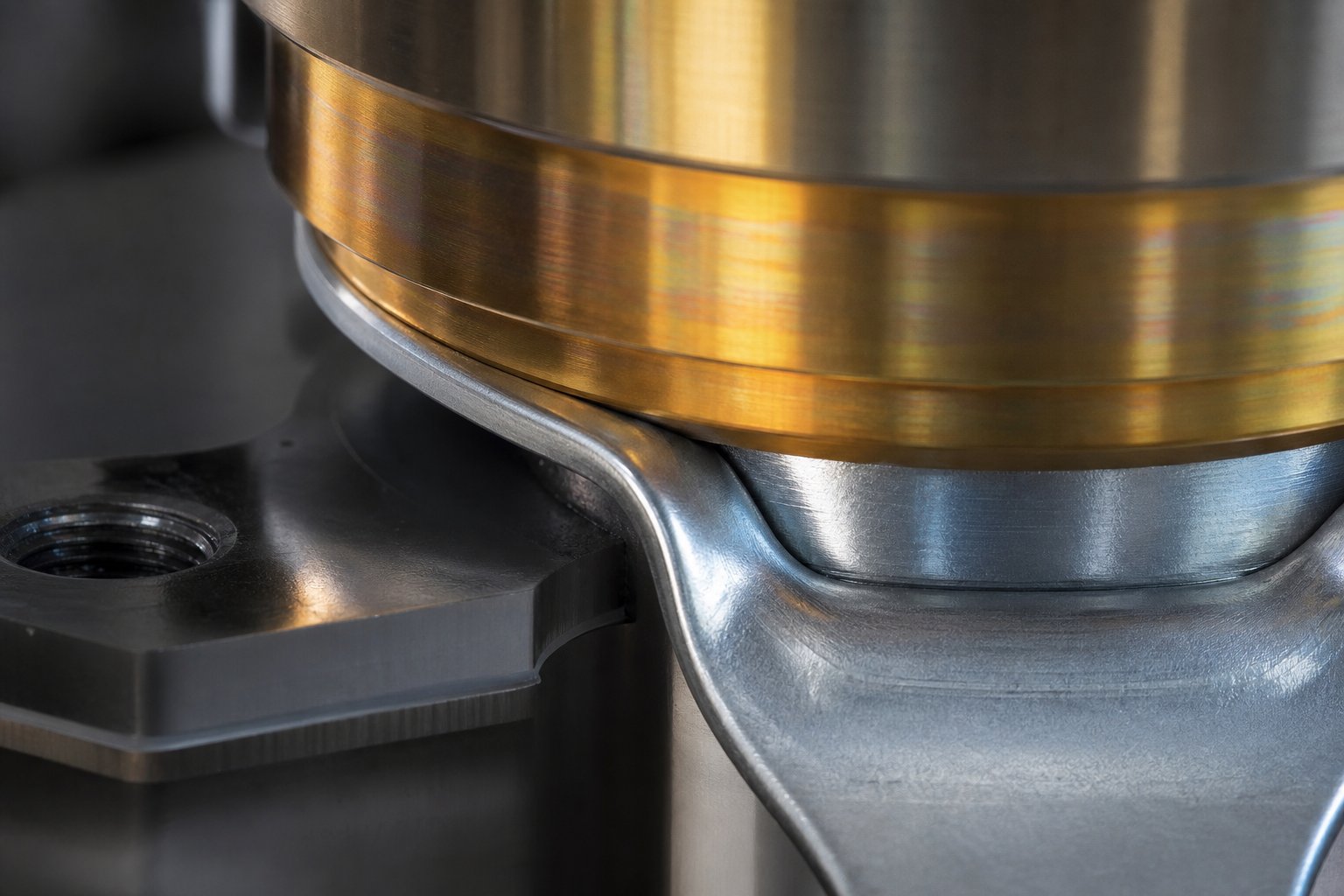
Narrower forming windows are only part of the story. The shift toward lighter, stronger vehicle architectures is fundamentally changing what's expected of every die in the press shop. Advanced high-strength steels push tonnage limits and chew through cutting edges. Aluminum galls onto forming surfaces if coatings aren't right. And multi-material body structures demand die flexibility that didn't exist a decade ago. For teams producing automotive metal stamping parts at scale, these material trends aren't theoretical. They dictate tooling budgets, maintenance intervals, and process stability every day.
AHSS and Its Demands on Die Engineering
When an OEM specifies DP780 or DP980 for a structural rail, the die engineer inherits a chain of consequences. Higher yield strength means higher forming forces, which means greater press tonnage. Cutting edges endure dramatically more abrasive wear because AHSS fractures with minimal plastic deformation, concentrating stress at the shear interface. And springback, the elastic recovery after forming, increases substantially.
The AHSS Insights knowledge base describes this clearly: the magnitude of springback is a function of as-formed flow stress, which combines starting yield strength with work hardening during deformation. Both values are higher in AHSS grades compared with mild or conventional HSLA steels. For a given part shape and thickness, a DP steel channel will spring open more than the same geometry in HSLA 350, even when strain distributions are nearly identical. The stress differences drive the dimensional deviation.
Three springback modes hit AHSS parts hardest: angular change at bend radii, sidewall curl from bending-unbending over die radii, and twist from unbalanced residual stresses in asymmetric cross sections. Each demands specific die geometry compensation, often calculated through simulation before any steel is cut.
Die design modifications required for AHSS grades:
- Increased press tonnage capacity - forming and cutting forces can be 50-100% higher than mild steel equivalents, requiring larger presses or redistributed station loading.
- Wider die clearances - cutting clearances move from the traditional 10% per side up to 12-20% to prevent punch chipping and reduce shock loads on tool steel.
- Springback compensation in die geometry - over-bending, over-crowning, and modified draw radii are built into tool surfaces so the part springs back to nominal dimensions.
- Upgraded cutting inserts - carbide or powdered-metal tool steels replace conventional D2 at trim and pierce stations to withstand abrasive wear from high-strength edges.
- Higher blank holder forces - increased wall tension during forming reduces springback, but requires stronger nitrogen springs or hydraulic cushion systems.
- Tighter process windows - less tolerance for variation in blank thickness, lubrication distribution, and die condition before parts drift out of spec.
Aluminum Body Panels and Die Coating Solutions
Aluminum saves weight, roughly 40% lighter than steel for equivalent panel area, but it punishes dies in ways steel never does. The primary culprit is galling: aluminum's oxide layer breaks during forming, and the exposed metal adheres to tool steel surfaces under pressure. Left unchecked, galling builds up into lumps that score every subsequent panel, generating scrap and requiring unplanned die maintenance.
Aluminum also presents springback challenges from a different angle. Its elastic modulus is roughly one-third that of steel (approximately 70 GPa versus 210 GPa), which means three times the elastic recovery for equivalent flow stress levels. Die geometries need even more aggressive compensation to hold final part dimensions, and forming simulations must account for this lower stiffness throughout the entire process.
Die design modifications required for aluminum panels:
- PVD or CVD hard coatings on forming surfaces - titanium aluminum nitride (TiAlN), chromium nitride (CrN), or diamond-like carbon (DLC) coatings dramatically reduce adhesive wear and galling tendency.
- Mirror-polished die surfaces - surface roughness below Ra 0.2 µm minimizes friction points where aluminum can initiate adhesion.
- Specialized lubricants - dry-film lubricants or aluminum-specific forming oils replace standard stamping lubricants that break down under the surface pressures involved.
- Modified draw radii - larger punch and die radii reduce local contact pressure and the risk of galling initiation at high-stress zones.
- Springback over-compensation - three times the compensation geometry compared to equivalent-strength steel, validated through simulation before machining.
- Frequent coating re-application schedules - planned maintenance intervals for re-polishing and re-coating forming surfaces before galling degrades panel quality.
Custom automotive metal stamping operations running aluminum closures (hoods, decklids, fenders) invest heavily in coating technology and surface maintenance. The upfront tooling cost is higher, but the alternative, frequent unplanned shutdowns to repair galled die surfaces, is far more expensive across a production run.
Multi-Material Architectures and Die Flexibility
Modern vehicle platforms rarely commit to a single material. A typical body-in-white might combine press-hardened boron steel in the B-pillars, DP980 in the structural rails, 5000-series aluminum in the closures, and mild steel in non-structural brackets. Each material demands its own clearance, tonnage, and surface treatment from the tooling.
For auto metal stamping operations supporting these mixed architectures, the challenge is maintaining die flexibility without ballooning tooling budgets. Some strategies that address this:
- Modular die inserts - interchangeable cutting and forming inserts allow a single die shoe to run different material grades by swapping components matched to each alloy.
- Adjustable blank holder systems - CNC cushions with programmable force profiles can be reconfigured between material changeovers without physical die modification.
- Multi-material process knowledge - die engineers who understand both AHSS springback behavior and aluminum galling prevention can design tooling that accommodates planned material changes over a platform's lifecycle.
Progressive stamping copper and other high-conductivity alloys for EV electrical components adds yet another material family to the mix. Copper's softness creates burr challenges at tight clearances, while its thermal conductivity dissipates heat differently than steel, affecting lubricant behavior and punch temperatures at high stroke rates. Metal stampings for automotive components now span a material spectrum that would have been unthinkable in a single facility twenty years ago.
This is where Industry 4.0 technologies earn their keep. When die wear accelerates unpredictably across multiple material families, traditional time-based maintenance schedules fall short. Modern solutions integrate sensing directly into the die:
- In-die load sensors - piezoelectric sensors embedded in the die detect force signature changes that indicate wear progression, material inconsistency, or lubrication breakdown in real time.
- Stroke counters with predictive algorithms - rather than scheduling maintenance at fixed intervals, algorithms correlate stroke count with material grade, press speed, and historical wear patterns to predict optimal service windows.
- In-process quality monitoring - proximity sensors and laser measurement systems within the die verify part dimensions at production speed, catching dimensional drift from springback variation before defective automotive metal stamped parts reach the next operation.
- Temperature monitoring - thermocouple arrays in forming surfaces track heat buildup that accelerates galling on aluminum or coating breakdown on coated inserts, triggering alerts before surface quality degrades.
These sensor-driven approaches transform die maintenance from reactive to predictive, which is especially valuable when a single press line rotates between AHSS structural parts and aluminum closures within the same shift. The data also feeds back into die design for the next program, closing the loop between production reality and engineering assumptions.
Advanced materials demand more from every stage of the die engineering process, from initial geometry compensation through surface treatment and ongoing maintenance. But the tooling itself is only as good as the simulation work that validates it before machining begins, a topic where virtual tryout technology has shifted the economics of die development dramatically.
Simulation and Virtual Tryout in Modern Die Engineering
A single automotive stamping die can take 20 or more weeks from design release to production approval. A significant chunk of that timeline historically went to physical tryout: loading the die into a press, running parts, measuring deviations, grinding corrections, and repeating until the part meets spec. Every loop costs press time, material, and skilled labor. Forming simulation flips that equation by catching problems in software weeks before any tool steel gets machined.
Forming Simulation and Springback Prediction
Imagine running your first press hit on a screen instead of a 2,000-ton press. That's the core value of modern forming simulation. Software packages use finite element analysis (FEA) to model how sheet metal deforms under punch and die contact, predicting what the material will do at every point in the stroke cycle. For progressive stamping die design, this means evaluating each station's forming contribution before the strip layout is finalized.
Tools like AutoForm's ProgSim, which uses incremental solving technology customized for progressive-die designers, act as virtual tryout presses. They deliver formability results including springback prediction, automatic blank development, and tonnage estimates, all before the actual die design is complete. Setup and simulation time can range from minutes for smaller dies to a few hours for larger ones, a fraction of what physical tryout demands.
Springback prediction is particularly critical for any automotive stamping die forming AHSS or aluminum. The simulation calculates how much elastic recovery occurs after the punch retracts, then engineers apply virtual compensation, modifying die surfaces so the part springs back to nominal dimensions. Without this step, you'd discover the dimensional deviation only after machining hundreds of thousands of dollars' worth of tool steel to the wrong geometry.
Here's what engineers evaluate from a typical simulation run:
- Forming limit diagrams (FLD) - map the strain state at every point in the part against the material's failure envelope, flagging regions at risk of splitting or necking.
- Material thinning maps - show percentage reduction in sheet thickness across the part, identifying areas where the material is stretching beyond safe limits.
- Wrinkle indicators - detect compressive instabilities in flanges and sidewalls that would produce surface defects or assembly interference.
- Springback displacement fields - quantify the magnitude and direction of elastic recovery at every node, guiding compensation geometry for die surfaces.
- Forming tonnage and pad force estimates - predict the press load and blank holder force required at each stage, informing press selection and nitrogen spring sizing.
- Draw-in patterns - track how much material flows into the die cavity from each edge of the blank, validating draw bead placement and blank size.
As research from Fraunhofer IWU demonstrates, even the elastic deflection of the press itself, often responsible for around 80% of total deflection in the tool-press system, can be modeled using reduced FE representations of the machine's clamping surfaces. This level of fidelity means simulation results now account for real-world boundary conditions that previous generations of software simply ignored.
Virtual Tryout vs Physical Tryout
Physical tryout isn't going away entirely. You still need to validate surface quality, confirm coating performance, and run production-speed trials. But the role of physical tryout has shifted from problem-solving to verification. The heavy diagnostic work, finding splits, resolving wrinkles, tuning springback, now happens virtually.
The contrast is stark. A traditional tryout loop for a complex body panel might require 8 to 12 physical iterations, each consuming press time, trial blanks, and toolmaker hours for grinding and shimming. Virtual tryout can compress that to 2 or 3 physical loops focused on fine-tuning rather than fundamental correction. The Fraunhofer IWU study showed that virtual spotting patterns, which simulate the pressure distribution between die surfaces under real forming loads, correlated excellently with physical spotting results after just one mechanical rework loop.
This matters beyond time savings. Every physical tryout iteration introduces risk: a grinding correction in one area shifts pressure distribution elsewhere, and the toolmaker chases cascading adjustments. Virtual simulation lets you test corrections in isolation, understand their system-wide effects, and arrive at the press with a die that needs refinement rather than reinvention.
For metal stamping for the automotive industries, where die development timelines directly impact vehicle launch schedules, the economic case is compelling. Front-loading quality into simulation compresses lead times, reduces costly engineering changes after tool build, and delivers more predictable program timing.
The full die lifecycle, from concept through production and eventual end-of-life, benefits from simulation at multiple stages:
- Concept and feasibility - one-step solvers provide rapid formability checks on proposed part geometry within minutes, flagging impossible shapes before detailed design begins.
- Detailed die design - incremental simulation validates strip layouts, station sequencing, draw bead placement, and blank development with full material models.
- Springback compensation - iterative virtual compensation refines die surfaces until predicted part geometry falls within tolerance bands.
- Die build and machining - simulation-derived compensation geometry feeds directly into CNC tool paths, with press deflection models informing crowning corrections.
- Physical tryout - reduced to validation and fine-tuning rather than fundamental problem-solving, cutting weeks from the schedule.
- Production support - simulation baselines become the reference for troubleshooting when process drift occurs during ongoing manufacturing.
- Maintenance and refurbishment - worn die surfaces can be re-evaluated against updated material models or revised part geometry when platforms refresh.
Simulation doesn't replace the toolmaker's expertise. It amplifies it by providing visibility into physics that no amount of experience can see with the naked eye. The result: dies that hit production targets faster, cost less to develop, and deliver more consistent part quality from the first approved hit onward.
All of this engineering effort, the material selection, the clearance calculations, the simulation-validated die geometry, ultimately serves one purpose: producing parts that meet specific vehicle system requirements. How those requirements vary across structural, chassis, interior, and powertrain applications shapes which die configurations and process strategies get deployed in practice.
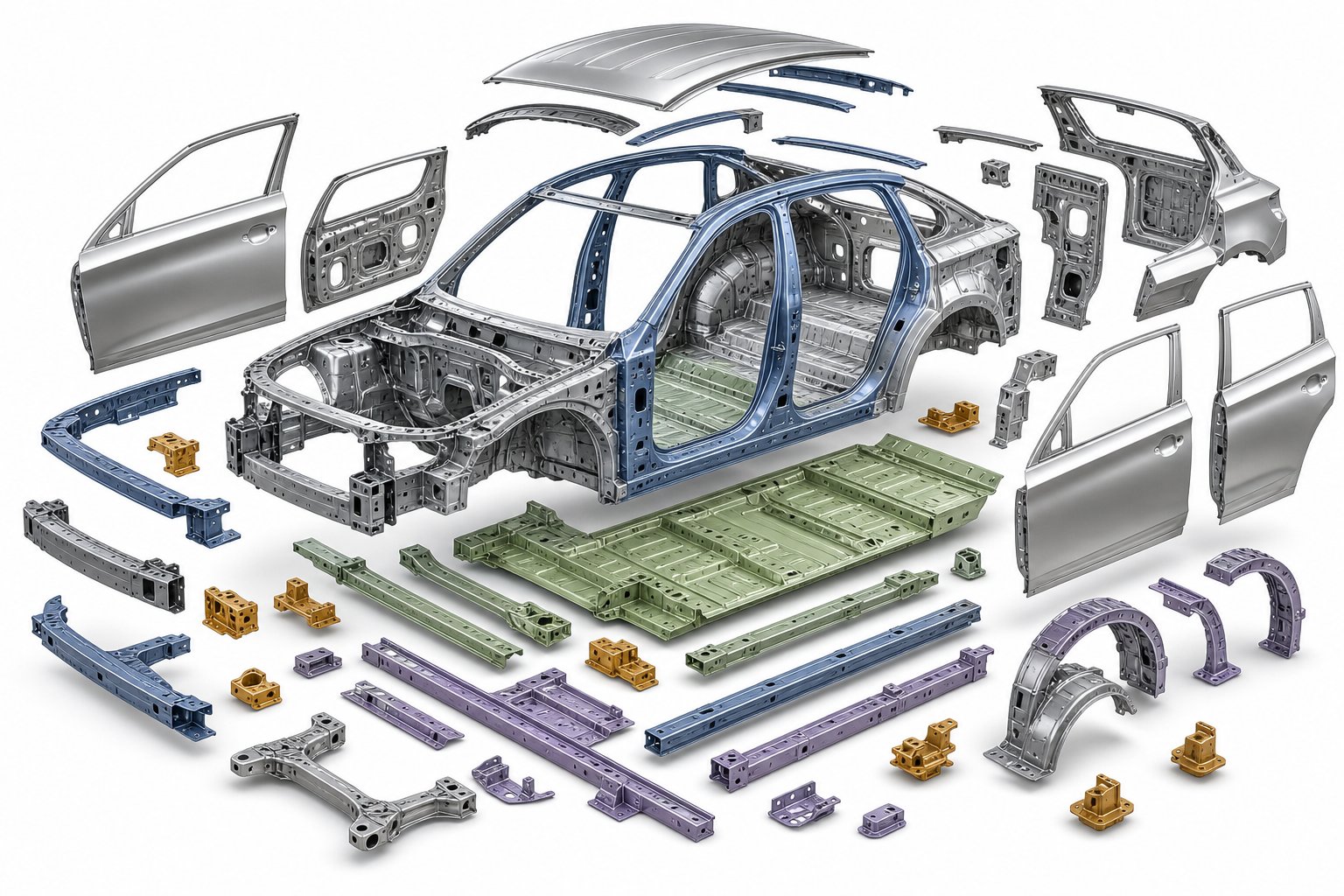
Stamping Die Applications Across Vehicle Systems
Every stamped part in a vehicle exists because a specific function demanded it: absorbing crash energy, supporting suspension loads, reinforcing a door cavity, or housing a transmission component. That function dictates the material, and the material dictates the die. When you trace this chain backward from the finished vehicle, clear patterns emerge in how die types map to vehicle systems. Understanding these patterns helps engineering and purchasing teams specify tooling that aligns with the actual performance requirements of each part rather than defaulting to a one-size-fits-all approach.
Structural and Body-in-White Stamping Applications
Body-in-white (BIW) represents the largest concentration of automotive stamping parts on any vehicle. These components define the passenger compartment geometry, manage crash energy paths, and provide mounting surfaces for closures, glass, and interior systems. The stamping challenges here are significant: large panel areas, tight surface-quality standards for Class A surfaces, and increasingly aggressive material grades for crash performance.
Outer body panels like doors, hoods, and fenders demand deep draw dies operating in tandem press lines. The priority is surface quality, so die surfaces are polished to mirror finish, coated to prevent marking, and maintained on strict schedules. Inner panels and structural reinforcements tolerate rougher surface conditions but require tighter dimensional control because they define the weld-flange geometry that holds the body together.
Structural rails, cross members, and pillar reinforcements increasingly use press-hardened boron steel or AHSS grades like DP980. These automotive metal stampings require hot forming lines for boron components or heavy-tonnage transfer presses for cold-formed AHSS. The die design must account for extreme springback compensation and rapid cutting-edge wear, making carbide inserts essential at trim stations.
Automotive parts that use die cutting in the BIW domain include virtually every reinforcement plate, pillar inner, and tunnel component. Trim and pierce operations finalize hole patterns, flange profiles, and mating surfaces after the primary forming stages complete the part's 3D geometry.
Chassis, Interior, and Truck Component Stamping
Chassis and suspension components operate under fatigue loading and corrosion exposure, which drives material selection toward HSLA steels and hot-dipped galvanized grades. Control arm brackets, subframe reinforcements, and spring seats are typical metal stamping car parts produced on transfer die lines where moderate draw depths and multiple piercing operations happen across sequential stations.
Interior metal reinforcements, think seat frames, instrument panel cross-car beams, and door anti-intrusion bars, combine structural function with packaging constraints. Many of these parts suit progressive dies because their geometry stays within strip-width limits and annual volumes run high. Stamping car parts for interior systems often involves combination dies that merge piercing and forming in a single stroke to reduce secondary operations and part-handling costs.
Truck-specific structural members push die engineering in a different direction entirely. Frame rails, crossmembers, and fifth-wheel mounting plates use thick-gauge high-strength steel (often 4-8 mm), demanding massive press tonnage and die construction robust enough to survive the impact loading that thick material generates. Transfer dies or dedicated single-station presses handle these parts, with die shoes and backup plates sized well beyond what passenger-vehicle tooling requires.
Powertrain housings and covers, including transmission cases, differential covers, and EV motor housings, rely on deep draw dies to produce hollow geometries without welded seams. Material choices span aluminum alloys for weight savings and stamped steel for cost targets, each demanding different die surface treatments and clearance configurations as discussed in earlier sections.
The table below maps these relationships systematically:
| Vehicle System | Typical Parts | Common Materials | Preferred Die Type | Key Design Considerations |
|---|---|---|---|---|
| Body-in-White (outer panels) | Doors, hoods, fenders, roof panels | Mild steel, aluminum 5xxx/6xxx | Tandem line with deep draw dies | Class A surface quality; galling prevention on aluminum; large press beds |
| Body-in-White (structural) | Pillars, rails, tunnel reinforcements | AHSS (DP780-DP980), press-hardened boron steel | Transfer dies; hot forming lines | Springback compensation; carbide trim inserts; high tonnage |
| Chassis and suspension | Control arm brackets, subframe parts, spring seats | HSLA steel, galvanized steel | Transfer dies | Fatigue resistance; corrosion protection; moderate draw depths |
| Interior reinforcements | Seat frames, IP beams, door anti-intrusion bars | HSLA steel, mild steel, DP steels | Progressive dies; combination dies | Tight packaging; high volume; multiple pierce features |
| Powertrain housings | Transmission covers, motor housings, differential covers | Aluminum alloys, deep-draw steel | Deep draw dies | Sealing surface flatness; wall uniformity; lubricant management |
| Truck structural | Frame rails, crossmembers, fifth-wheel plates | Thick-gauge HSLA (4-8 mm) | Transfer dies; single-station heavy presses | Extreme tonnage; robust die shoes; thick-stock clearances |
| Electrical and connectors | Bus bars, terminals, battery interconnects | Copper, brass, nickel alloys | Progressive dies | Tight tolerances; burr control; high-speed production |
Notice how the chain flows in one direction: function defines material, material defines forming behavior, and forming behavior dictates die type. A crash-critical B-pillar reinforcement can't use a progressive die because the material (press-hardened steel) demands hot forming. A high-volume seat bracket can't justify a tandem line because the economics don't support it. Each pairing in the table reflects an engineering logic, not an arbitrary assignment.
Car parts manufacturing at this level of complexity means engineering teams must evaluate stamping solutions holistically rather than specifying tooling in isolation. The die type, press configuration, material grade, and secondary operations all interact, and getting one wrong cascades through the others. For teams exploring how these interactions play out across real production programs, YICHEN's automotive case studies offer process examples spanning structural, interior, chassis, and truck-related metal stampings for automotive applications, providing a useful reference point when benchmarking die strategies against actual production outcomes.
Mapping die applications to vehicle systems clarifies what you need. The next question is who builds it, and what separates a die partner that delivers production-ready tooling from one that delivers headaches.
Selecting the Right Stamping Die Engineering Partner
Knowing which die type fits your part and how it should be built is only half the battle. The other half is finding a partner who can actually execute, delivering tooling that performs as designed, on schedule, and within budget across the full production lifecycle. For automotive stamping companies competing on quality and launch timing, the difference between a capable die partner and an underqualified one shows up in every metric from PPAP approval timelines to warranty PPM rates years into production.
Critical Capabilities to Evaluate in a Die Partner
Not all automotive metal stamping companies offer the same depth. Some excel at design but outsource machining. Others run great presses but lack simulation expertise. The evaluation challenge is identifying which capabilities matter most for your specific program and verifying that a supplier actually owns them rather than subcontracting critical steps.
Rank these criteria from highest to lowest impact on program success:
- In-house die design and forming simulation - A supplier that runs forming simulations internally, predicting springback, thinning, and material flow before cutting steel, catches problems weeks earlier than one that relies on customer-provided data or skips simulation entirely. As case studies from Centerline Engineering demonstrate, suppliers using forming simulation "right from the get-go" during quoting deliver more accurate blank estimates, optimized material usage, and dies that need fewer physical tryout iterations.
- In-house machining and tryout capacity - Verify that the supplier owns CNC mills (including 5-axis), wire EDM, and tryout presses covering your tonnage range. Outsourced toolrooms add lead time risk and reduce accountability. Progressive die manufacturers who maintain their own toolrooms can implement engineering changes faster and keep dies in production condition without third-party delays.
- Material expertise across AHSS and aluminum - Ask specifically about experience with dual-phase steels, press-hardened boron, and aluminum closure panels. Each material family requires different clearance strategies, coating systems, and springback compensation approaches. A partner without hands-on AHSS or aluminum experience will learn on your tooling budget.
- OEM quality system certification and PPAP capability - IATF 16949 certification in the supplier's stamping and tooling scope is the baseline for automotive programs. ISO 9001 alone does not include automotive-specific PPAP and APQP requirements. Confirm that the supplier can deliver ballooned prints, dimensional reports, control plans, FMEAs, Gage R&R studies, and capability studies at the level your OEM customer expects.
- Die maintenance programs and production ramp support - A die partner's job doesn't end at PPAP approval. Preventive maintenance schedules, spare insert inventories, and rapid-response repair capability determine whether your tooling sustains quality at volume or degrades into a firefighting exercise. Confirm documented maintenance logs, on-site die storage conditions, and engineering change management processes.
- Value-added services and vertical integration - Suppliers offering secondary operations like welding, finishing, sub-assembly, and custom packaging under one roof reduce handoff risk and compress lead times. For progressive die stampings suppliers, integrated services mean fewer purchase orders and a single point of accountability from raw coil through shipped assemblies.
A weighted scorecard helps structure the comparison objectively. Assign each criterion a weight based on your program's priorities, score shortlisted suppliers from 1 to 5 on every criterion, and let the math surface the strongest candidate rather than relying on relationship history alone.
Aligning Die Investment With Production Strategy
Die tooling is a capital asset with a lifespan measured in millions of strokes. The partner you select needs to align not just with today's production volumes but with your ramp trajectory, potential engineering changes, and end-of-program exit strategy.
A few questions that separate strategic die partners from transactional shops:
- Can they scale? - If your annual volume doubles after launch, does the supplier's press fleet and production cell structure accommodate that without new tooling or extended downtime? Automotive metal stamping services should be evaluated on both current capacity and growth headroom.
- How do they handle engineering changes? - Late-stage design revisions are a reality in automotive programs. A supplier with in-house tooling capability can implement ECOs faster and with lower risk than one dependent on external die shops.
- What are the die ownership and storage terms? - Confirm in writing who owns the tooling at program end, what the storage policy is for inactive dies, and whether the supplier commits to support including maintenance for the program's full lifecycle. Vague terms create disputes when volumes shift or programs sunset.
- Do they engage in early DFM collaboration? - The best auto parts manufacturer partners review drawings before quoting, flag tolerance stack-up risks, and recommend geometry refinements that improve formability without compromising part function. Programs that invite DFM input earlier avoid costly late-stage tooling changes.
For teams evaluating car parts manufacturer candidates in a reshoring or nearshoring context, proximity to the assembly plant reduces lead time exposure and supports just-in-time delivery requirements. As procurement strategies increasingly prioritize supply chain resilience, domestic or regional die partners with vertically integrated operations provide greater visibility and faster issue resolution than distributed multi-country tooling programs. Many automotive parts manufacturers in USA and other established regions now compete on responsiveness and operational control alongside unit cost.
One resource worth exploring during this evaluation is YICHEN's automotive industry page, which provides stamping and sheet metal fabrication case studies spanning OEM through Tier-2 programs for structural, interior, chassis, and truck components. Their coverage across multiple vehicle systems and supply chain tiers makes them a relevant option for teams seeking a partner that understands the full scope of automotive metal stamping services, from die design through production support.
Ultimately, the right die engineering partner isn't just the one with the lowest quote. It's the one whose capabilities, quality systems, and production support model align with your program's risk profile, volume trajectory, and material complexity. Apply these criteria broadly, verify claims through site audits and reference checks, and let documented performance data, not promises, drive your sourcing decision.
Frequently Asked Questions About Automotive Stamping Dies
1. What is the difference between progressive dies and transfer dies in automotive stamping?
Progressive dies keep a metal strip connected as it advances through multiple stations in a single die set, making them ideal for smaller, high-volume parts like brackets and connectors. Transfer dies cut the blank free early and move it between independent stations using mechanical fingers or robots, which suits larger, geometrically complex parts like structural cross members and suspension brackets. The choice depends on part size, draw depth, material scrap targets, and annual volume requirements.
2. How do you calculate die clearance for different sheet metal materials?
Die clearance is expressed as a percentage of material thickness per side. Mild steel typically uses around 10% clearance, while advanced high-strength steels (AHSS) require 12-20% due to their higher yield strength and fracture-dominant cutting behavior. Aluminum alloys generally need 8-12%, and stainless steel falls in the 12-16% range. Using incorrect clearance leads to premature tool wear, excessive burrs, or dimensional inaccuracy, so each material grade demands its own validated clearance value.
3. What die design changes are needed for stamping advanced high-strength steel (AHSS)?
AHSS grades like DP780 and DP980 require several die modifications: increased press tonnage (50-100% higher than mild steel), wider cutting clearances to prevent punch chipping, springback compensation built into die geometry, carbide or powdered-metal inserts at trim stations for wear resistance, higher blank holder forces, and tighter process control windows. Forming simulation becomes essential to predict and compensate for the significantly greater elastic recovery these materials exhibit after forming.
4. How long does it take to build an automotive stamping die?
A typical automotive stamping die takes 20 or more weeks from design release to production approval. This timeline covers CNC machining, EDM operations, heat treatment, surface finishing, assembly, and physical tryout. Modern forming simulation technology significantly reduces the tryout phase by catching formability issues virtually before steel is cut, compressing what formerly required 8-12 physical iterations down to 2-3 verification loops focused on fine-tuning rather than fundamental problem-solving.
5. What should you look for when selecting an automotive stamping die supplier?
Prioritize suppliers with in-house die design and forming simulation capability, owned CNC machining and tryout presses, proven experience with AHSS and aluminum materials, IATF 16949 certification with full PPAP capability, and documented die maintenance programs. Evaluate their ability to scale with your volume trajectory, handle engineering changes quickly, and provide early design-for-manufacturability collaboration. Partners like YICHEN that offer integrated stamping and sheet metal fabrication across OEM through Tier-2 programs provide single-source accountability from tooling through production support.


