


What Are Stamping Die Replacement Parts and Why They Matter
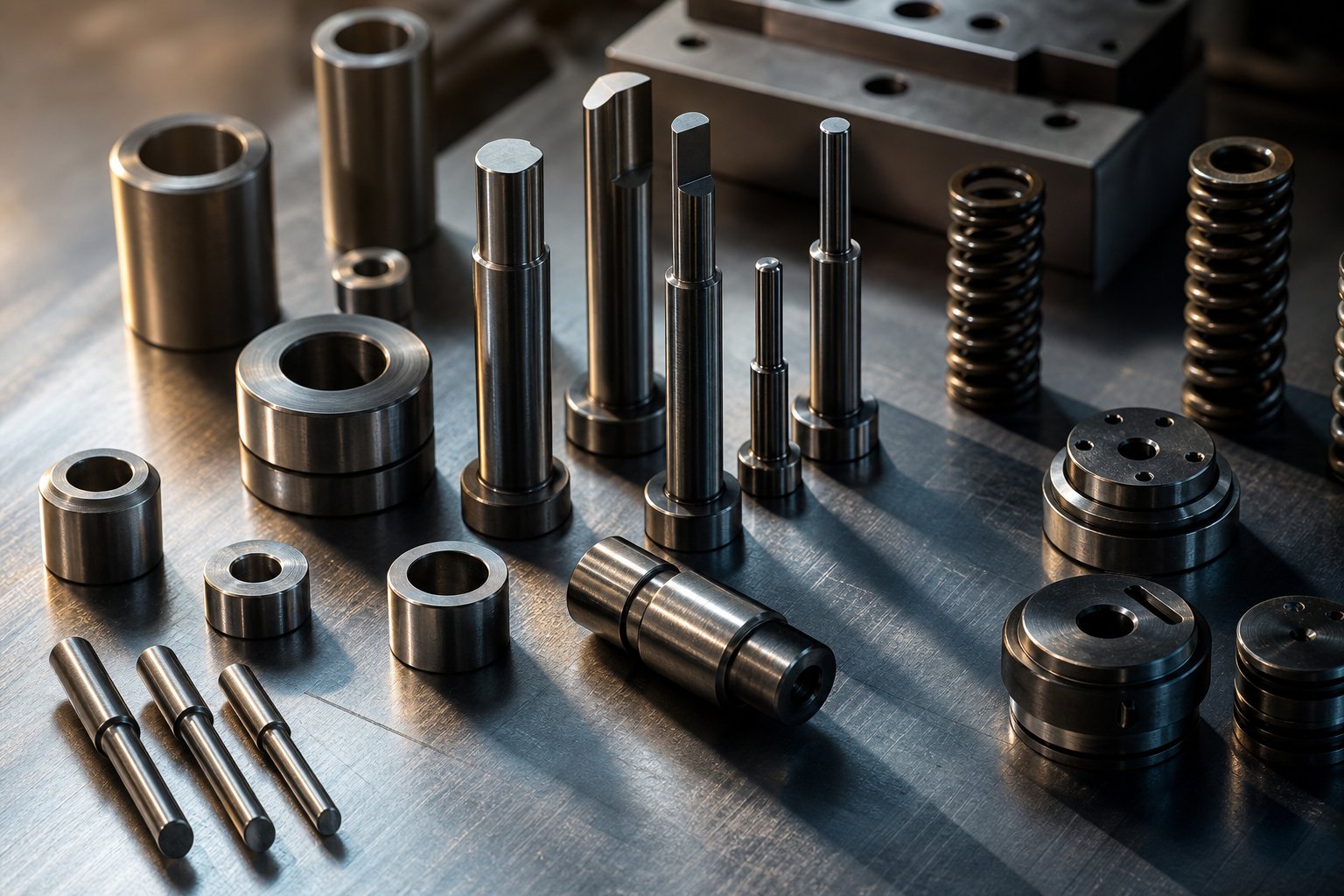
Stamping die replacement parts are the individual wear components inside a die assembly - punches, die buttons, guide pins, bushings, springs, and stripper plates - that require periodic changeout to maintain part quality and keep production running. Unlike the die shoes and structural base that form the permanent foundation of the tool, these components are designed to absorb the repetitive stress of the stamping process and degrade over time.
This guide bridges the gap between general die education and parts catalogs. You'll learn how to read wear symptoms, diagnose failing components, specify correct replacements, and source them with confidence.
Defining Stamping Die Replacement Parts
What separates a replacement part from a structural die component? It comes down to intended service life. Structural elements - upper and lower die shoes, bolster plates, and the die set frame - are engineered to last the full lifecycle of the tool. They rarely need replacement unless catastrophic damage occurs. Replacement parts, on the other hand, are the working elements that directly contact the strip material or manage forces within the assembly. Think of punches, die buttons, springs, retainers, and guide bushings - components subjected to repeated impact, friction, and fatigue every stroke of the press.
Replacement parts are consumables engineered to wear so the die shoe and structural elements do not.
Why a Systematic Replacement Approach Matters
When die parts need replacement and the changeout happens reactively - after a punch breaks mid-run or a bushing seizes - the cost multiplies fast. A single unplanned stoppage doesn't just mean one new component. It means idle press time, setup labor to pull and reset the die, scrap from defective parts produced before the failure was caught, and quality-lab hours to re-validate the process. According to MetalForming Magazine, unplanned die maintenance can cost four times more than planned maintenance once you factor in lost production, overhead, and downstream labor.
A systematic approach flips this equation. By understanding which stamping die wear components degrade predictably and tracking their condition against hit counts, you replace parts on your schedule - not the press's.
Common Stamping Die Wear Parts by Function
Every die assembly contains dozens of individual components, but not all of them wear at the same rate or for the same reasons. Organizing them by function - what role they play during the stamping cycle - gives maintenance teams a faster path to identifying which part is degrading and why. The categories below cover the full scope of common stamping die wear parts by function, from the cutting edges that shear material to the bearing surfaces that absorb lateral loads.
Cutting and Piercing Components
These are the workhorses of any blanking or progressive die. They make direct contact with the strip material every stroke, which means they experience the highest localized stress and the fastest wear rates in the assembly.
- Punches - Hardened tool steel pins or shaped profiles that penetrate the strip material to create holes, slots, or features. They absorb full shear force on every hit and are the most frequently replaced components in most dies.
- Die buttons - The mating openings that receive the punch. Proper clearance between punch and die button determines edge quality. Stamping die punch and die button replacement is often done as a matched set to restore correct clearance.
- Pilots - Precision pins that enter previously pierced holes to register the strip at exact position before the next station cuts. They endure repetitive insertion forces and strip drag, making them susceptible to tip wear and bending.
- Trim steels - Contoured cutting edges used in trimming operations on formed parts. Their complex profiles make regrinding more involved than simple punch resharpening.
When any cutting component dulls or chips, you'll notice burr height increasing on the stamped part - one of the earliest visible quality signals that a changeout is approaching.
Guiding and Alignment Components
Imagine running a progressive die where the upper and lower halves drift even 0.001 in. out of alignment. Suddenly, every punch-to-button clearance shifts, burrs appear on one side, and tool life drops dramatically. Guiding components prevent that scenario.
- Guide pins (guide posts) - Precision-ground cylindrical pins, typically hardened to 60+ HRC, that locate the upper and lower die shoes so all mounted components interface correctly. As The Fabricator notes, guide pins are ground to within 0.0001 in. and are available in friction-bearing or ball-bearing styles.
- Guide bushings - The precision-ground sleeves that receive guide pins. Ball-bearing bushings contain an aluminum ball cage, while friction bushings are often lined with aluminum-bronze and graphite plugs to reduce wear.
- Heel blocks - Steel blocks mounted on upper and lower shoes that absorb unbalanced lateral forces. They supplement guide pins when stamping operations generate severe one-directional side thrust.
- Keeper bars - Retaining rails that hold stripper inserts, punches, or die sections in position. They prevent lateral movement of working components under load.
Guide pin and bushing replacement for dies is often triggered by measurable play between the mating surfaces - a condition that shows up as inconsistent burr patterns or progressive feature misregistration across stations.
Stripping and Material Control Components
After a punch shears through the strip, something has to pull the strip off the punch and keep the material controlled for the next feed advance. That's the job of stamping die stripper plate components and their associated hardware.
- Stripper plates - Flat or contoured plates that press down on the strip material during cutting and then strip it off the punches as the ram retracts. They also guide punches close to the cutting point for improved accuracy.
- Lifters (lifter pins) - Spring-loaded pins or rails that raise the strip off the die face between strokes, allowing it to advance freely to the next station.
- Springs - Nitrogen gas springs, die springs (color-coded by load rating), and coil springs that provide stripping force, pressure pad preload, and lifter return. Spring fatigue is gradual, making it easy to miss until strip control problems appear.
- Pressure pads - Spring-backed or hydraulically supported plates that clamp the material during drawing or forming operations to control metal flow and prevent wrinkling.
These components rarely fail catastrophically. Instead, they lose force progressively - springs sag, lifter pins wear at the shoulder, and stripper plates develop concavity from repeated impact. The result is subtle: misfeeds, strip lifting, or inconsistent part ejection that worsens over weeks.
Wear and Bearing Components
Not every replacement part does "active" work on the strip. Some exist solely to absorb friction and prevent more expensive components from degrading prematurely.
- Wear plates - Hardened steel plates mounted on guide blocks, heel blocks, or anywhere two die surfaces slide against each other. They're sacrificial surfaces designed to be replaced cheaply rather than remachining the structural block beneath.
- Gibs - Precision wear strips that maintain alignment between sliding die sections (e.g., cam drivers and cam slides). They compensate for thermal expansion and absorb lateral thrust.
- Backing plates - Hardened plates positioned behind punches or between the punch retainer and die shoe to distribute impact force and prevent the punch head from peening into softer shoe material.
These parts are inexpensive individually, but neglecting them cascades into costly damage - a worn backing plate allows punch heads to mushroom, a degraded gib lets a cam slide drift, and suddenly you're replacing components that should have lasted years longer.
Quick-Reference Table: Die Component Failure Modes
The table below consolidates each component category into a scannable reference. Use it as a die component failure modes reference when inspecting tools or building replacement part inventories.
| Component Name | Function | Typical Material | Common Failure Mode |
|---|---|---|---|
| Punches | Pierce or blank strip material | D2, M2, carbide |
|
| Die Buttons | Receive punch, define cut profile | D2, M2, carbide |
|
| Pilots | Register strip position between stations | M2, HSS, carbide-tipped |
|
| Guide Pins | Align upper and lower die shoes | Hardened tool steel (60+ HRC) |
|
| Guide Bushings | Receive guide pins, reduce friction | Hardened steel, aluminum-bronze liner |
|
| Heel Blocks | Absorb lateral thrust forces | Tool steel with hardened wear plates |
|
| Stripper Plates | Strip material from punches, guide punches | A2, D2 tool steel |
|
| Springs | Provide stripping force, pad preload, lifter return | Chrome-silicon, nitrogen gas |
|
| Lifters | Raise strip for feed advance | Tool steel, hardened tips |
|
| Wear Plates | Sacrificial surface absorbing slide friction | Hardened tool steel, bronze |
|
| Backing Plates | Distribute punch impact, protect die shoe | Hardened tool steel (48-52 HRC) |
|
Each failure mode in the table produces distinct symptoms at the press - burr changes, dimensional shifts, or material handling issues. Recognizing those symptoms and tracing them back to the right component is where diagnostics begin, and that mapping from production floor observation to specific part failure is exactly what separates reactive firefighting from planned maintenance.
Stamping Die Troubleshooting by Symptom
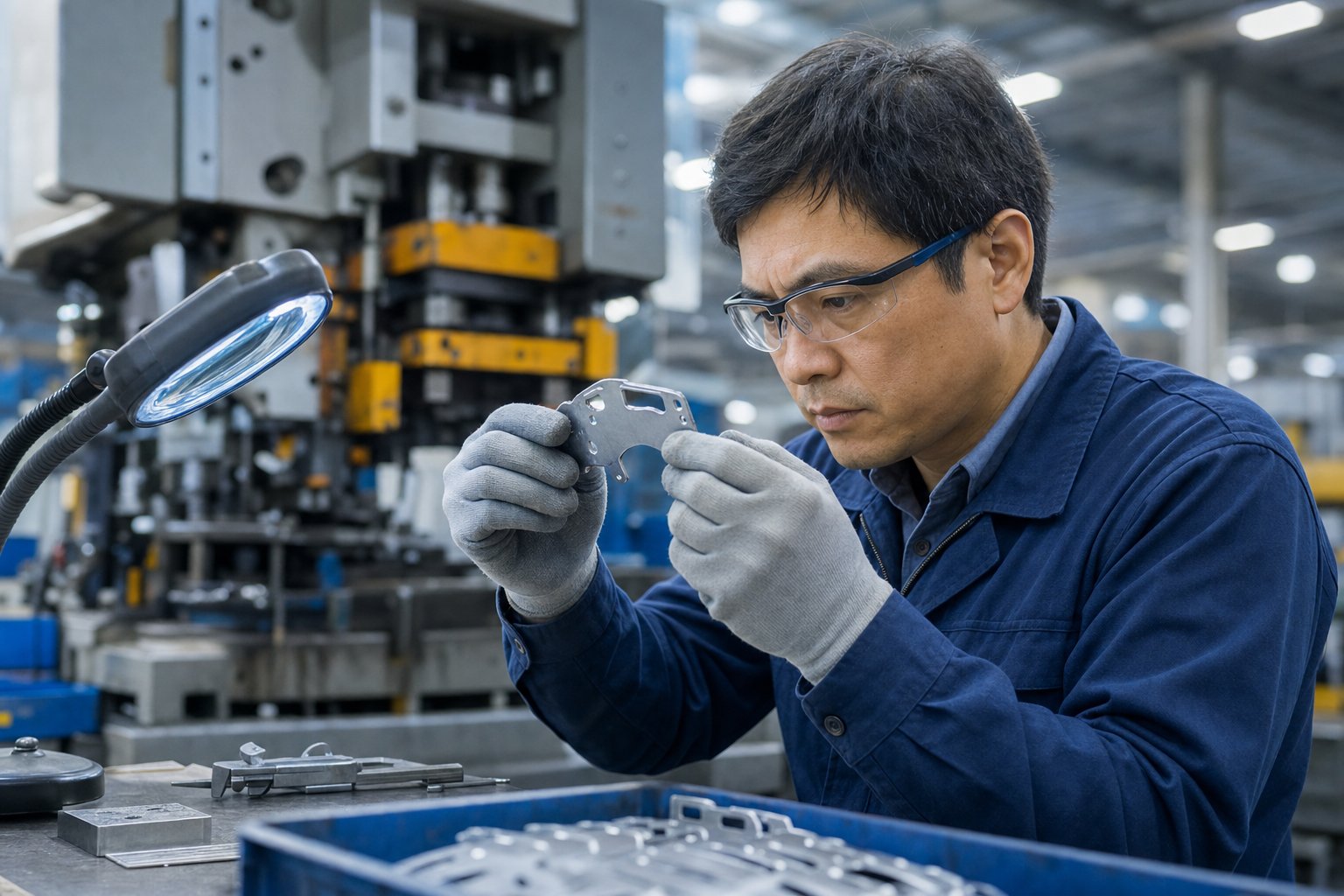
You're standing at the press, and something's off. Parts look different than they did last week - maybe a burr is growing on one edge, or hole locations are drifting out of spec. The challenge isn't knowing that a component is wearing. It's figuring out which one. Stamping die wear indicators and symptoms rarely announce themselves with a clear label. They show up as quality deviations on finished parts, and your job is to read those deviations backward to the source.
The sections below organize common failure signals the way you actually encounter them - by what you see on the part or at the press - and map each symptom to the most likely component requiring replacement.
Burr Formation and Edge Quality Degradation
Burr growth is the single most common early warning that cutting components are approaching end of life. But not all burrs point to the same root cause. The location, consistency, and height of the burr tell you where to look.
- Uniform burr increase on all features - Points to general punch edge dulling across the die. All cutting punches are approaching their sharpening or replacement interval simultaneously, often because they share the same tool steel grade and have experienced equal hit counts.
- Burr on one side of a feature only - Indicates uneven punch-to-die clearance, typically caused by guide pin wear or bushing play that allows the upper die to shift slightly. The tight-clearance side produces a clean shear; the open side tears and leaves a burr.
- Intermittent burr that appears and disappears - Often linked to spring fatigue in the stripper system. As stripping force weakens, the strip isn't held firmly during cutting, allowing micro-movement that produces inconsistent edge quality.
- Slug pulling with burr - When slugs adhere to the punch face and get carried back into the die, they create secondary burrs or witness marks on subsequent hits. This condition traces back to punch wear increasing vacuum adhesion, die button edge breakdown, or inadequate slug retention in the die opening.
Burr formation caused by die punch wear typically starts subtle - a few thousandths of an inch - and accelerates once the cutting edge rounds past a critical threshold. Catching it early means a simple resharpening rather than full punch replacement.
Dimensional Drift and Misalignment Symptoms
When parts start failing dimensional checks, the instinct is often to blame the cutting geometry. But dimensional drift from worn guide pins, degraded pilots, or loose bushings is far more common than actual punch or button dimensional change. Here's how to tell when die components need replacement based on what the measurements reveal.
- Hole-to-hole distance variance increasing over time - Points to pilot pin tip wear. As pilot diameter shrinks from repeated strip engagement, the strip has more freedom to shift between stations, and feature-to-feature distances drift progressively.
- All features shifting in one direction - Suggests guide pin or bushing wear allowing the upper die to favor one side. Every feature cut by the upper tooling migrates together in the same direction relative to the strip edge.
- Progressive misregistration that worsens station-to-station - In a progressive die, this pattern signals cumulative pilot wear. Each station's pilot adds a small positional error, and by the final station the accumulated drift exceeds tolerance. Worn pilot surfaces often cause cumulative dimensional drift long before defects become visually obvious.
- Forming angles inconsistent or variable - Can result from worn heel blocks or cam gibs that allow the forming steel to deflect under load rather than holding position. The inconsistency typically worsens at higher press speeds when dynamic forces increase.
The key distinction: if all features shift together uniformly, look at die-level alignment (guide pins, bushings, heel blocks). If features drift relative to each other, look at station-level registration (pilots, locators, individual insert positioning).
Material Handling Failures
Strip control problems feel different from quality defects - they interrupt the process itself rather than just degrading part dimensions. Misfeeds stop the press. Strip lifting damages tooling. Ejection failures jam the die. These symptoms map directly to the stripping and material control components covered in the previous section.
- Strip lifting between stations - Lifter pins have lost height from shoulder wear, or lifter springs have sagged below the force needed to elevate the strip cleanly above the die face. The strip drags on die surfaces and either misfeed or catches on forming steels.
- Misfeed or short-feed alarms - When the feeder advances correctly but the strip doesn't arrive at the right position, worn pilots aren't engaging deeply enough to detect the error, or stripper plate wear is allowing the strip to buckle rather than advance flat. Pressure pad degradation can also restrict strip movement by applying uneven clamping force.
- Parts not ejecting cleanly from the die - Shedder spring fatigue, lifter pin binding from debris accumulation, or worn ejector pin tips that no longer contact the part squarely. In progressive dies producing small connector components, even minor ejection inconsistency can cause parts to stack in the die cavity and create cascading damage.
- Strip vibration or audible flutter at speed - Stripper plate wear creating uneven unloading pressure, or degraded strip support structures (floating pins, guide rails) that no longer stabilize the material during rapid feed cycles.
How Press Parameters Accelerate These Patterns
Every symptom listed above has a timeline - and that timeline shortens or lengthens based on two press operation variables: tonnage and stroke rate. Higher press tonnage increases the peak force on every cutting and forming component per cycle. Running at the upper end of a die's tonnage rating compresses the service life of punches, die buttons, and especially springs, which fatigue faster under higher preloads.
Stroke rate compounds the effect differently. High-speed production generates more heat through friction, reduces lubrication film thickness, and increases dynamic loading on guide systems. A die running at 400 strokes per minute will wear guide bushings and pilot tips measurably faster than the same die at 200 SPM - not just because of double the hits, but because each individual stroke carries more inertial force and less recovery time for lubricant replenishment.
Tracking both parameters alongside hit counts gives you a more accurate picture of actual component wear than cycle count alone. Two dies at 500,000 hits can be in very different condition if one ran at 60 SPM in mild steel and the other ran at 350 SPM in stainless.
How to Diagnose Stamping Die Component Failure When Multiple Symptoms Overlap
Symptoms rarely show up one at a time. You pull a die for inspection and find burrs growing at station three, a dimensional drift at station seven, and intermittent misfeed alarms across the whole run. Three symptoms, potentially six or more candidate components. Replacing everything is expensive and unnecessary. Replacing the wrong part first wastes time and leaves the real problem untouched. What you need is a structured method to isolate the actual failure source - a progressive die inspection sequence that narrows the field systematically.
Systematic Inspection Sequence for Progressive Dies
When multiple stations show issues simultaneously, resist the urge to start with the most visible symptom. Instead, work through the die in a logical sequence that eliminates shared root causes before investigating station-specific components.
- Check die-level alignment first. Measure guide pin-to-bushing clearance with a dial indicator. If play exceeds specification (typically more than 0.0005 in. beyond nominal), every station in the die is affected. This single finding can explain burrs, dimensional drift, and inconsistent forming all at once.
- Inspect strip registration at the first pilot station. Verify pilot pin diameter and engagement depth. If pilots are undersize, all downstream features will show cumulative positional error - what looks like multiple station failures is actually one root cause propagating forward.
- Isolate individual stations by symptom location. Only after confirming die-level alignment and strip registration are within spec should you examine station-specific cutting components, form steels, or strippers.
- Verify spring forces and lifter heights. Measure free length on all stripper and pressure pad springs against the die maintenance record. Check lifter pin heights with a depth micrometer. Force degradation is cumulative and often affects multiple stations simultaneously without an obvious single-point failure.
- Document findings against the die maintenance log. Record measured values, not just pass/fail assessments. These measurements become the baseline for the next inspection interval.
Replacing a symptom-adjacent component without confirming the root cause leads to repeat failures - and repeat downtime. Always verify that the component you're replacing actually produced the defect you're correcting.
Using Production Data to Confirm Component Diagnosis
Physical inspection tells you what's worn. Production data tells you when it started wearing and how fast it's progressing - the context you need to confirm a diagnosis and time the replacement correctly.
Hit counters are the starting point. Every die should have a cumulative stroke counter and an interval counter that resets at each maintenance event. By comparing current hit count against the last recorded replacement or resharpening for each component, you can immediately identify which parts have exceeded their expected service life and which still have margin remaining.
SPC data adds a second confirmation layer. When a process attribute - say, a critical hole diameter - starts trending toward a control limit while still within specification, that drift pattern signals a component approaching failure before scrap actually occurs. As statistical process control methodology establishes, a process moving "out of control" on the control chart often still produces acceptable parts but indicates preventive maintenance is needed before production faults follow. Tracking the rate of drift, not just whether parts pass or fail, gives you lead time to schedule the replacement during a planned window.
Scrap tracking records complete the picture. A sudden spike in scrap at one station, correlated with a hit count milestone, confirms the component diagnosis. A gradual scrap increase spread across multiple stations more likely points to a die-level alignment issue or systemic spring fatigue.
Critical vs Non-Critical Part Triage
Budget and schedule constraints are real. When inspection reveals several components needing attention simultaneously, die replacement part triage prioritization determines what gets replaced now versus what can wait until the next scheduled maintenance window.
| Priority Level | Condition | Action |
|---|---|---|
| Replace immediately | Component is producing scrap or risks cascading damage to adjacent tooling (e.g., a chipped punch that could damage the die button) | Order and install before next production run |
| Replace at next PM window | Component shows measurable wear trending toward limit but still produces conforming parts (e.g., guide bushing with 0.0003 in. additional clearance) | Stage the replacement part, schedule install at next planned stop |
| Monitor and reassess | Component shows early wear indicators but production data confirms stable output (e.g., springs at 90% of rated free length with no strip control issues) | Record current measurement, set a hit count review point, reassess at next inspection |
The key question for triage: does this component's current condition risk damaging something more expensive? A worn backing plate that's starting to indent costs a few dollars to replace - but if left, it lets punch heads mushroom, and suddenly you're replacing both the backing plate and a full set of punches. Prioritize replacements that protect higher-value components from secondary damage.
Die maintenance tracking systems support these decisions by recording not just what was replaced, but what condition the part was in at removal. Over time, those records build component-specific lifecycle curves that tell you whether a particular punch in a particular station consistently lasts 800,000 hits or 1.2 million - data that turns triage from guesswork into forecasting.
With a confirmed diagnosis and a prioritized replacement list in hand, the next decision becomes material selection - choosing the right tool steel grade, hardness, and specification to match or exceed the service life of the original component.
Tool Steel Grades and Hardness Specifications for Stamping Die Parts
Knowing which component to replace is only half the job. Specifying the wrong material grade or hardness for that replacement turns a planned maintenance event into a repeat failure. A replacement punch machined to perfect geometry but heat-treated to the wrong hardness will chip in days. A die button made from an economy grade when the application demands premium wear resistance will round off and start producing burrs long before the expected interval.
Material selection for stamping die replacement parts requires matching three variables simultaneously: the workpiece material being stamped, the production volume the part must survive, and the dominant wear mechanism acting on that specific component. Get all three right, and you can exceed OEM service life. Miss one, and you're pulling the die again ahead of schedule.
Tool Steel Grades for Replacement Punches and Die Buttons
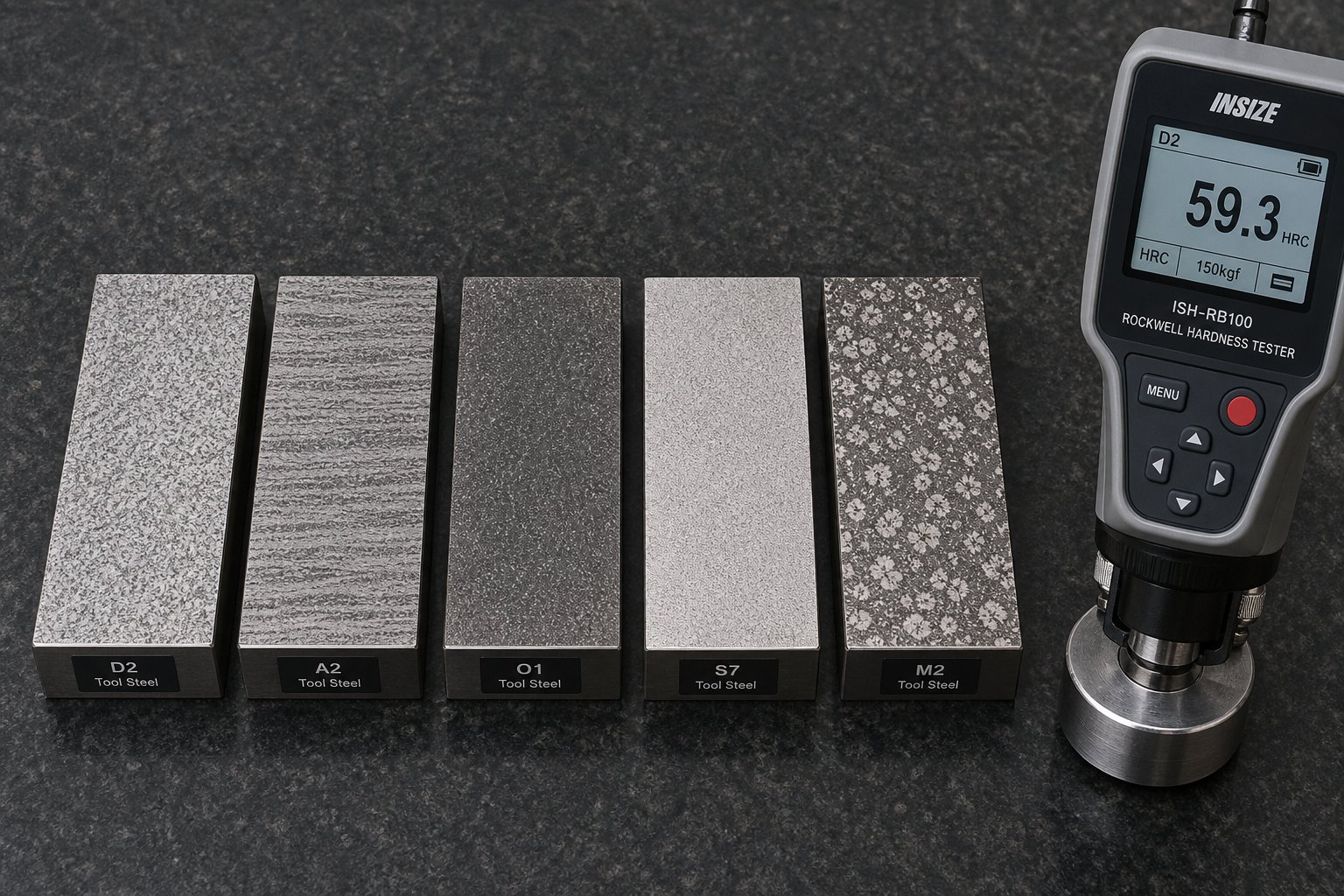
Five material families cover the vast majority of replacement cutting components. Each occupies a specific niche defined by its balance of hardness, toughness, and wear resistance.
- A2 (air-hardening) - The general-purpose baseline. A2 offers good toughness and adequate wear resistance for short-to-medium production runs in mild steel. It tolerates slight misalignment better than harder grades because its microstructure absorbs impact without catastrophic chipping. Hardened to 58-60 HRC, it handles moderate volumes but wears relatively quickly on abrasive materials.
- D2 (high-carbon, high-chromium) - The workhorse of high-volume cutting operations. D2 contains approximately 12% chromium and forms large chromium carbides that resist abrasive wear significantly better than A2. Typical hardness sits at 58-62 HRC. The tradeoff is reduced toughness - D2's blocky carbide structure makes it vulnerable to chipping and spalling under heavy vibration or lateral loading.
- M2 (high-speed steel) - When heat buildup from high-speed operation threatens edge integrity, M2 holds its hardness at elevated temperatures better than D2 or A2. Its finer, more evenly distributed carbides handle the snap-through shock of heavy blanking while maintaining strong edge retention. It's the preferred upgrade for progressive dies running at high stroke rates.
- S7 (shock-resistant) - The toughest option in the tool steel family, optimized for impact loading rather than pure abrasion resistance. S7 hardened to 54-56 HRC excels in applications involving thick material, heavy notching, or operations where the punch experiences significant lateral force. It won't hold an edge as long as D2, but it won't snap under shock either.
- Tungsten carbide - When nothing else survives the application. Carbide offers extreme hardness (typically 88-92 HRA) and wear resistance measured in millions of hits on abrasive materials like stainless steel or silicon electrical steel. The cost is substantially higher and the material is brittle - any misalignment or lateral deflection risks catastrophic fracture rather than gradual wear.
The D2 vs M2 decision for die replacement punches comes down to a straightforward question: is the dominant failure mode edge wear from abrasion, or edge chipping from impact and heat? D2 wins on pure abrasion resistance. M2 wins on shock tolerance and thermal stability at speed.
For hardness specifications for die components, cutting elements typically operate in the 58-62 HRC range to maintain sharp edges under repetitive shear loading. Structural wear parts - backing plates, wear plates, heel block inserts - run lower, usually 48-52 HRC, where increased toughness matters more than maximum surface hardness. As metallurgical research by George Vander Voort confirms, steels used for tools and dies are typically used at 58 to 68 HRC, and the careful balance between hardness and toughness is critical to avoiding premature failure.
How Workpiece Material and Volume Affect Grade Selection
You wouldn't specify the same replacement punch for a die running 50,000 hits per year in 20-gauge cold-rolled steel as one running 5 million hits per year in 0.060 in. stainless. The workpiece material's properties and the total production demand both drive the correct grade choice.
Material thickness and tensile strength determine the force each component absorbs per stroke. Thicker material at higher tensile strength means more shear force on the cutting edge and more stripping force on the punch sidewall. A replacement punch for 0.125 in. HSLA steel at 80 ksi tensile needs dramatically more toughness than one cutting 0.030 in. mild steel at 45 ksi - even if the geometry is identical. In high-strength applications, S7 or M2 often outperforms D2 because the shock loading exceeds what D2's brittle carbide network can tolerate.
Annual production volume defines how many cycles that replacement part must survive before the next changeout. For low-volume tooling (under 100,000 hits per year), A2 provides adequate life at the lowest cost. Mid-volume applications (100,000 to 1 million hits) are the domain of D2 and M2, where their superior wear resistance justifies the price premium. High-volume production above 1 million annual hits - especially in abrasive materials - is where carbide vs tool steel for stamping dies becomes a real economic comparison. Carbide costs three to five times more per component but can deliver ten or more times the service life, making it cheaper per-hit in demanding applications.
Workpiece material adhesiveness is a factor that's easy to overlook. Soft, gummy materials like aluminum and copper alloys don't wear tools through abrasion - they cold-weld to the punch surface through adhesive wear (galling). In these applications, maximum hardness alone doesn't solve the problem. A polished surface finish and appropriate coating matter more than upgrading from D2 to carbide.
Heat Treatment Requirements for Replacement Components
A replacement part machined to correct dimensions from the correct tool steel grade will still fail prematurely if heat treatment isn't properly executed. As noted in failure analysis literature, improper heat-treatment procedures are the single largest source of tool and die failures - whether during subsequent processing or in service. Each grade has a narrow recommended austenitizing temperature, quench method, and tempering protocol. Deviating from these parameters changes the microstructure in ways that compromise either hardness or toughness.
Through-hardening vs. case-hardening: Cutting components (punches, die buttons, trim steels) require through-hardening - uniform hardness from surface to core. This ensures that as the component is resharpened or as surface material wears away, the exposed subsurface retains the same cutting capability. Case-hardening, which creates a hard outer shell over a softer core, applies to components like guide pins and bushings where surface wear resistance matters but the core needs toughness to resist bending loads.
When a replacement component is through-hardened but specifies only surface hardness without defining core hardness, you risk receiving a part that was incompletely hardened - hard on the outside, soft in the center. Under load, the soft core deforms, the hard shell cracks, and the part fails far earlier than expected. Always specify both surface hardness and minimum core hardness on replacement part orders.
Common heat treatment failures in replacement parts include:
- Under-tempering - Leaves excessive retained austenite in the microstructure. The part seems hard enough on delivery but dimensionally changes in service as the retained austenite slowly transforms, causing unexpected growth or distortion.
- Over-austenitizing - Dissolves too much carbon, creating a coarse grain structure that chips easily despite achieving target hardness numbers.
- Decarburization - Carbon loss at the surface during heat treatment creates a soft skin that wears rapidly. The hardness reading on the finished part may check correctly if measured below the decarburized layer, masking the problem until the part goes into service.
- Inadequate stress relief - Residual stresses from quenching concentrate at geometric transitions (keyways, step diameters, sharp corners), initiating cracks during service loading.
Sounds complex? The practical takeaway is this: when sourcing replacement parts, verify that your supplier documents the full heat treatment cycle - not just final hardness. A certificate showing 60 HRC is insufficient if you don't know whether the part was properly tempered, whether core hardness meets specification, and whether surface chemistry was preserved during processing.
Tool Steel Grade Comparison for Replacement Parts
| Grade | Typical Use | Hardness Range (HRC) | Toughness Rating | Best Application Scenario |
|---|---|---|---|---|
| A2 | General-purpose punches and die sections | 58-60 | High | Short-to-medium runs in mild steel; applications with risk of lateral loading or slight misalignment |
| D2 | High-volume cutting punches and die buttons | 58-62 | Moderate | Long production runs in carbon steel and HSLA; pure abrasive wear environments with good alignment |
| M2 | High-speed punching, progressive die stations | 60-65 | Moderate-High | High stroke rates where heat buildup degrades other grades; thick material with snap-through shock |
| S7 | Notching punches, heavy-impact forming tools | 54-56 | Very High | Thick material cutting, operations with severe lateral force, applications where chipping risk outweighs wear concern |
| Tungsten Carbide | Extreme-volume piercing punches and die buttons | 88-92 HRA | Low | Multi-million hit production in stainless, silicon steel, or other highly abrasive sheet; requires excellent die alignment |
Selecting the correct grade and heat treatment gives replacement parts the foundation to perform. But the base material is only the starting point - surface treatments and coatings applied after heat treatment can push service life even further, particularly in applications where friction, adhesion, or temperature resistance become the limiting factors.
Best Coatings for Die Replacement Parts
A properly selected tool steel grade and heat treatment set the performance floor for any replacement component. But in many applications, the base material alone isn't the limiting factor - friction, adhesion, and thermal degradation at the cutting edge determine how long the part actually lasts in production. Surface coatings address exactly these failure mechanisms, adding a thin but remarkably hard barrier that reduces wear rates, prevents material pickup, and resists the localized heat that degrades uncoated tool steel surfaces.
For stamping die replacement parts, coatings represent a practical way to extend service intervals without redesigning the component or upgrading to significantly more expensive base materials. The key is matching the right coating to the specific workpiece material and wear mechanism - a mismatch delivers little benefit and wastes the coating investment.
Common Coating Options and Their Performance Benefits
Four coating families cover the majority of stamping die applications. Each delivers a distinct combination of hardness, thermal resistance, and friction reduction that targets specific failure modes.
- TiN (Titanium Nitride) - The most widely recognized PVD coating, identifiable by its gold color. TiN coating for stamping die punches provides a meaningful hardness increase (approximately 2,300 HV) and reduces friction compared to uncoated tool steel. It performs well in general-purpose cutting of mild and carbon steels at moderate production volumes. However, its oxidation temperature limit of around 600 degrees C means it degrades relatively quickly in high-speed operations where cutting edge temperatures climb.
- TiCN (Titanium Carbonitride) - A step up from TiN in both hardness (approximately 3,000 HV) and wear resistance. The carbon addition improves lubricity and makes TiCN particularly effective for cutting stainless steel and other work-hardening alloys where friction at the punch-to-strip interface generates significant heat. MISUMI's testing of TiCN-based coatings on high-tensile steel applications confirmed strong performance, though adhesion challenges appeared under extreme deformation loads at the Rockwell impression test level.
- AlTiN (Aluminum Titanium Nitride) - Engineered for high-temperature stability. AlTiN forms an aluminum oxide layer at the surface during operation that acts as a thermal barrier, allowing it to maintain performance at temperatures up to 900 degrees C. This makes it the preferred choice for high-speed progressive dies running at elevated stroke rates where cutting edge temperatures would degrade TiN or TiCN. Its hardness (approximately 3,300 HV) also delivers superior abrasion resistance in long-run applications.
- DLC (Diamond-Like Carbon) - A fundamentally different coating category designed to solve adhesion problems rather than purely abrasive wear. DLC coatings exhibit extremely low coefficients of friction (as low as 0.05-0.1) and, critically, resist material pickup from soft, gummy workpiece materials. As field trials documented by The Fabricator demonstrated, CrN + DLC coatings applied to trim inserts processing 6000 series aluminum eliminated sticking completely - and the tool produced over 800,000 parts with aluminum fines that could simply be wiped off with a cloth. DLC coating to prevent aluminum galling in dies is now the standard approach in automotive stamping where aluminum body panels have become widespread.
One important nuance: not all DLC coatings are equal. Multilayered designs with a CrN underlayer significantly outperform those with a WC-C (tungsten carbide/carbon) base when forming aluminum. The Fabricator's research showed that WC-C + DLC coatings failed after just a few thousand parts due to abrasive wear from aluminum alloys under high forming pressure, while the CrN + DLC combination withstood the same conditions and resisted both sticking and abrasion far more effectively.
Coating Performance Comparison
| Coating | Hardness (HV) | Max Operating Temperature | Friction Coefficient | Best Application |
|---|---|---|---|---|
| TiN | ~2,300 | 600°C | 0.4-0.5 | General-purpose cutting in mild steel; moderate volumes; cost-effective baseline improvement |
| TiCN | ~3,000 | 750°C | 0.3-0.4 | Stainless steel and high-strength steel cutting; operations generating significant friction heat |
| AlTiN | ~3,300 | 900°C | 0.3-0.4 | High-speed progressive dies; high stroke rates; abrasive materials at elevated temperatures |
| DLC (CrN + a-C:H) | 2,500-3,500 | 350°C | 0.05-0.1 | Aluminum and copper alloy stamping; anti-galling applications; trimming and piercing without lubrication |
| Al-Cr (RW type) | ~3,100 | 1,000°C+ | 0.3-0.4 | Ultra-high-tensile steel; thick plate stamping; extreme temperature at cutting edge |
Notice the tradeoff pattern: coatings optimized for thermal resistance (AlTiN, Al-Cr) don't offer the ultra-low friction of DLC, while DLC's temperature ceiling limits it to applications below 350 degrees C. Choosing correctly means identifying whether your replacement part is failing from heat degradation, abrasive wear, or adhesive material buildup - then selecting the coating that targets that specific mechanism.
When Coatings Justify Their Cost
Coating a replacement punch or die button typically adds 20-40% to the component cost, depending on geometry and coating type. That premium needs to pay for itself through extended service intervals, reduced scrap, or fewer unplanned stops. Here's when to coat stamping die components - and when the investment doesn't make sense.
Production volume thresholds: For dies running under 50,000 hits between maintenance cycles, the incremental life gain from coating may not offset the added cost and lead time. Above 200,000 hits per service interval - especially in abrasive materials - coatings routinely double or triple component life, making the cost-per-hit calculation strongly favorable. MISUMI's punching tests on 590 MPa high-tensile steel showed uncoated and standard-coated punches failing at 50,000-70,000 shots while advanced Al-Cr (RW) coated punches remained in usable condition past 100,000 shots with only minor surface wear.
Workpiece material abrasiveness: High-strength steels, stainless alloys, silicon electrical steels, and aluminum alloys with high silicon content all accelerate wear through different mechanisms. If your uncoated replacement parts consistently fail before the target hit count in these materials, coating is almost certainly justified.
Target maintenance intervals: When a die's scheduled PM cycle is 500,000 hits but uncoated punches wear out at 300,000, you're pulling the die off-schedule for a single component. Coating that punch to reach 600,000 hits aligns its replacement with the full PM cycle, eliminating the mid-run interruption entirely.
Coating a replacement part can be more cost-effective than upgrading the base material grade. A D2 punch with an AlTiN coating often outperforms an uncoated carbide punch at a fraction of the cost - while maintaining the toughness that carbide lacks.
One common mistake: applying coatings to components that fail from causes the coating can't address. A punch that breaks from lateral overload needs a tougher base material (S7) or a die alignment correction - not a harder surface coating. Coatings prevent gradual wear and adhesion. They don't compensate for impact overload, misalignment, or incorrect clearance settings.
The practical decision comes down to root cause. If your replacement parts are wearing out too fast from abrasion, heat, or material adhesion, the right coating extends their life past OEM baseline with minimal additional cost. If they're breaking or chipping, the solution lives in the base material grade and die setup - territory where the repair-versus-replace-versus-rebuild decision framework becomes the more relevant guide.
Stamping Die Repair vs Replace Decision
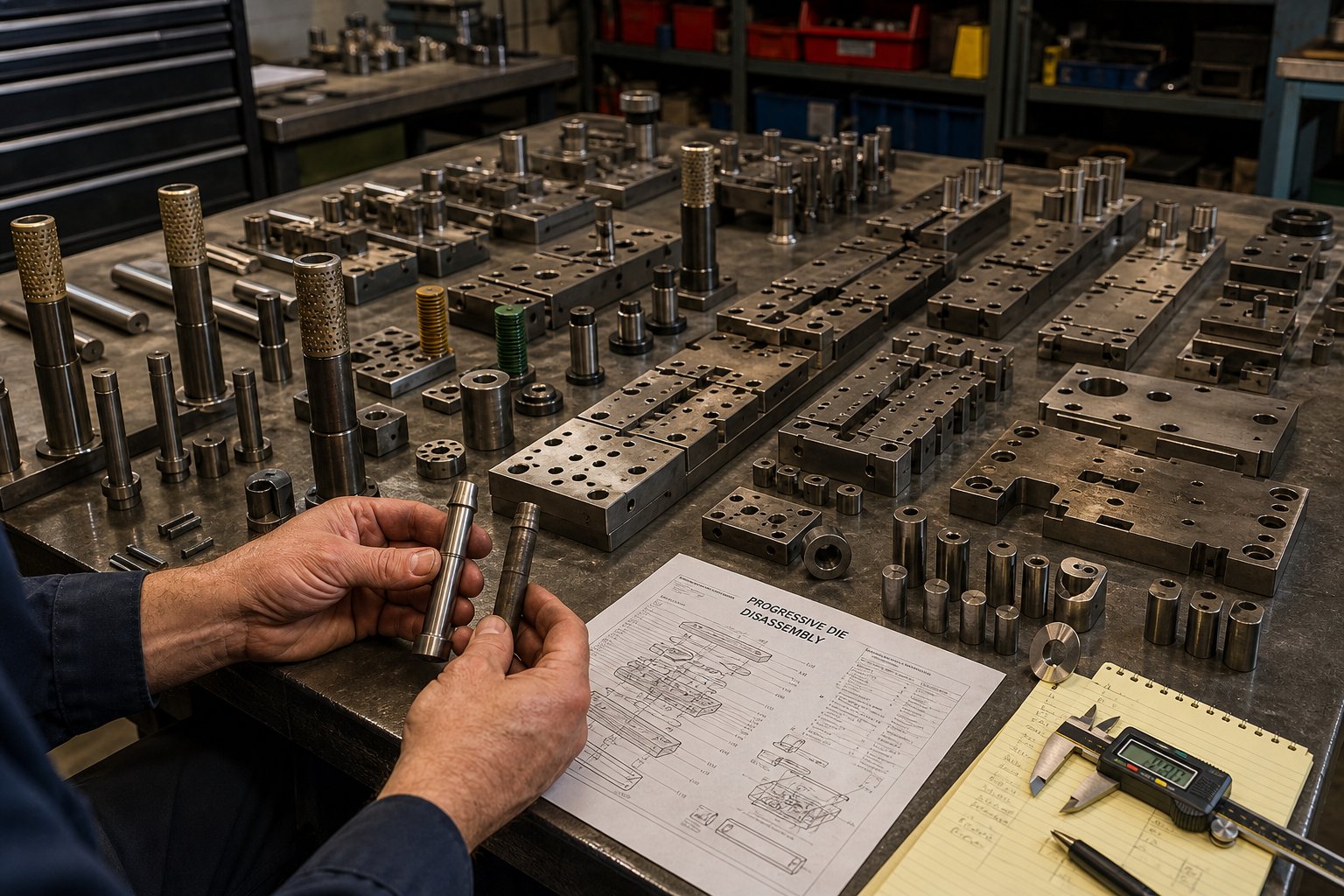
You've identified the failing component, confirmed the root cause, and selected the right material grade and coating. But one decision still remains: is swapping in a new part the right move, or does the situation call for reconditioning the existing component - or scrapping the entire die section and rebuilding? The stamping die repair vs replace decision isn't always straightforward, especially when multiple components show wear at different severity levels simultaneously.
The framework below helps you navigate that choice by matching die condition to the intervention that delivers the best cost-per-part outcome without introducing unnecessary risk.
When Individual Part Replacement Is Sufficient
Isolated component changeout is the right call when the failure is contained - a single punch has chipped, one die button has opened beyond clearance, or a set of springs has sagged past specification. Individual replacement works when these conditions hold true:
- Single-point wear with no cascading damage. The worn component hasn't degraded anything adjacent. A dull punch that was caught before it damaged the die button can be replaced alone. A punch that broke and scored the button requires replacing both.
- Structural integrity of the die shoe and retainers is intact. Guide pin bores haven't wallowed out, punch pockets haven't enlarged, and mounting surfaces remain flat and undamaged.
- The replacement part can be sourced to original specification. Dimensional tolerances, material grade, hardness, and coating can all be matched or improved without modifying adjacent components.
- Production data confirms the failure is isolated. Hit counter records show only this component has exceeded its expected life - neighboring parts still have service margin remaining.
Most routine die maintenance falls into this category. A well-maintained progressive die might consume dozens of individual replacement parts over its lifetime while the die structure itself remains perfectly serviceable.
When Repair or Reconditioning Makes More Sense
Die component reconditioning vs replacement becomes the relevant comparison when a component has wear that's correctable without full removal and re-manufacture. Reconditioning preserves the existing part's geometry and fit - important when the component has been custom-fitted to the die assembly and a new part would require additional hand-work to achieve the same interface.
Reconditioning is typically appropriate when:
- Cutting edges can be resharpened. Punches and die buttons with uniform edge wear (no chipping or cracking) can be surface-ground to restore the cutting profile. Each regrind removes material, so track cumulative stock removal against the component's maximum allowable shortening.
- Worn surfaces can be rebuilt without compromising base geometry. Techniques like weld buildup and remachining, chrome replating, or thermal spray can restore worn guide surfaces, heel block faces, or die cavity walls to original dimension - provided the base steel hasn't developed fatigue cracks beneath the wear zone.
- The cost of reconditioning is significantly below replacement. As Carver Roboweld's die regeneration analysis notes, repair is typically 40-60% less expensive than manufacturing a new component, with shorter turnaround time reducing downtime costs as well.
- The component's base material and metallurgical integrity remain sound. If non-destructive inspection (magnetic particle, ultrasonic, or dye penetrant) reveals subsurface cracking or material softening from thermal fatigue, reconditioning the surface won't solve the underlying problem.
One critical caution: reconditioning only works when the correct root cause of damage has been identified. Regrinding a punch that chipped due to misalignment - without correcting the alignment - simply produces another chipped punch in fewer hits than before.
When Full Rebuild Is the Only Viable Path
Knowing when to rebuild a stamping die saves you from the cycle of replacing parts into a structure that can no longer hold them to spec. A rebuild means remanufacturing the die section - recutting pockets, reboring guide pin holes, replacing retainers, and essentially restoring the structural foundation that individual components mount into.
Rebuild indicators include:
- Multiple components in the same die section failing ahead of schedule repeatedly. If you're replacing the same punch every 200,000 hits when it should last 800,000, the problem isn't the punch - it's the pocket, the alignment, or the structural geometry holding that punch.
- Guide pin bores or bushing seats have worn beyond remachining tolerance. When the die shoe itself has lost dimensional integrity, no replacement bushing can restore proper alignment.
- Cumulative regrinding has shortened cutting components beyond functional limits. Once punches have been resharpened past their maximum stack-up allowance, the die's shut height and timing relationships are compromised system-wide.
- Thermal fatigue or stress cracking in the die shoe or retainer plates. Surface cracks propagating into structural elements cannot be resolved by component-level intervention - the cracked structure must be replaced.
- Die design is outdated relative to current production requirements. If material specifications, part tolerances, or production volumes have changed substantially since the die was built, rebuilding with updated engineering is more effective than forcing new components into an obsolete design.
Stamping die rebuild indicators and cost often surprise teams that have been managing individual replacements for years. A full rebuild typically runs 50-70% of new die cost but delivers a tool with a fresh lifecycle - eliminating the accumulating risk of cascading failures that erode confidence in part quality.
Decision Comparison: Replace vs Recondition vs Rebuild
| Intervention Type | Typical Indicators | Relative Cost | Downtime Impact | Risk Level |
|---|---|---|---|---|
| Individual Part Replacement | Single component at end of life; no adjacent damage; structural integrity intact | Low (one component cost + install labor) | Minimal - often completed within a scheduled PM window | Low, provided root cause is confirmed and specification is correct |
| Repair / Reconditioning | Correctable surface wear; resharpening margin remaining; base material metallurgically sound | Moderate (40-60% of new component cost) | Low to moderate - depends on whether rework is done in-house or sent out | Moderate - improper reconditioning can introduce residual stress or dimensional error |
| Full Die Rebuild | Repeated premature failures; structural deformation; cumulative regrind limits exceeded; design obsolescence | High (50-70% of new die cost) | Significant - typically measured in weeks including engineering, machining, and tryout | Low post-completion (fresh lifecycle), but high opportunity cost during rebuild period |
Common Specification Mistakes That Force Premature Re-Intervention
Even when you make the right repair-or-replace decision, specification errors during the replacement process can undermine the outcome and put you right back at the press with the same problem. Watch for these frequent missteps:
- Specifying hardness without toughness context. Ordering a replacement punch at 62 HRC when the application generates lateral shock loads leads to chipping. The original may have been 58 HRC for good reason.
- Ignoring fit tolerances to the die assembly. A replacement die button ground to correct bore diameter but with an incorrect press-fit OD won't seat properly in the retainer - it shifts under load and changes effective clearance.
- Replacing a worn component without inspecting its mating part. A new guide pin installed into a worn bushing still produces misalignment. Mating components should always be evaluated together.
- Failing to match coating specification. If the original component was coated and the replacement arrives uncoated, service life will fall short of expectations regardless of correct base material selection.
Each of these mistakes shares a common thread: incomplete specification. The component that gets ordered needs to carry every critical dimension, material callout, hardness range, surface finish, and coating requirement to arrive ready for service. How to build that complete specification - and where to source components that meet it reliably - is the practical next step in moving from diagnosis to a correctly functioning die.
How to Specify and Source Stamping Die Replacement Parts Correctly
You've confirmed the root cause, decided on replacement over repair, and selected the right material grade and coating. The component is defined in your head - but the supplier doesn't live inside your head. A replacement part order that arrives wrong delays production just as effectively as not ordering at all. Incomplete specifications produce parts that look right on the shelf but fail at installation because a critical dimension, hardness callout, or surface finish detail was missing from the request.
Translating your diagnosis into a procurement-ready specification is where many maintenance teams lose time. The gap between knowing what you need and communicating it precisely enough for a supplier to manufacture it correctly is the most underestimated step in the entire replacement workflow.
Translating Diagnosis Into a Complete Part Specification
Every replacement part order - whether it's a single punch or a full set of guide bushings - requires the same core information package. Miss any element and you're relying on the supplier to guess, which introduces risk you don't control.
Here's the complete checklist of specification details to include in any replacement part request:
- Dimensional tolerances - Overall length, working diameter or profile, head diameter, and all critical interfaces. For cutting components, specify the sheared profile to the tightest tolerance the die requires. For guide components, include both bore ID and press-fit OD. Standard piercing tolerances in stamping run as tight as +/-0.002 in. for mild steel and +/-0.0025 in. for stainless, so tolerance requirements for die replacement parts must be explicit - don't assume a supplier will default to your needed precision.
- Material grade - Specify the exact tool steel grade (D2, M2, A2, S7, carbide) rather than generic descriptors like "tool steel" or "high-speed steel." If the application allows equivalent grades, state the acceptable alternatives explicitly.
- Hardness specification - Include both surface hardness range (e.g., 58-62 HRC) and minimum core hardness where applicable. For case-hardened components, state case depth as well.
- Heat treatment documentation requirements - Request a heat treatment certification that includes austenitizing temperature, quench method, tempering cycles, and final measured hardness. This is your verification that the process was executed correctly.
- Surface finish - Specify Ra values for critical surfaces, particularly punch sidewalls and die button bores where finish directly affects strip material flow and slug retention.
- Coating type and thickness - If the original part was coated, specify the same coating or an approved upgrade. Include coating thickness tolerance if the component fits into a tight pocket or bore where added microns matter.
- Geometric references - Provide datum references, angular orientation marks, and keying features that ensure the part installs in the correct rotational position. A round die button with a non-symmetric bore profile needs an orientation indicator.
- Part number and die identification - Cross-reference to the die maintenance records so the supplier can trace the component back to its application history if questions arise during manufacturing.
Sounds like a lot? Consider what happens without it. A replacement die button ordered with only a bore dimension and material callout arrives at correct ID - but the press-fit OD is 0.0003 in. undersize because the supplier used their standard tolerance rather than yours. It drops into the retainer with a slip fit instead of an interference fit, shifts under cutting load, and your clearance is immediately wrong. One missing line on the purchase order, one unnecessary die pull two weeks later.
Evaluating Replacement Part Quality Tiers
Not all replacement components are manufactured to the same standard, and the differences matter more than price alone suggests. Understanding OEM vs aftermarket die replacement components - and the tiers within aftermarket - helps you match sourcing decisions to application criticality.
OEM equivalent parts are manufactured to the original die builder's specification, often by the die builder themselves or a qualified subcontractor using the original prints. They guarantee dimensional, material, and performance parity with the component they replace. The tradeoff is cost and lead time - OEM-equivalent parts typically carry the highest price and may require weeks of lead time if they're made to order.
Premium aftermarket parts come from specialized tooling component manufacturers who produce to industry-standard specifications rather than a specific die builder's proprietary prints. These manufacturers often maintain extensive inventories of standard punch and die button geometries, guide pins, and bushings. Quality can equal or exceed OEM when the supplier invests in tight process controls, premium raw material sourcing, and documented heat treatment. The advantage is faster availability and lower cost for standard geometries.
Economy replacement options target the lowest price point. They meet basic dimensional requirements but may use less controlled material sourcing, minimal heat treatment documentation, and wider tolerance bands. For non-critical wear parts like standard compression springs or simple backing plates, economy components can be perfectly adequate. For precision cutting components where hardness uniformity and dimensional accuracy directly affect part quality, the savings often evaporate in shorter service life and more frequent changeouts.
The practical rule: match quality tier to consequence of failure. A pilot pin in a high-precision connector die running at 400 SPM demands OEM-equivalent or premium aftermarket quality - the cost of premature failure far exceeds the per-unit savings from a cheaper part. A lifter spring in a low-volume bracket die can run economy components without meaningful risk.
Working With Custom Die Manufacturers for Replacement Parts
Stamping die part sourcing best practices point to one approach that simplifies everything discussed above: sourcing replacement components from the manufacturer who originally engineered the die. When the die builder designed the tool with maintainability as a priority, they've already solved the specification problem for you. Every replacement part has documented dimensions, material grades, heat treatment protocols, and coating specifications captured during the original engineering process.
Manufacturers like YICHEN design dies with replacement part accessibility and specification documentation built into the engineering deliverable. When a component eventually wears, the full specification already exists - you're not reverse-engineering dimensions from a worn part or guessing at material grades. This approach to custom die manufacturer replacement part sourcing eliminates the most common failure mode in the procurement process: incomplete or inaccurate specifications leading to parts that don't perform as expected.
Beyond documentation, custom manufacturers who prioritize maintainability tend to make design choices that simplify future replacements:
- Standardized component interfaces - Using common punch head configurations, standard bushing press-fit dimensions, and modular insert mounting so replacement parts can be sourced from multiple qualified suppliers if needed.
- Accessible component mounting - Designing retention systems that allow individual component changeout without disassembling unrelated die sections.
- Material and hardness traceability - Providing component-level documentation that travels with the die maintenance records, ensuring the correct specification is available years after initial die delivery.
- Engineering support for replacement decisions - Offering guidance on when a component should be replaced versus reconditioned, based on their knowledge of the original design intent and safety margins.
This is where how to specify stamping die replacement parts becomes significantly easier. Rather than building a specification from scratch each time a component wears, you're referencing an existing engineering package that was created when the die was new and every dimension was at nominal. The result is replacement parts that arrive ready to install with confidence - matching the original design intent rather than approximating it from a worn sample.
Whether you source from the original die builder, a premium aftermarket supplier, or a combination of both, the critical constant is specification completeness. Every detail you capture upfront - tolerance, grade, hardness, finish, coating, orientation - is one less variable that can go wrong between your purchase order and the moment that part takes its first hit in the press.
Die Replacement Part Installation Verification and Lifecycle Tracking
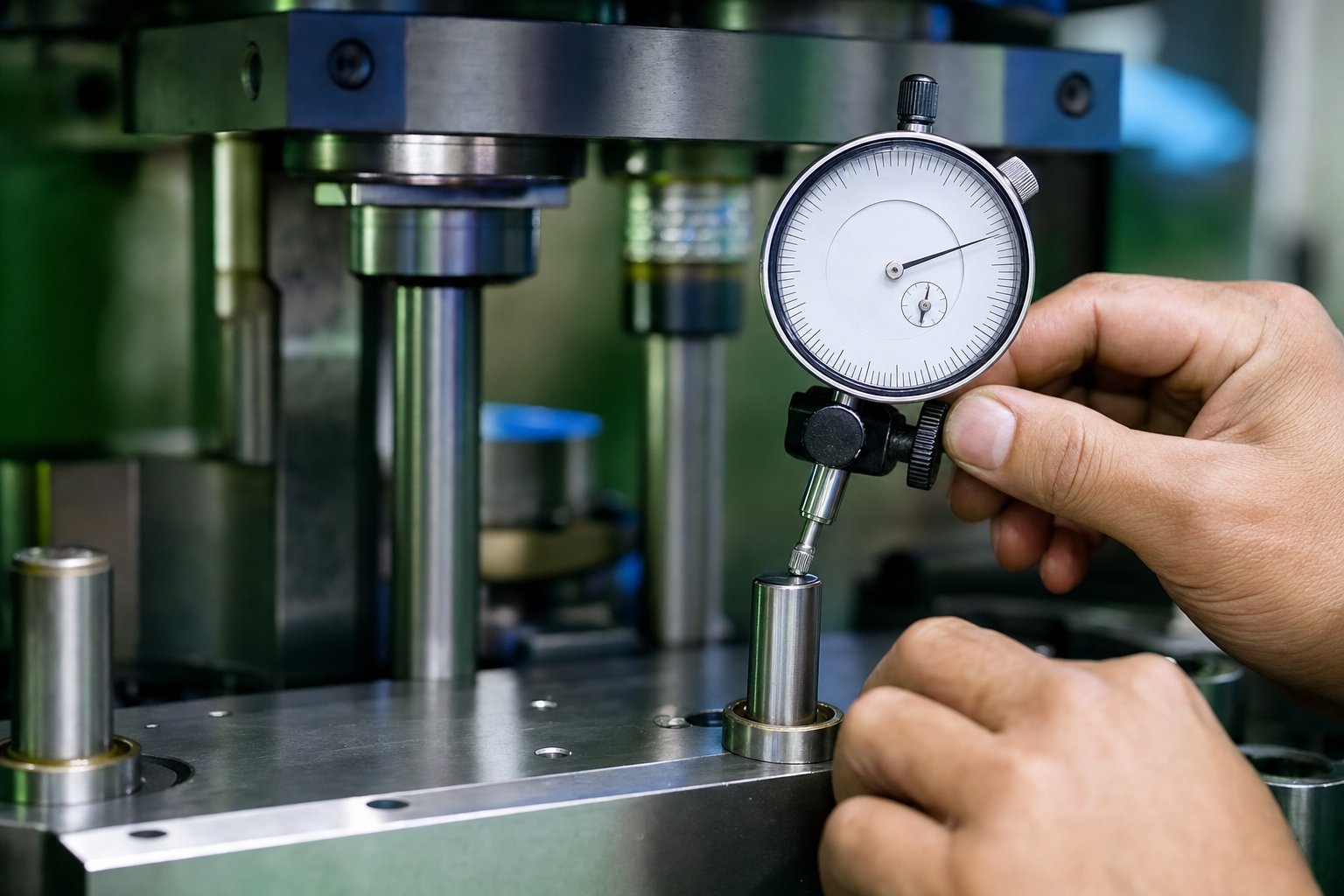
A correctly specified replacement part sitting on the workbench isn't the finish line - it's the starting line. The component still needs to prove it fits the die assembly, maintains proper clearances, and produces conforming parts from the first hit. Skipping post-installation verification is how shops end up pulling a die back out of the press thirty minutes after putting it in, having discovered that a new guide bushing is 0.0002 in. tight or a replacement punch sits proud of its neighbors by half a thou.
Verification also creates the baseline data that makes your next replacement smarter. Every measurement you record at installation becomes a reference point for future wear assessment - the starting condition against which all subsequent inspections compare.
Dimensional Verification Before and After Installation
How to verify stamping die component fit follows a logical sequence: confirm the part matches spec on the bench, confirm it interfaces correctly in the die, and confirm it produces acceptable output at the press. Each step catches a different category of error.
- Bench inspection against specification. Before the part goes anywhere near the die, verify critical dimensions against the purchase order spec. Measure working diameter or profile with calibrated micrometers or optical comparator. Check hardness with a portable Rockwell tester at multiple locations. Confirm surface finish visually or with a profilometer if Ra is specified. Reject anything out of tolerance before it consumes installation labor.
- Fit check in the die assembly. Install the component and verify interface dimensions. For press-fit components (die buttons, bushings), confirm seating depth and rotational orientation. For cutting components, check that punch-to-die clearance is within specification using feeler gauges or pin gauges at multiple points around the profile. Verify that guide pins travel freely through bushings without binding or excessive play.
- Alignment verification under static load. Close the die slowly on the press at inch speed without material. Confirm that punches enter die openings without contact, strippers seat flat against the die face, and cam systems engage at their designed timing point. Any interference at this stage indicates a dimensional error or installation mistake - correct it before running material.
- First-article inspection under production conditions. Run a small sample - typically five to twenty parts - at production speed and inspect them against the full dimensional specification. Post-installation inspection for die parts isn't complete until actual stamped output confirms that the replacement component delivers conforming results. Check burr height, hole dimensions, feature locations, and surface condition against control limits.
- Record all measurements as the new baseline. Document clearances, alignment readings, and first-article dimensions in the die maintenance record. These values represent the component's starting condition at zero hits - the reference you'll compare against at every subsequent inspection.
This sequence catches three distinct failure categories: manufacturing errors in the replacement part itself (step 1), installation errors in how it interfaces with the die (steps 2-3), and functional errors that only appear under actual stamping conditions (step 4). Skipping any step leaves a gap where problems hide until they've already produced scrap or damaged adjacent tooling.
Establishing Baseline Metrics for Ongoing Tracking
Tracking die component lifecycle data transforms replacement from a reactive event into a predictable, budgetable maintenance activity. The information you capture at installation - and at every inspection afterward - builds the dataset that tells you exactly when each component will need attention next.
Start with these core data points at every replacement event:
- Hit count at installation. Record the die's cumulative stroke counter reading when the new component goes in. This becomes the denominator for all future lifecycle calculations.
- Component specification details. Log material grade, hardness, coating type, and supplier. When two identical punches from different suppliers deliver different service lives, this data explains why.
- Condition of removed component. Note why it was replaced - measured wear, chipping, breakage, or proactive replacement based on hit count threshold. This builds failure mode history for that specific die station.
- Monitoring interval. Set the next inspection point based on historical data or manufacturer recommendation. If previous components in this station lasted 600,000 hits, schedule the first inspection at 400,000 to catch wear progression while the part is still serviceable.
Over multiple replacement cycles, this data builds component-specific lifecycle curves. You'll notice that station four's pilot consistently reaches wear limit at 750,000 hits regardless of supplier, while station seven's punch lasts 1.2 million hits with a TiCN coating but only 500,000 without it. Those patterns turn triage decisions from judgment calls into data-driven forecasts - and they help you set meaningful KPI benchmarks like MTBF targets for individual die components rather than just the die as a whole.
Plants using structured tracking systems - whether a CMMS platform, a dedicated die maintenance database, or even well-maintained spreadsheets - consistently report measurable gains. According to Oxmaint's manufacturing research, structured PM programs reduce unplanned downtime by 30-45% within six months and extend tool life by up to 50% through proper alignment and monitoring disciplines. The tracking doesn't create those gains directly - it enables the timing precision that makes planned replacement possible.
Systematic tracking transforms replacement from a reactive emergency into planned maintenance. The data you collect today determines whether next year's budget is a forecast or a guess.
Working with manufacturers who prioritize stable production performance simplifies this entire verification and tracking process. When replacement components are engineered to original design intent - with documented specifications, controlled material sourcing, and verified heat treatment - the verification steps confirm fit rather than diagnose problems. Manufacturers like YICHEN pair custom stamping die manufacturing with engineering attention to maintainability, which means replacement parts arrive with the dimensional precision and metallurgical consistency that make first-article inspection a confirmation step rather than a troubleshooting exercise. The result is less time validating and more time producing.
Stamping die replacement parts will always be consumables - they're designed to wear so your die structure doesn't. But how you verify, track, and plan around that wear determines whether replacement is a controlled maintenance activity or an unplanned production emergency. Build the verification habit at installation, capture the data at every touchpoint, and let the lifecycle curves guide your decisions. The press keeps running, and you stay ahead of the wear.
Frequently Asked Questions About Stamping Die Replacement Parts
1. What are the most commonly replaced parts in a stamping die?
The most frequently replaced stamping die components are punches, die buttons, guide pins, guide bushings, springs, pilots, and stripper plates. These parts directly contact the strip material or manage internal forces during each press stroke, causing them to wear faster than structural elements like die shoes. Punches and die buttons top the list because they absorb full shear force on every hit, while springs degrade gradually through fatigue cycling. Working with manufacturers like YICHEN who design dies with maintainability in mind ensures these high-wear components are accessible and fully documented for streamlined replacement.
2. How do you know when stamping die components need replacement?
Key indicators include increasing burr height on stamped parts, dimensional drift detected during quality checks, misfeed alarms, strip lifting between stations, and inconsistent part ejection. Uniform burr growth across all features signals general punch dulling, while one-sided burrs point to guide pin or bushing wear causing misalignment. Hole-to-hole distance variance often traces back to worn pilot pins. Monitoring hit counts alongside SPC data and scrap tracking records helps confirm which specific component is degrading and when replacement should be scheduled.
3. What tool steel grade should I use for replacement die punches?
The correct grade depends on your workpiece material, production volume, and dominant failure mode. A2 suits short-to-medium runs in mild steel with good toughness. D2 excels in high-volume abrasive wear applications with its 58-62 HRC hardness range. M2 handles high stroke rates and heat buildup better than D2. S7 at 54-56 HRC is ideal for thick material and heavy impact where chipping risk outweighs wear concerns. Tungsten carbide delivers millions of hits on abrasive materials like stainless steel but requires excellent die alignment due to its brittleness.
4. Should I repair or replace a worn stamping die component?
Choose individual replacement when failure is isolated to one component with no cascading damage and the die structure remains intact. Reconditioning through regrinding or replating makes sense when correctable surface wear exists and costs 40-60% less than new manufacturing. Full die rebuild becomes necessary when multiple components fail prematurely and repeatedly, guide pin bores have worn beyond tolerance, or cumulative regrinding has exceeded functional limits. The deciding factor is whether the component's current condition risks damaging something more expensive if left unaddressed.
5. How do coatings extend the life of stamping die replacement parts?
Surface coatings like TiN, TiCN, AlTiN, and DLC add a hard barrier that reduces friction, prevents material adhesion, and resists thermal degradation at cutting edges. TiCN works well for stainless steel cutting, AlTiN handles high-speed operations up to 900 degrees C, and DLC with a CrN underlayer eliminates aluminum galling with friction coefficients as low as 0.05. Coatings typically add 20-40% to component cost but can double or triple service life in abrasive applications above 200,000 hits per interval, often making them more cost-effective than upgrading the base material grade.


