


What Is Robotic Transfer Die Stamping
Ask five stamping engineers to define robotic transfer die stamping and you'll likely get five different answers. Some confuse it with basic press tending. Others lump it in with progressive die operations. The reality is more specific, and getting the definition right matters when you're specifying equipment or quoting a new program.
What Robotic Transfer Die Stamping Actually Means
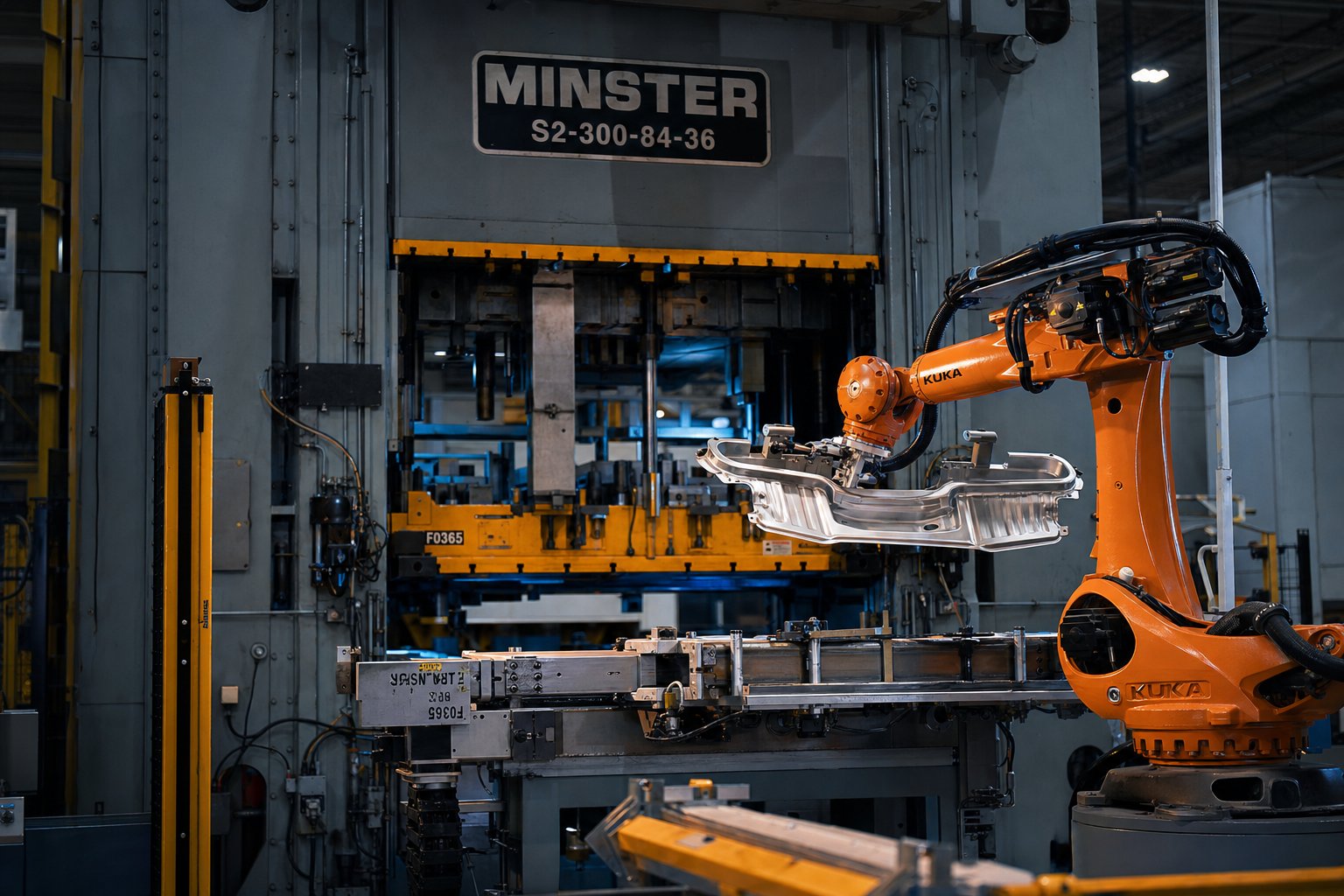
Robotic transfer die stamping is a multi-station metal forming process in which articulated robots or servo-driven transfer mechanisms move individual workpieces between sequential die stations inside a press or press line, synchronizing part handling with the press stroke to perform progressive forming operations on discrete blanks rather than a continuous strip.
That distinction from progressive die stamping is critical. In a progressive die setup, a continuous strip of sheet metal feeds through integrated stations within a single die block, and parts remain attached to the carrier strip until the final cutoff. In a robotic transfer system, blanks are separated first, then physically relocated between independent die stations by a robotic handling mechanism. This is what gives the process its flexibility for larger or geometrically complex parts that simply can't stay connected to a strip.
It's also not the same as general robotic press tending, where a robot simply loads and unloads a single-station die. Here, the robot is integral to the forming sequence itself, repositioning workpieces between multiple forming stages within one press cycle or across a synchronized press line.
Core Components of the Process
Three essential elements work together in every robotic transfer die stamping cell:
- The transfer die set - multiple die stations designed with specific clearance profiles that allow robotic access for part pickup and placement between forming stages.
- The robotic handling system - servo transfer bars, crossbar mechanisms, or six-axis articulated arms that move parts through the transfer motion envelope at speeds matching the target stroke rate.
- The synchronization layer - controllers and communication protocols that tie robot motion to press position in real time, ensuring the workpiece clears the die space before the ram descends.
Each element constrains the others. Die clearance profiles dictate how much room the robot has to maneuver. The transfer motion envelope determines achievable strokes per minute. And the synchronization layer decides whether you can push cycle times faster or need to back off for safety margins.
Understanding how these three components interact is what separates a well-specified system from one that underperforms on the shop floor. The performance envelope of the entire cell depends on which transfer system type you select, how it communicates with the press, and whether the die was designed with robotic access in mind from the start.
How Robotic Transfer Compares to Progressive and Mechanical Systems
Choosing between progressive die stamping, mechanical transfer, and robotic transfer isn't a matter of which is "better." It's a matter of which constraints dominate your program: part geometry, volume targets, changeover frequency, or capital budget. The problem is that most decision-making happens without a structured framework, and engineers default to whatever their shop ran last time.
Here's a side-by-side comparison that maps the real trade-offs across six factors engineers care about most:
| Factor | Progressive Die Stamping | Mechanical Transfer Press | Robotic Transfer Die Stamping |
|---|---|---|---|
| Flexibility | Low - dedicated to one part on a continuous strip | Low to moderate - cam-driven motion fixed per setup | High - programmable paths, easy re-tasking for new part families |
| Changeover Time | 1–4 hours (die change + strip threading) | 2–8 hours (mechanical adjustments + cam retiming) | 30 min–2 hours (EOAT swap + program recall) |
| Part Complexity | Moderate - limited by strip attachment and flat forming planes | Moderate to high - discrete blanks allow deeper draws | High - full reorientation between stations enables complex 3D geometry |
| Tonnage Range | 30T–600T typical | 200T–2500T typical | 60T–3000T+ (scalable across press sizes) |
| Programming Complexity | Minimal - strip advance is mechanical or servo-fed at fixed pitch | Moderate - cam profiles set during build, limited adjustability | High - robot path programming, sync tuning, collision avoidance |
| Typical SPM (Strokes Per Minute) | 30–60+ | 20–30 | 10–20 (six-axis robots) / 15–25 (servo transfer bars) |
Progressive Dies vs Robotic Transfer Dies
Progressive die stamping dominates when you're producing small to medium parts at high volume on a continuous strip. Imagine a bracket or connector terminal that stays flat enough to remain attached to the carrier strip through 15 or 20 stations. The strip feeds at a fixed pitch, every stroke produces a finished part, and you can push cycle rates above 30 SPM with ease. Material utilization tends to be lower because the strip requires consistent carrier sections between stations, but speed and per-piece cost make up for it in volume.
Robotic transfer changes the equation when parts get larger, need deep draws, or require reorientation between forming stages. Since each workpiece travels as a discrete blank, there's no strip-width constraint and no need to keep geometry compatible with carrier attachment. The trade-off is speed: transferring individual parts between stations takes more time than advancing a continuous strip by a fixed distance. For programs running under 100,000 parts annually or parts with complex 3D geometry, that speed gap rarely matters. For programs pushing a million-plus units of a simple shape, progressive dies still win on economics.
Mechanical Transfer vs Robotic Transfer Systems
Dedicated mechanical transfer presses use cam-driven bars or linkage systems to shuttle parts between stations at fixed timing intervals. They're fast, reliable, and perfectly suited to high-volume production of medium-sized parts where the forming sequence doesn't change. Think automotive structural brackets produced on a 600-ton press at 25 SPM for years without a die change.
The limitation shows up the moment you need flexibility. Mechanical cam profiles are set during machine build or major retooling. Changing the transfer motion to accommodate a different part family means physical adjustments that can take a full shift or more. Robotic transfer systems solve this with programmable motion paths. You swap the end-of-arm tooling, load a stored program, validate positioning, and run. That robotic transfer die changeover time comparison often favors the robotic approach by 50–75% for shops running mixed part families on the same press line.
Programming complexity is where the cost shifts back. A mechanical transfer press needs little ongoing software work once commissioned. A robotic system demands path programming, synchronization tuning, and collision avoidance validation every time you introduce a new part. Shops without in-house robot programmers either outsource this work or invest in offline simulation tools to develop and verify programs before tying up press time.
The decision framework boils down to three questions: How often do you change over? How complex is your part geometry? And can your volume targets tolerate transfer die stamping strokes per minute in the 10–25 range rather than 30+? Answer those honestly, and the right system type usually reveals itself. What gets trickier is matching the transfer mechanism itself to your specific part requirements, which opens up an entirely different set of choices.
Types of Robotic Transfer Systems and Their Use Cases
Knowing that a robotic transfer approach fits your program is only half the answer. The next question - which type of transfer mechanism - determines your achievable speed, payload limits, and how much freedom you have to reorient parts between stations. The robotic transfer system tonnage range spans from 60T bench-scale presses up to 3000T+ tandem lines, and the mechanism you choose has to match both the press and the part.
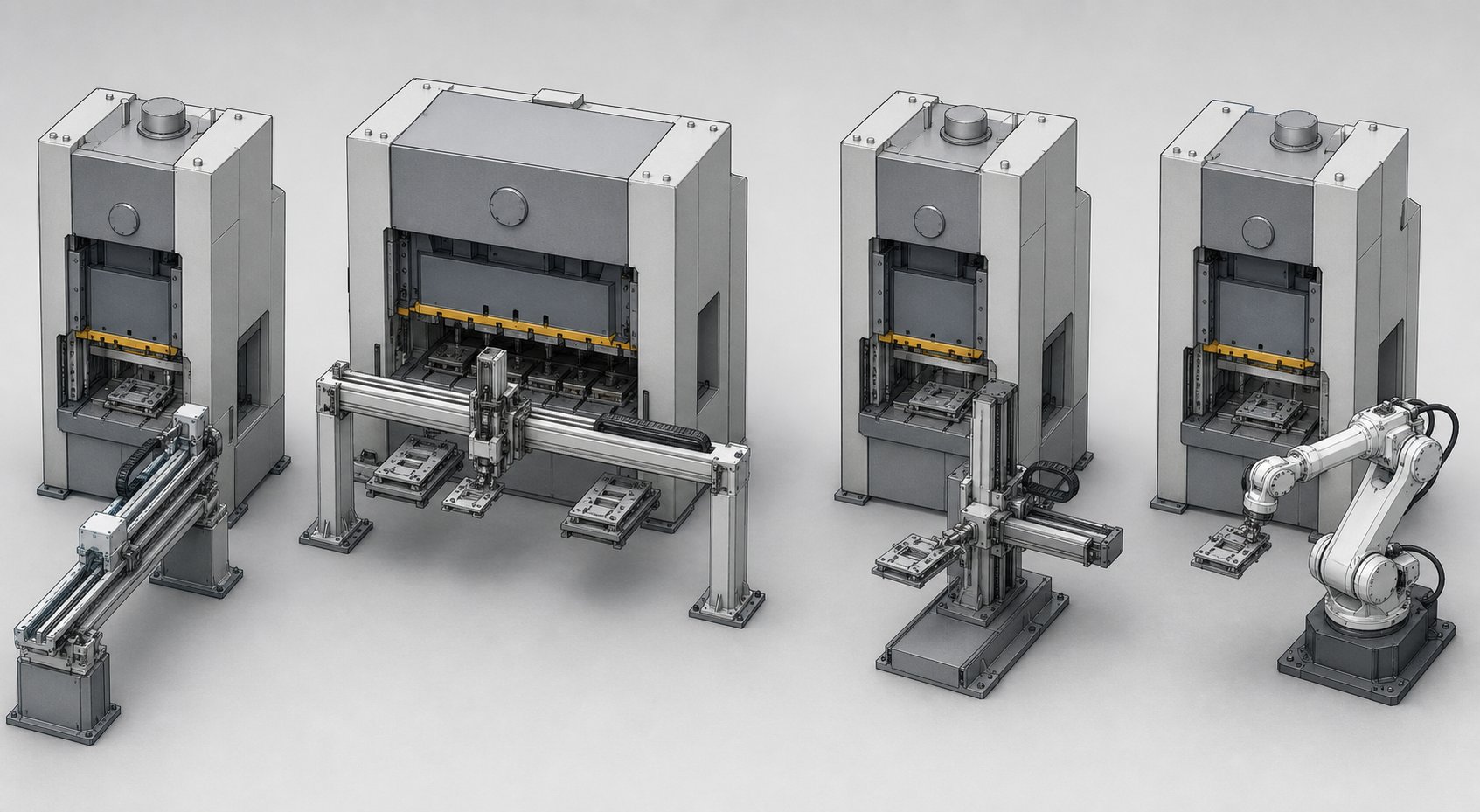
Here's a breakdown of the four primary system types you'll encounter when specifying a robotic transfer die stamping cell:
| System Type | Tonnage Range | Speed (SPM) | Payload Capacity | Part Size Range | Typical Use Cases |
|---|---|---|---|---|---|
| Servo Transfer Bars | 200T–1500T | 15–25 | Up to 15 kg | Small to medium (up to ~600 mm) | Automotive brackets, structural components, high-speed inline production |
| Crossbar Systems | 400T–2500T | 10–18 | Up to 40 kg | Medium to large (up to ~1500 mm) | Body panels, wide stampings, parts requiring lateral movement |
| Tri-Axis Transfers | 60T–800T | 12–30 | Up to 10 kg | Small to medium (up to ~400 mm) | Complex motion profiles, deep-draw parts, in-die transfer applications |
| Six-Axis Articulated Robots | 60T–3000T+ | 6–15 | Up to 80 kg+ | Any (limited by robot reach) | Part reorientation, tandem press lines, mixed part families, maximum flexibility |
Servo Transfer Bars and Crossbar Systems
A servo transfer bar stamping system is the workhorse for medium-volume inline production. Imagine two parallel bars running the length of your die set, driven by servo motors that control lift, clamp, and advance motions independently. The bars grip the workpiece at each station, lift it clear of the lower die, advance it to the next station at a programmed pitch, and set it down - all within the window between consecutive press strokes. Because travel distances are short and motion is linear, these systems can sustain 15–25 SPM depending on part weight and pitch length.
You'll notice servo bars excel where parts remain oriented in a consistent plane throughout the forming sequence. They handle station-to-station transfers without rotation, making them ideal for progressive-style forming on discrete blanks: think structural brackets, reinforcement panels, and mounting plates that simply move forward between draw, trim, and flange stations.
Crossbar systems extend this concept for wider parts. Instead of parallel bars with fingers, a crossbar spans the full press width, carrying a single tooling beam that grips the part at its widest points. This crossbar transfer die system handles use cases where parts exceed 600 mm in width - door inners, roof panels, or large appliance components that would overhang standard transfer fingers. The trade-off is speed: the larger moving mass and longer traverse distances typically limit crossbar systems to 10–18 SPM.
Both systems mount either to the press frame or inside the die set itself. Die-mounted transfers can run at faster stroke rates due to shorter travel distances, though they add design complexity by integrating transfer components directly into the die structure. Press-mounted systems offer easier maintenance access and simpler die design, at the cost of slightly longer motion paths.
Tri-Axis Transfers and Articulated Robot Arms
When your part needs to move in three dimensions between stations - lifted out of a deep draw cavity, shifted laterally, and lowered into the next station at a different height - a tri-axis transfer press system handles the job. These systems operate in the X-Y-Z planes, providing the lift, transfer, and clamp motions needed to clear complex lower-die geometry including cams, nesting blocks, and guiding components.
Tri-axis transfers are commonly plate-mounted or press-mounted, with tooling designed to provide clearance for the fingers' return path while avoiding interference with lower-die steels. Positioning accuracy relies on a combination of part geometry, nesting blocks, and locator pins to maintain orientation during finger retraction. One challenge worth noting: longer pitch lengths produce higher accelerations, which can introduce vibration and unstable movement of the stamping. Thin materials are particularly vulnerable to this effect, often requiring transfer-motion simulation to determine a profile that balances speed against positioning stability.
Six-axis robot transfer die stamping represents the opposite end of the flexibility spectrum. An articulated six-axis robot can approach a workpiece from any angle, pick it from one station, rotate it 90 or 180 degrees in mid-air, and place it into the next die at a completely different orientation. This makes six-axis systems the only viable choice when your forming sequence requires part reorientation between stages - flipping a deep-drawn shell to access the opposite side, or rotating a bracket to form flanges on multiple faces.
The trade-off is speed. A six-axis arm carrying a stamped part through a complex motion path typically achieves 6–15 SPM, well below servo bars or tri-axis systems. Larger, heavier workpieces compound the issue: increased part weight plus end-of-arm tooling mass raises inertia loads, often forcing even slower operating speeds for safe deceleration and accurate placement.
So what drives the decision between these four system types? Three factors dominate:
- Part geometry and orientation needs - if the part stays flat and moves straight forward, servo bars win on speed. If it needs rotation or complex repositioning, six-axis robots are your only realistic option.
- Part weight and size - heavier and wider parts push you toward crossbar systems or high-payload six-axis robots. Lightweight parts under 10 kg open the door to faster tri-axis or servo bar options.
- Required orientation changes - forming sequences that demand flipping, tilting, or rotating parts between stations eliminate linear transfer options entirely. Only six-axis articulated arms deliver full reorientation capability.
The spectrum scales naturally. Simple robotic press tending with a single six-axis arm loading and unloading one station sits at one end. Fully integrated multi-station lines with servo crossbar transfers running at 18 SPM sit at the other. Most real applications fall somewhere in between - and getting the mechanism selection right determines whether your cell hits its cycle time targets or leaves throughput on the table.
Selecting the mechanism is only part of the puzzle, though. The tooling that actually grabs and holds the part between stations - the end-of-arm tooling - introduces its own engineering challenges that vary by material, part geometry, and how much the workpiece shape changes as it progresses through forming stages.
End-of-Arm Tooling Design for Transfer Die Applications
In general robotics, EOAT design is relatively straightforward - pick up an object, move it, set it down. In transfer die stamping, the problem multiplies. The part you're gripping at station three looks nothing like the part at station one. It's deeper, flanged differently, and coated in forming lubricant. Designing end of arm tooling for transfer die stamping means solving a moving target: every station produces a different geometry that demands its own gripping strategy.
Gripper Types for Stamped Part Handling
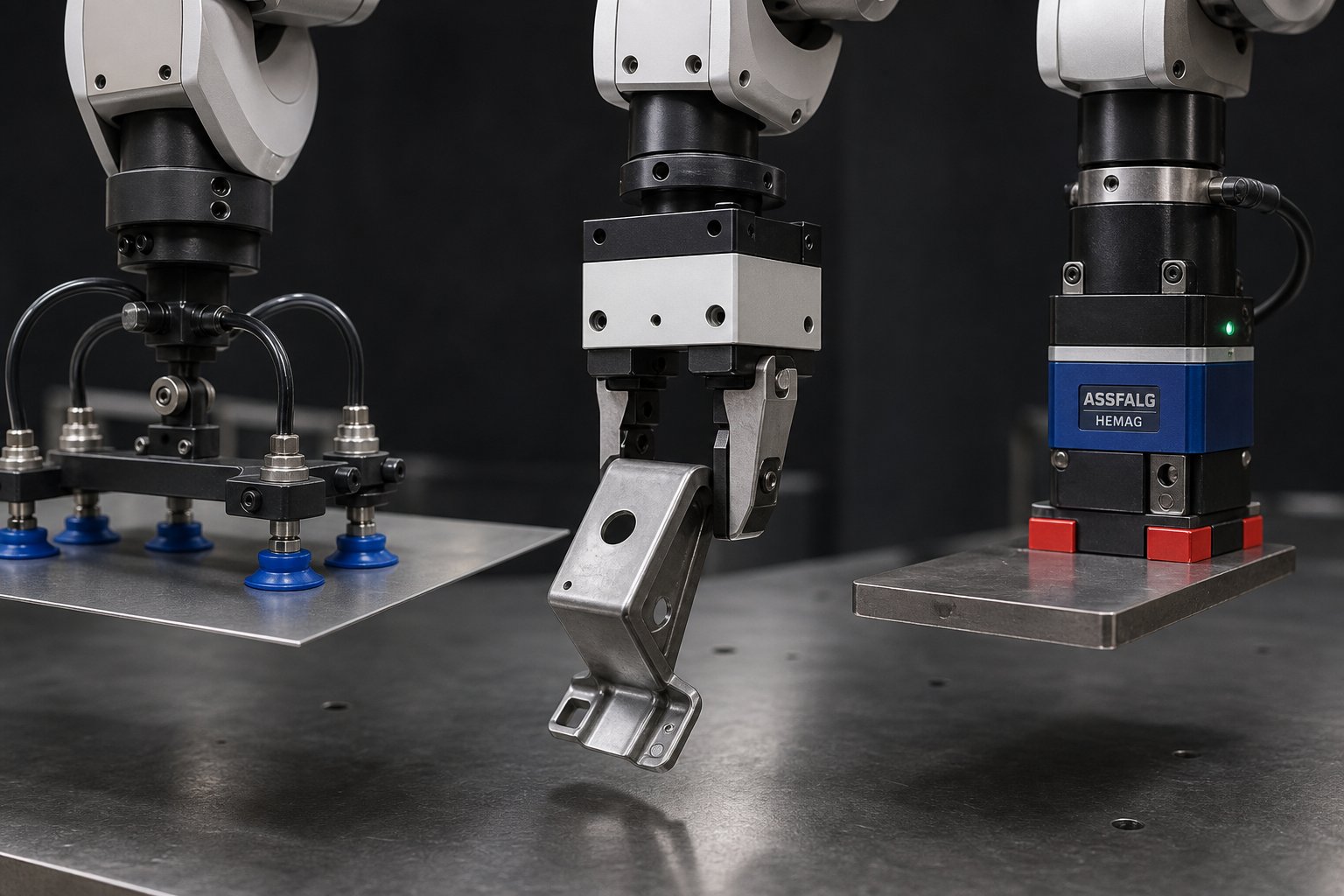
Three gripper families dominate transfer die applications, each suited to different part characteristics:
Vacuum cup arrays work best on flat or gently curved surfaces with enough area to maintain seal integrity. They're fast to actuate, lightweight, and leave minimal marking on finished surfaces. The limitation? Forming lubricants, oil films, and perforated geometries destroy suction reliability. If your part comes out of a draw station coated in stamping oil with a flanged perimeter, vacuum cups will struggle to hold.
Mechanical grippers - including pneumatic jaw grippers and servo-controlled fingers - physically clamp the workpiece at defined edges or features. They handle oily parts, irregular profiles, and heavier payloads without issue. The trade-off is speed: jaw actuation adds milliseconds to each transfer cycle, and gripping features must exist on the part geometry at every station.
Magnetic grippers offer instant engagement with ferrous materials and excel at handling flat blanks or lightly formed steel parts. They require no specific gripping features and tolerate lubricant films well. However, they're limited to ferromagnetic materials, can't handle aluminum or stainless steel, and may leave residual magnetism that causes problems in downstream assembly.
When evaluating vacuum gripper vs mechanical gripper stamping applications, consider these selection criteria:
- Part weight - heavier parts favor mechanical grippers with positive clamping force over vacuum systems limited by available surface area
- Surface finish sensitivity - Class A surfaces or painted panels require non-marking vacuum cups or soft-contact grippers to avoid witness marks
- Forming lubricant presence - heavy oil application reduces vacuum seal effectiveness and often pushes the design toward mechanical or magnetic solutions
- Temperature exposure - hot-stamped parts exceed 200°C at transfer, demanding heat-resistant tooling materials and eliminating standard vacuum cups
- Cycle time constraints - vacuum engagement is nearly instantaneous; mechanical jaw actuation adds 50–150 ms per grip/release cycle
A critical challenge unique to transfer die EOAT design for stamped parts is geometry progression. The blank entering station one is flat. By station three, it has drawn walls and a flange. By station five, trim cuts have removed material your gripper relied on at earlier stations. This means each station often requires a different gripper configuration - or a universal tooling frame with adjustable pickup points that accommodate the part's evolving shape.
Gripper compliance also matters more than in typical pick-and-place applications. Stamped parts carry dimensional variation from material springback, thickness changes, and thermal effects. A rigid gripper with zero tolerance for positional error will either miss the pickup or stress the part. Adding compliant elements - spring-loaded fingers, floating vacuum mounts, or force-limited servo grippers - lets the tooling absorb variation without sacrificing placement accuracy at the next station.
Material-Specific EOAT Considerations
The workpiece material changes the gripper selection equation significantly. What works perfectly for mild steel stampings can damage aluminum or fail entirely on hot-formed boron steel.
Aluminum requires non-marking grippers across the board. Soft vacuum cups with polyurethane or silicone contact surfaces are common for gripper selection for aluminum stamping transfer lines. Mechanical grippers, if used, need plastic or Delrin jaw inserts to prevent surface scratching. Aluminum's lower stiffness also means parts deflect more during transfer, so support points must be distributed to avoid permanent deformation during high-acceleration moves.
Hot-stamped boron steel presents a thermal challenge. Parts exit the forming die at temperatures well above 200°C, and transfer tooling must survive repeated heat exposure without degradation. Standard rubber vacuum cups melt. Heat-resistant silicone compounds, ceramic-coated fingers, or water-cooled mechanical grippers become necessary. Heat shielding on the tooling frame itself protects sensors, wiring, and pneumatic lines from radiant heat damage.
Stainless steel combines two problems: heavy lubricant application and non-ferromagnetic grades that eliminate magnetic grippers. The thick oil films common in stainless forming interfere with vacuum seal formation, making cup arrays unreliable. Mechanical grippers with serrated or knurled jaw surfaces cut through the oil film to establish positive grip - the trade-off being potential marking on non-critical surfaces. For visible parts, engineers often design dedicated gripping tabs into the blank that get trimmed in later stations.
Ultimately, EOAT design in transfer die stamping isn't a one-time decision. It's a station-by-station engineering exercise that evolves with the part through its forming sequence. Getting it right means the robot places parts accurately and consistently. Getting it wrong means die crashes, scrap, and cycle time losses that no amount of synchronization tuning can fix - which brings us to exactly how that synchronization between press and robot actually works.
Press-to-Robot Synchronization and Integration Requirements
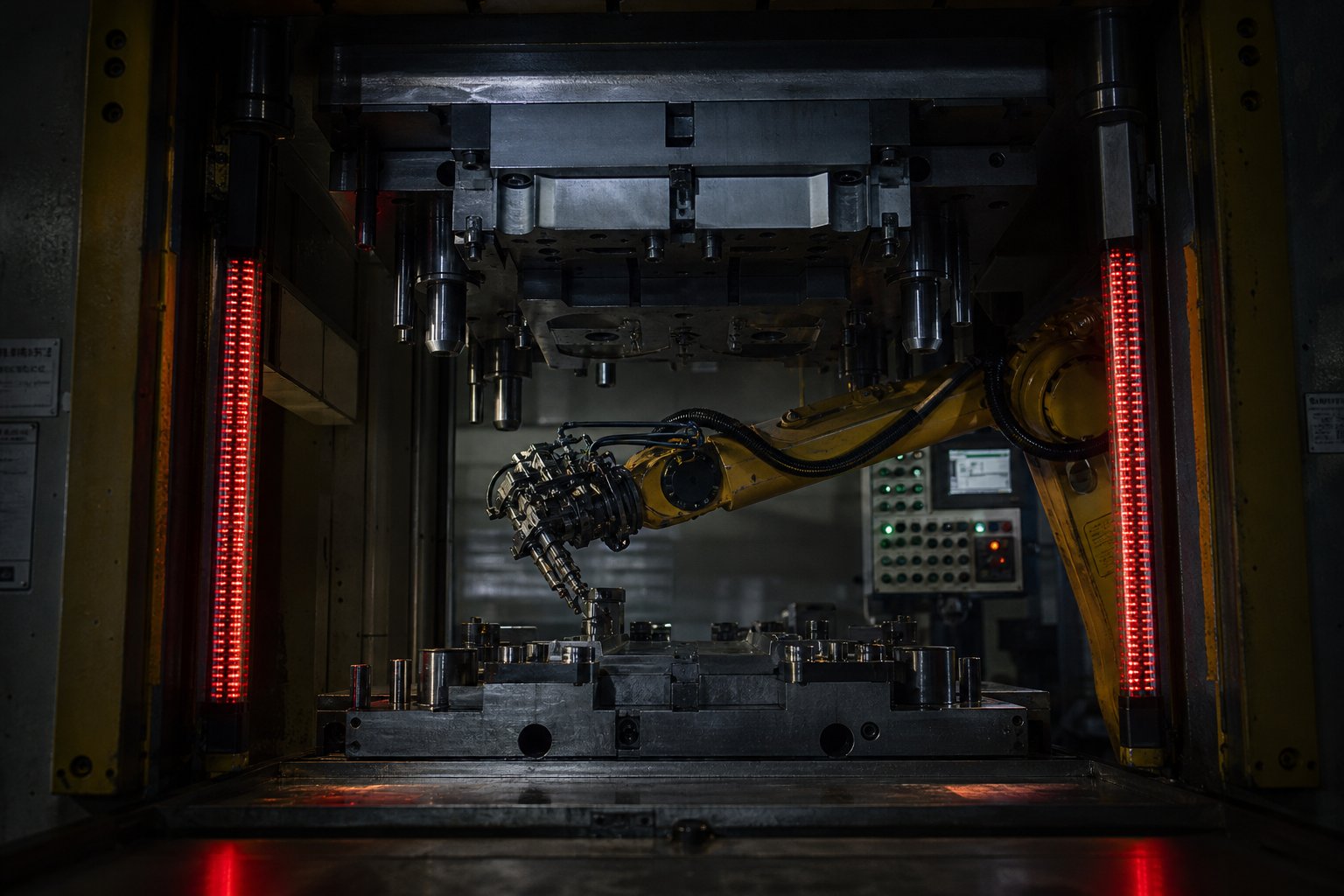
Every millisecond the ram descends toward a die station, the transfer system must already be clear. A robot arm lingering 50 ms too long inside the die space doesn't just damage tooling - it can destroy the press, the part, and the end-of-arm tooling in a single stroke. Press to robot synchronization in a transfer die cell is the invisible engineering that makes everything else possible: accurate part placement, safe die clearance, and consistent cycle times stroke after stroke.
The synchronization approach you use depends entirely on what type of press you're running and how much real-time communication your control architecture supports.
Cam-Based Timing and Servo-Driven Synchronization
On conventional mechanical presses with a fixed-speed flywheel and clutch-brake system, synchronization relies on cam-based timing. A rotary encoder mounted on the press crankshaft reports angular position continuously. The robot controller maps its motion profile against specific crank angles: "begin entry at 180 degrees, complete placement by 250 degrees, clear die space by 310 degrees." The robot treats the press stroke as a repeating timing wheel and must complete its entire transfer motion within the permitted angular window.
This works reliably at steady-state speeds but introduces constraints. The press runs at a fixed SPM, the angular window is non-negotiable, and the robot must hit its marks every cycle regardless of part weight variation or gripper actuation delays. If the system can't consistently complete transfers within the window, you either slow the press or redesign the motion path.
Servo press robotic transfer timing works differently - and offers a significant advantage. Because a servo press controls ram position and velocity independently through the stroke, it can actually pause or slow the ram at top dead center to give the robot extra time for transfer. The press and robot operate as coordinated axes rather than master-slave devices. The robot controller and press controller share position data in real time, allowing the press to adapt its motion curve to the robot's actual progress rather than assuming fixed timing. This coordination enables faster effective throughput because the press doesn't waste time dwelling at TDC waiting for a worst-case transfer scenario that may not occur on every cycle.
Communication Protocols and Die Protection Interlocks
The synchronization layer depends on fieldbus communication between robot controllers and press controls. Three protocols dominate robotic transfer die stamping installations:
- EtherCAT - processes data "on the fly" as packets pass through network nodes, delivering cycle times under 1 ms with minimal latency. Its flexibility in network topology (line, star, tree) makes it well-suited for complex multi-station cells where devices are distributed across the press line.
- PROFINET - Siemens-developed and widely deployed in European press shops, offering deterministic communication with predictable packet delivery timing. Its strength lies in rapid real-time data transfer, particularly in environments already built around Siemens PLCs.
- DeviceNet - a CAN-based protocol common in North American installations, particularly on older press lines. It handles I/O-level communication well but lacks the cycle speed of EtherCAT or PROFINET for high-speed transfer applications.
Choosing between EtherCAT and PROFINET for press robot communication often comes down to existing infrastructure. Shops with Siemens-based press controls lean toward PROFINET for seamless integration. Facilities using Beckhoff or multi-vendor architectures gravitate toward EtherCAT's open-protocol flexibility. Either way, the fieldbus must deliver position updates fast enough that the robot controller can react within one press cycle - typically under 4 ms for applications running above 15 SPM.
The die protection interlock is the safety backbone of the entire system. Here's the logic: before every downstroke, the press controller checks whether the robot has reported a "clear" signal confirming it has exited the die space and reached a safe position outside the transfer motion envelope. If that signal doesn't arrive within the configured timing window - measured in crank-angle degrees or absolute milliseconds - the press halts immediately. No exceptions.
A robust die protection interlock for robotic transfer uses redundant confirmation. The robot controller sends the clear signal, and an independent sensor (light curtain, proximity switch, or zone-detection laser) verifies the robot is physically outside the die area. Dual-channel verification prevents a software fault in the robot controller from sending a false "clear" that allows the press to cycle into an occupied die space.
Robotic transfer positioning accuracy requirements typically demand ±0.5 mm or better at the placement point. Repeatability - the ability to hit the same position cycle after cycle - often needs to be tighter still, in the ±0.1 to ±0.2 mm range, to prevent cumulative drift that leads to mis-hits on locating pins or die nests. Temperature changes in the press frame, robot arm thermal growth over extended runs, and EOAT wear all challenge these specs over time.
Two technologies add intelligence beyond pure position control:
- Vision-guided placement - cameras mounted above or beside die stations capture part position in real time and feed offset corrections to the robot controller. This compensates for part shift during transfer, gripper slip, or blank positioning error, tightening effective placement accuracy beyond what the robot's native repeatability delivers alone.
- Force-torque sensing - sensors integrated at the robot wrist or in the EOAT detect contact forces during placement. If the part encounters unexpected resistance - a misaligned locator pin, a slug in the die cavity, or a previous part that wasn't ejected - the sensor triggers a halt before the robot drives the part into the obstruction. This protects both the die and the workpiece while providing early warning of tooling issues that would otherwise go undetected until a quality defect appears downstream.
Together, these sensing layers transform the synchronization system from a purely reactive timing mechanism into a proactive quality gate. The robot doesn't just move parts fast enough to avoid the ram - it confirms correct placement, detects anomalies, and protects the die investment every cycle. That combination of speed, precision, and intelligence is what makes robotic transfer viable for production environments where die repair costs and scrap rates directly impact program profitability.
Still, all this synchronization sophistication comes at a cost. More sensors, more programming, more maintenance - and in some programs, that overhead simply isn't justified. Knowing where the technology falls short matters just as much as understanding where it excels.
Limitations and When Robotic Transfer Is Not the Right Choice
Flexibility, programmability, and complex part handling make robotic transfer systems attractive on paper. But here's what sales presentations rarely emphasize: for a significant number of stamping programs, this technology adds cost and complexity without delivering a proportional return. Knowing when not to use robotic transfer stamping is just as valuable as knowing when it fits.
Volume and Speed Limitations
The physics are straightforward. Moving a discrete part through space with a robotic mechanism takes longer than advancing a continuous strip by a fixed pitch. Progressive die lines routinely sustain 30 to 60+ strokes per minute, while robotic transfer cells typically operate between 6 and 25 SPM depending on mechanism type. That gap compounds over millions of cycles.
Consider a simple bracket produced at 500,000 units annually. At 40 SPM on a progressive die, you need roughly 210 hours of press time. The same part on a robotic transfer system running 15 SPM requires 556 hours - nearly three times the press capacity. When floor time carries a loaded cost of $200–$400 per hour, the robotic transfer die stamping speed limitations translate directly into program economics that don't close.
Dedicated mechanical transfer presses face a similar comparison but fare better on speed. Cam-driven bars operating at 20–30 SPM bridge the gap between progressive dies and robotic systems. For programs with stable, long-running part families that don't need frequent changeover, mechanical transfers deliver higher throughput with fewer failure modes and less programming overhead.
When Simpler Solutions Win
Robotic transfer isn't the wrong choice everywhere - but it's the wrong choice in specific, identifiable scenarios. If your program matches any of these conditions, a simpler approach likely wins:
- Very high volume, simple geometry - parts that can remain attached to a carrier strip through all forming stations belong on a progressive die. The per-piece cost advantage at volumes above 250,000 units annually is difficult to overcome.
- Small, lightweight parts that don't need reorientation - if the workpiece stays in a single plane throughout forming and weighs under a few kilograms, mechanical transfer bars outperform robotic arms on speed and reliability.
- Cycle time targets above 30 SPM - no six-axis robot and few servo transfer bars can sustain this rate reliably. Dedicated mechanical systems with fixed cam timing are more predictable at these speeds.
- Limited floor space - a progressive die runs inside a single press with a compact coil line. Robotic transfer cells often require additional safety fencing, robot reach envelopes, EOAT storage racks, and clearance zones that expand the footprint significantly.
- Budget-constrained programs where part geometry allows strip-based forming - if your part can be produced on a strip without secondary operations, the lower tooling and integration cost of progressive dies makes them the financially rational choice.
There's also the robotic transfer vs progressive die break-even volume question every manufacturing engineer should answer before committing capital. The break-even calculation compares total system cost (press integration, robot, EOAT, programming, validation) against the per-piece savings from reduced secondary operations or improved material utilization. For geometrically simple parts, that break-even point may sit at volumes so high they never materialize for your program. Running the numbers early prevents expensive over-engineering.
Programming complexity deserves honest acknowledgment too. Every new part introduced to a robotic transfer cell requires path programming, synchronization validation, collision-check simulation, and EOAT qualification. Shops without dedicated robot programmers face outsourcing costs of $5,000–$15,000 per new program, plus the press downtime consumed during on-machine validation. Progressive dies, by contrast, need no programming at all - the strip advance is mechanical, and the only setup variable is feed pitch.
Maintenance skill requirements shift upward as well. A progressive die line needs tool-and-die makers and press operators. A robotic transfer cell adds servo drive troubleshooting, fieldbus network diagnostics, vision system calibration, and robot-specific fault recovery to the maintenance team's responsibilities. Smaller shops without multi-discipline technicians often find the support burden unsustainable.
Even changeover flexibility - the primary selling point of robotic transfer - deserves a reality check. Swapping EOAT, loading a new robot program, and running validation parts still takes 30 minutes to two hours. That's faster than retooling a mechanical transfer press, but it's not zero. And unlike a progressive die that produces good parts from the first stroke after setup, a robotic system may need several cycles of position fine-tuning before parts consistently hit die locators within specification.
None of this makes robotic transfer a flawed technology. It makes it a specialized one - engineered for programs where part complexity, size, or family diversity genuinely demand flexible automated handling. The engineers who get the best results are the ones who evaluate honestly whether their program actually needs that capability, or whether a proven, simpler method delivers the same outcome at lower risk and cost. That evaluation process itself follows a structured path worth examining in detail.
How Manufacturing Engineers Evaluate Transfer Die Stamping Systems
So you've confirmed that your program genuinely requires robotic transfer - the part geometry demands reorientation, volumes justify the investment, and simpler methods fall short. Where do you start? Specifying a robotic transfer die stamping system isn't a single decision. It's a sequence of interdependent choices, each one constraining the next. Skip a step or get the order wrong, and you'll end up with a press that can't clear the tooling, a robot that can't hit cycle time, or dies that weren't designed with robotic access in mind.
Part Geometry and Process Sequence Analysis
The evaluation always begins with the part itself - not the press, not the robot, and not the budget. Here's the structured sequence experienced engineers follow when specifying a system for a new program:
- Define part geometry and forming sequence - map every forming stage from flat blank to finished part. Identify draw depths, trim operations, flange angles, and any stations requiring part reorientation. This sequence dictates the number of die stations and the complexity of transfer motions between them.
- Determine tonnage and bed size requirements - calculate forming forces for each station based on material properties, draw ratios, and part surface area. The highest-tonnage station sets your minimum press capacity, and the total number of stations drives bed size. Robotic transfer die tonnage and bed size requirements must account for spacing between stations that leaves room for robotic entry and exit paths.
- Analyze transfer motion envelope needs - define how the part moves between each pair of stations. Straight-line pitch? Vertical lift over die components? Full rotation? This analysis determines whether servo bars, crossbar systems, or six-axis arms are viable for your application.
- Specify positioning accuracy and repeatability - establish placement tolerances at each station based on die locator geometry and part feature tolerances. Transfer die station-to-station alignment accuracy typically requires ±0.5 mm placement with ±0.1–0.2 mm repeatability to avoid mis-hits on locating pins.
- Evaluate cycle time targets against system capabilities - compare your required SPM to the realistic throughput of candidate transfer mechanisms. If your volume plan needs 18 SPM and your motion envelope demands six-axis articulation, you have a conflict that needs resolving before going further.
- Assess changeover flexibility requirements - determine how many part families will run on this system, how frequently changeovers occur, and what EOAT complexity each family demands. High-mix programs need modular tooling strategies and stored programs for rapid recall.
Each step feeds forward. You can't specify positioning accuracy without understanding part geometry. You can't evaluate cycle time without knowing the transfer motion envelope. And you can't assess changeover needs without knowing how many part families the system must handle. Engineers who try to shortcut this sequence - jumping straight to press tonnage based on gut feel, for example - often discover mismatches during integration that cost six figures to resolve.
System Specification and Supplier Evaluation Criteria
With the technical specification defined, the focus shifts to evaluating suppliers who can deliver dies engineered for robotic integration. This is where many programs stumble. A die that performs beautifully in a manual-load or progressive application can fail completely in a robotic transfer cell if it wasn't designed with access clearances, consistent station spacing, and stable repeatability in mind.
When evaluating transfer die supplier evaluation criteria, look for demonstrated understanding of these integration requirements:
- Robotic access clearances - die designs must accommodate gripper entry and exit paths without interference from guide pins, heel blocks, or upper-die components. As MetalForming Magazine notes, guide pins placed in traditional outboard locations force longer clamp strokes and slower transfer speeds. Suppliers experienced in robotic transfer place pins and heel blocks strategically to minimize interference with finger return paths.
- Station-to-station alignment - all die stations must maintain consistent pass line height and shut height across the full die set. Variation between stations forces the robot to compensate with different Z-axis positions at each stop, adding programming complexity and increasing the risk of placement errors over long production runs.
- Stable repeatability across production volumes - die wear, thermal expansion, and maintenance cycles all introduce dimensional drift. Suppliers who design with robust locating systems, wear-resistant tool steels at contact points, and accessible adjustment mechanisms help maintain the tight placement windows robotic transfer demands.
- Transfer motion curve compatibility - the die designer needs the transfer system's motion profiles (lift height, pitch distance, clamp stroke) before beginning detailed design. Suppliers who request this information upfront and design clearances around it avoid costly interference discoveries during tryout.
This last point deserves emphasis. Transfer motion curves and interference curves must be available to the die designer at project start - not after detailed design is complete. Suppliers like YICHEN, who specialize in transfer stamping dies engineered for multi-station forming with robotic transfer compatibility, build this coordination into their standard workflow. Their focus on larger and geometrically complex metal parts means die layouts are developed with robotic access paths, consistent station alignment, and stable repeatability as baseline design parameters rather than afterthoughts.
The practical takeaway for engineers learning how to specify a robotic transfer die stamping system: engage your die supplier and transfer-system provider simultaneously at the start of the project. A die designed in isolation from the transfer mechanism will almost certainly require modification - adding cost, extending timelines, and introducing quality risk that proper upfront coordination eliminates entirely.
With the right evaluation framework and supplier relationships in place, the remaining challenge is keeping the system performing at specification over years of production. That's where emerging technologies - AI-driven quality monitoring, predictive maintenance, and digital twin simulation - are beginning to reshape what's possible.

Emerging Technologies and Implementation Planning
A robotic transfer die stamping cell that ran flawlessly during commissioning can drift quietly toward trouble over thousands of production hours. Die edges wear. Placement accuracy degrades. A subtle force spike goes unnoticed until scrap rates climb and someone finally pulls the die for inspection. The next generation of transfer stamping technology doesn't just move parts faster - it watches, learns, and warns before problems become expensive.
AI-Enabled Quality Control and Predictive Maintenance
Inline AI vision systems are now being deployed directly within transfer press lines, inspecting every part during the transfer window itself - not after the part leaves the press. High-resolution cameras with structured lighting capture surface and dimensional data as the robot moves the workpiece between stations, classifying defects like splits, wrinkles, and dimensional drift in under 100 milliseconds per frame. Detection accuracy on these systems reaches 99.5% or higher at line speed, compared to 55–85% for human inspectors depending on shift fatigue and defect type.
What makes AI quality control in robotic transfer stamping particularly powerful is timing. Because the part is already in motion between stations, the vision system can evaluate forming results at intermediate stages - catching a developing split at station three before the part receives further forming at stations four and five. Traditional end-of-line inspection only catches the finished defect, after all forming energy and press time has been consumed. Inline AI catches the precursor, enabling immediate die adjustment or automatic part rejection before downstream stations compound the damage.
Predictive maintenance in transfer die stamping builds on force-torque sensing data already present in many robotic cells. By trending the force signatures recorded at each placement - the contact forces when the part seats against locator pins, the resistance during gripper release, the subtle load variations as die wear changes part geometry - machine learning models identify degradation patterns days before they manifest as quality escapes. A stamping facility case study documented that 68% of unplanned press stoppages could have been prevented with 4 to 48 hours advance warning, based on progressive die wear patterns visible in part quality metrics well before tool failure.
The practical impact for transfer die operations is significant:
- Scrap reduction - catching defects at intermediate forming stages eliminates wasted press time on parts already compromised. Facilities report scrap rate reductions of 30–45% after deploying real-time monitoring.
- Die life extension - predictive models track wear progression and recommend service at optimal timing rather than on fixed stroke-count schedules, recovering 8–15% of die life that would otherwise be lost to premature or late intervention.
- Unplanned downtime prevention - digital twin monitoring systems predict 70–85% of failures 6 to 36 hours in advance, converting emergency breakdowns into planned maintenance windows.
Digital Twin Simulation for Transfer Motion Validation
Imagine validating your entire transfer motion sequence - robot paths, press timing, EOAT clearances, collision zones - before a single piece of steel hits the shop floor. Digital twin transfer die simulation makes this routine rather than aspirational.
Modern simulation platforms combine physics-accurate robot models with photorealistic environment rendering to close the gap between virtual and real-world performance. ABB's RobotStudio HyperReality, for instance, runs the same controller firmware used in physical robots, achieving approximately 99% correlation between simulated and actual robot behavior. Positioning errors drop from the 8–15 mm typical of conventional simulation approaches down to around 0.5 mm using absolute accuracy calibration - well within the placement tolerances transfer die stamping demands.
For engineers planning a robotic transfer cell, digital twin simulation delivers three concrete benefits:
- Transfer motion verification before build - validate that the robot can complete its full motion profile within the available press-stroke window, including acceleration ramps, orientation changes, and die clearance margins. Catching an interference issue in simulation costs hours of engineering time. Catching it during physical tryout costs weeks and tooling rework.
- Commissioning time reduction - facilities using controller-accurate digital twins report up to 80% shorter commissioning periods because robot programs transfer directly from simulation to physical hardware with minimal on-machine tuning.
- AI model training in virtual environments - synthetic data generated from photorealistic simulation trains vision and perception models without requiring thousands of physical production cycles. Domain randomization - automatically varying lighting, part positioning, and surface conditions - produces robust AI models that generalize to real factory conditions from day one.
Planning Your Robotic Transfer Die Stamping Implementation
Technology alone doesn't guarantee results. Engineers who succeed with robotic transfer implementations follow a deliberate ramp-up strategy rather than attempting full-scale deployment from day one. Here's a practical path forward:
Start with part family analysis. Audit your current and planned part portfolio to identify which families genuinely benefit from robotic transfer - parts requiring reorientation, multi-station deep draws, or frequent changeover between geometries. Group parts by transfer motion complexity, not just tonnage or material, to determine which system type and EOAT strategy serves the broadest family.
Engage die suppliers early. Transfer die design and robotic system specification must happen in parallel, not sequentially. Die clearances, station spacing, and pass-line consistency all depend on knowing the transfer mechanism's motion envelope before detailed die design begins. Partners like YICHEN, who specialize in transfer stamping dies for complex multi-station forming, build robotic access compatibility into their standard design process - ensuring die layouts accommodate gripper paths and maintain the station-to-station alignment that robotic systems require for stable repeatability.
Pilot with lower-complexity parts. Choose an initial program with moderate forming stages (three to four stations), straightforward transfer motions, and forgiving cycle time targets. Build operator confidence, validate your synchronization approach, and establish maintenance procedures on a manageable scope before scaling to eight-station lines running at 18 SPM.
Layer in intelligence incrementally. Deploy basic die protection interlocks and position verification first. Add force-torque monitoring once baseline data establishes normal contact signatures. Introduce AI vision inspection after the mechanical system runs reliably. Each layer builds on verified performance rather than introducing multiple unknowns simultaneously.
The engineers who get the most from robotic transfer die stamping treat it as a system integration challenge, not a component purchase. Press, robot, die, EOAT, synchronization, and now AI-driven monitoring all interact. Getting any one element right in isolation means little if the interfaces between them weren't designed together from the start. That systems-level thinking - combined with experienced die partners and a disciplined implementation sequence - is what separates transfer cells that hit their targets from ones that consume years of troubleshooting before delivering on their original promise.
Frequently Asked Questions About Robotic Transfer Die Stamping
1. What is the difference between robotic transfer die stamping and progressive die stamping?
Progressive die stamping feeds a continuous metal strip through integrated stations within one die block, with parts staying attached to a carrier strip until final cutoff. Robotic transfer die stamping separates blanks first, then uses robots or servo-driven mechanisms to physically move discrete workpieces between independent die stations. This makes robotic transfer ideal for larger parts, deep draws, and geometries requiring reorientation between forming stages. Progressive dies excel at high-volume simple parts running above 30 SPM, while robotic transfer typically operates at 6-25 SPM but handles far greater part complexity.
2. How fast can robotic transfer die stamping systems run in strokes per minute?
Speed varies significantly by mechanism type. Servo transfer bars achieve 15-25 SPM for inline production of small to medium parts. Crossbar systems handle wider parts at 10-18 SPM. Tri-axis transfers reach 12-30 SPM for compact parts with complex motion profiles. Six-axis articulated robots are slowest at 6-15 SPM but offer maximum flexibility for part reorientation. Part weight, transfer distance, and orientation changes all reduce achievable speed. By comparison, progressive dies routinely sustain 30-60+ SPM, making them faster for simple geometries at high volumes.
3. What positioning accuracy do robotic transfer die stamping systems require?
Most robotic transfer die stamping applications demand placement accuracy of plus or minus 0.5 mm at each die station, with repeatability specs tighter still at plus or minus 0.1 to 0.2 mm. These tolerances ensure parts consistently seat on locating pins and die nests without mis-hits that cause tooling damage. Achieving and maintaining these specs requires proper synchronization protocols, thermal compensation strategies, and often vision-guided placement systems that provide real-time offset corrections to the robot controller during production.
4. How do you choose between vacuum, mechanical, and magnetic grippers for transfer die stamping?
Gripper selection depends on material type, surface requirements, lubricant presence, and cycle time needs. Vacuum cups suit flat or gently curved surfaces with clean or lightly oiled finishes, offering fast actuation and minimal marking. Mechanical grippers handle oily parts, irregular profiles, and heavier payloads through positive clamping but add 50-150 ms per cycle. Magnetic grippers work only on ferrous materials but engage instantly and tolerate lubricants well. Aluminum parts require non-marking soft-contact grippers, hot-stamped boron steel needs heat-resistant tooling above 200 degrees C, and stainless steel typically demands mechanical grippers because oil films defeat vacuum seals.
5. When should you NOT use robotic transfer die stamping?
Robotic transfer is not cost-effective for very high-volume simple parts that can stay on a continuous strip, where progressive dies deliver lower per-piece cost above 250,000 annual units. It also falls short when cycle targets exceed 30 SPM, when parts are small and lightweight without reorientation needs, when floor space is limited, or when budgets are constrained and part geometry permits strip-based forming. Engineers should perform a break-even volume analysis comparing total system cost against per-piece savings before committing. Programming complexity and maintenance skill requirements for robotic systems also add ongoing overhead that simpler approaches avoid.


