


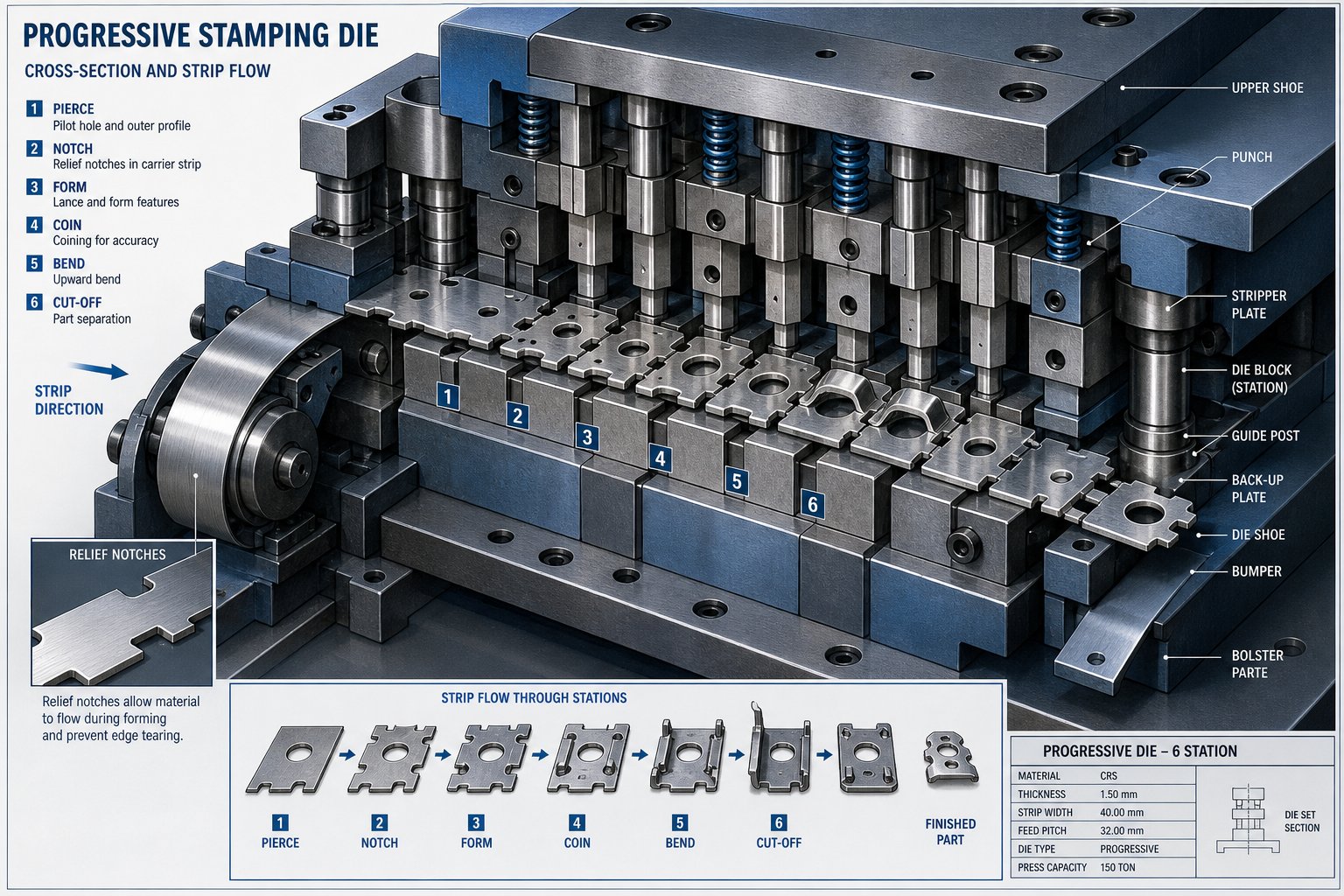
What Bypass Notches Are and Why They Matter in Die Design
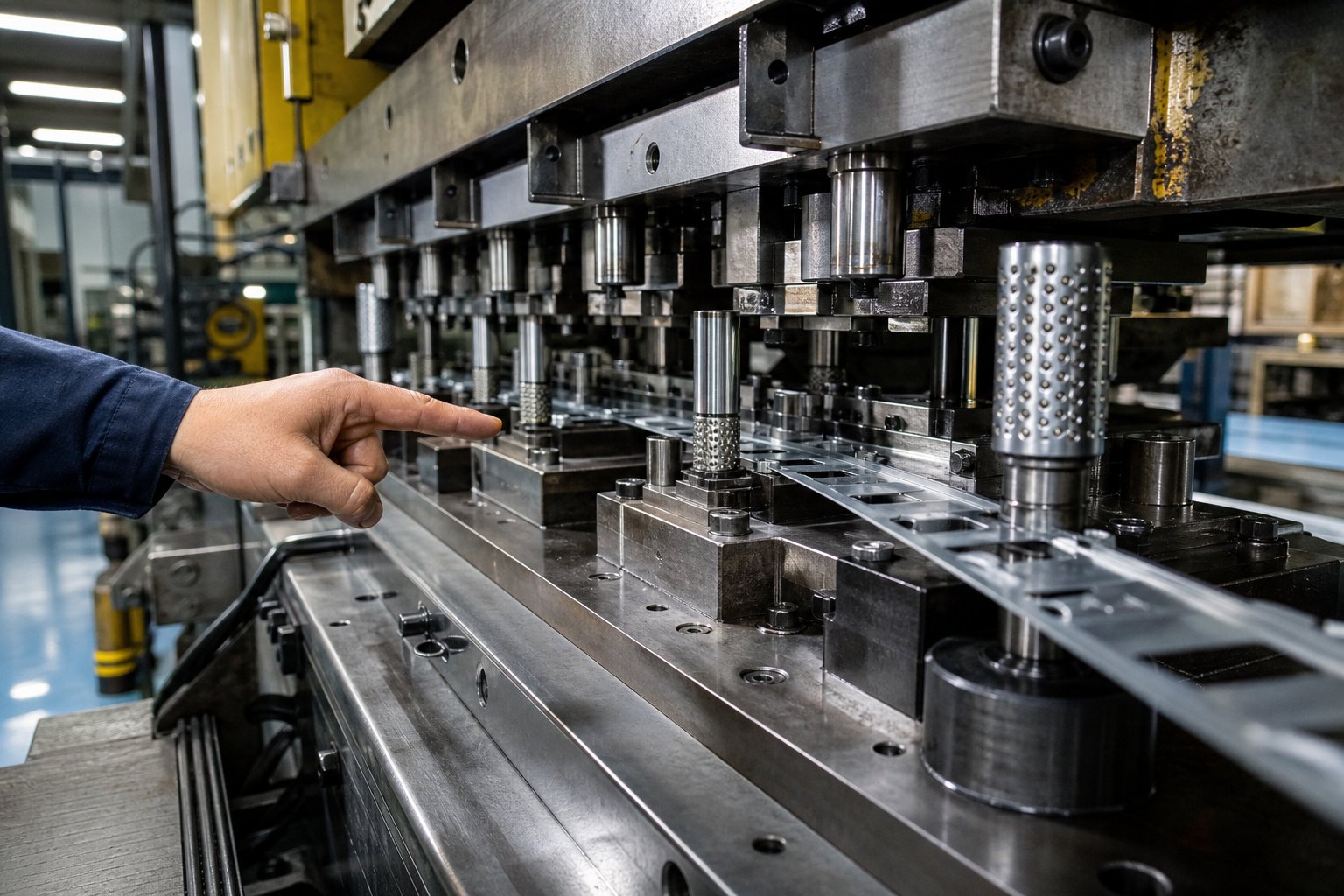
Imagine a metal strip advancing through a progressive die. At station three, a flange gets formed upward. At station four, the strip needs to move forward, but that raised flange is now in the path of adjacent tooling. What happens? Collision, scratch marks, or a full misfeed. This is the exact problem bypass notches solve.
What Are Bypass Notches in Progressive Dies
A bypass notch is a local relief or cutout feature added to a progressive die strip layout that prevents interference between previously formed features and downstream tooling during strip advancement. Its purpose is to provide clearance so the strip moves safely from station to station without collision, distortion, or feeding instability.
In practical terms, these are small but deliberate cuts made in the carrier strip or blank shape. They allow bent, drawn, or embossed features to pass freely through subsequent stations without contacting punches, lifters, inserts, or trim sections. Without proper relief geometry, the strip may jam, deform, or damage the die itself.
The bypass notch design process balances three priorities: enough clearance for safe movement, enough remaining material strength for stable feeding, and enough control to keep the part accurate through all stations.
Why Strip Progression Demands Relief Geometry
Progressive dies rely on precise, repeatable strip advancement. Every hit of the press moves the strip forward by one pitch length. Any formed feature that interferes with that motion creates a cascading problem: misfeeds lead to mislocated pilots, which lead to out-of-tolerance parts or catastrophic die crashes.
Relief cuts in the carrier strip give previously formed geometry a clear path. You'll notice this matters most in dies with deep draws, tall flanges, or embossments that protrude above or below the strip plane. The deeper the form, the more critical the bypass notch becomes.
One source of confusion worth addressing: bypass notches are sometimes called pitch notches, carrier notches, or strip notches depending on shop convention. A pitch notch in many shops refers specifically to a registration feature that prevents overfeeding, while a bypass notch refers to clearance relief for formed features. The terminology varies between facilities and even between designers within the same company, but the core function remains consistent: control strip movement and prevent interference during progressive die operation.
Getting this detail wrong during the strip layout stage is where most problems originate. A notch that looks harmless in CAD can become a feeding nightmare once the press runs at production speed, making early design decisions around bypass geometry one of the most underestimated factors in die performance.
Bypass Notches vs Pitch Notches and Other Strip Control Terms
When you hear "notch" on a progressive die shop floor, it could mean three different things depending on who you're talking to. One designer calls it a bypass notch, the toolmaker across the aisle says pitch notch, and the print from the customer labels it a carrier notch. This terminology confusion causes real design errors, especially when a new engineer inherits a strip layout from another facility and misinterprets the function of each feature.
Bypass Notches vs Pitch Notches Explained
The bypass notch vs pitch notch difference comes down to function, not appearance. A pitch notch, sometimes called a French notch, is a small section of material cut away from one or both edges of the strip at the beginning stations of a progressive die. Its primary job is to provide a solid stop for the leading edge of the material, preventing overfeeding during setup and production. It controls how far the strip advances and helps register the strip at each station.
A bypass notch, by contrast, exists purely as relief geometry. It removes or relocates material so that previously formed features can pass through downstream stations without interference. It doesn't control feed distance or provide a mechanical stop. It simply creates room for the strip to move freely past tooling that would otherwise collide with raised or lowered features.
Here's where the confusion deepens: pitch notches also serve a secondary relief function. By cutting away edge material, they straighten camber and allow smoother feeding. Some shops recognize this overlap and use the terms interchangeably. But conflating the two during design review leads to problems. A pitch notch sized only for registration may not provide enough clearance for a formed feature. And a bypass notch designed purely for clearance won't necessarily prevent overfeeding or aid in strip location.
Mapping Industry Terminology to Specific Functions
Beyond pitch and bypass notches, you'll encounter the term "carrier notch" in strip layouts. This refers broadly to any notch cut into the carrier portion of the strip, regardless of whether it serves a registration or clearance purpose. It's a geometric description rather than a functional one. Knowing which specific function a notch performs is critical for sizing, placement, and troubleshooting.
The following table maps the three most common strip control notch types in stamping dies to their specific roles:
| Feature | Bypass Notch | Pitch Notch (French Notch) | Carrier Notch |
|---|---|---|---|
| Primary Function | Relief geometry to prevent interference with formed features during strip advancement | Registration and feed control; provides a solid stop to prevent overfeeding and aids strip location | General term for any notch in the carrier strip; function depends on specific design intent |
| Location on Strip | Adjacent to formed features, positioned where clearance is needed at downstream stations | One or both edges of the strip, typically cut at the first or second station | Carrier edge or within the carrier web, varies by application |
| Typical Geometry | Contoured relief matching the formed feature profile plus clearance; can be positive or negative | Rectangular or semi-circular cutout, often only two times material thickness in width | Varies widely; rectangular, U-shaped, or irregular depending on purpose |
| When Used | Required whenever formed features would collide with die components during strip progression | Recommended for most progressive dies to simplify setup, prevent die crashes, and remove edge camber | Used as a catch-all reference in prints where the specific function is implied by context |
A practical way to remember the distinction: pitch notches solve a feeding and registration problem, while bypass notches solve an interference problem. Both appear as cutouts in the strip. Both affect carrier strength. But their design drivers are fundamentally different, and sizing one as if it were the other creates either insufficient clearance or wasted material.
This distinction matters most when a single strip layout requires both types. Imagine a die where the first station cuts pitch notches for registration, and then station five needs bypass relief for a deep-drawn cup. Those are two separate design decisions with different sizing rules, different placement logic, and different failure modes. Treating progressive die notch terminology as interchangeable obscures those differences and leads to tooling that works in theory but jams in production.
The real question for any notch on your strip layout isn't what you call it. It's whether it fulfills a clearance function, a registration function, or both. That answer drives everything from geometry selection to how the notch interacts with pilots, lifters, and forming stations downstream.
Positive and Negative Bypass Notch Types Compared
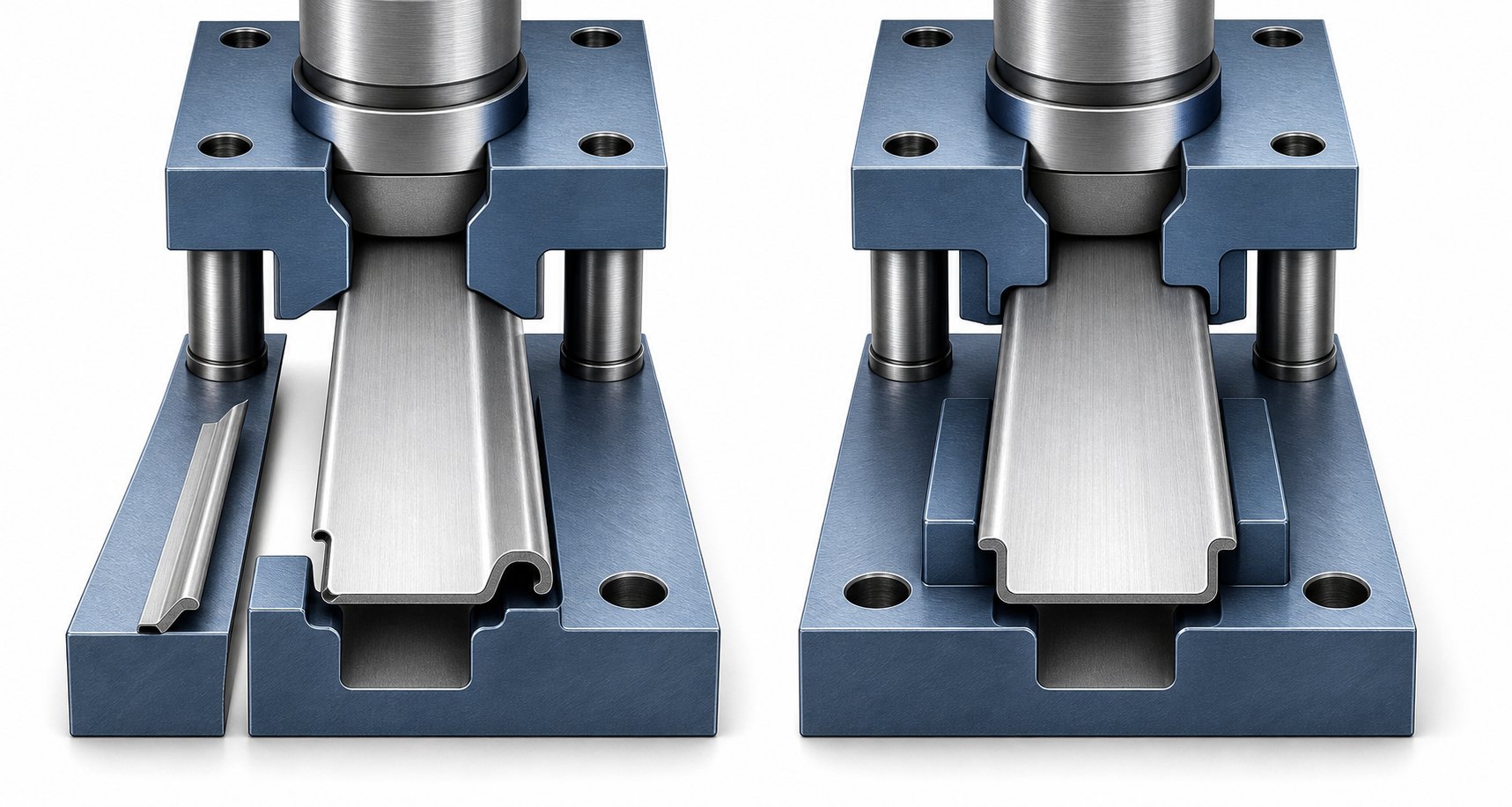
Knowing a notch serves a clearance function is only half the design decision. The other half is choosing the direction of that relief. Do you remove material from the strip to create room, or do you leave material in place and build clearance into the die stations themselves? This is the core distinction between negative and positive bypass notch types, and selecting the wrong one for your application creates problems that don't show up until the press is running.
Negative Bypass Notches and When to Use Them
A negative bypass notch removes material from the strip edge or carrier area. Think of it as cutting away a section of the strip so that a formed feature, whether a flange, draw, or embossment, can pass through downstream stations without contacting punches, inserts, or die walls. The material is gone. The clearance exists because there's simply nothing left to interfere.
This is the more common approach in progressive die strip layouts. The cutaway creates clearance around tooling, formed geometry, or later station movement. It reduces interference, improves scrap release, and provides room for forming and trimming operations.
When should you reach for a negative bypass notch? Consider these situations:
- Deep draws or tall flanges that extend significantly above or below the strip plane and would collide with lower die components or upper tooling during advancement
- Parts with complex formed geometry that changes profile at multiple stations, requiring progressive relief as the strip moves forward
- Tight station spacing where there isn't enough lateral room to route the strip around existing tooling without removing carrier material
- Applications where scrap slug ejection is straightforward and the removed material can fall cleanly through the die without retention issues
- Thicker materials where the formed feature has enough rigidity that removing adjacent carrier material won't cause deformation at the notch boundary
The tradeoff is direct: every piece of material you cut away weakens the carrier. A negative notch that's too generous can leave the strip flimsy and prone to twisting, bending, or misfeed during high-speed operation. The designer must size the relief to clear the formed feature while retaining enough carrier strength for stable progression through all remaining stations.
Positive Bypass Notches and Their Advantages
A positive bypass notch works in the opposite direction. Instead of removing material from the strip, you keep or extend material locally while building clearance slots into the forming stations themselves. The strip retains its material, and the die accommodates the strip profile by providing recesses or open areas where those retained sections can pass through without interference.
In practice, a positive bypass notch means a local tab or section of the carrier that remains intact, guided through matching relief pockets machined into the die shoe or forming inserts. The strip stays stronger because you haven't cut material away. The die does the accommodating rather than the strip.
Positive bypass notches offer distinct advantages in progressive die applications:
- Carrier strength is preserved because no material is removed from the strip itself
- Feed stability improves, particularly in thin materials that lose rigidity quickly when carrier sections are cut away
- Strip guidance remains consistent since the full carrier width is maintained through all stations
- Reduced risk of strip twist or lateral wander in high-speed operations where weakened carriers tend to oscillate
The cost is on the die side. Every station that the positive notch passes through needs a matching clearance pocket or slot machined into the die components. This adds complexity to the tool build, increases the number of inserts that need maintenance, and limits future design changes since moving a positive bypass feature requires reworking multiple stations.
Choosing Between Positive and Negative Types
The selection criteria come down to a balance between strip integrity, die complexity, and production conditions. Neither type is universally superior. Each fits a specific set of constraints.
Use these factors to guide your bypass notch type selection:
- Forming depth and bypass notch geometry: Shallow forms under 1.5 times material thickness often work fine with negative notches because the clearance required is minimal and carrier weakening is limited. Deep forms benefit from positive notches that keep the carrier intact while the die provides room.
- Material thickness: Thin materials (below 0.5 mm) lose carrier strength rapidly with negative notches. Positive types preserve rigidity. Thicker materials tolerate negative notch removal better without feeding instability.
- Station count and strip length: Long progression strips with many stations accumulate feeding forces. Each negative notch reduces the strip's ability to resist those forces. Positive notches distribute the load across a full-width carrier.
- Die maintenance access: Positive notches require more die-side machining and maintenance. If rapid insert changes are needed for production flexibility, negative notches simplify the tool structure.
- Production speed: High-speed progressive operations above 200 strokes per minute amplify every weakness in the carrier. Positive bypass designs reduce the chance of strip oscillation and misfeed at speed.
- Part geometry complexity: Parts with asymmetric forms or varying feature heights across the strip may require a combination of both types at different stations.
Many experienced die designers use a hybrid approach. Negative bypass notches handle the stations where clearance needs are simple and carrier weakening is manageable. Positive bypass geometry gets reserved for critical stations where strip stability is non-negotiable. The strip layout becomes a map of these decisions, with each notch type placed according to what that specific station demands.
The deeper issue isn't geometry alone. How these notches interact with pilots, lifters, and strippers during the actual press cycle determines whether a theoretically correct design survives contact with production reality.
How Bypass Notches Interact With Other Die Components
A bypass notch drawn in isolation on a strip layout looks straightforward. But the moment the press cycles, that notch exists inside a system of pilots, lifters, strippers, and forming inserts all moving in coordinated sequence. Bypass notch placement that ignores these neighboring components produces designs that look clean on screen and jam in production.
How Bypass Notches Work With Pilots and Registration
Pilot pins locate the strip precisely before any punch engages the material. They enter previously pierced holes in the strip and pull it into exact position, typically correcting any feed error within a few thousandths of an inch. The relationship between bypass notch and pilot pin placement is critical because both features occupy the same limited carrier real estate.
Here's the problem: a bypass notch cut too close to a pilot hole weakens the surrounding material. When the pilot pin enters and shifts the strip into alignment, it applies lateral force to the hole edge. If a nearby notch has removed the supporting material, the pilot hole deforms, elongates, or tears under repeated cycling. Registration degrades progressively, and part dimensions drift out of tolerance without an obvious cause.
The general rule is to maintain a minimum distance of 1.5 to 2 times the material thickness between the edge of any bypass notch and the nearest pilot hole. For thin materials, this minimum often needs to increase because the remaining web between notch and pilot lacks the stiffness to resist lateral pilot forces. When station spacing forces the notch and pilot into close proximity, reinforcing the area with a local stiffening rib or choosing a positive bypass geometry that preserves full carrier width becomes the safer path.
Interaction With Lifters and Strippers During Progression
Lifters raise the strip between press strokes so it clears lower die features during advancement. They provide vertical clearance. Bypass notches provide lateral clearance. Together, they create a three-dimensional envelope that lets formed features pass safely through each station. Understanding how lifters and bypass notches work together prevents the scenario where the strip clears vertically but still catches on adjacent tooling horizontally.
Imagine a strip with a formed downward lance at station four. The lifter raises the strip enough to clear the lower die post at station five during feed. But if that lance is wide, it may still contact the side wall of a forming insert as the strip slides forward. The bypass notch removes that lateral interference, complementing the lifter's vertical lift with horizontal relief.
Stripper design adds another layer of interaction. As the punch retracts after each stroke, the stripper plate holds the strip down against the die surface to prevent material from traveling upward with the punch. If a bypass notch creates an unsupported gap in the strip directly beneath the stripper, the strip can deflect downward into that gap during stripping action. This causes the strip to hang up, hesitate during feed, or catch on the edge of the notch opening during the next advancement. Stripper design bypass notch clearance coordination means ensuring the stripper has adequate backup support wherever notch geometry creates an unsupported span.
The full strip progression sequence through a forming station reveals exactly where bypass clearance becomes critical:
- The feeder advances the strip one pitch length. Lifters hold the strip elevated so formed features clear the lower die surface during travel. Bypass notches provide lateral room so the strip doesn't contact forming inserts or adjacent punches.
- Lifters retract as the press ram descends. The strip settles onto the die surface. Pilot pins enter their holes and pull the strip into final registered position.
- The stripper plate contacts the strip and applies hold-down pressure. The strip must sit flat and stable. Any bypass notch beneath the stripper must have backup support or the plate bridges over the gap without deflecting the strip.
- Punches perform forming, piercing, or trimming operations. New features are created that will need bypass clearance at downstream stations.
- The ram retracts. The stripper holds the strip down, separating it from the punches. Elastic springback in formed features can shift geometry slightly. Bypass notch clearance must account for this post-stripping dimensional change, not just the nominal formed shape.
- Lifters raise the strip again. The cycle repeats. Each newly formed feature must pass cleanly through all remaining downstream stations using the relief geometry designed into the layout.
One detail that catches designers off guard: bypass notch clearance isn't static. Springback after stripping means a formed flange might sit 0.5 to 1 degree wider than its nominal angle. A notch sized exactly to the formed geometry with no springback margin becomes an interference fit one station later. Building in a small angular clearance allowance, typically 5 to 10 percent beyond the nominal formed profile, prevents these marginal contact issues from escalating into full misfeeds at production speed.
The interplay between these components highlights why bypass notch decisions can't be made in isolation from the rest of the die structure. Every notch interacts with pilots above, lifters below, strippers returning, and forming inserts adjacent. Getting the geometry right for one component while ignoring the others is the most common reason bypass notch designs fail during tryout. And because these interactions compound across stations, even small errors in clearance geometry at one location propagate through the entire strip as cumulative feed instability.
Material properties add another variable to this equation. A strip that behaves predictably through these interactions in 1.0 mm cold-rolled steel may respond very differently in 0.5 mm aluminum or 1.5 mm stainless, shifting how much clearance each notch truly needs at every station.
Material Type and Thickness Effects on Bypass Notch Design
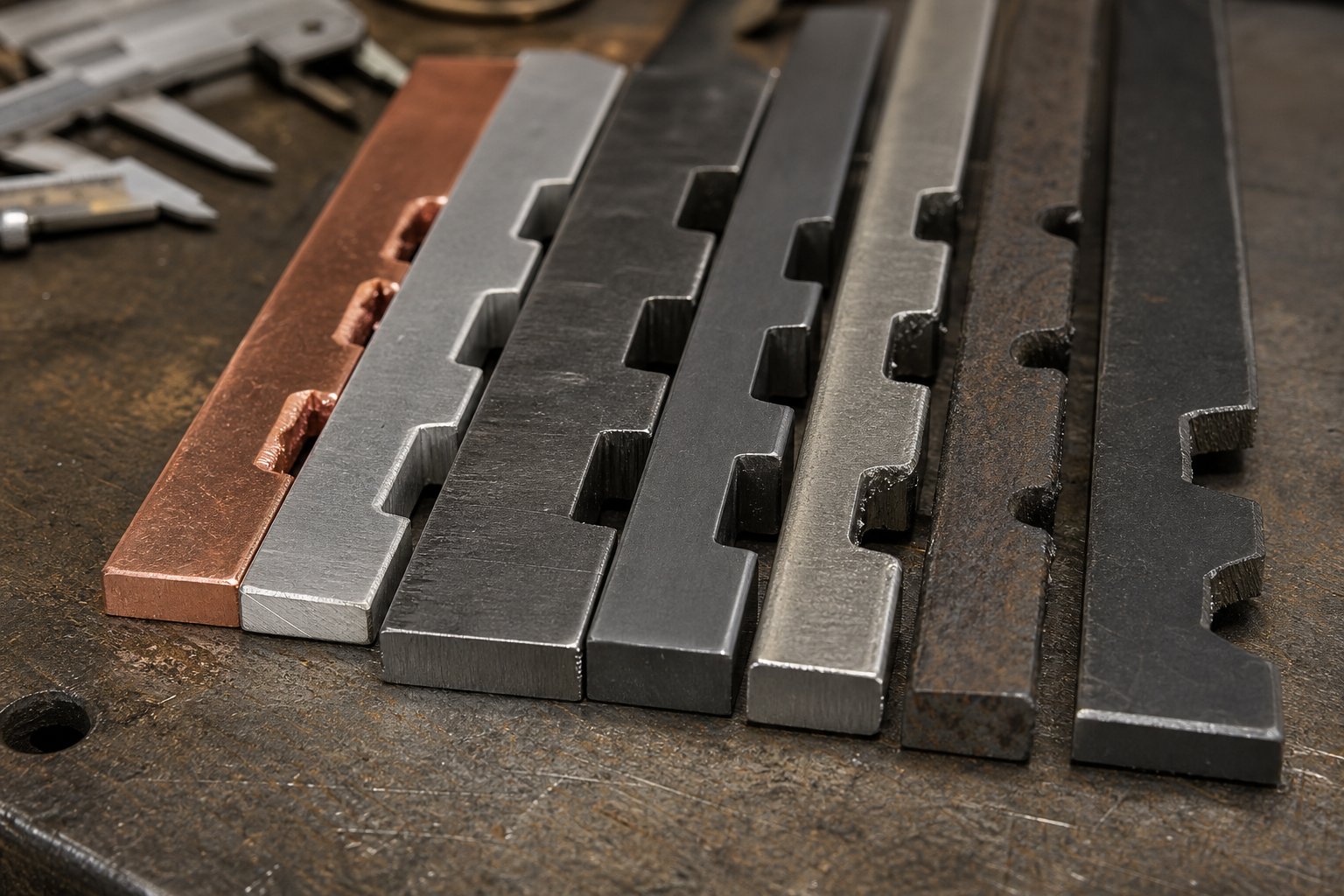
A bypass notch that works perfectly for 1.0 mm cold-rolled steel may fail completely in 0.5 mm aluminum or 1.2 mm phosphor bronze. The same clearance geometry, the same station spacing, the same strip layout concept, yet entirely different production results. Why? Because each material responds differently to forming, feeds differently under tension, and springs back by different amounts after the press retracts. Bypass notch sizing for material thickness isn't a single formula. It's a set of decisions shaped by how the specific alloy behaves under the conditions your die creates.
Bypass Notch Sizing for Steel and Aluminum Strips
Steel and aluminum represent the two most common progressive die material families, yet they demand very different bypass notch approaches. The key differences come down to hardness, springback behavior, and how the material responds to cutting.
Low-carbon steel (CRS, typically 1008 to 1010 grades) in the 0.5 mm to 2.0 mm range behaves predictably. Formed features hold their shape with relatively modest springback, usually 1 to 3 degrees on open bends. Bypass notch clearance can be sized close to the nominal formed profile because what you form is largely what you get after stripping. The material's stiffness also means the carrier strip retains its rigidity even with negative notches cut into it, provided the remaining carrier width stays above two to three times material thickness.
Higher-strength steels change this equation dramatically. As MetalForming Magazine notes, modern high-strength steels have yield strengths much closer to their tensile strengths compared with traditional low-carbon grades. This means less plastic deformation occurs before fracture, which translates to more aggressive springback on formed features. A flange formed in HSLA 50 steel will spring back further than the same geometry in 1008 CRS. Your bypass notch must account for that wider post-spring profile, not just the die geometry at bottom dead center.
Aluminum introduces a different set of challenges. Springback in aluminum alloys like 5052-H32 or 6061-T6 typically runs 5 to 8 degrees on comparable bend geometries, significantly more than mild steel. That means formed features end up wider, taller, or at steeper angles than nominal after stripping. Bypass notch clearance must account for this larger envelope. Additionally, aluminum's lower modulus of elasticity makes the carrier strip less rigid. A negative bypass notch that's acceptable in steel at a given width may leave an aluminum carrier too floppy for stable feeding, especially at speeds above 150 strokes per minute.
The practical implication: bypass notch clearance for aluminum typically needs 15 to 25 percent more room than the same geometry in mild steel of equivalent thickness. And thinner aluminum strips (below 0.8 mm) often benefit from positive bypass designs that avoid weakening the already-flexible carrier.
Adjusting Notch Design for Copper and Brass Alloys
Copper and brass bring a third behavioral profile that many die designers underestimate. These materials are soft, highly ductile, and prone to deformation at stress concentration points. The material springback effect on notch geometry isn't the primary concern here. Instead, it's the notch edges themselves that create problems.
Soft copper (C110, half-hard or less) running through a progressive die at production speed experiences feed forces at the carrier edges. Where a bypass notch creates a sharp internal corner, copper deforms locally under that feeding pressure. The notch profile gradually closes, reducing the clearance that was designed into the layout. After several hundred strokes, what started as adequate bypass room becomes marginal interference. After several thousand strokes, it's a misfeed.
The solution involves two adjustments. First, copper strip bypass notch design should use radiused internal corners rather than sharp transitions. A radius of at least 1.5 times material thickness at internal notch corners distributes feed stress over a larger area and resists local deformation. Second, copper notches benefit from slightly oversized clearance, typically 20 to 30 percent beyond the nominal formed feature envelope, to account for gradual profile drift during production runs.
Brass (C260 or C270) is harder than pure copper but still significantly softer than steel. It sits in between, tolerating sharper notch corners but still requiring more generous clearances than ferrous materials. Brass also work-hardens during progression, meaning the carrier strip gets stiffer as it moves through stations. This is actually advantageous for negative bypass notches because the hardened carrier resists the bending and twisting that plague softer materials at high speeds.
Material thickness amplifies these effects across all alloys. Thicker materials produce taller formed features that require wider bypass clearances. They also generate higher feed forces, which stress notch boundaries more aggressively. The relationship isn't perfectly linear, but a general principle holds: doubling material thickness roughly requires 1.5 to 1.8 times the bypass clearance for equivalent feature geometry.
The following table summarizes how material type and thickness range influence bypass notch design decisions:
| Material Type | Typical Thickness Range | Recommended Notch Clearance Approach | Key Design Considerations |
|---|---|---|---|
| Low-Carbon Steel (CRS 1008-1010) | 0.4 mm - 3.0 mm | Size to nominal formed profile plus 5-10% for springback allowance | Predictable springback; carrier retains rigidity; negative notches work well across most thicknesses |
| High-Strength Steel (HSLA, DP) | 0.6 mm - 2.5 mm | Size to formed profile plus 15-20% to accommodate aggressive springback | Higher springback than CRS; fracture-prone at sharp notch corners; consider stress-relief radii on notch transitions |
| Aluminum (5052, 6061) | 0.3 mm - 2.0 mm | Size to formed profile plus 15-25%; favor positive bypass for thin gauges below 0.8 mm | High springback (5-8 degrees); low carrier rigidity; strip oscillation risk at speed; needs wider clearance margins |
| Copper (C110, C102) | 0.2 mm - 1.5 mm | Size to formed profile plus 20-30%; use radiused notch corners (min 1.5x thickness) | Soft material deforms at notch edges under feed force; notch profiles close over time; oversizing is necessary for sustained runs |
| Brass (C260, C270) | 0.3 mm - 2.0 mm | Size to formed profile plus 10-15%; radiused corners recommended but less critical than copper | Work-hardens during progression; moderate springback; carrier stiffens through stations; tolerates negative notches better than copper |
One pattern worth noting across all materials: as thickness increases beyond 1.5 mm, negative bypass notches become increasingly viable regardless of alloy softness. The thicker carrier retains structural integrity even with material removed. Below 0.5 mm, positive bypass designs earn their added die complexity by preserving the thin carrier's ability to feed reliably at production rates.
These material-driven decisions don't exist in isolation. Every bypass notch interacts with the overall strip layout, affecting carrier width requirements, material cost per part, and how scrap slugs from notch cuts are managed during production. The same notch that provides ideal clearance for copper strip feeding might generate a slug shape that refuses to eject cleanly from the die, creating a different problem entirely.
Strip Layout Optimization and Scrap Management Strategies
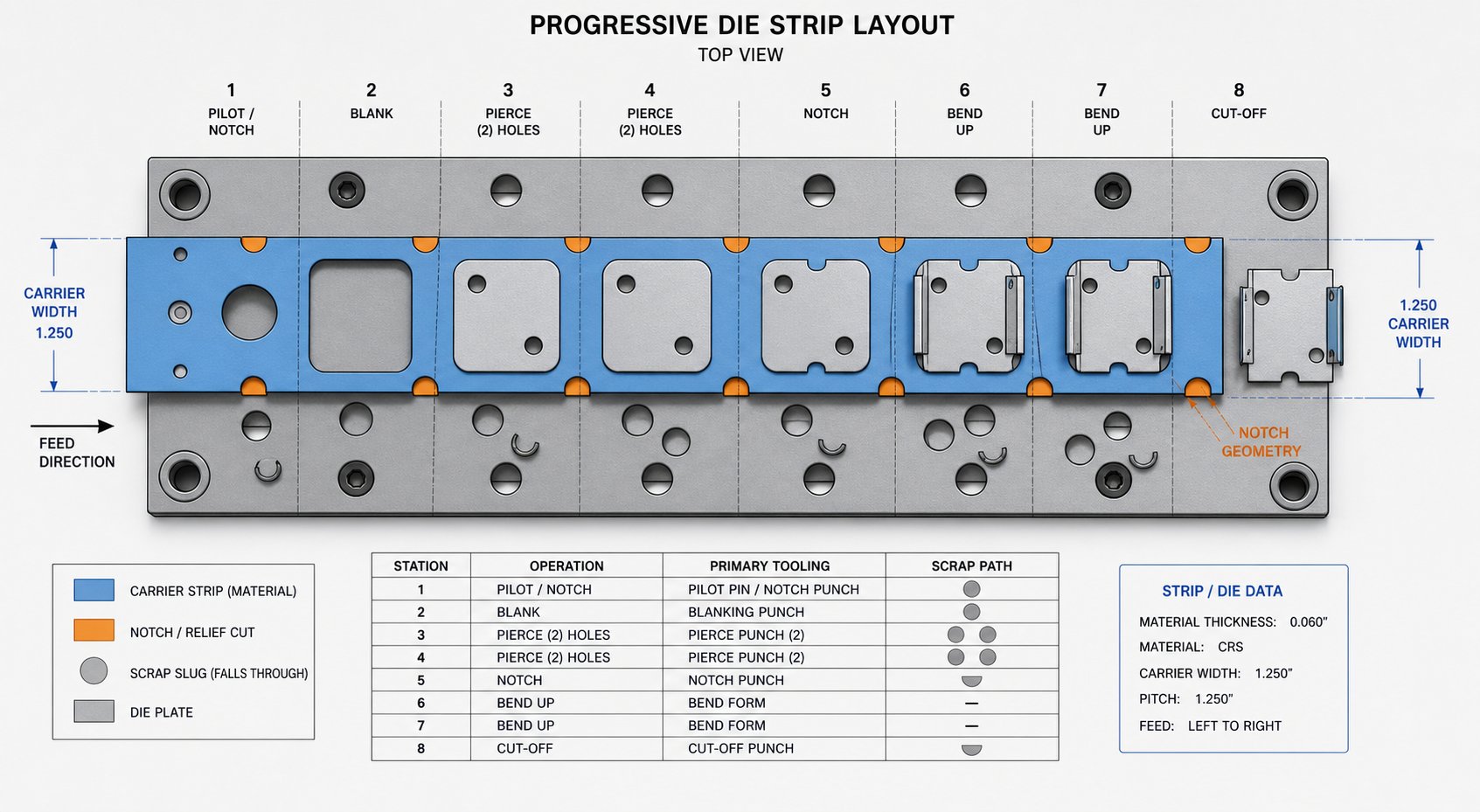
Every bypass notch represents removed material. And every millimeter of removed material has a cost. The geometry you choose for clearance relief directly determines how wide the carrier strip needs to be, how much scrap you generate per stroke, and whether those scrap slugs eject cleanly or pile up inside the die until something breaks. Bypass notch strip layout optimization isn't a separate discipline from notch design. It's the economic consequence of every clearance decision you've already made.
Strip Layout Optimization and Carrier Width Decisions
Carrier strip width is one of the largest drivers of material cost in progressive die stamping. The carrier exists solely to transport the part from station to station. It contributes nothing to the finished piece. Once the part is separated, the carrier becomes scrap. So every fraction of extra width added to accommodate bypass notch clearance translates directly into higher material consumption per part.
Here's the tradeoff: generous bypass clearance makes the strip feed reliably. Tight clearance saves material but risks interference, misfeeds, and production stoppages. The cost of a single die crash from inadequate clearance can exceed the material savings from thousands of parts run on a narrower carrier. As die design expert Art Hedrick has noted in The Fabricator, one severe die crash can cost 100 times more than the additional material consumed by a notch feature.
The practical question isn't whether to minimize carrier width. It's how much margin above minimum clearance actually pays for itself in reduced downtime. For high-volume runs above 500,000 parts per year, even 0.5 mm of unnecessary carrier width adds up to significant coil consumption. For short runs, the math tilts toward generous clearance because setup time and crash risk dominate your cost structure more than material usage.
Carrier strip width and bypass notch sizing decisions depend on several factors working together. When you're planning the strip layout, consider the following:
- Calculate the maximum formed feature envelope including springback, not just the nominal geometry at bottom dead center. Add clearance margin appropriate to the material type (5-30% depending on alloy, as covered previously).
- Account for strip wander during feeding. The carrier must remain wide enough that lateral drift doesn't push formed features into tooling, even at the edge of normal feed tolerance.
- Verify that the remaining carrier section between the bypass notch and the strip edge retains enough strength for stable progression. A carrier weakened below two times material thickness at any cross-section risks feeding instability.
- Check whether multiple bypass notches at adjacent stations overlap or stack. Overlapping notch clearances can create a compound weakened zone that fails under cumulative feed force even though each individual notch appears adequate.
- Evaluate whether a positive bypass design could achieve the same clearance without widening the carrier, trading die complexity for material savings on long production runs.
- Factor in coil width availability from your supplier. Standard coil widths may not align with your ideal carrier dimension, making a slightly wider layout no more expensive in practice if it falls within the same standard width band.
Material utilization bypass notch tradeoffs ultimately come down to a simple principle: design the narrowest carrier that still feeds reliably at your target production speed, in your specific material, with your specific formed features. Anything narrower creates risk. Anything wider creates waste. The sweet spot lives in the overlap between those two boundaries.
Scrap Slug Management for Bypass Notch Cuts
Sounds straightforward? The geometry challenge gets harder once you consider what happens to the material you cut away. Every negative bypass notch produces a scrap slug. That slug must go somewhere, and "somewhere" better not be inside the die cavity.
Scrap slug management for progressive die notches is one of those details that rarely appears on the strip layout print but determines whether the die runs for hours or minutes before jamming. Wilson Manufacturing highlights the core problem: without scrap management built into the die design, waste collects in cavities and between die blades. As layers stack, pressure builds until it breaks out the blades. Smaller cavities fill faster, making compact bypass notch slugs particularly prone to retention.
The shape of the bypass notch directly influences whether its slug ejects cleanly. Consider these relationships:
- Rectangular slugs with parallel sides tend to wedge in die cavities. The slug's straight edges create friction against the cavity walls, resisting ejection by gravity alone. Drafting the cavity walls by 0.5 to 1 degree per side helps, but adds machining complexity.
- Tapered or trapezoidal slugs eject more reliably because the narrower end leads the exit path. Designing the bypass notch with a slight taper built into its geometry improves slug release without affecting clearance function.
- Very small slugs (under two times material thickness in any dimension) are the highest risk for retention. They lack the weight for gravity ejection and tend to cling to punch faces or wedge between die components. If your bypass notch produces a slug this small, consider air-assisted ejection or spring plunger mechanisms.
- Irregular or L-shaped slugs produced by complex notch profiles can tumble and reorient during ejection, catching on cavity edges. Simplifying the notch geometry into two separate cuts rather than one complex shape often solves this problem at the cost of an additional station.
Slug retention doesn't just damage blades. Retained slugs that get carried up with the strip on the return stroke can end up between the stripper and the workpiece, causing surface defects, dimensional errors, or secondary die damage. The failure mode cascades: one retained slug leads to a marked part, which leads to a quality stop, which leads to someone opening the die to investigate, which reveals three more slugs wedged in adjacent cavities.
Practical slug ejection strategies for bypass notch cuts include gravity drop through clearance holes in the die shoe, vacuum-assisted removal for small or lightweight slugs, and positive mechanical ejection using spring-loaded pins or compressed air timed to the press cycle. The right choice depends on slug size, die orientation, and available press infrastructure. Vertical presses with open bottoms allow gravity ejection for most slug shapes. Inclined or inverted die orientations require mechanical assistance regardless of slug geometry.
One often-overlooked option sidesteps slug management entirely: the lance-and-form bypass notch. Instead of cutting material free from the strip, you lance three sides and bend the tab downward or upward, creating clearance without producing a separate slug. The displaced material stays attached to the strip and exits the die as part of the carrier scrap. This approach, similar to the lance and flange pitch stop concept, eliminates slug retention risk entirely. The tradeoff is that the bent tab must clear downstream stations, which means you may need additional relief in the die to accommodate it.
The connection between strip layout economics and slug management creates a feedback loop. Wider notches produce larger slugs that eject more easily but waste more material. Narrower notches save material but produce small slugs that resist ejection. The optimal bypass notch geometry balances clearance function, carrier strength, material cost, and scrap behavior simultaneously. Getting all four right is what separates a strip layout that runs reliably from one that generates constant maintenance calls.
These layout-level decisions form the foundation, but they still need a structured framework for implementation. When should you use bypass notches at all versus alternative strip control methods? And when the press starts running and problems appear, how do you trace symptoms back to their root cause in the notch design?
Practical Design Decision Framework and Troubleshooting
Strip layout decisions, material considerations, and component interactions all feed into one central question: does this specific die actually need bypass notches, or will a simpler strip control method do the job? And once you commit to bypass geometry, how do you diagnose the inevitable production problems that surface during tryout and sustained runs? A bypass notch design decision framework turns these open-ended questions into a structured sequence that any die designer can follow from concept through production troubleshooting.
Decision Framework for Bypass Notch Implementation
Not every progressive die requires bypass notches. Simple flat blanking dies with no formed features never need them. Tab carriers and continuous carriers can sometimes handle mild interference situations without dedicated relief cuts. The decision of when to use bypass notches vs tab carriers depends on forming depth, feature orientation, and how much vertical lift the strip system can provide.
Tab carriers connect the part to the strip using narrow bridges of material. They work well when formed features are shallow enough that lifters alone can raise the strip over lower die components during feed. Continuous carriers maintain the full edge of the strip intact and rely entirely on vertical lift for clearance. Both approaches avoid the carrier weakening and slug management complications that come with bypass notches.
However, when formed features extend beyond what lifters can clear vertically, or when lateral interference exists between formed geometry and adjacent tooling, bypass notches become necessary. Here's a step-by-step decision checklist to determine whether your die needs them and how to implement them:
- Map every formed feature in the strip layout that extends above or below the strip plane. Record the maximum height, width, and angular profile of each feature including springback allowance.
- Calculate the lifter travel available at each station. If lifter height alone provides clearance for all formed features to pass downstream tooling during feed, bypass notches may not be required.
- Check lateral clearance between formed features and adjacent die components (forming inserts, trim punches, cam slides) at each downstream station. If any feature profile is within 1.5 times material thickness of a neighboring component during strip advancement, bypass relief is needed.
- Determine whether positive or negative bypass geometry is appropriate based on material type, carrier strength requirements, and die complexity tolerance (reference the selection criteria from your material and thickness analysis).
- Size each notch to the formed feature envelope plus the appropriate clearance margin for your alloy (5-30% depending on springback and material softness).
- Verify that bypass notch placement maintains minimum distance from pilot holes (1.5 to 2 times material thickness) and does not create unsupported spans beneath the stripper plate.
- Evaluate the resulting carrier cross-section at every station. Confirm the remaining material exceeds two times material thickness at the narrowest point to maintain feeding stability.
- Assess scrap slug geometry from each negative notch. Confirm that slug shape allows reliable ejection through the die shoe or that mechanical/vacuum-assisted ejection is incorporated.
- Review the complete strip layout for overlapping or stacked notch clearances that might create compound weakened zones in the carrier.
- Run a mental progression simulation: trace the strip through every station, checking that each previously formed feature has clearance at every downstream station it passes through, not just the station immediately following the forming operation.
This sequence catches most progressive die strip advancement problems before the die ever reaches the press. Skipping step 10 is the single most common oversight. A feature formed at station 3 doesn't just need clearance at station 4. It needs clearance at stations 5, 6, 7, and every subsequent station until the part separates from the carrier. Designers who check only the next station downstream discover interference at station 8 during tryout, requiring expensive rework.
For complex progressive dies involving deep draws, multiple forming stages, or challenging materials, working with tooling partners experienced in custom stamping die solutions can help validate these decisions before committing to tool steel. Design-heavy progressive die projects benefit from collaborative review at the strip layout stage, when changes cost hours rather than weeks.
Troubleshooting Common Bypass Notch Problems in Production
Even well-designed bypass geometry encounters production issues. Tooling wears. Feed conditions drift. Material properties vary coil to coil. Troubleshooting strip misfeed bypass notch issues starts with recognizing the symptom pattern and tracing it back to the specific notch-related root cause.
Art Hedrick's analysis in The Fabricator identifies poor strip feeding as one of the most common progressive die problems, often caused by issues that interact directly with bypass notch design: die alignment errors, incorrect feed height, coil camber, and improper pilot release timing. Each of these factors compounds any marginal bypass clearance situation into a full misfeed.
Slug pulling presents a particularly deceptive failure mode. The slug pulling bypass notch root cause traces to vacuum adhesion between the punch face and the cut slug. As MetalForming Magazine explains, when air flows rapidly between two parallel surfaces (the punch face and the slug), it creates a low-pressure zone that holds the slug against the punch during retraction. This is the same aerodynamic principle that makes a curveball curve. For bypass notch slugs, the problem is especially acute because these slugs are often small, light, and perfectly shaped to seal against the punch face.
When a pulled slug travels upward with the punch and then drops back onto the strip or die surface, it causes the next feed stroke to jam, creates surface defects on the workpiece, or wedges between die components. The corrective action depends on slug size: larger slugs respond to vacuum-breaking features on the punch face (grooves or dimples), while smaller slugs often require mechanical ejector pins or timed air blasts.
The following troubleshooting matrix maps the most common bypass notch production symptoms to their likely root causes and corrective actions:
| Symptom | Likely Root Cause | Corrective Action |
|---|---|---|
| Strip misfeeds intermittently at one station | Bypass notch clearance is marginal for the formed feature at that station; material springback exceeds design allowance | Widen notch clearance by 10-15%; verify springback with actual part measurement, not nominal geometry |
| Strip buckles or twists during feed | Carrier weakened excessively by bypass notch removal; overlapping notch zones create compound weak section | Increase carrier width at weakened cross-sections; consider switching to positive bypass at critical stations; add intermediate lifter support |
| Pilot holes elongate progressively over production run | Bypass notch too close to pilot hole; insufficient supporting material between notch edge and pilot hole perimeter | Relocate notch or pilot to increase separation distance to minimum 2x material thickness; reinforce web between features |
| Part dimensions drift out of tolerance at downstream stations | Strip misregistration caused by strip hanging on bypass notch edges during feed; notch edge burr catching on die components | Deburr or radius notch edges; check lifter height is adequate for strip to clear notch boundaries during advancement |
| Slugs retained in die cavity; periodic jamming | Bypass notch geometry produces small or rectangular slugs that resist gravity ejection; die cavity walls lack draft angle | Redesign notch profile with taper for slug release; add 0.5-1 degree draft to cavity walls; install spring plunger or air-assisted ejection |
| Slug pulled back up with punch on retraction | Vacuum adhesion between punch face and slug; bypass notch slug is flat and seals against punch surface | Add vacuum-breaking grooves or dimples to punch face; install mechanical ejector pins; apply timed air blast at bottom dead center |
| Strip hangs up during return stroke after forming | Stripper plate deflects strip into unsupported bypass notch opening; strip catches on notch edge during upward travel | Add backup support beneath stripper where notch creates unsupported span; verify stripper pressure distribution; chamfer notch entry edges |
| Bypass notch edges deform over production run (copper/soft alloys) | Feed forces concentrate at sharp internal notch corners; soft material yields under repeated stress | Radius all internal notch corners to minimum 1.5x material thickness; oversize notch clearance by 20-30% to account for profile closure |
One pattern emerges across these failure modes: most bypass notch production problems trace back to insufficient margin in the original design. A notch sized to theoretical minimum clearance works during slow-speed tryout but fails at production rate. Feed dynamics, material variation, and tool wear all consume the clearance budget. Building in 10 to 20 percent extra clearance at the design stage is cheap insurance against the troubleshooting cycle that follows when margins are too tight.
The other recurring theme is interaction effects. A bypass notch problem rarely exists in isolation. A marginal notch combined with a slightly worn lifter and a coil that runs 0.02 mm thicker than nominal creates a three-factor failure that no single adjustment resolves. Effective troubleshooting requires examining the notch, the adjacent components, and the incoming material simultaneously rather than chasing one variable at a time.
These frameworks and diagnostic tools serve die designers and production engineers working through the full lifecycle of progressive tooling. But they also underscore a broader principle: bypass notch decisions are inseparable from overall die performance. They connect to every other design choice you've made, from pilot placement to material selection to strip economics.
Applying Bypass Notch Principles to Your Die Design Projects
Bypass notches occupy a small footprint on the strip layout, yet their influence reaches every corner of the die. A single notch connects to pilot registration accuracy, carrier feeding stability, lifter clearance strategy, material economics, and scrap ejection reliability. Treating these relief features as isolated geometry decisions is the mistake most toolmakers make. The designers who get it right understand that bypass notch impact on part quality is cumulative, emerging from how each notch interacts with every component it passes through across the full progression sequence.
Connecting Bypass Notch Design to Die Performance
The through-line across everything covered here is integration. Progressive die design bypass notch integration means your clearance geometry, carrier width, notch type selection, and slug management all reflect a single coherent strategy rather than a collection of station-by-station patches. When these elements align, the strip feeds smoothly, parts hold tolerance, and the die runs without intervention. When they conflict, you troubleshoot symptoms that keep shifting because the root cause lives in a design decision made three stations upstream.
Bypass notch design best practices summary: size clearance to the formed feature envelope plus material-specific springback margin, maintain minimum separation from pilot holes, preserve carrier strength above two times material thickness at every cross-section, design slug geometry for reliable ejection, and verify clearance at every downstream station the feature passes through, not just the next one.
Mastering these principles marks the difference between a die that survives tryout and one that runs millions of cycles without intervention. Advanced stamping die engineering principles don't live in exotic tooling or expensive simulation software alone. They live in details like bypass notch geometry that most designers treat as afterthoughts.
Resources for Advanced Stamping Die Engineering
For tooling engineers working through complex progressive die projects where bypass notches intersect with forming depth, material flow, and multi-station component integration, having access to experienced tooling partners shortens the development cycle. YICHEN's custom stamping die solutions provide engineering support for design-heavy projects involving die structure, punch and lifter configuration, clearance optimization, and strip layout validation. When your strip layout involves the kind of multi-variable decisions covered throughout this article, collaborative review with a capable tooling team catches problems that solo design work often misses.
The stamping die design bypass notches purpose isn't complexity for its own sake. It's controlled clearance that lets everything else in the die work as intended. Get the notches right, and the rest of the die follows.
Frequently Asked Questions About Bypass Notches in Stamping Die Design
1. What is the purpose of bypass notches in progressive stamping dies?
Bypass notches serve as relief geometry cut into the carrier strip that prevents previously formed features like flanges, draws, or embossments from colliding with downstream tooling during strip advancement. They ensure the strip moves freely from station to station without jamming, distortion, or die damage. Without proper bypass relief, raised or lowered features interfere with punches, inserts, and lifters as the strip progresses, leading to misfeeds, scratched parts, or catastrophic die crashes that can cost 100 times more than the material saved by omitting the notch.
2. What is the difference between a bypass notch and a pitch notch?
A pitch notch (also called a French notch) primarily controls strip feed distance and registration by providing a mechanical stop that prevents overfeeding. A bypass notch exists solely as clearance relief to prevent formed features from contacting downstream die components during advancement. While pitch notches are typically rectangular cuts at the strip edge made at the first station, bypass notches are contoured to match the formed feature profile and placed adjacent to wherever interference would occur. Some shops use these terms interchangeably, but their design drivers, sizing rules, and failure modes differ significantly.
3. When should I use positive bypass notches instead of negative bypass notches?
Positive bypass notches are preferred when carrier strip strength must be preserved, particularly in thin materials below 0.5 mm where removing material makes the carrier too flexible for stable feeding. They also suit high-speed operations above 200 strokes per minute where strip oscillation risk is high, and long-progression dies where cumulative feed forces demand full carrier width. The tradeoff is increased die complexity since every downstream station needs matching clearance pockets machined into die components. Negative bypass notches work better for thicker materials, simpler die structures, and applications where slug ejection is straightforward.
4. How does material type affect bypass notch sizing in progressive dies?
Each material requires different clearance margins due to varying springback, hardness, and ductility. Mild steel needs only 5-10% clearance beyond the formed profile due to predictable springback. Aluminum requires 15-25% extra clearance because springback runs 5-8 degrees on comparable bends. Copper demands 20-30% oversize with radiused internal corners because soft material deforms at notch edges under feed pressure, causing the notch profile to close over time. High-strength steels need 15-20% margin due to aggressive springback. YICHEN's custom stamping die solutions at yichen-group.com can help engineers validate these material-specific clearance decisions during strip layout development.
5. How do I troubleshoot strip misfeeds caused by bypass notch issues?
Start by identifying the symptom pattern. Intermittent misfeeds at one station suggest marginal clearance where material springback exceeds the design allowance, requiring 10-15% wider notches. Strip buckling or twisting indicates the carrier is weakened excessively by notch removal, needing increased carrier width or a switch to positive bypass. Progressive pilot hole elongation means the notch is too close to the pilot, requiring relocation to maintain 2x material thickness separation. Slug retention causing periodic jams needs notch profile redesign with taper or draft angles. Most bypass notch production problems trace to insufficient design margin that works during slow tryout but fails at production speed.


