


Progressive Die Stamping Company Red Flags Smart Buyers Catch
What a Progressive Die Stamping Company Actually Does
Before you can spot red flags in a supplier, you need a clear picture of what the process involves and what a progressive die stamping company is really delivering. Too many buyers jump straight to quoting without understanding the mechanics behind the parts they need. That knowledge gap is exactly where costly mistakes start.
What Is Progressive Die Stamping
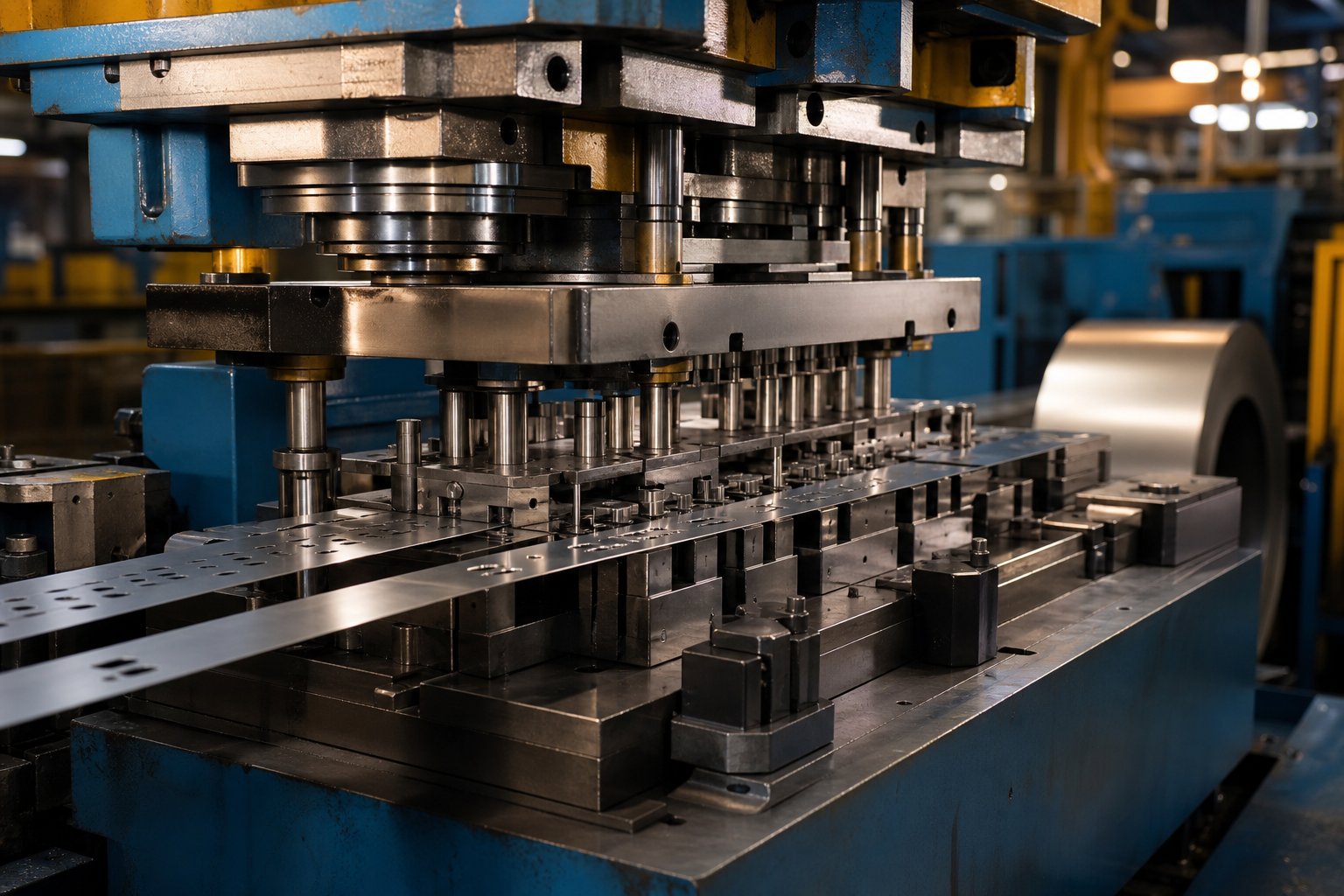
Progressive die stamping is a metal forming process in which a continuous strip of metal feeds through a single die containing multiple stations, each performing a distinct operation - piercing, blanking, bending, or forming - until the finished part is separated at the final station with every press stroke.
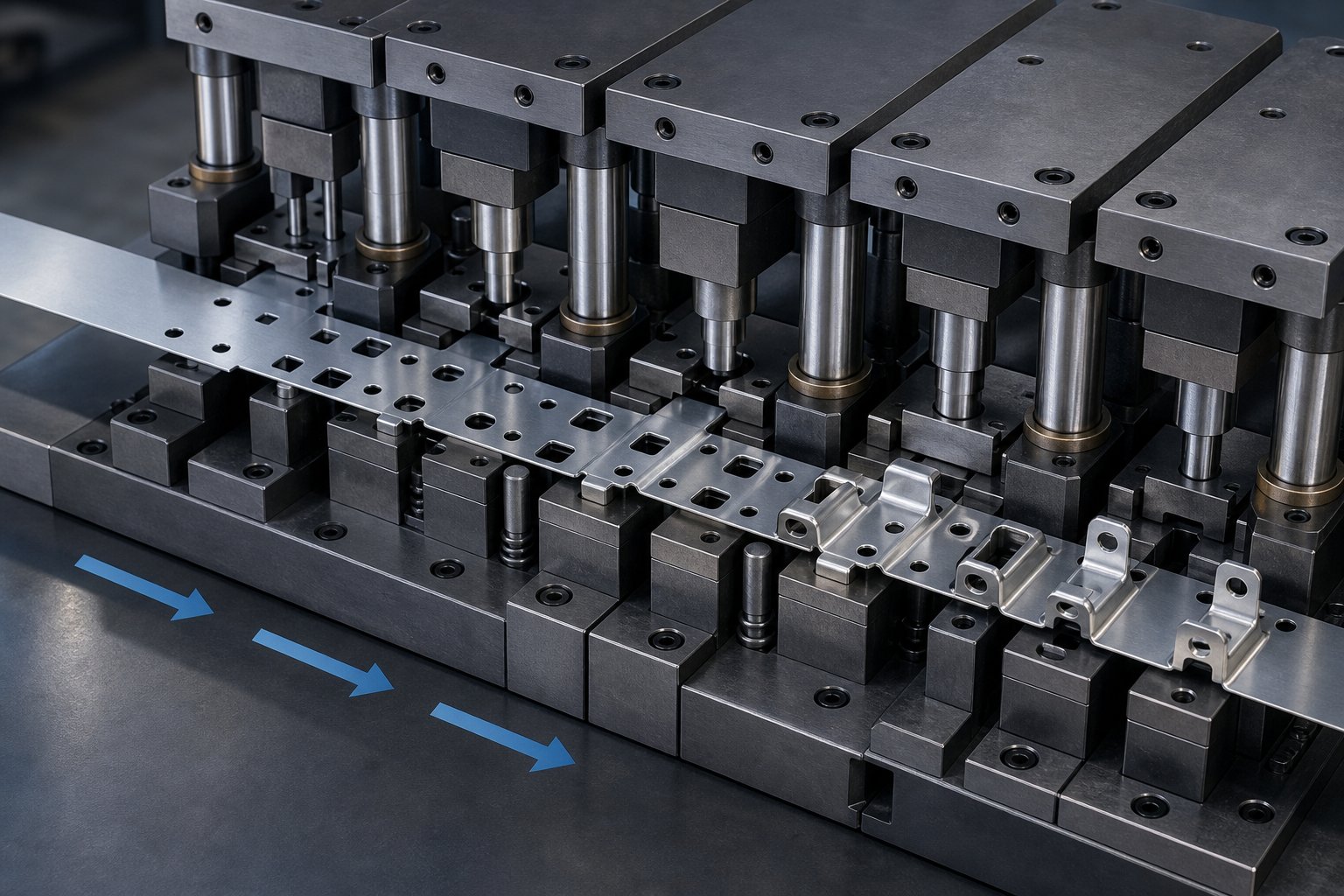
So what is a progressive die, exactly? Think of it as an assembly line compressed into one tool. A coil of flat sheet metal - steel, aluminum, copper, or other alloys - unwinds and feeds into a stamping press. With each stroke, the strip advances a precise increment (called die pitch) into the next station. One station might punch a hole, the next bends a tab, and another forms a contour. By the time the strip reaches the last station, a fully shaped component drops free. The leftover carrier strip becomes recyclable scrap.
A progressive die stamping company designs, builds, and runs these multi-station tools to produce finished parts at scale. Presses typically operate between 25 and over 200 strokes per minute, meaning a single die can output hundreds of identical components every few minutes. The result is repeatable geometry, tight tolerances, and low per-unit costs once tooling is in place.
How Progressive Dies Differ From Single-Station Dies
Imagine needing a bracket that requires a hole, two bends, and a notch. With single-station tooling, each of those operations happens in a separate die on a separate press cycle. An operator - or a robot - moves the part between stations manually. It works for prototypes or short runs, but it is slower and introduces handling errors.
Progressive metal stamping eliminates that part-to-part handling entirely. Because the strip stays connected through a carrier web, every operation stays aligned to the same datum. You get faster cycle times, fewer quality variables, and dramatically lower labor costs. The trade-off is a higher upfront investment in tooling - a custom progressive die can range from $10,000 to $200,000 or more depending on part complexity and station count.
For buyers sourcing mid-to-high-volume components - think thousands to millions of parts annually - progressive stamping is often the most cost-effective path. Understanding how this differs from simpler methods gives you a baseline for evaluating whether a supplier's capabilities genuinely match your production requirements.
That evaluation, however, depends on knowing what happens inside the die at each station and how strip layout decisions directly affect part quality, material usage, and cost.
How the Progressive Die Stamping Process Works Step by Step
Strip layout decisions shape everything that follows - from how many stations a die contains to how much raw material ends up as scrap. Understanding the progressive die stamping process at this level separates buyers who catch supplier red flags from those who discover problems after tooling is paid for.
Strip Layout and Station Sequencing
Every progressive stamping die design starts with the strip layout. Engineers map out exactly how the part will be oriented on the metal strip, which operations happen at which stations, and how much material sits between each feature. This blueprint determines feed pitch (the distance the strip advances per stroke), carrier web width, and the sequence of cuts and forms.
Why does sequencing matter so much? Piercing and notching typically come first, while the material is still flat and stable. Bending and forming follow after the profile has been established. If you reverse that order, holes and slots can distort during later forming steps, pushing parts out of tolerance. A well-planned strip layout also balances cutting forces across stations to prevent the strip from tipping or buckling inside the die.
Material utilization is where progressive stamping die design directly affects your cost. The industry benchmark targets at least 75% material efficiency. Engineers achieve this by optimizing part nesting - sometimes tilting parts at an angle or using alternative carrier configurations - to minimize the scrap skeleton left behind. Carrier web width follows a practical rule: generally at least two times the material thickness to maintain strip rigidity without wasting stock.
From Coil to Finished Part
Picture a coil of sheet metal weighing hundreds or thousands of pounds. The progressive stamping process transforms that raw coil into precision components through a tightly controlled sequence. Here is how a typical cycle runs on a progressive stamping machine:
- Coil loading and uncoiling: The metal coil mounts on an uncoiler, which pays out strip at a controlled rate matched to press speed.
- Straightening: The strip passes through a straightener that removes coil set - the curvature memory from being wound - so the material enters the die flat and stress-free.
- Feeding: A servo feeder advances the strip by a precise pitch distance with each press stroke, typically accurate to within thousandths of an inch.
- Piloting: Pilot pins engage pre-punched holes to lock the strip into exact position before any forming occurs.
- Sequential station operations: Each station performs its designated task - piercing holes, blanking profiles, bending tabs, drawing features, coining surfaces, or embossing details.
- Carrier transport: Throughout the process, the part remains connected to the carrier strip, which acts as a conveyor moving the workpiece from station to station.
- Final cutoff: At the last station, the finished part is severed from the carrier strip.
- Ejection and collection: Completed parts drop into bins or onto conveyors, while scrap slugs and the spent carrier strip are routed to recycling.
This entire cycle - from feed to ejection - happens with every single press stroke. At high production speeds, a prog die running at 200 or more strokes per minute can output thousands of finished parts per hour with minimal human intervention.
Pilot Holes and Registration Accuracy
Pilot holes are arguably the most critical feature in progressive die tooling. They are small, precisely punched holes - usually created at the first or second station - that serve one purpose: keeping every subsequent operation aligned to the same reference point.
Here is the problem they solve. Servo feeders are accurate, but minor variations in feed distance accumulate over multiple stations. Without correction, a part that needs a hole centered 5 mm from a bend edge might drift 0.05 mm per station - enough to push final dimensions out of spec across a 10-station die. Pilot pins, entering the pre-punched holes just before the press closes, physically re-register the strip to its correct position every stroke.
For precision work, pilot-to-hole clearance typically runs between 0.0005 and 0.001 inches. That tight fit ensures the strip cannot shift laterally or longitudinally during forming. When a supplier's parts show inconsistent hole-to-feature relationships, worn or improperly sized pilots are often the culprit - a quality signal worth investigating during supplier audits.
Carrier strip design ties directly into pilot reliability. If the carrier is too narrow or lacks stiffness, it can flex between stations, causing pilot holes to elongate over time. Engineers balance carrier width against material savings, knowing that a failed carrier means a failed production run regardless of how efficient the nesting looks on paper.
These design fundamentals - strip layout, station sequencing, and pilot registration - form the technical foundation that separates capable suppliers from those assembling tooling they do not fully understand. The real test comes when you compare how different die methods handle parts that push beyond simple flat geometries.
Comparing Progressive Dies to Transfer and Compound Stamping Methods
Not every part belongs in a progressive die. Recognizing that distinction is one of the clearest signals that separate informed buyers from those who accept whatever a supplier proposes. If a vendor recommends progressive die metal stamping for a part that would be better suited to a transfer or compound process, that is a red flag worth catching early.
Progressive vs. Transfer vs. Compound Die Stamping
Each method uses a die and stamping press to shape sheet metal, but they differ fundamentally in how material moves, what geometries they handle, and where they make economic sense.
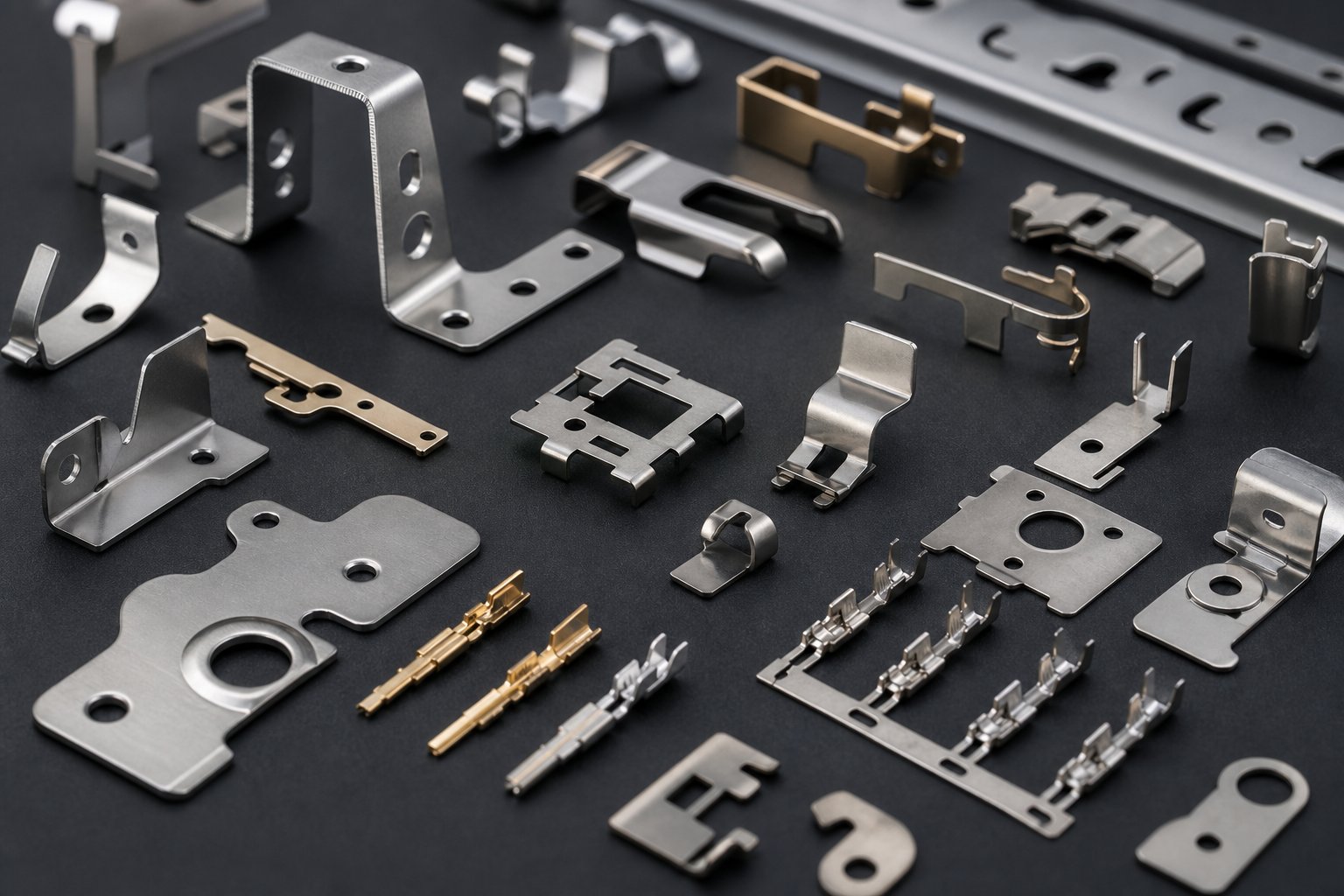
Progressive dies keep the workpiece attached to a carrier strip throughout. The strip feeds forward station by station, picking up new features with each press stroke. This makes progressive dies ideal for high-volume runs of small-to-medium parts with moderate geometric complexity - brackets, terminals, clips, and connectors produced by the hundreds of thousands.
Transfer dies separate the blank from the strip at the first station. Mechanical fingers or shuttle mechanisms then move that free blank between subsequent stations. Because the part is no longer constrained by strip width, transfer die stamping handles larger components and deeper draws that progressive dies cannot accommodate. Think structural automotive panels, cylindrical housings, or deep-drawn cups.
Compound dies perform multiple cutting operations - such as blanking and piercing - in a single press stroke. They excel at producing simple flat parts where tight concentricity between inner and outer profiles is critical, like washers, flat rings, and electrical laminations. Speed is lower than progressive stamping, but dimensional precision between features is inherently superior because everything is cut simultaneously.
The table below maps these methods across the criteria that matter most during supplier evaluation:
| Criteria | Progressive Dies | Transfer Dies | Compound Dies |
|---|---|---|---|
| Part Size | Small to medium (limited by strip width) | Medium to large (no strip constraint) | Small to medium (flat profiles) |
| Production Volume Threshold | High (typically 100,000+ annually) | Medium to high (10,000–500,000+) | Low to medium (1,000–100,000) |
| Geometric Complexity | Moderate (bends, forms, pierces in one plane) | High (deep draws, multi-axis forming) | Low (flat cutting operations only) |
| Tooling Cost | High ($10K–$200K+) | Moderate to high | Low to moderate |
| Cycle Speed | Fastest (up to 1,200+ strokes/min) | Moderate (mechanical transfer limits speed) | Moderate (single-stroke, lower throughput) |
You will notice that progressive die and stamping transfer methods overlap in the mid-volume range. That overlap is exactly where supplier expertise matters most - an experienced engineer can identify which method delivers better per-unit economics for your specific geometry and annual demand.
Part Geometries That Are Not Suitable for Progressive Dies
Honest suppliers will tell you when progressive dies are the wrong tool for the job. Here are the scenarios where they fall short:
- Deep draws exceeding material limits: When a part's draw depth exceeds roughly its diameter or smallest width, the strip cannot maintain integrity between stations. The material thins beyond acceptable limits or tears entirely. Transfer die stamping, which allows re-gripping and redrawing the free blank, handles these geometries reliably.
- Oversized parts: Progressive dies are constrained by available strip widths, typically maxing out around 24 inches depending on press capacity. Parts larger than what a coil can supply simply will not fit the format.
- Extremely low volumes: If annual demand sits below 5,000 to 10,000 units, the tooling investment for a progressive die rarely pays back. Simpler single-station setups or compound dies offer a faster, cheaper path to production.
- Parts requiring operations on multiple surfaces: Because the strip constrains orientation, progressive dies struggle with features that must be formed on the top, bottom, and sides of a component in a single pass. Transfer systems, with their ability to rotate and reposition blanks, handle multi-surface work more naturally.
A supplier who pushes progressive dies for every application regardless of fit is prioritizing their equipment utilization over your project's needs. The best die and stamping partners recommend the method that matches your part - even when that means a different process than their primary capability.
Knowing which method suits your geometry and volume is foundational. The next question is whether your specific industry adds requirements - tolerances, material certifications, or compliance standards - that further narrow which suppliers can actually deliver.
Industries and Part Types Best Suited for Progressive Die Stamping
Industry-specific requirements do more than narrow your supplier shortlist - they determine whether progressive die stamping is even the right process for the part in question. A red flag worth catching early? A supplier who lists "automotive, electronics, medical, and HVAC" on their website without explaining what characteristics of parts in those sectors actually demand progressive tooling. That gap between a generic industry label and real technical fit is where procurement missteps happen.
The common thread across every industry where progressive dies dominate is not the sector itself. It is the combination of three part traits: consistent repeatable geometry, high annual volumes (typically tens of thousands to millions of units), and materials compatible with continuous strip forming. When your component checks all three boxes, progressive stamping delivers unmatched cost efficiency.
Automotive and EV Component Requirements
Automotive OEMs and EV manufacturers consume progressive stamped automotive parts by the millions each year. But what makes a bracket, connector, or clip suitable for this process? It comes down to specific characteristics that align with multi-station strip forming:
- Volume justification: A single vehicle platform might require 500,000 to 2 million units annually of one bracket alone. Those volumes amortize tooling costs quickly, often recouping the investment within months.
- Dimensional repeatability across long runs: Structural clips and sensor brackets must maintain tolerances cycle after cycle without drift. Progressive dies, with their pilot-registered strip feeding, deliver that consistency where single-station methods introduce cumulative handling variation.
- Material compatibility: Automotive parts commonly use high-strength low-alloy steel, galvanized steel, or aluminum - all materials that feed reliably from coil and form predictably at progressive stamping speeds.
- Multi-feature integration: A typical EV busbar or battery connector requires pierced holes, formed tabs, and coined contact surfaces. Progressive dies accomplish all of this in one pass rather than routing parts through multiple operations.
- Safety-critical consistency: Seat components, airbag housings, and structural reinforcements face strict PPAP and IATF 16949 requirements. High volume stampings produced in a controlled, automated progressive cycle inherently reduce the human-variable quality risk.
For EV-specific applications, copper and aluminum busbars carrying high current loads demand burr-free edges and precise cross-sections. Progressive dies with properly maintained cutting edges deliver that finish at production speeds that discrete machining cannot match economically.
Electronics and Medical Device Applications
Miniaturization drives both of these industries toward progressive stamping, though for different reasons.
In electronics, you are dealing with terminals, shielding cans, connector housings, and heat sinks - often measuring just a few millimeters across. Copper progressive stamping dominates here because copper and brass alloys offer the conductivity these components require while being highly formable in thin gauges. Key characteristics that make electronics parts progressive-die candidates include:
- Extremely tight tolerances: Contact spring terminals might require bend angles held within half a degree to maintain proper mating force. Progressive dies with precision pilots achieve positioning accuracy within 0.001 inches across every station.
- Thin material gauges: Strip thicknesses of 0.1 mm to 0.5 mm are common. These gauges are impractical for individual blank handling but feed smoothly through progressive tooling.
- High piece counts: A single connector series might need 10 million terminals per year. Only progressive stamping delivers those quantities economically.
- Reel-to-reel output: Many electronic terminals stay on a carrier strip after stamping, shipped in reel form for automated insertion during PCB assembly.
Medical progressive stamping shares the precision demands but adds regulatory constraints. Surgical instrument components, implantable device housings, and diagnostic equipment parts require burr-free edges, biocompatible materials (primarily stainless steel or titanium alloys), and complete traceability from coil lot to finished part. The characteristics that signal progressive die suitability in medical applications include:
- Burr-free edge requirements: Implant housings and surgical clips cannot have sharp edges that might damage tissue. Properly designed progressive dies with correct punch-to-die clearances produce edges that meet medical-grade surface specifications without secondary deburring.
- Lot traceability: Automated progressive stamping lines can track coil heat numbers and correlate them to specific production runs - critical for FDA compliance.
- Consistent surface finish: Diagnostic components and surgical tools demand uniform surfaces for sterilization compatibility.
HVAC and Industrial Parts
HVAC progressive stamping covers a broad range of components, from tiny heat exchanger fins to larger housing brackets. What unites them is geometry suited to strip forming and volumes that justify dedicated tooling:
- Heat exchanger fins: These thin aluminum or copper elements feature repetitive louvered patterns stamped at extremely high speeds - often 800 or more strokes per minute. Their uniform geometry and massive annual quantities make them textbook progressive die applications.
- Housing brackets and mounting clips: HVAC units use dozens of formed steel brackets for compressor mounting, ductwork attachment, and panel retention. Each bracket type might run 100,000 to 500,000 units per year across multiple equipment models.
- Motor laminations: Electric motor stators and rotors in HVAC blowers consist of stacked laminations punched from electrical steel. Progressive dies produce these at high speed with the tight concentricity required for motor efficiency.
- Ventilation grille components: Repetitive slotted patterns in sheet metal lend themselves to progressive piercing and forming operations.
Industrial applications mirror these traits - conveyor components, electrical enclosure parts, and fastener hardware all share the volume and geometry profile that progressive stamping serves best.
Recognizing whether your parts genuinely fit these profiles matters because it shapes the questions you ask during supplier evaluation. A vendor with deep experience in your industry will reference specific failure modes, material behaviors, and tolerance challenges unique to your application - not just recite a list of sectors they claim to serve. That depth of quality awareness, and the inspection methods backing it, reveals the real distance between capable suppliers and those who are simply equipped with presses.
Quality Control and Inspection in Progressive Die Stamping
A supplier can list every certification on their homepage and still ship bad parts. The real differentiator between a capable progressive die stamping company and one that merely owns presses is what happens between the first stroke and the shipping dock - the monitoring systems, sensing technology, and failure-response protocols embedded in day-to-day production. When you understand what quality control should look like in high precision metal stamping, you can spot the vendors who are actually practicing it versus those recycling marketing language.
In-Die Sensing and Real-Time Monitoring
In-die sensing started as crash prevention. Early systems did one thing: stop the press before upper and lower die halves collided catastrophically. That alone saved tens of thousands in repair costs. But the technology evolved. Modern in-die sensing now functions as a continuous quality gate - detecting anomalies like slug pulling, misfeed conditions, and punch wear before defective parts ever reach a bin.
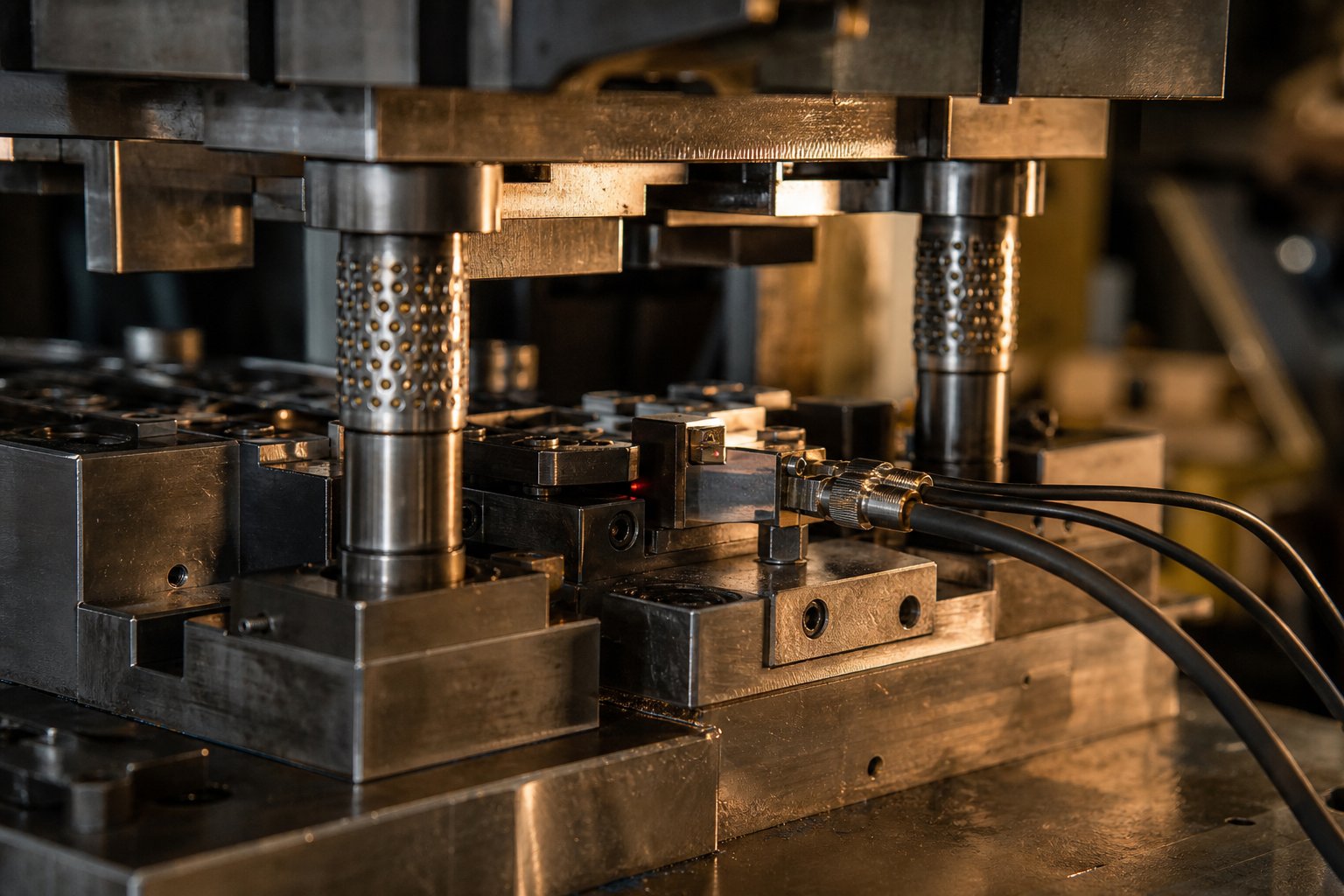
How does it work? Sensors installed directly in the tooling monitor specific conditions every stroke. The most common configurations include:
- Stripper level sensors: Proximity sensors mounted at the corners of the lower die monitor whether the stripper plate closes to its expected depth. If a pulled slug lands on the strip surface, it prevents the stripper from reaching full travel - and the sensor stops the press within one stroke. On materials thinner than 0.010 inches, analog sensors measure stripper depth to within +/- 0.0005 inches.
- Hole presence detection: Springback probes or optical sensors verify that punched holes exist at each station. A missing hole typically means a broken punch - catching it immediately prevents downstream damage and scrap accumulation.
- Force monitoring: Miniature load cells built into specific punch holders detect force changes that indicate dulling, chipping, or material variation. Any significant force shift signals that part quality is at risk.
- Feature presence verification: Digital sensors confirm that assembled components - a pressed nut, a bowl-fed insert, or a secondary strip - are correctly positioned. This is especially valuable in tooling that incorporates in-die assembly operations, where missing components would produce non-functional parts.
Advanced systems go beyond simple stop/start logic. Closed-loop configurations use analog sensors to measure bend angles or material thickness in real time, then command servomotors to adjust forming stations between strokes. The die self-corrects without stopping the press. This level of control matters most in precision die stamping for tight-tolerance, high-margin components - and it is a strong signal of supplier sophistication during evaluation.
When touring a supplier's facility, look for the physical evidence: umbilical connectors linking tooling to press controls, sensor junction boxes with military-spec connectors, and a dedicated sensor lab where technicians map sensor fields before dies are even built. Shops running a progressive stamping press without visible sensor infrastructure are relying on operator vigilance alone - a risky proposition on unattended high speed stamping lines running hundreds of strokes per minute.
Common Failure Modes and How to Prevent Them
Progressive die failures rarely arrive as a single catastrophic event. Most problems develop gradually through wear accumulation, strip instability, and lubrication inconsistency during continuous production. Understanding these failure modes helps you evaluate whether a supplier's maintenance practices are proactive or reactive.
The table below maps the most common progressive die failure modes to their root causes and the prevention strategies a well-run operation should have in place:
| Failure Mode | Root Cause | Prevention Method |
|---|---|---|
| Burr formation | Worn cutting edges, improper punch-to-die clearance, insufficient lubrication | Stroke-count-based sharpening schedules, carbide inserts in high-wear stations, proper clearance design (typically 5-10% of material thickness per side) |
| Slug pulling | Vacuum between punch and scrap, punch surface wear, excessive stripping resistance | Air blow systems, spring ejectors, vacuum relief geometry, stripper-level sensor monitoring |
| Material thinning in draw stations | Excessive draw depth, inadequate lubrication, improper blank holder force | Multi-stage draw sequencing, draw bead optimization, force monitoring with predictive adjustment |
| Dimensional drift | Pilot pin wear, feed system inconsistency, thermal expansion during long runs | Pilot clearance inspection at scheduled intervals, servo feeder calibration, SPC trending with control limits |
| Punch breakage | Undersized punch relative to material thickness, lateral loading from strip misalignment | Guided stripper systems, reinforced punch designs, optical sensors verifying punch tip presence each stroke |
| Strip misfeed | Feeder release timing errors, worn guide rails, coil set not fully straightened | Feed-progression sensors (pilot engagement verification), guided strip lifters, straightener calibration checks |
Notice how interconnected these failures are. Punch wear increases burr height, which raises stripping resistance, which causes slugs to adhere during withdrawal - a single root cause cascading through multiple symptoms. Suppliers who track only the visible symptom (burrs) without addressing the upstream cause (punch condition) are fighting an endless loop of reactive maintenance.
Preventive sharpening programs based on actual stroke count rather than visual inspection alone represent best practice. High speed stamping of stainless steel, for example, demands more frequent sharpening intervals than softer materials like copper or aluminum. A supplier who can tell you their sharpening thresholds for your specific material and geometry demonstrates genuine process control - not just equipment ownership.
SPC and Inspection Methods for Stamped Parts
Statistical process control bridges the gap between in-die sensing (which catches immediate catastrophic events) and final inspection (which catches defects after the fact). SPC monitors dimensional trends across production runs, flagging when a process is drifting toward a control limit before parts actually go out of spec.
For a die stamping press producing tens of thousands of parts per shift, spot-checking every hundredth part is necessary but insufficient. SPC adds mathematical structure to that sampling. Operators measure critical dimensions - hole positions, bend angles, overall profiles - and plot them on control charts. Western Electric rules flag patterns that indicate a process shifting even when individual readings remain within tolerance.
Predictive SPC takes this further. By feeding tonnage signatures, die temperature readings, and lubrication pressure data into AI models, modern systems detect drift 2 to 6 hours before a bad part reaches the conveyor. A Tier 1 automotive supplier using this approach reported 54% reduction in split-related scrap and 61% reduction in wrinkle defects across 14 progressive die lines. That kind of data-driven quality management is increasingly the standard for IATF 16949-certified operations.
Beyond SPC, inspection methods for stamped parts typically include:
- Vision systems: High-speed cameras positioned at die exit verify surface condition, edge quality, and dimensional conformance at full production speed. They catch cosmetic defects and gross dimensional errors that SPC sampling might miss between measurement intervals.
- Optical comparators: Used during setup and periodic checks, these project part silhouettes against tolerance overlays for rapid geometric verification.
- CMM (Coordinate Measuring Machines): Provide the highest accuracy for critical dimensions during first-article inspection and periodic audits, though they are too slow for inline production use.
- Go/no-go gauges: Custom fixtures that verify critical features - hole diameters, tab heights, overall flatness - through pass/fail physical checks at the press.
The red flag here is obvious: a supplier who cannot describe their SPC protocol, show you control charts from recent runs, or explain their sensor infrastructure is likely running on inspection-after-the-fact alone. That approach finds defects. It does not prevent them. And in high precision metal stamping where tolerances are measured in thousandths, finding defects after a 50,000-piece run means sorting or scrapping an entire lot.
Quality systems tell you how a supplier thinks about risk. But the practical questions buyers face next - how long tooling takes to build, which materials run best, and whether a vertically integrated shop delivers faster than one outsourcing die construction - directly determine project timelines and total cost of ownership.
Project Timelines and Material Considerations for Buyers
You can have the most sophisticated quality systems in place, but none of that matters if your tooling takes six months longer than expected or your chosen material wears out punch edges faster than the maintenance schedule accounts for. Lead time and material selection are where procurement teams either build comfortable project buffers or find themselves scrambling to explain delays to production planners.
Tooling Lead Times and What Drives Them
A high-quality progressive die typically requires 12 to 20 weeks to design, machine, heat treat, grind, assemble, and commission. That range exists because complexity varies enormously. A simple 6-station die for a flat bracket with a few holes might land closer to 10 weeks. A 30-station die producing a tight-tolerance connector with drawn features, coined surfaces, and in-die tapping can push past 20 weeks - especially if tool steel availability or heat treatment queues create bottlenecks.
What specifically drives timeline variation?
- Station count: More stations mean more individual components to design, machine, fit, and debug. Each station adds EDM time, grinding passes, and assembly complexity.
- Tolerance requirements: Tighter part tolerances demand tighter die component tolerances, which increases grinding and inspection cycles. Features held to +/- 0.025 mm require significantly more tryout iterations than those at +/- 0.1 mm.
- Material being stamped: Dies running stainless steel or high-strength alloys often need carbide inserts or specialized coatings, adding sourcing and treatment time to the build schedule.
- Design changes after approval: A late-stage revision after machining has started can cost as much as half the original tool price in rework and add weeks to the timeline. Lock your part design before committing capital to steel.
Production run lead times are separate from tooling build. Once a progressive die press is set up and the die is proven, first-article parts typically ship within days. Ongoing production depends on press availability, coil stock lead times, and run quantities - but cycle time itself is rarely the constraint. A die running at 150 strokes per minute produces 9,000 parts per hour. The bottleneck is almost always upstream: tooling readiness, material procurement, or scheduling priority.
Material Selection and Its Impact on Production
Progressive stamping materials directly influence die wear rates, production speeds, and maintenance intervals. Choosing a material is not just about what the finished part needs to do - it shapes how the die performs over hundreds of thousands of strokes. Here is how the most common materials behave in progressive tooling:
- Carbon steel (1008, 1010, 1050): The most forgiving material for progressive stamping. Carbon steel progressive stamping runs at high speeds with relatively low die wear due to the material's softness and ductility. Tooling lasts longest on these grades, and sharpening intervals can stretch further between cycles.
- Stainless steel (301, 304, 316, 410): Harder and more abrasive than carbon steel, stainless steel progressive stamping demands premium tool steels (D2 or M2) or carbide inserts at cutting stations. Press speeds typically drop 20-40% compared to mild steel to manage increased forming forces and heat generation. Lubrication is critical - dry running causes galling almost immediately.
- Aluminum (1100, 3003, 5052, 6061): Soft and highly formable, making aluminum progressive stamping fast and gentle on tooling. The challenge is material handling: aluminum scratches easily and tends to build up on punch surfaces without proper coatings or lubrication. Tonnage requirements are lower, allowing higher stroke rates.
- Copper and brass (C110, C260, C510): Excellent formability with moderate die wear characteristics. High conductivity makes these essential for electrical components. Thin-gauge copper runs at the fastest speeds in high speed progressive die stamping applications - often exceeding 400 strokes per minute for small terminals.
- High-strength low-alloy steel (HSLA) and advanced high-strength steel (AHSS): Common in automotive structural components. These materials require significantly higher press tonnage - sometimes qualifying as heavy stamping applications - and accelerate punch wear due to their hardness. Die stations handling AHSS often incorporate carbide or coated tooling to maintain acceptable service life.
Press tonnage must match material strength, strip width, and the number of simultaneous operations. An undersized press produces inconsistent parts as it struggles to fully form features. An oversized press wastes energy and floor space. High speed metal stamping of thin copper might need only 25 tons, while a wide stainless steel bracket with multiple draw stations could demand 200 tons or more on the same progressive die press.
Vertically Integrated vs. Contract Manufacturers
Where your supplier builds their tooling changes everything about communication speed, troubleshooting responsiveness, and total project timeline.
A vertically integrated progressive die stamping company designs the die, machines the components, assembles and debugs the tool, and runs production - all under one roof. When a problem surfaces during tryout, the toolmaker walks to the press, diagnoses the issue, and modifies the die the same day. Design intent stays intact because the engineers who drew the strip layout are the same people grinding the punches.
Contract manufacturers, by contrast, outsource die construction to a separate tool shop - sometimes overseas. This introduces handoff friction. Engineering changes require formal documentation between companies. Debugging problems means shipping the die to an external facility, waiting for their queue, and hoping the interpretation matches your original intent. Lead times stretch 4 to 8 weeks longer on average because every iteration passes through a communication layer that a vertically integrated operation simply does not have.
The trade-off? Vertically integrated suppliers carry higher overhead, which can reflect in tooling quotes. Contract manufacturers sometimes offer lower initial pricing by leveraging lower-cost external shops. But that price advantage often evaporates when you factor in extended timelines, rework cycles from miscommunication, and the hidden cost of managing two vendor relationships instead of one.
For buyers, the question to ask is direct: do you build your dies in-house, and can I walk the tool room during my facility audit? A yes to both signals a supplier who owns their process end-to-end. A hesitation or redirect to a "tooling partner" signals a different risk profile - not necessarily disqualifying, but worth understanding before you commit purchase orders.
Timelines and material choices define what is possible. The next layer - evaluating whether a supplier actually has the engineering depth, certifications, and equipment to execute on those possibilities - is where buyer due diligence separates smart procurement from expensive surprises.
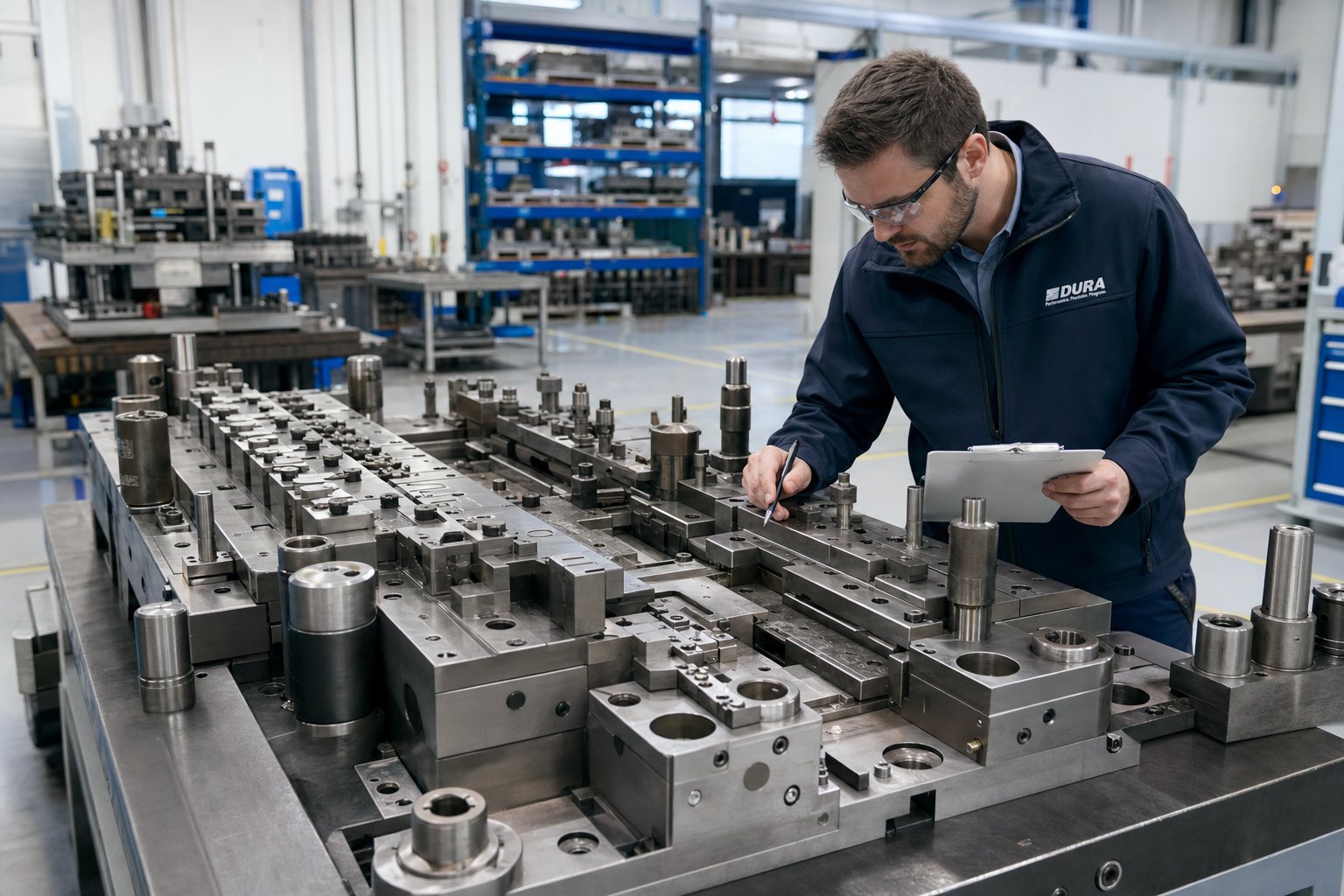
How to Evaluate a Progressive Die Stamping Company
Knowing what materials run best and how long tooling takes to build is useful background. But when you are sitting across the table from progressive die manufacturers competing for your business, you need a structured framework for separating genuine capability from polished sales presentations. The evaluation criteria below give procurement teams and production engineers a repeatable method for grading suppliers before any purchase order is signed.
Certifications and Equipment That Signal Real Capability
Certifications are not just wall decorations. They indicate whether a progressive stamping company has invested in the management systems and process discipline your industry demands. Here is what to look for based on your supply chain:
- ISO 9001:2015 - the baseline. Any stamping die manufacturers worth evaluating should hold this as a minimum. It confirms documented quality processes, risk-based thinking, and performance evaluation systems are in place. If they lack even this, walk away.
- IATF 16949:2016 - mandatory for automotive. This standard adds roughly 100 additional requirements on top of ISO 9001, including PPAP readiness, control plan methodology, and integration of OEM-specific customer requirements. If you are sourcing parts for any Tier 1 or OEM program and the supplier lacks IATF certification, that is a disqualifying red flag.
- AS9100 Rev D - required for aerospace and defense. This certification adds configuration management, first article inspection protocols, and counterfeit-part prevention controls that have no equivalent in automotive standards. It is not interchangeable with IATF 16949 even for suppliers serving both sectors.
Beyond certifications, equipment specs reveal whether a supplier can physically produce your parts. Ask for specifics: press tonnage range (does it cover your material and geometry requirements?), maximum strip width capacity, and speed ratings in strokes per minute. A shop with only light-tonnage presses cannot reliably form stainless steel brackets, and one limited to 60 strokes per minute will struggle with the economics of high-volume terminal production. Metal stamping die manufacturers with genuine depth typically operate presses spanning 25 to 300+ tons across multiple speed ranges.
Equipment age matters too. Presses built in the last decade typically feature servo-driven feeds, integrated tonnage monitors, and programmable shut heights - all of which contribute to tighter process control. Older mechanical presses still produce good parts, but they demand more manual oversight and lack the data output modern quality systems rely on.
Questions to Ask Potential Suppliers
The questions you ask during evaluation reveal more about a supplier's depth than any brochure. Progressive die stampings suppliers with real experience answer these without hesitation. Those who deflect or generalize are signaling gaps they would rather you not probe.
Use this checklist during supplier meetings or facility audits:
- What is your typical station count range? Experienced progressive die manufacturers routinely build dies with 15 to 40+ stations. A shop that caps at 8 to 10 stations may lack the design sophistication for complex parts.
- What is the tightest tolerance you have held in production - not prototype, production? Look for specific numbers (e.g., +/- 0.013 mm on a hole position). Vague answers like "very tight" indicate they have not measured it rigorously.
- What is your longest continuous production run on a single progressive stamping tool? A die that has produced 20 million hits without major rebuild demonstrates both design quality and maintenance discipline. Short run histories suggest either newer tooling or poor die longevity.
- Do you design and build your progressive dies in-house? This is the question that separates true die manufacturers from assemblers who outsource tooling and only run production. In-house design means faster iterations, direct accountability, and engineering teams who understand every detail of your progressive stamping tool from concept through tryout.
- Can you show me a strip layout from a recent project and explain your material utilization percentage? Suppliers with strong DFM capability will show you nesting strategies, scrap rates, and explain how they optimized pitch and web width for cost reduction. If they cannot produce this artifact, they likely lack the engineering depth to optimize your project.
- What does your DFM feedback process look like during quoting? A capable partner challenges your design and suggests improvements - flagging tight tolerances that drive cost without adding function, recommending material alternatives for better formability, or proposing geometry changes that simplify tooling. A supplier who accepts every drawing without comment is not managing your risk. They are ignoring it.
- What is your preventive maintenance protocol for dies in active production? Ask for stroke-count-based sharpening thresholds and spare component strategies. If they run dies until failure rather than maintaining on a schedule, your parts will degrade over time.
One subtle but telling distinction: experienced progressive die manufacturers talk about problems they have solved. They will reference a part that required springback compensation in forming stations, or a material that demanded custom punch coatings after standard tool steel failed prematurely. That problem-solving narrative - specific, data-backed, and honest about challenges - is something no amount of marketing polish can fabricate.
Suppliers who outsource die building are not automatically inferior, but the evaluation shifts. You need to understand who actually designs the tooling, how engineering changes are communicated between organizations, and what happens when a die needs emergency repair at 2 AM on a Friday. The further removed a supplier is from their own tooling, the longer every corrective action takes - and in high-volume production, downtime is measured in dollars per minute.
With a clear framework for grading technical capability, the final step is translating your specific project requirements - volume, material, tolerance, and compliance needs - into a supplier decision that balances capability against cost and timeline realities.
Choosing the Right Partner for Your Progressive Die Stamping Needs
Evaluation frameworks only create value when they translate into a decision. You have the technical knowledge - process mechanics, material behavior, quality benchmarks, and supplier qualification questions. The remaining step is matching those criteria against your specific project requirements and committing to a partner whose proven capabilities align with what your parts actually demand.
Matching Your Requirements to the Right Supplier
No single progressive die stamping company is the best fit for every application. A supplier excelling at high-speed copper terminal production may lack the tonnage or tooling expertise for thick stainless steel structural brackets. A shop certified to IATF 16949 for automotive might not hold the AS9100 registration your aerospace program requires. The goal is alignment - your requirements mapped against demonstrated, verifiable capability.
Before requesting quotes, define your project along these decision factors:
- Annual volume and production life: Are you committing to 50,000 parts per year or 5 million? Higher volumes justify more complex progressive stamping dies with additional stations for tighter tolerances, while moderate volumes might favor simpler tooling with fewer stations.
- Material and gauge: Your material choice narrows the supplier field immediately. Not every shop runs thin copper at 400+ strokes per minute, and not every press handles the tonnage required for AHSS at 2.0 mm thickness.
- Tolerance criticality: Parts with standard commercial tolerances open your options broadly. Features held to +/- 0.013 mm require suppliers with proven SPC data, premium tooling, and press equipment capable of maintaining BDC repeatability stroke after stroke.
- Industry compliance: Automotive, medical, and aerospace each impose certification and documentation requirements that eliminate suppliers who lack the corresponding quality management infrastructure.
- Vertical integration preference: If your project timeline is aggressive or your part geometry requires iterative tryout, a progressive die manufacturer that designs, builds, and runs tooling under one roof eliminates the communication delays that multi-vendor arrangements introduce.
- DFM engagement: For new part designs, you want a supplier whose engineering team provides strip layout optimization, material utilization feedback, and geometry recommendations during quoting - not after tooling is committed.
For production engineers sourcing high-volume metal parts that require efficient multi-station forming, tight repeatability, and scalable mass production, vertically integrated suppliers consistently deliver shorter lead times and more responsive problem resolution. The engineering team that designed your progressive tool and die is the same team debugging it during tryout - no translation layer, no handoff friction, no finger-pointing between separate organizations when something needs adjustment.
Starting Your Progressive Die Stamping Project
Translating requirements into action means engaging suppliers who can demonstrate - not just claim - alignment with your needs. Start by requesting strip layout examples from comparable projects, asking for production data from similar materials and volumes, and scheduling facility walks where you observe their tool room, press floor, and quality lab firsthand.
For teams evaluating suppliers with in-house progressive die design and manufacturing capability, YICHEN's Progressive Stamping Die resources offer a reference point for understanding how vertically integrated die manufacturers structure their progressive die stamping services - from initial DFM consultation through high-volume production. Their focus on progressive stamping dies optimized for mass production efficiency makes them a practical starting point for procurement teams benchmarking supplier capability.
Whatever supplier you engage, the red flags covered throughout this article give you a structured lens for evaluation. A partner who answers your questions with specifics, shows you data from actual production runs, and honestly tells you when your part does not suit their progressive die metal stamping services is a partner worth keeping. The ones who say yes to everything without qualification? Those are the expensive lessons smart buyers learn to avoid.
Progressive Die Stamping Company FAQs
1. What is progressive die stamping and how does it work?
Progressive die stamping feeds a continuous metal strip through a single die containing multiple stations. Each station performs a different operation such as piercing, blanking, bending, or forming. With every press stroke, the strip advances one pitch distance forward, and the finished part separates at the final station. This process produces high-volume precision parts at speeds ranging from 25 to over 1,200 strokes per minute, making it one of the most efficient metal forming methods for repeatable geometries.
2. How long does it take to build a progressive die?
A typical progressive die requires 12 to 20 weeks from design through commissioning. Simple dies with 6 to 8 stations for flat brackets may take closer to 10 weeks, while complex 30-station tools with tight tolerances and drawn features can exceed 20 weeks. Key factors driving timeline include station count, tolerance requirements, material being stamped, and whether the supplier builds tooling in-house or outsources die construction. Vertically integrated manufacturers like YICHEN who design and build progressive stamping dies under one roof typically deliver faster because they eliminate communication delays between separate organizations.
3. What materials can be used in progressive die stamping?
Common materials include carbon steel (1008, 1010, 1050), stainless steel (301, 304, 316), aluminum (1100, 3003, 5052), copper and brass alloys (C110, C260, C510), and high-strength low-alloy steels. Each material impacts die wear rates, production speed, and maintenance intervals differently. Carbon steel is the most forgiving and allows highest speeds, while stainless steel demands premium tool steels and reduced press speeds. Material choice should balance part performance requirements with production economics and die longevity.
4. When should I choose progressive die stamping over transfer or compound die stamping?
Progressive die stamping is ideal when your parts are small to medium in size, require moderate geometric complexity (bends, forms, and pierces in one plane), and demand annual volumes above 100,000 units. Transfer dies work better for larger parts, deep-drawn geometries, or components needing multi-surface forming. Compound dies suit simple flat parts requiring tight concentricity at lower volumes. If your part exceeds available strip widths, needs draws deeper than its diameter, or has annual demand below 5,000 to 10,000 pieces, progressive tooling likely is not cost-justified.
5. What certifications should a progressive die stamping company have?
ISO 9001:2015 is the minimum baseline confirming documented quality processes. Automotive suppliers must hold IATF 16949:2016, which adds roughly 100 additional requirements including PPAP readiness and control plan methodology. Aerospace applications require AS9100 Rev D for configuration management and counterfeit-part prevention. Beyond certifications, evaluate equipment specifications including press tonnage range, maximum strip width, and stroke-per-minute ratings. A supplier lacking the certification your industry demands is a disqualifying red flag regardless of their quoted pricing.


