


Inside the Automobile Stamping Die: One Tool, Thousands of Parts
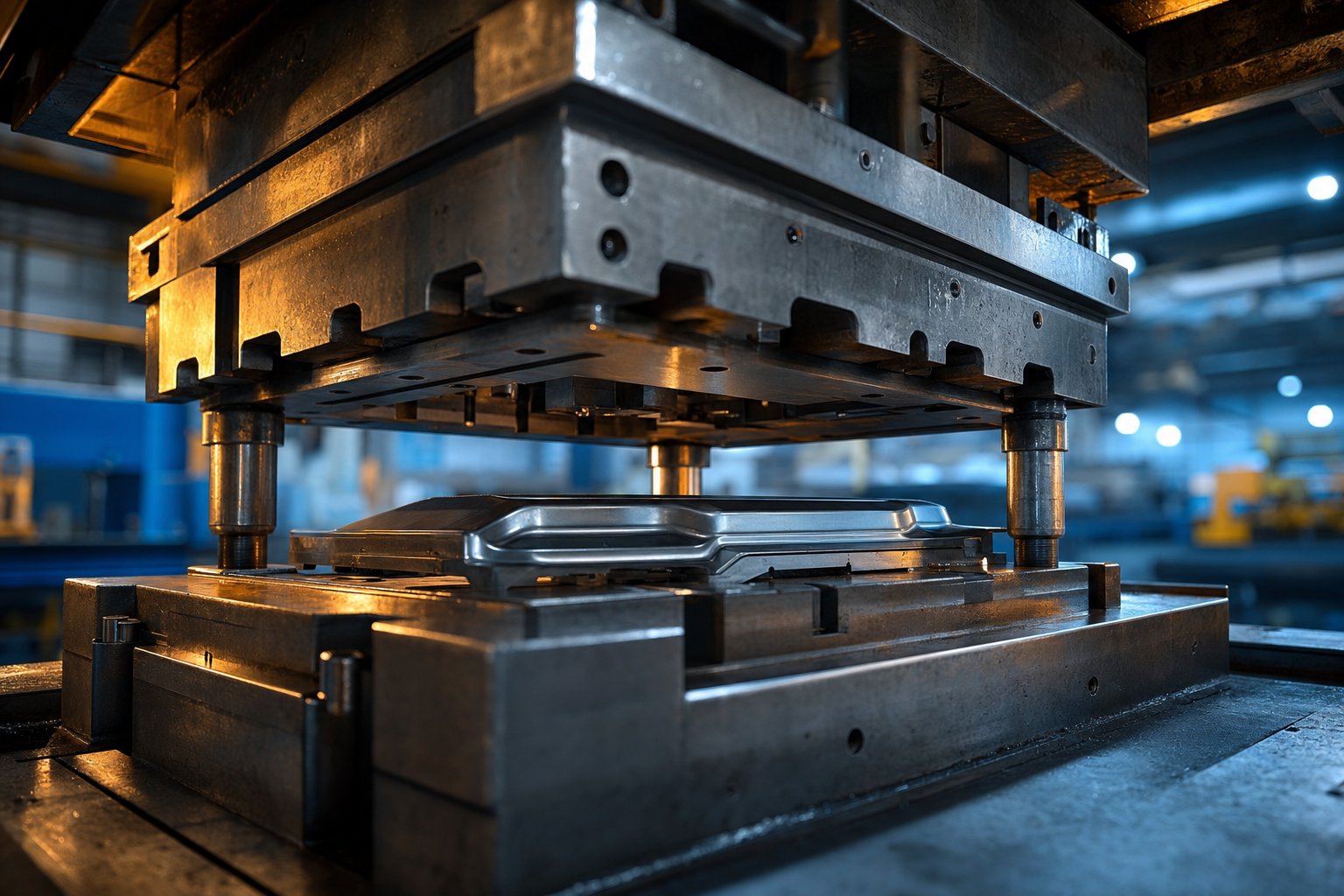
Understanding the Automobile Stamping Die and Its Role in Vehicle Manufacturing
Imagine a single tool producing thousands of identical vehicle parts, day after day, with sub-millimeter precision. That is exactly what an automobile stamping die does. It is the unsung workhorse behind nearly every sheet metal component you see on a modern car, from fenders and door panels to structural reinforcements hidden beneath the surface.
What Is an Automobile Stamping Die
An automobile stamping die is a precision-engineered tool, composed of a matched set of hardened tool steel components, that cuts, bends, draws, or shapes flat sheet metal into three-dimensional vehicle parts under controlled press tonnage.
Picture two halves of a mold clamped into a stamping press. The upper half descends with tremendous force, and the flat metal sheet between them transforms into a complex, contoured component in a fraction of a second. The cutting and forming sections are typically made from special hardenable tool steels, and in high-wear areas, carbide inserts or wear-resistant coatings extend the tool's productive life.
Stamping is a cold-forming operation. No external heat is intentionally applied to the die or sheet material. However, the friction generated during cutting and forming means stamped parts often exit the tooling hot to the touch. This process can cycle at extraordinary speeds, with some dies completing over 1,000 strokes per minute for smaller components.
Why Stamping Dies Matter in Vehicle Production
Automotive stamping dies occupy a critical position in the vehicle manufacturing chain. They sit directly between the stamping press and body-in-white assembly, converting raw coil stock into the precise components that welding robots and adhesive systems join together to form a vehicle's structure and skin.
Why does this matter so much? Because modern vehicles contain hundreds of stamped parts, and every one of them must meet tight dimensional tolerances to ensure proper fit, structural integrity, and crash performance. A single progressive die system can integrate multiple forming operations into one continuous stroke, eliminating handling errors and slashing cycle times for brackets, connectors, and small structural parts. Larger transfer and tandem line dies handle the sweeping body panels and deep-drawn structural members that define a vehicle's shape and strength.
The precision and durability of these dies directly influence cost efficiency, part consistency, and production speed. They enable manufacturers to produce millions of uniform components per year while keeping per-part costs low. As regulatory pressure mounts around fuel efficiency, crash safety, and electrification, automotive stamping dies are evolving rapidly to handle advanced high-strength steels, aluminum alloys, and entirely new component geometries demanded by EV platforms.
This article walks through that full landscape: die types and how to match them to specific components, material selection strategies, the progressive stamping process in detail, how electrification is reshaping die design, the tryout and validation workflow before mass production, failure mode troubleshooting, and what to look for in a die manufacturing partner. Each section builds a practical framework for engineering teams navigating tooling decisions in a fast-changing industry.
Types of Stamping Dies Used in Automotive Production
Not all automotive dies are interchangeable. The geometry of the part, the volume you need, and the material you are stamping all dictate which die architecture makes sense. Choose wrong, and you face inflated tooling costs, excessive scrap, or cycle times that can not keep pace with production targets. So how do engineering teams sort through the options?
Progressive, Transfer, and Tandem Line Dies Explained
Four primary types of stamping dies dominate automotive sheet metal production. Each serves a distinct role in the manufacturing chain.
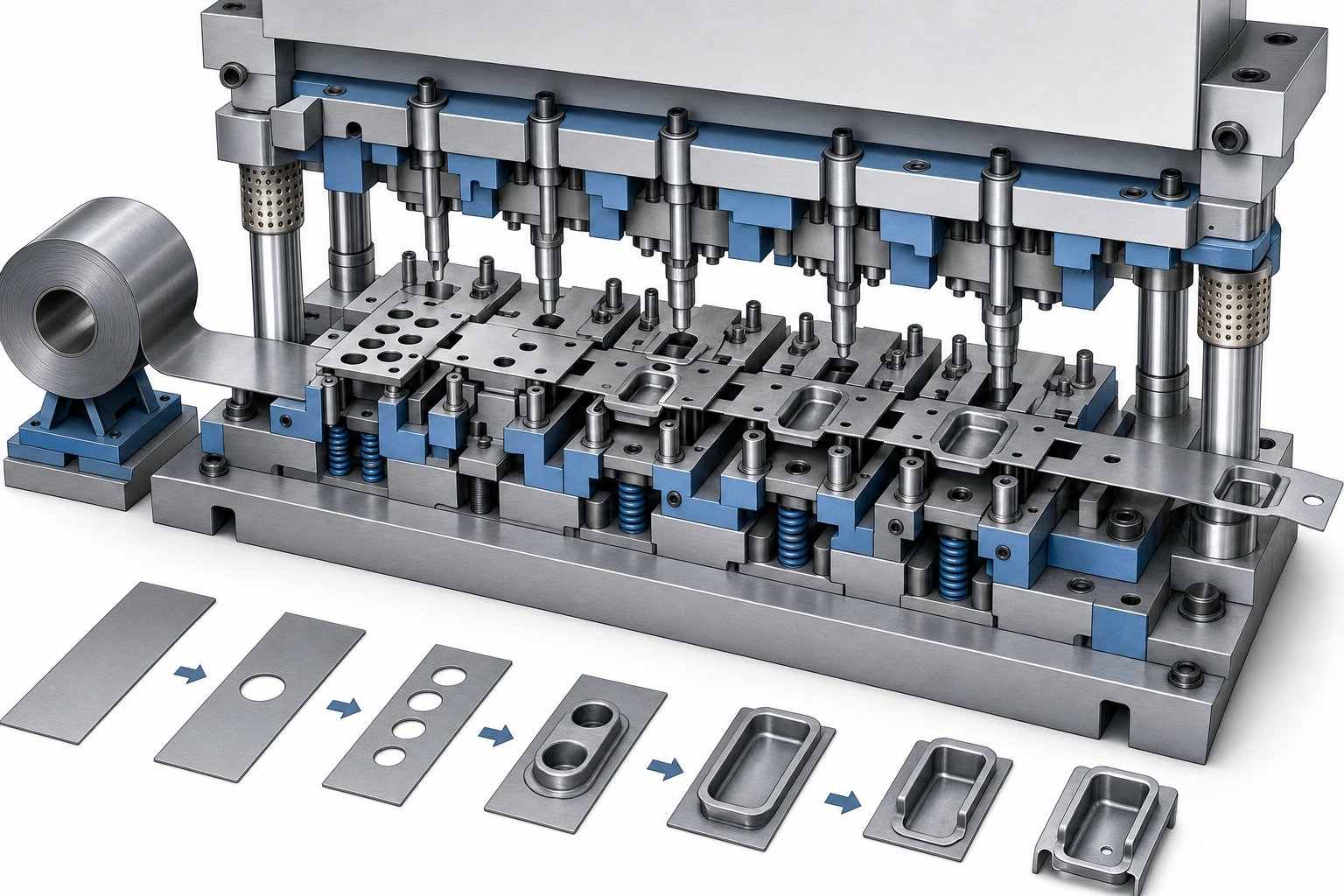
Progressive dies use a continuous metal strip that advances through multiple stations within a single die set. Each station performs one operation, such as piercing, bending, coining, or trimming, and a finished part drops off at the final cutoff station. Progressive dies excel at high-speed production of smaller components, often cycling at 30 to 60 or more strokes per minute. You will find them producing seat belt brackets, mounting clips, electrical housings, and small structural reinforcements.
Transfer dies arrange multiple independent die stations on a single large-tonnage press. Individual blanks, rather than a connected strip, move between stations via mechanical feeding bars or robotic arms. This setup handles medium-to-large structural parts that are too complex or too big for progressive tooling. Typical products include structural cross members, suspension components, reinforcement panels, and beam-like parts with complex shapes.
Tandem line dies take flexibility further. Multiple presses are arranged in sequence, each containing a single-operation die. Robotic arms load, transfer, and unload parts between presses. Tandem lines are the standard choice for large exterior body panels such as hoods, doors, roof panels, and fenders, where each forming stage requires independent press tonnage and process control.
Compound dies perform two or more cutting operations in a single press stroke, commonly blanking and piercing simultaneously. They occupy a niche for medium-complexity flat components where concentricity and edge alignment are critical. In automotive contexts, you will see them producing reinforcement plates and simple brackets where speed and positional accuracy matter more than deep forming capability.
Matching Die Type to Automotive Component Geometry
Choosing between a transfer die vs progressive die in automotive applications comes down to part size, forming complexity, and annual volume requirements. A bracket stamped at 500,000 units per year justifies progressive tooling. A deep-drawn structural housing produced at 150,000 units suits a transfer setup. A Class A exterior panel with tight surface quality standards belongs on a tandem line.
The table below frames this as a decision-support tool, comparing the four major types of stamping dies across the parameters that matter most to automotive program planners.
| Die Type | Typical Automotive Parts | Material Thickness Range | Production Volume Suitability | Relative Tooling Cost |
|---|---|---|---|---|
| Progressive Die | Brackets, clips, small reinforcements, electrical housings | 0.3 mm - 3.2 mm | High (300K+ units/year) | Moderate |
| Transfer Die | Structural cross members, suspension parts, large reinforcements | 0.8 mm - 6.0 mm | Medium to High (100K - 500K units/year) | High |
| Tandem Line Die | Hoods, doors, fenders, roof panels, large body sides | 0.6 mm - 2.0 mm | Medium (50K - 300K units/year) | Low per die, High overall (multiple presses) |
| Compound Die | Reinforcement plates, simple pierced brackets, flat structural elements | 0.5 mm - 4.0 mm | Medium to High (100K+ units/year) | Low to Moderate |
Notice the tradeoffs. Progressive dies deliver the lowest per-part cost at high volumes but cannot handle large panel geometry. Tandem lines offer the highest flexibility and independent process control for each stage, yet they require significant floor space and robotic integration. Transfer systems split the difference, handling complex geometry at reasonable speed without needing multiple press machines.
The right choice also depends on material behavior. Advanced high-strength steels and aluminum alloys complicate forming operations, sometimes pushing parts that would normally suit progressive tooling into transfer setups where each station can be independently tuned. That interplay between die type and material properties shapes every tooling investment decision in the automotive space.
Stamping Die Material Selection and Construction
Die type determines the process architecture, but what the die is made from determines how long it lasts, how good the parts look, and what your cost per hit actually becomes. A progressive die running at 40 strokes per minute will see millions of impacts over its lifespan. If the tool steel cannot handle that abuse, you are looking at premature wear, unplanned downtime, and scrap parts that never reach assembly.
Tool Steel Grades and Carbide Inserts for Automotive Dies
Three tool steel families dominate automotive stamping die construction, each engineered for a different balance of hardness, toughness, and wear resistance.
AISI D2 is the classic cold work steel for blanking and piercing operations. Hardened to 58-62 HRC, it delivers excellent abrasive wear resistance thanks to its high chromium and carbon content. D2 excels in cutting stations where edge retention matters most. The tradeoff? It is relatively brittle, making it vulnerable to chipping under severe shock loads.
AISI A2 offers a middle ground, balancing moderate wear resistance with better toughness than D2. It is air-hardening, which reduces distortion during heat treatment, and works well for forming operations with medium production volumes. Engineering teams often specify A2 for trimming and flanging stations where some impact resistance is needed alongside decent tool life.
AISI S7 prioritizes shock resistance above all else. Hardened to 54-58 HRC, it absorbs sudden loads without cracking, making it ideal for heavy forming and drawing operations where the die endures significant mechanical stress each cycle. Complex structural part dies frequently rely on S7 in high-impact zones.
For stations experiencing extreme abrasive wear, carbide inserts extend die life by 500-1000% compared to conventional tool steels. These tungsten carbide components are brazed or mechanically fastened into the die body at localized high-wear areas, such as cutting edges and draw radii. Their brittleness limits use to low-impact zones, but the payoff in reduced maintenance intervals is substantial for high-volume automotive programs.
Powder metallurgy (PM) tool steels represent a newer tier. Their manufacturing process produces finer, more evenly distributed carbides than conventional ingot metallurgy, delivering a near 10x improvement in impact toughness at equivalent hardness. When standard D2 tools failed after only 5,000-7,000 cycles forming a 580 MPa ferrite-bainite steel, switching to a PM grade restored tool life to 40,000-50,000 cycles.
Specialized coatings further enhance performance regardless of base steel grade:
- TiN (Titanium Nitride): General-purpose coating that reduces friction and extends tool life by 30-50% in many applications
- TiCN (Titanium Carbonitride): Higher hardness than TiN, suited for cutting and piercing AHSS grades
- CrN (Chromium Nitride): Effective against galling when forming galvanized steels, where PVD coatings like TiAlN may cause zinc buildup
- TiAlN (Titanium Aluminum Nitride): Excellent for uncoated advanced high-strength steels, producing cleaner cut edges even after 200,000+ parts
The application method matters too. PVD coatings bond at lower temperatures, preserving die hardness without risk of dimensional distortion. CVD and thermal diffusion processes create stronger metallurgical bonds but require temperatures around 1000 degrees C, potentially softening the substrate and necessitating rehardening. Several global automakers now specify PVD-only coatings for this reason.
Class A Surface Dies vs Structural Component Dies
Not every stamping die demands the same construction philosophy. The distinction between Class A surface dies and structural component dies shapes every material and finishing decision.
Class A surface dies produce exterior body panels: doors, hoods, fenders, and roof skins. These parts receive a painted clearcoat finish, which means any surface imperfection on the die transfers directly to the panel and becomes visible to consumers. Toolmakers hand-grind and polish these dies to surface finishes of Ra 0.2-0.4 micrometers or better, using progressively finer stones and polishing papers. Even a defect as small as a human hair falling into a Class A die will leave a visible mark on the stamped panel. The tool steels and surface treatments chosen here prioritize surface integrity, lubricity, and resistance to material pickup over raw wear resistance.
Structural component dies prioritize dimensional accuracy and springback control. Interior reinforcements, B-pillars, and chassis members do not require mirror finishes, but they must hold tight GD&T tolerances across millions of cycles. Here, die material selection focuses on compressive strength and fatigue life, with harder tool steels and aggressive coatings acceptable because cosmetic surface quality is secondary.
When selecting die materials for any automotive program, engineers weigh several interacting factors:
- Production volume: Short runs under 100,000 parts can use A2; volumes above 1,000,000 justify carbide inserts or PM steels
- Sheet metal being stamped: AHSS grades with tensile strengths above 980 MPa approach the hardness of the tooling itself, demanding harder substrates and mandatory coatings
- Draw depth and forming severity: Deep draws increase contact pressure and heat, accelerating wear and galling risk
- Surface finish requirements: Class A panels need highly polished die surfaces with low-friction coatings; structural parts tolerate more utilitarian finishes
AHSS and aluminum alloys deserve special attention in stamping die material selection. Dual phase and martensitic steels can reach hardness values four to five times higher than mild steel, and some martensitic grades exceed 57 HRC. At that level, the sheet metal hardness approaches the die itself. Standard uncoated D2 is insufficient; PVD-coated or ion-nitrided substrates become necessary to maintain acceptable tool life.
Aluminum presents a different challenge. Rather than abrasive wear, aluminum tends toward adhesive wear and galling, micro-welding itself to the die surface under friction and heat. Highly polished surfaces with low-friction coatings combat this tendency. The right combination of substrate hardening plus surface treatment can mean the difference between a die lasting 50,000 parts and one producing over 1.2 million.
Material choice is only the starting point. How the die performs in practice depends equally on what happens during tryout and validation, where simulation predictions meet physical reality and iterative adjustments bring the tool to production readiness.
The Progressive Die Stamping Process for Automotive Components
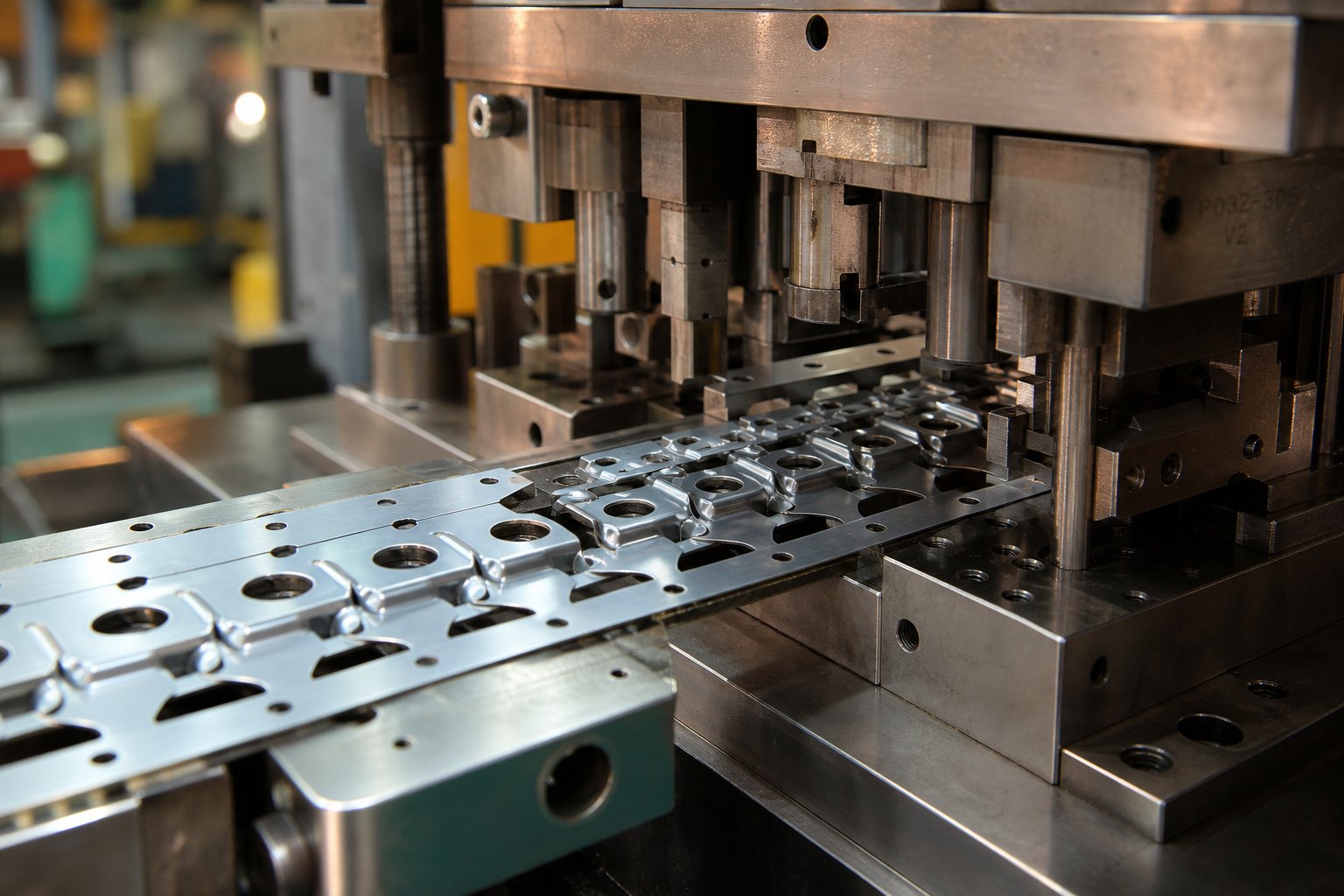
Knowing what a die is made from only tells half the story. The real magic of high-volume automotive components progressive stamping lies in how the process choreographs dozens of operations into a single, continuous flow. With presses cycling at 25 to 200 strokes per minute or more, a progressive die produces a finished part with every stroke once the strip is fully loaded. That speed and repeatability make it the dominant manufacturing method for small-to-medium automotive parts produced in the millions.
How the Progressive Die Stamping Process Works Station by Station
Imagine a coil of sheet metal unrolling into a stamping press. The strip advances at a precise increment, called the die pitch, and each station it passes through performs exactly one operation. By the time the strip reaches the final station, a fully formed part separates and drops into a collection bin. Here is the progressive die stamping process broken into its sequential stages:
- Coil feed and straightening: The metal coil feeds through a straightener to remove residual curvature, then into a servo feeder that advances the strip at the exact pitch distance with every press stroke.
- Pilot hole piercing: The first station punches pilot holes into the carrier strip. These small holes serve as precision registration points for every subsequent station.
- Pilot pin engagement: As the strip advances, hardened pilot pins in each downstream station enter the pilot holes, correcting any minor feeding inaccuracy and locking the strip in position before the press closes.
- Piercing and blanking: Cutting stations punch interior holes, slots, and partial blank outlines needed for the final part geometry.
- Forming and drawing: Bending, drawing, and coining stations shape the flat blank into a three-dimensional component. Each forming step is incremental, distributing strain across multiple stations rather than forcing the material in a single hit.
- Coining and embossing: Stations apply localized high pressure to achieve tight tolerances on critical features such as bearing surfaces or locating tabs.
- Final trim and cutoff: The last station severs the finished part from the carrier strip. The remaining skeleton scrap exits the die for recycling.
Each station is mechanically synchronized to the press stroke, so the entire sequence happens simultaneously across the loaded strip. One part exits while the next six or seven are mid-process in upstream stations.
Strip Layout Optimization for Automotive Parts
Progressive die strip layout design is where cost control begins. The layout is essentially the blueprint that dictates how the part is oriented, spaced, and connected on the metal strip. A well-optimized layout targets over 75% material utilization, meaning less than a quarter of the coil stock becomes scrap. When you are stamping millions of brackets or reinforcements per year, even a 2-3% improvement in utilization translates into significant raw material savings.
Several layout strategies exist to maximize efficiency:
- Single row, one pass: Parts in a straight line along the strip. Simple die design but often lower material yield.
- Angular pass (nesting): Parts tilted at an angle so they interlock like puzzle pieces, recovering material that would otherwise be skeleton scrap.
- Multi-row layouts: Two or more parts produced side by side from a wider coil, increasing throughput per stroke.
Critical to any layout is the carrier strip, the skeleton framework that holds parts together as they advance through the die. Carrier design must balance two competing demands: enough rigidity to push the strip reliably through every station without buckling, and enough flexibility to accommodate vertical movement when forming stations draw material downward. Engineers use solid carriers for flat parts with simple bends, and stretch web carriers with strategic relief cuts for parts requiring deep draws or complex vertical forming.
The bridge, a thin section of material between adjacent parts and between parts and the strip edge, maintains structural integrity. A common engineering rule sets minimum bridge thickness at 1.25 to 1.5 times the material thickness, keeping the carrier stable without wasting excess material.
Pilot pin location within the carrier is equally critical. Pins must engage clean, round holes punched in early stations, and those holes need to be positioned on stable sections of the carrier that will not deform during downstream forming. Misalignment here cascades through every subsequent station, producing out-of-tolerance parts.
Simulation software has transformed how engineers approach both strip layout and process validation. Modern CAE platforms allow designers to model the entire stamping sequence virtually, stroke by stroke, predicting material flow, thinning, and potential defects like splits or wrinkles before any steel is cut. Virtual tryout using forming limit diagrams and thickness plots identifies problem areas early, allowing modifications to part geometry, draw bead placement, or station sequence without expensive physical iteration. This predict-and-optimize approach can eliminate 80-90% of traditional tryout time, because the diemaker already knows the tool will produce a good part when it first hits the press.
Carrier web stretching is also simulated. Engineers model how the web deforms during forming stations, verifying that pilot holes remain stable and that the carrier maintains enough strength to advance the strip the full length of the tool. Without this step, a carrier that works for two or three test parts might fail catastrophically during sustained production runs.
For automotive programs producing millions of identical parts, the progressive die stamping process delivers an unmatched combination of speed, consistency, and cost efficiency. But the tool itself is only production-ready after it survives a rigorous tryout and validation sequence, where virtual predictions meet physical sheet metal and the iterative process of dialing in tolerances begins.
How Electrification and Lightweighting Are Changing Stamping Dies for Electric Vehicles
Every progressive die, transfer system, and tandem line discussed so far was developed in an era dominated by mild steel body panels and internal combustion architectures. That era is ending. Electric vehicle platforms demand fundamentally different sheet metal components, different materials, and as a result, different die engineering. The battery pack alone, which typically represents 20 to 25% of an EV's total weight, introduces stamped components with no precedent in conventional vehicle design. For die engineers, this shift is not incremental. It rewrites the rules around tonnage, coating strategy, and springback compensation.
EV Battery Enclosure and Structural Die Requirements
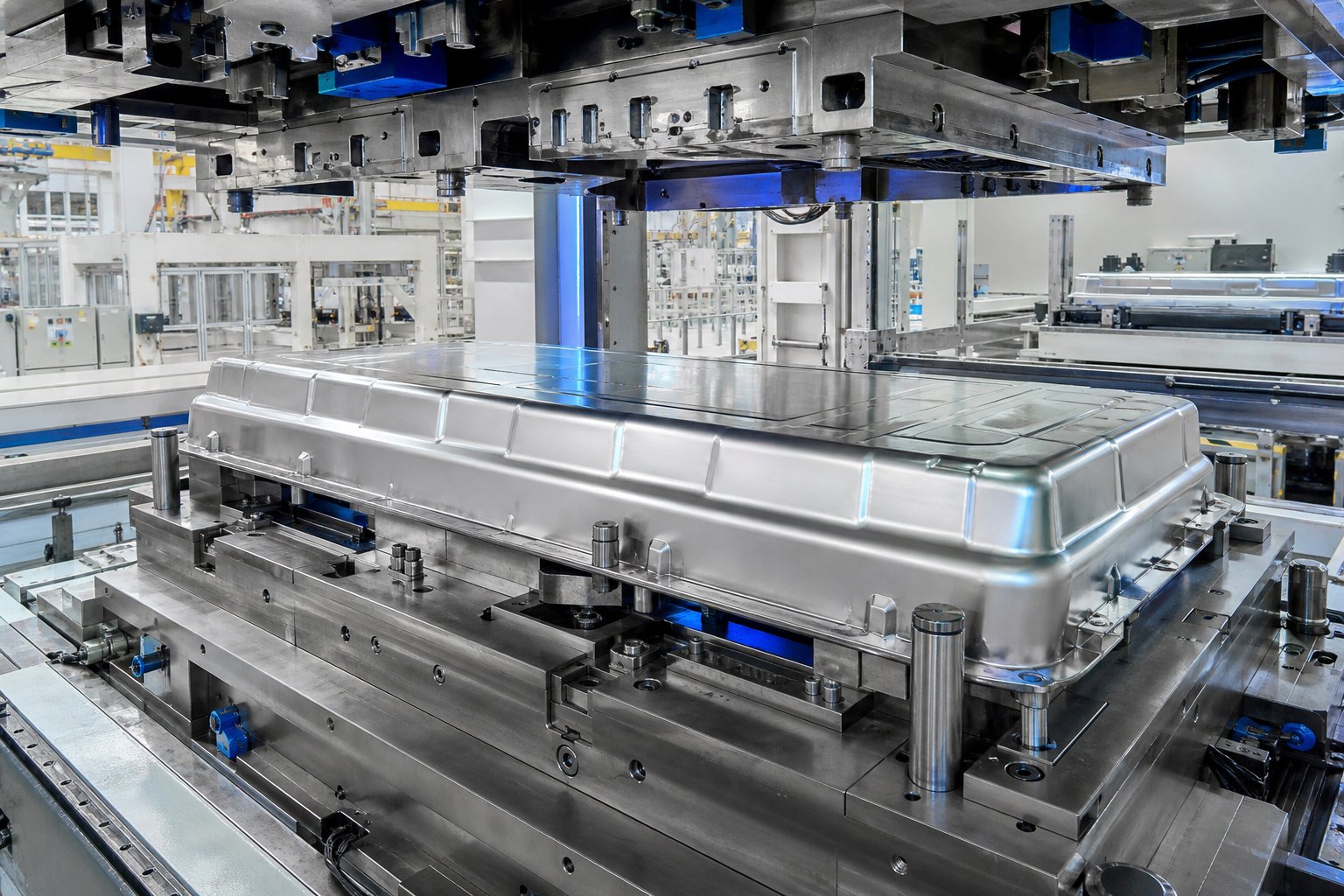
Picture the underside of an electric vehicle. Where a traditional car has a transmission tunnel and exhaust routing, an EV carries a flat, skateboard-style battery enclosure spanning nearly the full wheelbase. Stamping this enclosure from sheet metal creates some of the largest and deepest drawn panels in automotive production.
Battery trays demand large-format dies capable of forming panels that can exceed 2 meters in length. The depth of draw is severe because the enclosure must house battery modules while maintaining structural rigidity for crash protection. Material selection compounds the challenge. Aluminum alloys (5000 and 6000 series) are popular for their weight savings, but their tendency toward galling and springback makes die design significantly more complex than equivalent mild steel components.
Steel-based solutions are evolving rapidly as well. Cleveland-Cliffs and AutoForm demonstrated a one-piece stamped battery tray using a tailor-welded blank (TWB) that combines advanced high-strength steel for underfloor impact protection with lower-strength, more formable steel in areas requiring severe deformation. Their initial design placed AHSS (M1500 or M1700 grade) in the flat bottom and mild steel in the corners and sidewalls, creating a hashtag-shaped configuration that minimized weld-line movement during stamping. Simulation and physical trials confirmed the resulting tray met flange flatness requirements of no more than plus or minus 1.5 mm variation, with no splits or wrinkles, all formed in a single press hit.
This approach eliminates the need for extra under-battery floor protection and reduces part count compared to multi-piece aluminum extrusion assemblies. But the die itself must manage the wildly different forming behaviors of two steel grades within one tool. Draw beads need localized tuning, blank holder pressure zones become material-specific, and springback compensation must account for the differential recovery between AHSS and mild steel sections.
Beyond the battery tray, EV-specific structural components include motor mounts, front and rear subframe reinforcements designed around electric drive units, and crash structures engineered to protect high-voltage systems. Each introduces geometries that conventional ICE-era dies never encountered, with packaging constraints driven by battery module placement rather than engine and drivetrain routing.
Designing Dies for Advanced High-Strength Steel and Aluminum
Mixed-material body strategies are now standard across EV programs. A single vehicle platform might use ultra-high-strength press-hardened steel for the safety cage, dual phase or TRIP steels for structural reinforcements, and aluminum for closures and battery housings. Each material imposes distinct demands on the sheet metal stamping dies that form it.
Sounds complex? It is. AHSS grades with tensile strengths above 980 MPa can reach hardness values four to five times higher than mild steel, with some martensitic grades exceeding 57 HRC. At that level, the sheet metal approaches the hardness of the die itself. Standard tooling strategies collapse under these conditions. D2 tool steel that lasted 50,000 cycles on mild steel may fail catastrophically after 5,000 to 7,000 cycles on a 580 MPa ferrite-bainite grade, let alone a 1180 MPa dual phase steel.
Higher-strength materials also demand greater press tonnage, sometimes two to four times what mild steel requires for equivalent part geometry. This increased force cascades through the entire die system: heavier die shoes, stiffer guideposts, reinforced press bolsters, and modified draw bead designs that control material flow without cracking the sheet. The reduced thickness enabled by AHSS paradoxically increases wrinkling tendency, requiring higher blankholder forces that further accelerate wear on draw radii and binder surfaces.
Aluminum stamping die design presents an entirely different failure mode. Rather than abrasive wear from hard sheet surfaces, aluminum adheres to the tooling through micro-welding at friction-heated contact points. This galling mechanism builds up progressively, with transferred aluminum particles scoring subsequent panels and degrading surface quality. Die surfaces must be polished to extremely low roughness values (below Ra 0.2 micrometers) and protected with low-friction coatings optimized for aluminum's adhesive behavior.
The table below compares how these material shifts translate into concrete die engineering differences:
| Parameter | Traditional Mild Steel | AHSS (DP/TRIP 780-1180 MPa) | Aluminum (5000/6000 Series) |
|---|---|---|---|
| Tonnage Multiplier (vs. mild steel baseline) | 1x | 2x - 4x | 0.6x - 0.8x |
| Primary Wear Mechanism | Abrasive wear | Abrasive + adhesive wear, chipping | Adhesive wear / galling |
| Die Coating Requirement | Optional (chrome plating common) | Mandatory (PVD TiAlN or ion nitriding) | Mandatory (low-friction PVD, DLC, or polished CrN) |
| Recommended Tool Steel | D2, cast iron inserts | PM tool steels, carbide inserts at high-wear zones | Polished D2 or A2 with specialized coatings |
| Springback Compensation Strategy | Minimal overbend (1-3 degrees) | Aggressive overbend (5-10+ degrees), multi-step forming, simulation-driven compensation | Moderate overbend, stress relief features, age-hardening consideration |
| Draw Bead Design | Standard round beads | Modified geometry, higher restraining force, risk of edge cracking | Shallow beads, polished surfaces, controlled lubrication zones |
| Surface Finish Sensitivity | Moderate | Low (structural parts dominant) | Very high (galling prevention + Class A panels) |
Notice the divergence in strategy. AHSS demands brute-force toughness from the die substrate, with coatings serving primarily as wear barriers against a sheet material that is nearly as hard as the tool. Aluminum demands finesse, with mirror-polished surfaces and friction-minimizing coatings that prevent the softer sheet from bonding to the die face. A single EV body-in-white program may require both strategies deployed across different die sets, sometimes within different stations of the same transfer die.
Simulation plays an outsized role in aluminum stamping die design and AHSS die engineering alike. The severe springback observed in high-strength steel battery trays, where initial TWB designs produced twisting that violated the 1.5 mm flatness requirement for leak-tight flanges, was identified and resolved through iterative AutoForm simulation before physical prototyping confirmed the fix. Virtual tryout is no longer optional for these materials. It is the only economically viable way to converge on a working die design when physical iteration on a 2-meter-long deep-draw tool costs weeks and hundreds of thousands of dollars per loop.
These material and geometry challenges do not end at die design. They carry directly into tryout, where simulation predictions meet real sheet metal behavior, and the iterative process of validating dimensional accuracy, surface quality, and structural performance determines whether a die is truly production-ready.
Die Tryout and Validation Before Mass Production
A stamping tool and die can look flawless on the shop floor and still produce panels riddled with splits, wrinkles, or dimensional deviations that no assembly plant will accept. The gap between a freshly machined die and a production-approved tool is bridged by tryout, a rigorous, iterative validation sequence that typically consumes 30% of the total tooling cost and roughly 40% of the total engineering timeline. Skip or rush this phase, and quality problems migrate downstream to body-in-white assembly where they become exponentially more expensive to fix.
So what actually happens between the moment a die leaves the machining center and the day it runs at full production speed? The stamping die tryout process follows a structured sequence of physical checks, measurement loops, and iterative corrections, all governed by OEM-specific acceptance standards.
Die Tryout Stages from Spotting to OEM Approval
Every automobile stamping die passes through the same fundamental validation phases, though the depth and rigor of each stage scales with part criticality. A Class A exterior panel die will spend months in tryout. A simple bracket die might clear in days. Here is the sequential workflow:
- Die spotting: The die surfaces are checked for proper contact distribution before any parts are stamped. A clean blank is placed between the upper and lower die halves, painted with blue layout dye. The press closes, and the dye transfer pattern reveals where contact occurs and where gaps remain. Toolmakers hand-grind high spots, removing as little as 0.05 mm at a time, then re-check. This cycle repeats until a minimum of 80% contact area is achieved across the spotted zones. For a full die set of four operations, spotting alone can require four to five months of meticulous manual work.
- Initial tryout on production-intent press: The die is installed on a press that matches or closely replicates the tonnage, speed, and cushion characteristics of the production press line. First panels are stamped at reduced speed, and engineers visually inspect for gross defects: cracks, severe wrinkling, or material flow problems.
- Panel measurement and GD&T verification: Stamped panels are placed on a checking fixture and measured against the geometric dimensioning and tolerancing (GD&T) callouts defined by the OEM. Critical datums, hole positions, flange angles, and profile tolerances are verified using coordinate measuring machines (CMMs) or portable measurement arms.
- Blue-light or white-light scanning: Full-surface 3D scanning captures millions of data points across the stamped panel, generating a digital twin that is overlaid against the CAD nominal geometry. Color deviation maps instantly reveal areas exceeding tolerance, showing engineers exactly where the die needs correction.
- Engineering change iterations: Based on measurement data, die engineers modify tool surfaces, adjust draw beads, add or remove material from forming radii, or re-machine trim steels. Each modification triggers another tryout loop: stamp panels, measure, compare to tolerance, adjust again.
- OEM panel approval and die buy-off: The customer's quality team inspects final sample panels against appearance standards, dimensional specifications, and functional assembly checks. For exterior panels, visual inspections under controlled lighting (oil-stoning or highlight checking) reveal surface imperfections invisible to measurement equipment. Only after all criteria are met does the OEM issue formal die acceptance.
The number of iteration loops varies. Simple structural parts may require two or three rounds. Complex Class A panels with tight springback and surface requirements can cycle through ten or more correction rounds before buy-off.
Simulation-to-Physical Validation Workflow
Virtual tryout using forming simulation software has fundamentally changed how engineers approach die validation and approval in automotive programs. Before any steel is cut, finite element analysis predicts material flow, thinning distributions, wrinkling risk zones, and springback magnitude across the entire forming sequence. These predictions guide initial die surface compensation, draw bead placement, and blank holder pressure settings.
But simulation does not eliminate physical tryout. It compresses it. Virtual die tryouts identify and resolve the majority of forming issues digitally, so the physical die arrives at the press already close to production quality. Instead of discovering a split on the first hit and spending weeks troubleshooting, engineers already know where the material is thinning and have pre-compensated accordingly. The physical tryout then serves as confirmation rather than exploration.
Where discrepancies appear between simulation predictions and physical outcomes, engineers investigate root causes: material property variation between the simulation input and the actual coil, press deflection under load that the simulation did not capture, or friction conditions that differ from the modeled coefficient. Each discrepancy feeds back into the simulation model, improving accuracy for the next program.
The relationship works both ways. Physical tryout data, particularly blue-light scan results overlaid against simulation predictions, validates the forming simulation's accuracy. OEMs increasingly require this correlation as part of their die validation and approval automotive standards. If your simulation predicted plus or minus 0.5 mm springback and the physical panel shows plus or minus 2.0 mm, the toolmaker must demonstrate root cause understanding before the OEM will accept the correction path.
Common issues discovered during tryout fall into predictable categories:
- Splits: Material thinning beyond the forming limit, typically at tight radii or where draw depth exceeds material ductility. Corrective actions include increasing radii, adding draw beads to redirect material flow, or modifying blank shape.
- Wrinkles: Insufficient restraining force in the binder area or excessive material compression. Solutions range from increasing blank holder pressure to adding lock beads or modifying binder geometry.
- Springback deviation: Elastic recovery after the press opens drives the panel out of tolerance. Correction involves re-machining die surfaces to over-compensate, sometimes requiring multiple iterations as each change shifts the springback pattern elsewhere on the panel.
- Surface defects: Imperfections visible only under controlled lighting, including sink marks over reinforcement ribs, die marks from incomplete spotting, or sliding marks from improper material flow. Resolving these on Class A dies demands extremely precise local grinding and re-polishing.
Each corrective action follows the same loop: modify the die, stamp new panels, measure, compare. It is painstaking work, but it is what separates a tool that stamps acceptable parts from one that holds Class A tolerances at 12 strokes per minute, shift after shift, for five or more years of production.
Die validation confirms that the tool can make good parts. Keeping it making good parts over millions of cycles introduces an entirely different discipline: planned maintenance, wear monitoring, and systematic failure mode management that prevents small problems from becoming unplanned line stoppages.
Stamping Die Failure Modes and Maintenance Troubleshooting
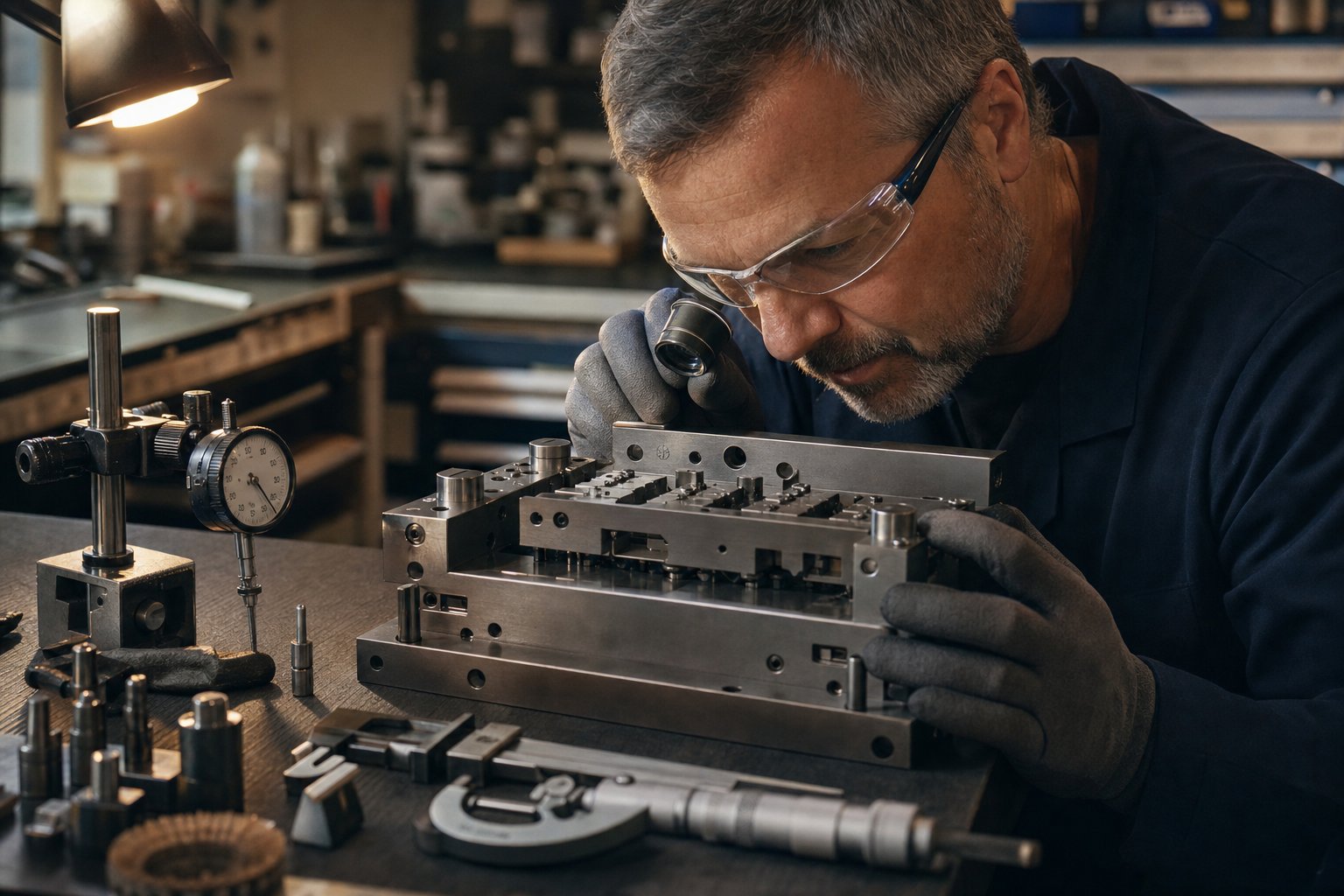
Validation confirms a die can produce good parts. Keeping it producing good parts across millions of cycles is an entirely different challenge. In high-speed automotive stamping, a single hour of unplanned downtime can cost $26,000 to $260,000 or more depending on plant scale. Yet most stamping die failure modes and repair scenarios are predictable, which means they are preventable. The gap between reactive firefighting and proactive control comes down to understanding how dies degrade and building a stamping die maintenance schedule that catches wear before it becomes scrap.
Common Die Failure Modes in Automotive Stamping
Every die tells a story through its wear patterns. When you know what to look for, the physical evidence points directly to root cause. Here are the failure modes that production teams encounter most frequently on automotive stamping lines:
Cutting edge wear and breakdown. This is the most common failure mode. Friction between the sheet metal and cutting surfaces gradually rounds the edge profile, producing progressively larger burrs on stamped parts. With AHSS grades, the abrasive wear rate accelerates dramatically because the sheet material hardness approaches that of the tooling itself. Carbide stamping dies at piercing stations resist this degradation far longer than conventional tool steels, but even carbide inserts eventually require regrinding or replacement.
Draw radius breakdown. Forming radii experience intense contact pressure as sheet metal flows over them during every stroke. Over time, micro-polishing transitions to galling, then to surface roughening that marks every panel passing through. On Class A dies, even subtle radius degradation becomes visible on the stamped panel surface.
Cracking from thermal fatigue and mechanical overload. Cyclic loading introduces micro-cracks at stress concentration points such as sharp internal corners, fillet transitions, and areas with surface defects. These cracks grow incrementally with each press stroke. Thermal fatigue compounds the problem, particularly in high-speed operations where friction-generated heat cycles create expansion and contraction stresses at the die surface. If undetected, micro-cracks propagate until catastrophic fracture occurs.
Galling. Especially problematic with aluminum and advanced high-strength steels, galling occurs when material transfers from the sheet to the die surface through micro-welding at friction-heated contact points. With aluminum, the transferred material builds progressively, scoring subsequent panels. With AHSS, the extreme contact pressures can strip PVD coatings and initiate adhesive wear on exposed substrate. Galling is particularly insidious because it accelerates once started, each cycle pressing previously transferred material deeper into the die surface.
Timing and feed-related failures. Progressive dies depend on precise synchronization between press stroke, strip feed advance, and pilot pin engagement. When feed pitch drifts, pilot timing shifts, or strip lifters bind, the strip arrives at stations slightly off-position. The result ranges from mispunched holes and distorted features to catastrophic slug pulling where cut slugs are drawn back up into the die face, damaging cutting edges and forming surfaces in a single stroke.
The table below maps these failure modes to their root causes, the symptoms visible on the production floor, and the corrective actions that resolve them:
| Failure Mode | Root Causes | Visible Symptoms | Corrective Actions |
|---|---|---|---|
| Cutting edge wear | Abrasive contact with sheet metal, insufficient die hardness for material grade, inadequate lubrication | Growing burrs on stamped parts, increased cutting force, rough cut edges | Sharpen or regrind cutting edges, apply PVD coatings, upgrade to carbide inserts for high-wear stations, verify lubricant delivery |
| Draw radius breakdown | High contact pressure during forming, material pickup, poor surface finish on radius, inadequate coating | Score marks on formed panels, visible galling on draw radii, surface roughening on Class A parts | Polish and restore radius surfaces, apply low-friction coatings (CrN or DLC), increase lubrication at draw radii, verify blank holder pressure settings |
| Thermal fatigue cracking | Cyclic heating/cooling at die surface, high-speed operation, sharp internal corners creating stress concentration | Fine crack networks (heat checking) on working surfaces, eventual chipping or spalling | Increase fillet radii to reduce stress concentration, reduce press speed if possible, select tool steels with higher thermal fatigue resistance (S7 or hot-work grades), schedule inspection intervals based on hit counts |
| Mechanical overload cracking | Excessive press tonnage, slug stacking, double-hit events, insufficient die section thickness | Sudden fracture of die components, visible crack propagation from corners or mounting holes | Verify tonnage settings, install overload protection, redesign sections with inadequate cross-section, inspect for slug buildup at shift intervals |
| Galling (aluminum) | Adhesive wear from micro-welding, insufficient surface polish, dry or poorly lubricated contact, tight draw clearance | Material buildup on die surfaces, progressive scratching on stamped parts, increasing pull force | Polish die surfaces below Ra 0.2 micrometers, apply DLC or polished CrN coatings, optimize lubrication type and coverage, open draw clearances where feasible |
| Galling (AHSS) | Extreme contact pressure stripping coatings, high sheet hardness, coating delamination from substrate | Coating loss at high-wear areas, adhesive material transfer, surface scoring on formed parts | Upgrade to PM tool steel substrates, apply multi-layer PVD systems (TiAlN), increase die hardness at substrate level, verify coating adhesion during PM stops |
| Feed and timing failures | Pitch drift, pilot wear, lifter rail binding, servo feeder error, strip buckling | Mispunched holes, part-to-part dimensional variation, slug pulling, strip jams, press emergency stops | Verify feed pitch and pilot condition, inspect lifter rails for debris or wear, check servo feeder calibration, clean scrap paths to prevent slug pulling |
Preventive Maintenance Schedules and Inspection Protocols
Reactive maintenance costs three to five times more than planned intervention. A well-structured stamping die maintenance schedule ties inspection and service tasks to production-based triggers, specifically stroke counts, rather than relying on calendar dates alone. Dies do not wear at the same rate. A tool running 200,000 hits per month on 1180 MPa dual phase steel degrades far faster than one stamping 50,000 mild steel brackets.
The most effective approach combines time-based checks with stroke-count-based triggers at documented hits-per-service intervals for known wear items. Here is a practical framework:
- Per shift: Visual check for burrs on parts, abnormal press noise, slug buildup in scrap paths, and lubrication delivery confirmation. Flag any edge-related quality change immediately.
- Daily: Inspect pilots, springs, guides, strip tracking, and repeat-problem stations. Clean scrap paths and contact surfaces. Log any defects, adjustments, or downtime causes.
- Weekly: Measure recurring wear items against documented criteria. Torque-check fasteners with a history of loosening. Update the hits-per-service history for each critical station.
- Stroke-count-based (typically every 50,000 to 150,000 hits depending on material and die complexity): Full sharpening review of all cutting edges, inspection of draw radii for galling or roughening, coating condition assessment, spring free-length check, guide pin and bushing service, and dimensional verification of critical formed features.
- Annual or at major hit-count milestones: Complete teardown, full metrology review, cumulative wear trending analysis, and PM standard revision based on historical data.
The stroke-count trigger is critical because it reflects actual die loading rather than elapsed time. A die sitting idle for three weeks needs cleaning and rust prevention, not sharpening. A die that ran 400,000 hits in two weeks needs full edge inspection regardless of what the calendar says.
Recording findings at each PM stop builds the data foundation for continuous improvement. When you can track that Station 4's piercing punch consistently needs regrinding at 120,000 hits while Station 7 lasts 200,000, you can plan sharpening schedules that prevent burr-related quality escapes without pulling the die from the press prematurely. That history also reveals when routine maintenance is no longer enough, when a station's service interval keeps shortening, signaling that the root problem has shifted from normal wear to a design or material incompatibility that no amount of sharpening will solve.
Proactive die maintenance extends tool life, reduces unplanned downtime, and stabilizes part quality across production campaigns lasting years. It also produces the institutional knowledge that engineering teams need when evaluating whether a die partner can support the full program lifecycle, from initial build through decades of production service.
Selecting the Right Automotive Stamping Die Supplier
A die that stamps flawless parts is only as reliable as the partner who built it, maintains it, and supports it across a vehicle program that may span a decade or more. The previous sections covered everything from material selection to failure mode prevention, but all of that knowledge lives or dies based on one decision: which metal stamping dies manufacturer you trust with your tooling investment. Choose well, and you get a collaborative engineering relationship that anticipates problems before they reach the press floor. Choose poorly, and you inherit quality instability, delivery delays, and the expensive discovery that your tooling partner cannot support engineering changes mid-program.
So what separates a capable automotive stamping die supplier from one that merely quotes a competitive price? The evaluation goes far deeper than cost-per-tool comparisons.
Key Criteria for Evaluating a Stamping Die Manufacturer
When engineering teams approach stamping die manufacturing partner selection, they need a structured framework that covers technical capability, quality systems, and lifecycle readiness. Here are the criteria that matter most:
- Engineering and simulation capability: Can the supplier perform stamping simulation (AutoForm, PAM-STAMP, or equivalent) in-house? Do they offer design-for-manufacturability (DFM) feedback during part development? A partner with simulation expertise identifies forming risks before die construction begins, compressing tryout timelines and reducing iteration loops.
- Material and process expertise: Does the manufacturer have documented experience with the specific materials your program requires? Forming AHSS, aluminum, and mixed-material blanks each demand different tooling strategies. A supplier that only has deep experience in mild steel will struggle with the coating, tonnage, and springback challenges that modern EV and lightweighted platforms introduce.
- Press capacity for tryout: A die builder without adequate press tonnage and bed size for in-house tryout must outsource validation, adding cost, lead time, and communication layers. Verify that their tryout presses match or closely replicate your production press characteristics, including cushion systems, slide speed, and tonnage capacity.
- Quality certifications: IATF 16949 certification is the automotive industry's quality management standard and signals that a supplier maintains the process discipline, traceability, and continuous improvement systems OEMs require. ISO 9001 provides the broader quality management foundation. Both should be non-negotiable baseline requirements for any serious automotive tooling program.
- Full lifecycle support: The best partnerships extend from prototype tooling through production launch, ongoing maintenance, and engineering change implementation. A supplier who builds the die but cannot support mid-life refurbishment, spare component fabrication, or re-engineering for material changes leaves you stranded when production requirements evolve.
- Prototyping and sampling services: The ability to produce prototype parts before committing to production tooling lets your team validate fit, function, and assembly compatibility early. This catches design issues when changes are cheap, not after hardened production dies are already cut.
- Production volume flexibility: Your program volumes may shift due to market demand changes or platform extensions. A partner with both high-volume progressive die capability and flexibility for lower-volume transfer or prototype runs adapts with your program rather than forcing you to source multiple suppliers.
- Communication and collaboration infrastructure: Responsive engineering support, clear project milestone tracking, and transparent technical communication during tryout iterations are as important as machining accuracy. Poor communication is one of the most common red flags in supplier relationships, often indicating deeper organizational issues that will surface during critical program milestones.
Beyond individual criteria, evaluate how these capabilities integrate. A supplier with excellent CNC machining but no simulation capability will build exactly what you draw, even if the design contains forming risks that simulation would have flagged weeks earlier. A supplier with strong engineering but inadequate press infrastructure cannot validate their own work. You want the full chain connected under one roof.
How YICHEN Supports Automotive Stamping Programs
Applying these evaluation criteria to real-world suppliers, YICHEN offers a concrete example of a manufacturing partner built around automotive stamping program support. Their capabilities span the full range of criteria engineering teams should be evaluating.
YICHEN supports OEM, Tier-1, and Tier-2 engineering teams with stamping and sheet metal fabrication services covering structural components, interior parts, chassis members, and truck-related metal assemblies. This breadth matters because it demonstrates experience across multiple die types and material families rather than narrow specialization in a single component category. A partner who has produced chassis brackets, structural reinforcements, and interior metal trim understands how different die architectures, material grades, and tolerance requirements interact across a vehicle program.
Their automotive industry page provides process case studies that engineering teams can review when assessing whether the supplier's demonstrated capability aligns with their specific program requirements. For teams in the early stages of stamping die manufacturing partner selection, this kind of documented project evidence is more valuable than generic capability claims.
What makes this type of integrated partner valuable is the lifecycle continuity. When the same organization that designed and built the die also supports tryout, production ramp, and ongoing maintenance, institutional knowledge stays intact. The engineers who understand why a particular draw bead was placed at a specific location are the same ones diagnosing a forming issue three years into production. That continuity eliminates the knowledge gaps that plague programs where design, build, and maintenance are split across disconnected vendors.
Regardless of which supplier you ultimately select, the evaluation framework above gives your team a structured path through the decision. Price will always matter, but in automotive stamping, the cheapest die is rarely the least expensive one over a program's full lifecycle. The right partner delivers tooling that runs reliably for years, adapts when engineering changes arrive, and maintains the dimensional stability that keeps your assembly line moving without interruption.
Frequently Asked Questions About Automobile Stamping Dies
1. What is the difference between a progressive die and a transfer die in automotive stamping?
A progressive die uses a continuous metal strip that advances through multiple stations within one die set, producing small parts like brackets and clips at high speed (30-60+ strokes per minute). A transfer die uses individual blanks moved between independent stations by mechanical bars or robots, handling medium-to-large structural parts too complex for strip-based progression. The choice depends on part size, forming complexity, and annual volume. Parts under 300mm with volumes above 300,000 units per year typically suit progressive tooling, while larger structural members with complex geometry fit transfer setups where each station can be independently tuned for tonnage and material flow control.
2. How long does an automobile stamping die last before it needs replacement?
Die lifespan varies significantly based on the sheet metal being stamped, production speed, and maintenance quality. A well-maintained progressive die stamping mild steel can produce 1 million or more parts before major refurbishment. However, when stamping advanced high-strength steels (AHSS) above 980 MPa, tool life can drop to 50,000-100,000 hits without proper coatings and PM-grade tool steels. Carbide inserts at high-wear stations extend life by 500-1000% compared to conventional tool steels. Preventive maintenance tied to stroke-count triggers, rather than calendar dates, is the single most effective strategy for maximizing die longevity and avoiding unplanned failures.
3. Why is die tryout so important before mass production in automotive stamping?
Die tryout bridges the gap between a freshly machined tool and production-ready performance. It typically consumes 30% of total tooling cost and 40% of engineering timeline because even perfectly machined dies can produce panels with splits, wrinkles, or dimensional deviations. The process includes die spotting for contact verification, initial panel stamping, GD&T measurement using CMMs, full-surface 3D scanning against CAD geometry, and iterative corrections until OEM acceptance criteria are met. Skipping or rushing tryout pushes quality problems downstream to body-in-white assembly where corrections become exponentially more expensive.
4. How are stamping dies different for electric vehicles compared to traditional cars?
EV platforms introduce stamped components with no precedent in conventional vehicle design, particularly battery enclosures that can exceed 2 meters in length with severe draw depths. These battery trays often use aluminum alloys prone to galling or tailor-welded blanks combining AHSS with mild steel, requiring dies that manage wildly different forming behaviors within one tool. EV body structures also use mixed-material strategies where a single platform may need dies optimized for press-hardened steel, dual phase steels, and aluminum closures, each demanding different coatings, tonnage settings, and springback compensation approaches that traditional mild-steel-era tooling never required.
5. What should I look for when selecting an automotive stamping die manufacturer?
Evaluate suppliers across several integrated capabilities: in-house stamping simulation for early forming risk identification, documented material expertise matching your program's steel or aluminum grades, press capacity that replicates your production conditions for tryout, IATF 16949 certification for automotive quality discipline, and full lifecycle support from prototype through production maintenance. Partners like YICHEN that support OEM, Tier-1, and Tier-2 teams across structural, chassis, interior, and truck-related stamped parts demonstrate the breadth needed for complex programs. Prioritize suppliers where design, build, and maintenance reside under one roof so institutional knowledge stays intact across the program's full lifespan.


