


What Is Manual Transfer Die Stamping and Why Does It Matter
When you receive a tooling quote for a stamped metal part, the line items rarely explain the process philosophy behind the price. One of the most commonly misunderstood methods sitting behind those numbers is manual transfer die stamping, a process that blends multi-station forming precision with hands-on operator control. Whether you're a manufacturing engineer evaluating production methods or a buyer trying to decode a supplier's proposal, understanding this process changes how you read every quote that lands on your desk.
Defining Manual Transfer Die Stamping
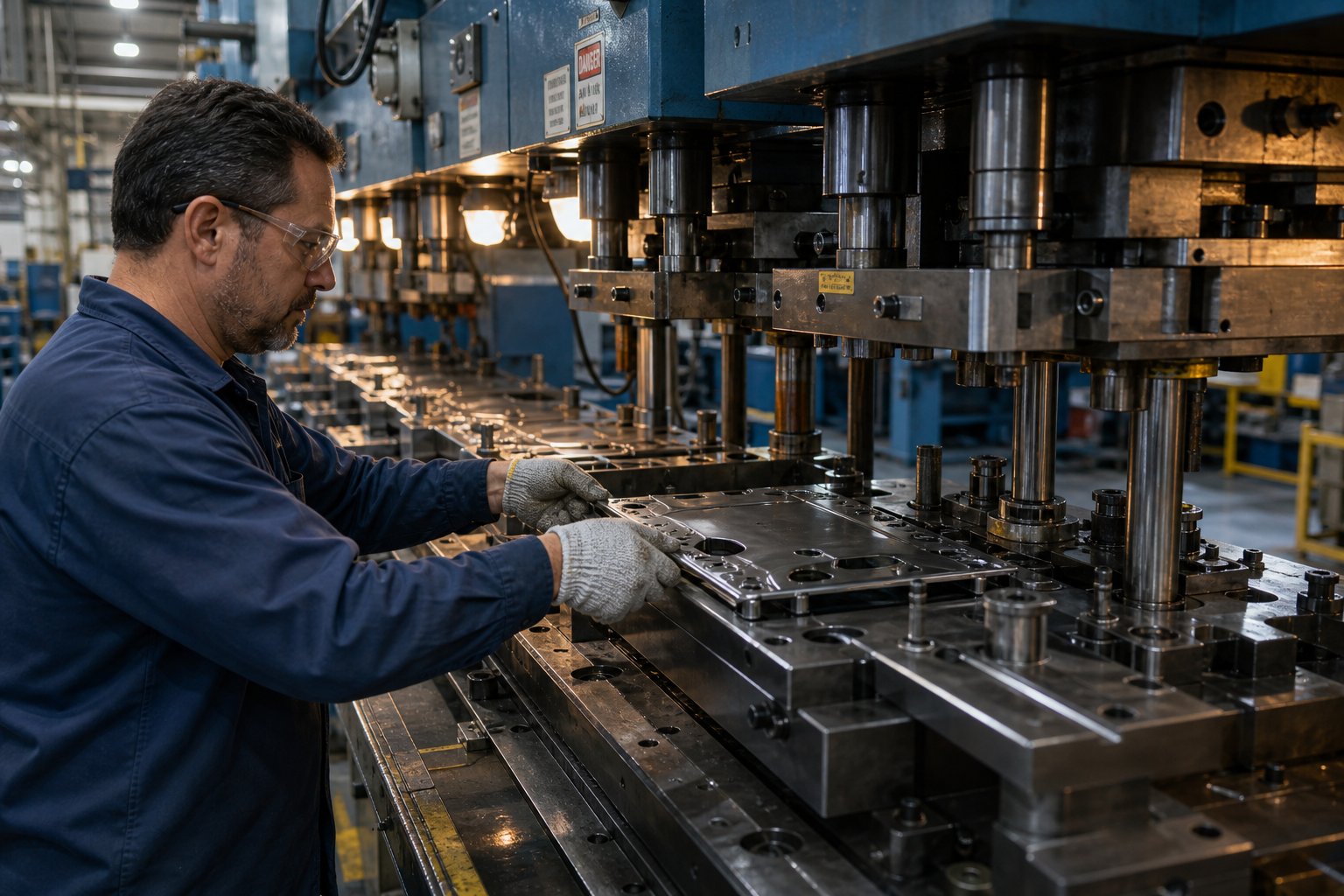
Manual transfer die stamping is a metal forming process in which a human operator physically moves individual workpieces between separate die stations within a press, with each station performing a distinct operation such as blanking, drawing, piercing, or trimming until the final part geometry is achieved.
A few terms tend to get tangled in conversation, so let's sort them out. A transfer die refers to the tooling itself, a set of independent die stations designed to progressively form a part. A transfer press is the machine that houses those stations and provides the tonnage for forming. Transfer stamping is the broader process category. When the word "manual" precedes any of these, it signals that the part movement between stations relies on a skilled operator rather than robotic arms or mechanical fingers.
How It Differs from Automated Transfer and Progressive Dies
Imagine a progressive die setup: a continuous metal strip feeds through a series of stations, and the part stays connected to that strip until the final cutoff. The strip itself acts as the transport mechanism. In automated transfer stamping, individual blanks move between stations via mechanical grippers or robotic systems without human intervention.
Manual transfer sits between these approaches. Like automated transfer, the workpiece is a free individual blank rather than part of a continuous strip. This allows the part to be rotated, flipped, or repositioned between stations, enabling complex geometries that strip-fed progressive dies simply cannot produce. The critical difference is that a trained operator handles each transfer, using tactile feedback and visual inspection at every stage. There are no robotic grippers, no programmable motion paths, just experienced hands guided by process knowledge.
Progressive dies excel at high-volume, smaller parts. Automated transfer lines handle large or complex parts at production speeds. Manual transfer occupies the space where part complexity demands free-state manipulation, but volumes or budgets don't justify the capital investment in automation.
Why This Process Still Matters in Modern Manufacturing
You might wonder why any shop would rely on manual part handling in an era of Industry 4.0. The answer is economics and flexibility. Not every stamped part runs in volumes of 500,000 per year. Not every project has the lead time or budget for robotic integration. And not every part geometry stays frozen long enough to justify automated tooling.
Manual transfer die stamping remains relevant for low-to-medium volume production, prototype validation, and parts whose size or forming complexity rules out progressive strip feeding. The operator becomes a built-in quality checkpoint, catching material defects, misfeeds, or forming anomalies in real time. That human element introduces variability, yes, but it also introduces adaptability that rigid automation cannot match.
This article is a vendor-neutral engineering resource. No sales pitch, no brand favoritism. The goal is to give you the technical and economic framework to evaluate whether manual transfer belongs in your next project, and to help you see exactly what's hiding inside that tooling quote.
How Manual Transfer Die Stamping Works Step by Step
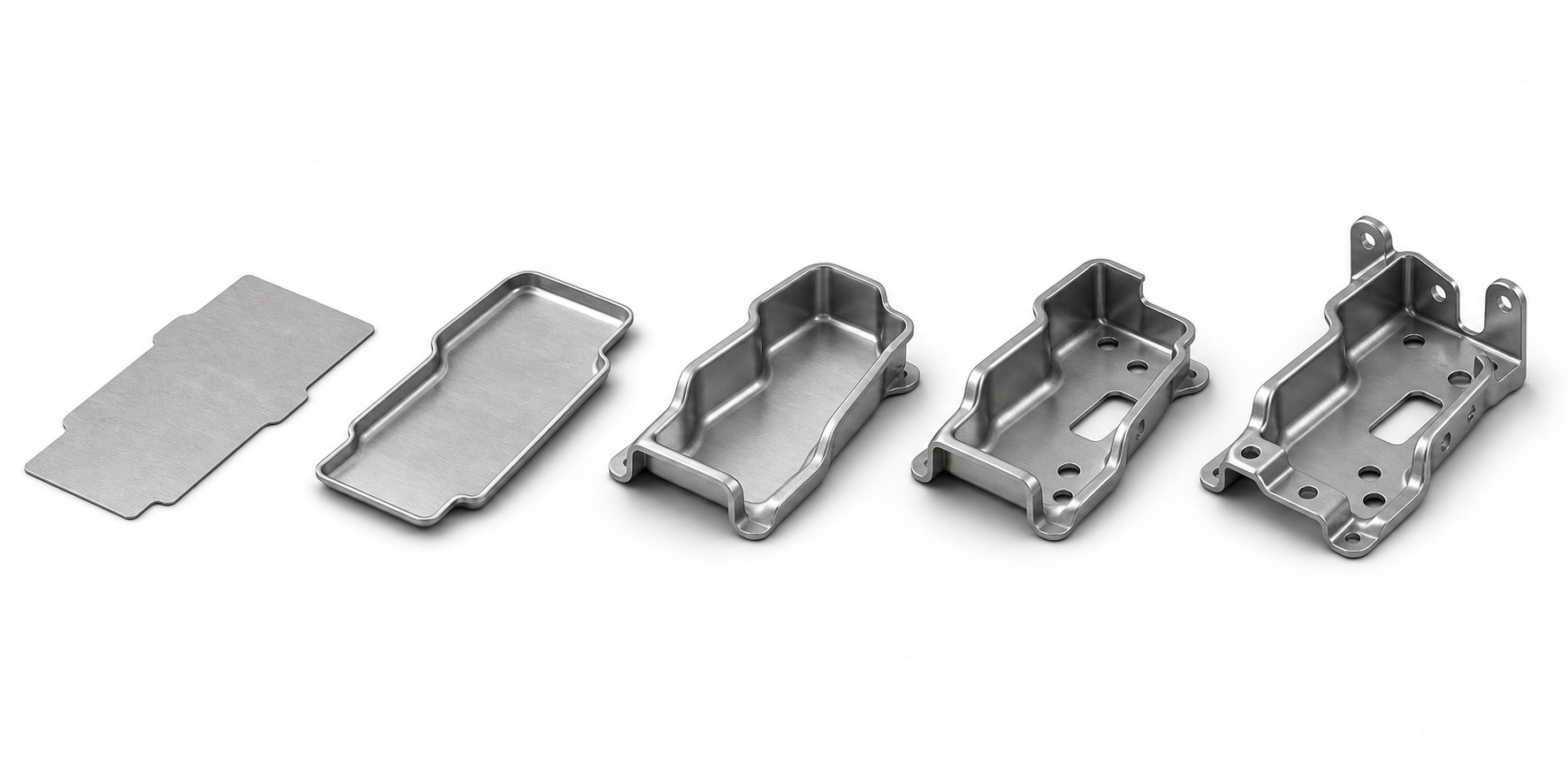
Picture yourself standing at the press. A stack of flat metal blanks sits to your left. The die bed stretches in front of you with three, four, maybe six stations arranged in sequence, each one tooled to perform a specific forming operation. Your job is to guide a piece of sheet metal through every station, transforming it from a flat blank into a finished three-dimensional part. That's the transfer die stamping step by step process in its most essential form, and every movement you make carries consequence for dimensional accuracy and part quality.
Loading and First Station Operations
The cycle begins with blank preparation. Depending on the shop setup, blanks arrive either pre-cut from a separate blanking operation or sheared from coil stock offline and stacked on a pallet near the press. The operator selects a blank, visually inspects it for surface defects or burrs, and positions it onto the locating features of the first die station. These locators, typically pilot pins or nest blocks, ensure the blank sits in precise alignment before the press cycles.
With the blank seated, the operator activates the press stroke using a two-hand control (a safety requirement that keeps both hands clear of the die). The ram descends, and the first station performs its operation. In many cases, this initial station handles a draw or form that establishes the part's primary shape. The material is forced into a die cavity, creating depth and contour where a flat sheet existed moments before.
As the ram retracts, part lifters built into the lower die raise the workpiece above the die surface. This is the operator's cue. The partially formed part is now accessible for pickup, sitting slightly elevated on spring-loaded lifters that make gripping easier and reduce the risk of the part sticking in the cavity.
Inter-Station Transfer and Operator Workflow
Here's where the manual element truly defines the process. The operator reaches in, grasps the workpiece, lifts it free of the first station, and repositions it into the next. This sounds simple but requires developed skill. The part must be oriented correctly, placed precisely onto the next station's locating features, and released cleanly before the next stroke can occur.
Each station performs a distinct operation in a carefully planned sequence designed to shape the part progressively without overstressing the material. A typical multi-station workflow might look like this:
- Station 1 - Draw: The flat blank is formed into an initial cup or shell shape, establishing the part's depth and basic contour.
- Station 2 - Redraw or reform: The drawn shape is further refined, deepened, or reshaped to tighter radii and more defined features.
- Station 3 - Pierce: Holes, slots, or other internal features are punched into the partially formed part while it's held in a controlled position.
- Station 4 - Flange or form: Edges are bent, flanged, or coined to final geometry and dimensional specifications.
- Station 5 - Trim: Excess material from the draw flange or perimeter is cut away, establishing the final outer profile.
Between each station, the operator performs a rapid visual inspection. Is the draw uniform? Are there cracks or wrinkles forming? Did the pierce operation produce clean holes without excessive burr? This built-in quality gate is what makes the manual die station workflow unique. An automated system relies on sensors and post-process inspection. A skilled operator detects subtle anomalies through sight and touch in real time, often catching problems before they propagate into scrap.
The operator's role in transfer die stamping goes beyond simple material handling. Experienced press operators develop tactile sensitivity to how a part "feels" during placement. A part that doesn't seat smoothly into locators might indicate tooling wear, a dimensional shift from material variation, or a forming issue from the previous station. That feedback loop, occurring at every transfer, functions as continuous in-process monitoring.
Final Forming, Trimming, and Part Ejection
The last station typically handles final trimming, coining, or restrike operations that bring critical dimensions into tolerance. Coining applies high localized force to sharpen features, flatten surfaces, or achieve tight dimensional control on specific areas. A restrike operation re-forms features that may have sprung back slightly after initial forming.
Once the final press stroke completes, the operator removes the finished part and places it into a collection bin or inspection station. In some setups, this final removal doubles as another quality check, with the operator gauging the part against a go/no-go fixture before it leaves the press area.
Throughout this entire cycle, press controls and safety systems support the operator's workflow. Two-hand actuation prevents the ram from cycling while hands are in the die area. Light curtains provide secondary protection, halting the press if the operator's body breaks the sensor plane at the wrong moment. Die alignment features such as guide pins and heel blocks, as noted by MetalForming Magazine, ensure the upper and lower die halves meet with precision regardless of the press's mechanical condition.
Cycle times in manual transfer typically range from a few seconds to over a minute per station, depending on part size, complexity, and the number of stations. Compared to automated transfer systems running 15 to 45 strokes per minute, the manual approach is significantly slower. But speed isn't the point. The value lies in flexibility, lower capital requirements, and the operator's ability to adapt to process variations on the fly.
What this step-by-step walkthrough reveals is a process where human judgment is embedded at every stage. The trade-off between throughput and adaptability shapes every decision about when manual transfer makes sense, and that trade-off becomes particularly sharp when you compare it against other stamping methods head to head.
When to Choose Manual Transfer Over Other Stamping Methods
Every stamping method exists because it solves a specific set of constraints better than the alternatives. The challenge for engineers and buyers is matching the right process to their actual production scenario rather than defaulting to what a supplier happens to specialize in. Choosing between manual transfer vs progressive die stamping, automated transfer, or compound die approaches comes down to a handful of measurable variables: part size, annual volume, geometric complexity, budget, and timeline.
Manual Transfer vs. Progressive Die Stamping
Progressive dies keep the workpiece attached to a carrier strip throughout the forming sequence. That strip acts as both the transport mechanism and the positional reference. It works beautifully for smaller parts produced at high volumes, but it imposes hard constraints. If your part is too large for efficient strip feeding, or if it requires deep draws that would tear the carrier strip, progressive tooling simply isn't feasible.
Manual transfer eliminates the strip entirely. Each blank is a free individual piece, which means the operator can rotate it, flip it, or reposition it between stations. Parts requiring operations on multiple faces, deep cavity forming, or asymmetric geometries that demand reorientation become achievable. The trade-off is speed and labor cost. Progressive die stamping produces parts at rates that manual methods cannot approach, and the per-part labor component drops to near zero in a well-running progressive line.
When to use manual transfer die stamping instead of progressive? When your part geometry requires free-state manipulation, when annual volumes fall below the threshold where progressive tooling investment pays back, or when the design is still evolving and you need the flexibility to modify station operations without scrapping an entire progressive strip die.
Manual Transfer vs. Automated Transfer Lines
Automated transfer systems use mechanical fingers or robotic arms to move parts between stations at production speeds of 15 to 45 strokes per minute. They combine the geometric flexibility of transfer dies with the throughput consistency of automation. Sounds ideal, right?
The catch is capital investment and lead time. Automated transfer lines require significant upfront spending on robotics, programming, integration, and end-of-arm tooling specific to each part. That investment pays back handsomely at high volumes, but it creates a break-even threshold below which manual operation is more economical. For many manufacturers, that crossover point sits somewhere in the range of 50,000 to 150,000 parts annually, depending on part complexity, cycle time, and labor rates.
Manual transfer also offers faster setup for new part introductions. There's no robotic path programming, no gripper design, and no integration debugging. An experienced operator can begin running a new die set with minimal changeover time. For short production runs, engineering samples, or bridge production while automated tooling is being built, manual handling provides immediate capability without automation lead times.
Decision Matrix for Stamping Method Selection
The following table organizes the key selection criteria across four common stamping approaches. Use it as a transfer die stamping method selection guide to narrow your options before engaging suppliers for detailed quotations.
| Criteria | Manual Transfer | Automated Transfer | Progressive Die | Compound Die |
|---|---|---|---|---|
| Part Size Range | Medium to large | Medium to large | Small to medium | Small to medium |
| Ideal Annual Volume | 1,000 - 50,000 | 50,000 - 500,000+ | 100,000+ | 10,000 - 200,000 |
| Geometric Complexity | High (multi-axis forming, deep draws) | High (multi-axis forming, deep draws) | Moderate to high (limited by strip format) | Low (flat or simple bends) |
| Tooling Lead Time | 6 - 12 weeks | 12 - 20 weeks (includes automation integration) | 8 - 16 weeks | 4 - 8 weeks |
| Capital Investment | Low to moderate (die cost only) | High (dies + robotics + integration) | Moderate to high (complex strip die) | Low |
| Flexibility for Design Changes | High (individual stations easily modified) | Moderate (may require reprogramming) | Low (strip layout changes are expensive) | Moderate |
| Throughput Rate | Low (operator-paced) | High (15 - 45 SPM) | High (20 - 60+ SPM) | Moderate to high |
| Operator Dependency | High | Low | Low | Low to moderate |
A few patterns emerge from this comparison. Manual transfer occupies a distinct niche: geometrically complex parts at volumes too low to justify automation, or projects where design fluidity demands tooling that can adapt without massive reinvestment. It's not the fastest method. It's not the cheapest at scale. But it fills a gap that no other single approach covers as economically for its target volume range.
Limitations deserve honest acknowledgment. Operator variability affects cycle consistency. Fatigue over long shifts can degrade quality. And throughput will never match automated alternatives. If your forecast shows volumes climbing above 50,000 parts annually with stable geometry, the manual vs automated transfer die comparison starts favoring automation purely on per-part economics.
The real decision isn't just about which method is cheapest today. It's about which method fits your production reality right now while leaving a viable path forward as volumes grow. That forward-looking lens matters especially when you start evaluating what materials and geometries the process can actually handle within its tolerance envelope.
Materials, Tolerances, and Part Geometry Suitability
Choosing the right stamping method is only half the equation. The other half is knowing whether your material, thickness, and part geometry actually work within that method's capabilities. Manual transfer die stamping is versatile, but it isn't universal. Certain metals behave better across multiple forming stations, certain gauges create handling challenges for operators, and certain geometries demand more stations than the process can economically justify. Understanding these boundaries helps you avoid tooling quotes built on assumptions that don't match your part's reality.
Metals and Alloys Suited for Manual Transfer
The best materials for transfer die stamping share a common trait: they tolerate multi-stage forming without cracking, excessive springback, or work-hardening to the point where subsequent stations can't shape them further. Since each station in a manual transfer setup performs a distinct operation on a free-standing blank, the material must maintain enough ductility through the entire forming sequence to reach the final geometry without failure.
Mild steel (grades like DC01 through DC06) remains the workhorse. Its high formability, predictable behavior, and low cost make it ideal for structural brackets, housings, and general-purpose stampings. Stainless steel (304, 316, 430) offers corrosion resistance but demands higher press tonnage and introduces more springback, which means additional stations for restrike or calibration. Aluminum alloys (1xxx, 3xxx, 5xxx, 6xxx series) form easily and weigh less, but their tendency to gall against tooling surfaces requires careful lubrication management and sometimes specialized die coatings.
Copper and brass stamp well for electrical and decorative components, offering excellent ductility and consistent material flow. Specialty alloys like HSLA steels (340-700 MPa) and advanced high-strength steels (AHSS/DP/TRIP) are increasingly common in automotive applications where transfer die stamping enables the deep draws and complex geometries these demanding materials require. However, higher-strength materials generally need more forming stations because each individual draw or bend must be less aggressive to avoid cracking.
One factor unique to manual transfer: the operator physically handles the workpiece between every station. Materials that produce sharp burrs (harder stainless grades, AHSS) or retain heat from forming friction create ergonomic concerns. Shops running these alloys often incorporate glove requirements, deburring between stations, or modified handling techniques that add seconds to each cycle.
Thickness Ranges and Formability Considerations
Material thickness directly affects two things in manual transfer: what the press can form and what the operator can handle. The general metal thickness range for transfer dies spans 0.5 mm to 8.0 mm, though the practical sweet spot for manual operations narrows somewhat based on part size and weight.
Thinner materials (below 1.0 mm) form easily but present handling challenges. A large, thin blank is floppy and difficult to position accurately into locating nests. It may deform under its own weight during transfer, introducing dimensional inconsistency that automated grippers would avoid. Thicker stock (above 4.0 mm) requires substantially higher press tonnage and produces heavier workpieces that fatigue operators faster, especially across multi-hour shifts.
Formability ratings determine how aggressively each station can shape the material before the next transfer. A highly formable material like deep-drawing-quality mild steel might achieve the final geometry in four stations, while a less ductile stainless grade requires six or seven stations to reach the same shape without tearing. More stations mean more transfers, longer cycle times, and higher cumulative operator handling, all of which factor into your per-part cost.
| Material Type | Typical Thickness Range | Formability Rating | Common Applications |
|---|---|---|---|
| Mild Steel (DC01-DC06) | 0.5 - 6.0 mm | High | Brackets, structural reinforcements, housings |
| Stainless Steel (304, 316, 430) | 0.5 - 4.0 mm | Medium | Medical enclosures, appliance panels, food equipment |
| Aluminum (1xxx, 3xxx, 5xxx, 6xxx) | 0.5 - 5.0 mm | High to Very High | Heat sinks, enclosures, lightweight structural parts |
| Copper | 0.5 - 3.0 mm | High | Electrical bus bars, connectors, heat exchangers |
| Brass | 0.5 - 3.0 mm | High | Decorative hardware, electrical contacts, plumbing fittings |
| HSLA / AHSS (340-1500 MPa) | 0.8 - 8.0 mm | Low to Medium | Automotive structural components, safety-critical parts |
Achievable Tolerances and Press Tonnage Requirements
Tolerance capability is where manual transfer die stamping tolerances need honest context. The tooling itself can hold tight dimensions. Industry data shows standard production tolerances of ±0.05 mm on formed features and ±0.03 mm on pierced hole locations, with precision coining stations achieving ±0.02 mm on critical surfaces. These numbers are achievable in manual transfer, but with a caveat: operator placement consistency introduces a variable that automated systems eliminate.
When a robot places a part into a die station, positional repeatability sits within hundredths of a millimeter every single cycle. When a human operator places that same part, repeatability depends on locating feature design, operator skill, and fatigue levels. Well-designed nests and pilot pins compensate for this by guiding the part into exact position regardless of how precisely the operator drops it. But if your tolerance stack requires positioning accuracy beyond what passive locating features can enforce, you'll see higher reject rates in manual operations compared to automated equivalents.
For piercing tolerances, same-plane holes punched in a single station hold ±0.05 mm (approximately ±0.002 inches) reliably because the die handles all positional accuracy internally. Problems surface when hole-to-hole relationships span multiple stations, since each transfer introduces a small positional variable. Tightly toleranced features that reference across stations may require qualifying operations or secondary sizing hits that add cost.
Press tonnage requirements depend on material type, thickness, and the specific forming operation. A general rule: drawing operations in mild steel require roughly 0.7 to 1.0 tons per centimeter of blank perimeter, while piercing requires approximately 80% of material tensile strength multiplied by the shear area. Transfer die presses typically range from 200 to 1,500 tons, with most manual transfer applications falling in the 200 to 600 ton range since the largest tonnage presses usually justify automated handling.
Part geometry suitability for manual transfer stamping ties directly to station count and forming severity. Deep draws (up to 250 mm depth across multiple redraw stations), complex multi-bend geometries, and asymmetric features all work well because the free-standing blank allows full 360-degree die access. However, each geometric feature that requires a separate forming operation adds another station and another manual transfer. A part with six distinct features requiring six stations is feasible. A part requiring twelve stations pushes the economic case toward automation simply because the cumulative labor content per piece becomes prohibitive.
The interplay between material choice, thickness, tolerances, and geometry complexity defines what your tooling will actually look like. And it's precisely these factors that drive tooling design decisions most buyers never see in a quote, particularly how die stations are laid out and what features enable an operator to achieve consistent results across thousands of cycles.
Tooling Design for Manual Transfer Die Stamping
A tooling quote might list station count, material type, and press tonnage, but it rarely explains the design philosophy embedded in the die itself. When parts will be moved by hand rather than by robotic fingers, every aspect of the die layout changes. Station spacing widens. Locating features get more forgiving entry angles. Part pickup points are shaped for human grip rather than mechanical clamp force. These details don't appear as separate line items, yet they directly influence tooling cost, cycle time, and the consistency of your finished parts.
Die Station Layout for Manual Handling
In automated transfer systems, stations can be packed tightly together because mechanical arms follow programmed paths with millimeter-level repeatability. Pitch length, the center-to-center distance between stations, is minimized to reduce transfer travel and maximize speed. Manual operations flip that priority. Station spacing must accommodate the operator's arms, torso, and sightlines.
Imagine reaching into a press bed to place a partially formed part onto a nest while your other hand still holds the part from the previous station. If stations sit too close together, the operator's hands collide with die components, upper shoe guide pins, or the workpiece in the adjacent station. Tooling designers working on manual transfer die design features account for this by increasing pitch length beyond what the part geometry strictly requires, giving the operator physical clearance to grip, orient, and release each workpiece without interference.
Die height also matters. In automated setups, the feed line height is optimized purely for transfer mechanism speed and stroke efficiency. For manual handling, the die surface where the operator places and retrieves parts needs to sit at a comfortable working height, typically between waist and mid-chest level. If stations require the operator to reach too high or bend too low repeatedly, fatigue accelerates and placement accuracy degrades across a shift.
Press bed layout follows the same logic. Die sets are positioned so the operator can access all stations from a single standing position or with minimal lateral movement. For dies with five or more stations, the layout may stagger pickup and placement zones to keep critical movements within arm's reach without requiring the operator to lean across the die face.
Locating Features, Nests, and Pilot Systems
Here's the core challenge of tooling design for manual transfer stamping: the operator doesn't place parts with robotic precision. A skilled person might achieve placement repeatability within 1-2 mm on a good day, but locating features in the die must absorb that variability and guide the workpiece to its exact required position every time.
Several design elements accomplish this:
- Pilot pins: Tapered pins that engage holes previously pierced in the part. The operator drops the workpiece approximately over the pins, and the taper guides it to exact center as the part settles by gravity or as the die closes.
- Nest blocks: Contoured lower die surfaces shaped to match the part's current formed geometry. A cone-shaped part, for example, automatically nests in the proper location simply through its shape interacting with the cavity.
- Gauge rails and stops: Physical edges that prevent the part from sliding past the correct position in the X or Y axis. The operator pushes the part until it contacts the stop, eliminating guesswork in one or more directions.
- Hold-down pins: Spring-loaded pins that trap the part in position after the operator releases it, holding it stable until the upper die descends and captures the workpiece for forming.
- Lead-in chamfers: Generous entry angles on nest features that funnel the part toward center even if the operator's initial placement is slightly off-target.
The combination of these locating features in transfer die tooling effectively creates a system where rough human placement is refined to precise die positioning. The better the locating system, the less operator skill is demanded per cycle, and the more consistent the resulting parts become across production runs.
One design consideration specific to manual work: locating features can't obstruct the operator's fingers during placement. A nest that perfectly captures the part geometry but requires the operator to thread the workpiece between tight-clearance walls creates fumbling and slows cycle time. Tooling designers widen entry clearances and add relief cuts so parts can be dropped in from above with a natural hand motion rather than threaded in from the side.
Bypass Notches and Inter-Station Design Elements
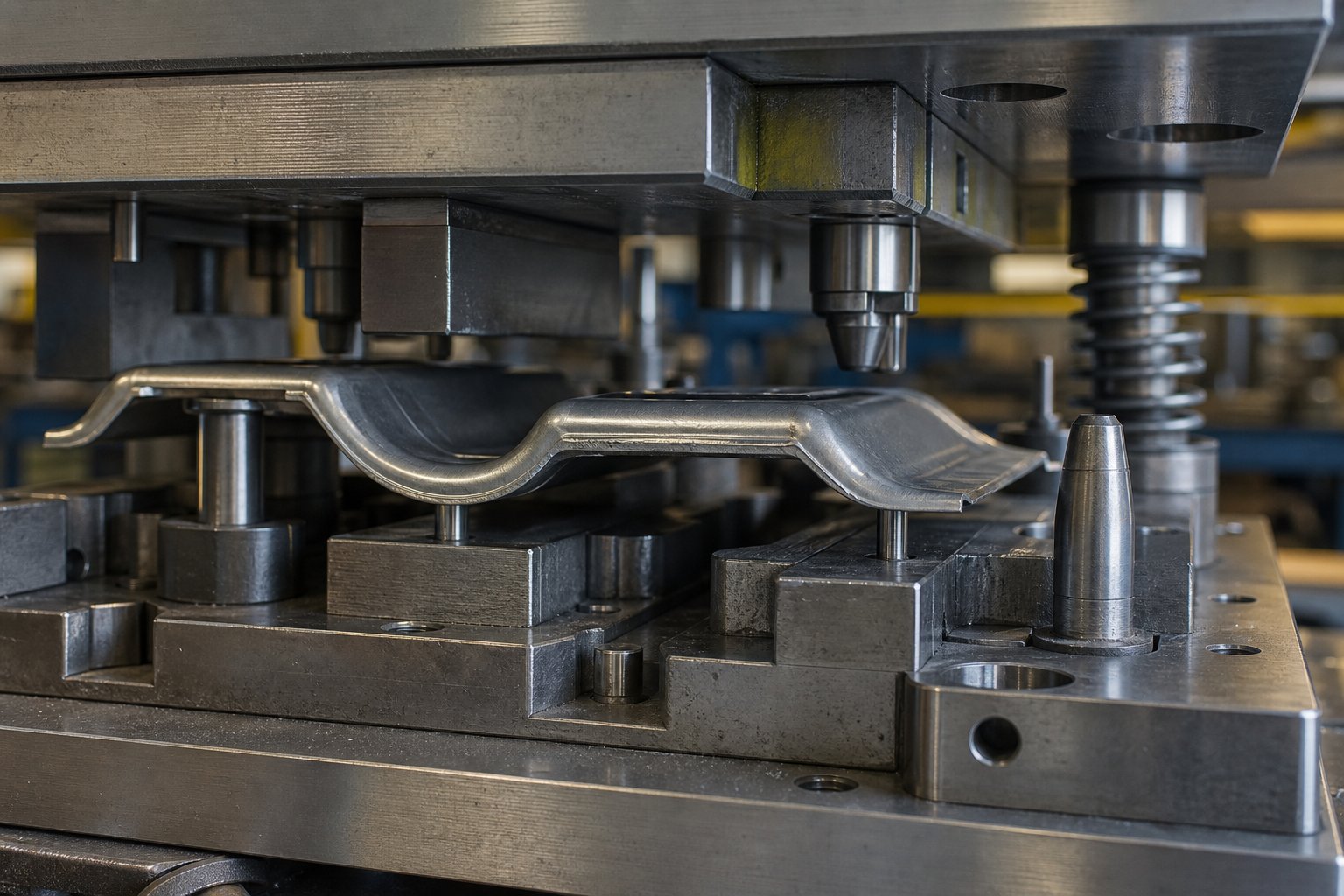
Bypass notches in stamping die design serve a specific functional purpose that many tooling quotes never explain. These are machined relief areas in the die shoes or guide plates that allow partially formed parts to pass between stations without interfering with adjacent tooling components. In a progressive die, the strip carrier handles vertical and horizontal positioning continuously. In transfer work, the part travels through open space between stations, and any protruding die component in that path creates an obstruction.
For manual transfer, bypass notches take on additional significance. The operator lifts the part up and out of one station, moves it laterally, and lowers it into the next. The vertical lift component means the part must clear any upper die components, stripper plates, or guide pins in the travel path. Notches cut into stripper plates or relief machined into upper shoes create that vertical clearance without compromising the structural integrity of the tooling.
Additional inter-station design elements that differ between manual and automated transfer dies include:
- Guide post placement in the upper shoe: Posts are almost always located in the upper die half rather than the lower, keeping the lower die surface clear for operator access and eliminating obstacles in the part's transfer path.
- Increased open height: The press stroke and die shut height are specified to provide ample open daylight between upper and lower die halves, giving the operator time and space to place parts before the next cycle.
- Spring-loaded lifters with extended travel: Parts are raised higher out of forming cavities than in automated setups, making them easier to grasp without reaching deep into a die pocket.
- Ergonomic grip surfaces on formed parts: Tooling designers sometimes add small non-functional flat zones or flanges to the part geometry specifically to give operators a gripping point, with these features trimmed off in a later station.
- Station visibility: Upper die components are designed to minimize visual obstruction so the operator can see the locating features and confirm proper placement before initiating the press stroke.
- Scrap chute routing: Trim scrap must exit the die without falling into operator transfer zones or requiring manual removal that breaks the handling rhythm.
Each of these elements adds cost to die construction. Wider station spacing means larger die shoes and bigger press beds. Upper-mounted guide posts require different manufacturing approaches than standard lower-post die sets. Extended lifters add components and maintenance points. These aren't arbitrary design choices; they're the direct engineering response to having a human in the process loop rather than a machine.
The balance that tooling designers strike between precision and ergonomics ultimately shapes what you pay for the die and what you pay per part in labor. A die designed with poor operator access might cost less to build, but it will produce slower cycle times, more placement errors, and higher scrap rates. That trade-off between upfront tooling investment and ongoing production efficiency is exactly the economic puzzle that determines whether manual transfer remains cost-effective for your volumes, or whether the numbers start pointing toward automation.
Cost Structure and Production Economics of Manual Transfer
That economic puzzle from the tooling side has a mirror image on the production floor. Every manual transfer die stamping cost analysis eventually lands on the same question: at what volume does the lower capital investment stop compensating for higher per-part labor? The answer isn't a single number. It's a function of die complexity, operator wages, cycle time, and how many parts you need to amortize your tooling across. Most tooling quotes obscure this relationship by presenting a lump-sum die cost without revealing the per-part economics that determine whether you're actually saving money or just deferring it.
Tooling Investment and Capital Costs
Manual transfer dies carry lower upfront investment than automated transfer systems for a straightforward reason: you're buying die stations without the robotics, programming, end-of-arm tooling, and integration engineering that automation demands. A manual transfer die set for a moderately complex part might fall in the same general range as a progressive die of similar station count, while an automated transfer line for the same part could require two to three times that investment once you factor in mechanical handling systems and controls integration.
The transfer die tooling investment comparison breaks down further when you consider lead time. Manual transfer tooling typically delivers in 6 to 12 weeks because you're building die stations alone. Automated systems add weeks or months for gripper design, motion programming, runoff testing, and integration debugging. That extended timeline carries its own cost in delayed production revenue and longer time-to-market.
Die complexity still drives the base tooling price regardless of transfer method. More stations mean more tool steel, more machining time, and more tryout cycles. A five-station manual transfer die costs more than a three-station die for the same reason a larger house costs more than a smaller one: more material, more labor, more engineering. Station count is determined by part geometry and material formability, not by whether a robot or a person moves the part.
Per-Part Cost Drivers and Labor Considerations
Here's where the per-part cost manual transfer die stamping reality diverges sharply from automated alternatives. The standard cost formula for stamped parts bundles material (45-55%), labor (15-25%), overhead (10-20%), quality (2-8%), and packaging (2-5%) into a unit price. In manual transfer, the labor slice expands significantly compared to automated methods because an operator is actively engaged for every single cycle.
Consider the cost drivers that compound across each part produced:
- Cycle time: Manual transfer cycles run slower than automated systems. Where a robotic line might produce 20 to 40 parts per minute, a manual operation might yield 2 to 8 parts per minute depending on station count. That difference directly scales labor cost per piece.
- Operator wages: Skilled press operators in Western markets typically earn $18-25 per hour. Every second of cycle time translates into measurable labor content per part. A 30-second manual cycle at $20/hour adds roughly $0.17 in direct labor alone, before overhead loading.
- Scrap rates: Operator variability can produce slightly higher scrap rates than automated systems, particularly during shift transitions or extended runs where fatigue accumulates. Each scrapped part carries the full material and processing cost up to the point of rejection.
- Throughput ceiling: The maximum daily output is bounded by human speed, break schedules, and shift structures. You can't simply run manual operations faster to meet a surge in demand without adding shifts or operators.
Material cost remains roughly constant regardless of transfer method since the same blank feeds both manual and automated stations. Overhead, quality inspection, and packaging costs vary by shop but don't shift dramatically based on the transfer mechanism alone.
Break-Even Analysis Across Production Volumes
The break-even volume manual vs automated stamping calculation follows a predictable logic. Manual transfer has lower fixed costs (tooling investment) but higher variable costs (labor per part). Automation flips that ratio: high fixed costs amortized across a large volume, with minimal variable labor per piece. At some crossover point, the total cost curves intersect.
Rather than offering fabricated break-even numbers that depend entirely on your specific situation, here's the framework for running this analysis on your own project:
- Calculate total manual cost: Tooling investment + (per-part labor + material + overhead) multiplied by projected annual volume.
- Calculate total automated cost: Tooling investment + automation capital + integration costs + (per-part material + minimal labor + overhead) multiplied by projected annual volume.
- Find the intersection: Solve for the volume where both equations produce equal total cost. Below that volume, manual wins. Above it, automation wins.
Several factors push the break-even threshold higher (favoring manual transfer longer): high automation integration costs, short product lifecycles where tooling won't run long enough to amortize, frequent design changes that would require reprogramming, and parts with geometries that demand expensive custom end-of-arm tooling. Factors that pull the threshold lower (favoring earlier automation): high local labor rates, tight cycle time requirements, very consistent tolerance demands, and multi-shift production schedules where operator fatigue becomes a quality variable.
For projects sitting near the crossover zone, tooling costs ranging from $5,000 for simple dies to $100,000+ for complex multi-station progressive sets illustrate how wide the investment spread can be. Manual transfer tooling for moderate-complexity parts generally clusters in the lower portion of that range, which is precisely why it remains economically attractive for annual volumes under 50,000 pieces where automation's premium can't be spread thin enough to justify itself.
The honest takeaway: manual transfer die stamping is not cheap per part at scale. It's cheap to enter. The lower barrier to tooling investment lets you start production faster, validate your design in real conditions, and generate revenue while you gather the volume data needed to justify an automation decision. That lifecycle perspective, starting manual and scaling toward automation as demand proves itself, shapes how smart engineering teams plan their stamping investments from day one.
Operator Skills, Safety, and Ergonomic Factors in Manual Transfer Stamping
That lower barrier to entry on tooling investment comes with a hidden cost line that most quotes never itemize: the human element. Every dollar saved on automation is partially offset by the operator skill requirements transfer die press operations demand. The person standing at that press isn't just moving metal between stations. They're performing real-time quality inspection, maintaining positional accuracy through tactile feedback, and sustaining physical output across hours of repetitive motion. Understanding what that demands, and what protections it requires, changes how you evaluate both the feasibility and the true running cost of manual transfer.
Operator Skill Requirements and Training
Manual transfer die stamping operator training goes well beyond basic press operation. A qualified operator needs to understand the forming sequence conceptually, knowing what each station does to the material and why the order matters. That knowledge isn't decorative. It's what allows the operator to detect when something goes wrong at station three before it produces scrap at station five.
The core competencies include:
- Forming sequence comprehension: Understanding how material flows, where thinning occurs, and what a properly formed intermediate stage looks like versus one showing early signs of cracking or wrinkling.
- Defect recognition between stations: Identifying surface splits, orange peel texture indicating overstretching, burr irregularities on pierced features, and dimensional drift from station misalignment or tooling wear.
- Handling technique for varied part geometry: Gripping partially formed parts without deforming thin walls, rotating asymmetric shapes to correct orientation, and placing workpieces into locating features with consistent accuracy across hundreds of repetitions.
- Press control familiarity: Operating stroke selectors, understanding single-stroke versus inch mode, and knowing when and how to use emergency stop functions.
This skill set develops over months, not days. Most shops pair new operators with experienced mentors for an extended ramp-up period, starting with simpler die sets (two or three stations, forgiving tolerances) before progressing to complex multi-station tooling where placement precision directly affects part conformance. As OSHA 1910.217(f)(2) requires, employers must train and instruct operators in the safe method of work before starting any operation, and ensure through adequate supervision that correct procedures are being followed.
Safety Systems and Protocols for Manual Transfer
The safety requirements for transfer die stamping are non-negotiable. When a human operator reaches between die halves to place or retrieve a workpiece, the consequences of an unintended press stroke are severe. Every manual transfer setup relies on layered safeguards designed so that no single failure results in operator injury.
A properly configured manual transfer press includes the following safety elements:
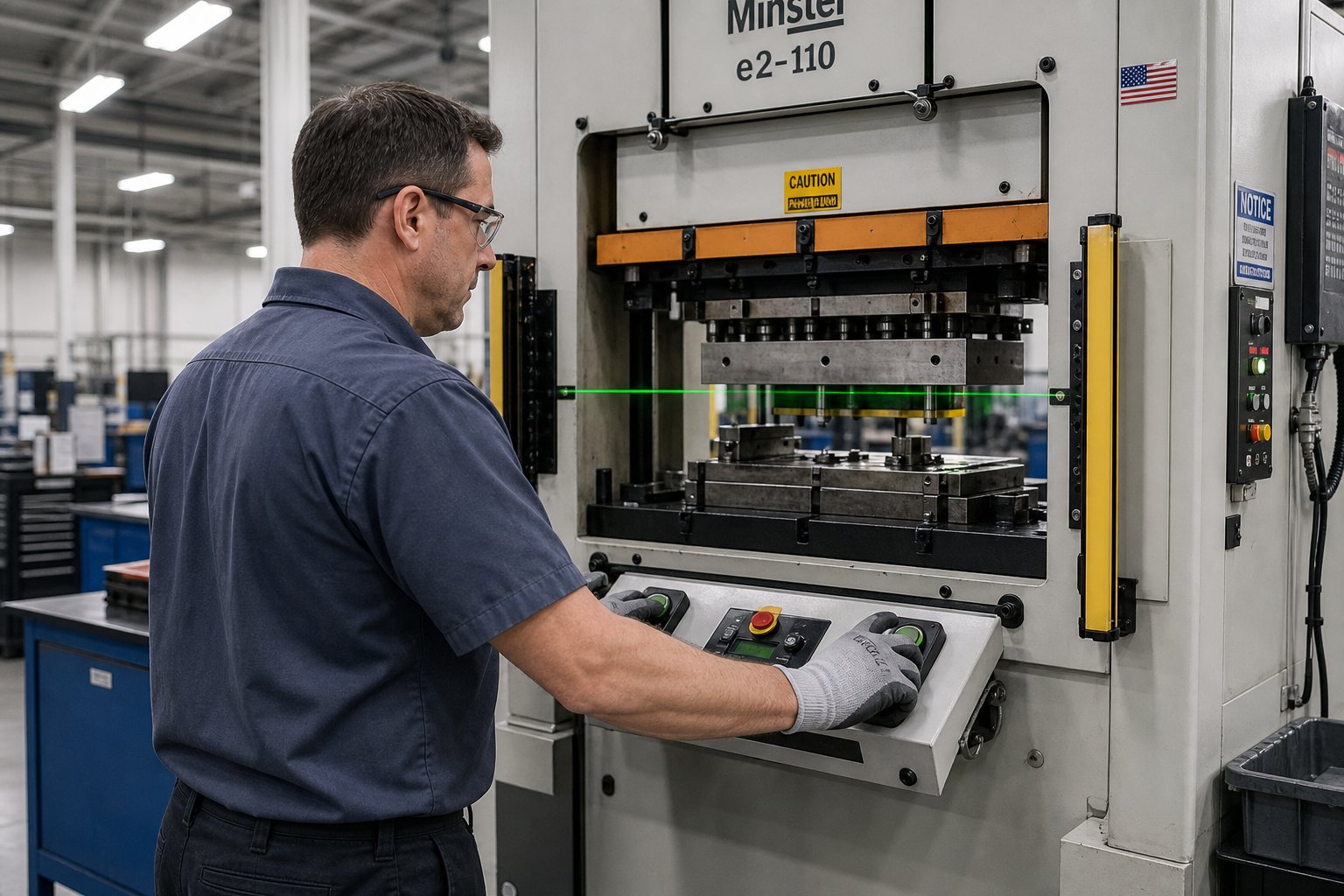
- Two-hand controls: The press stroke activates only when both of the operator's hands simultaneously engage separated control buttons, ensuring hands are clear of the point of operation during die closure. Per OSHA requirements, these controls must be protected against unintended operation and designed to prevent activation unless both hands are used concurrently.
- Presence sensing devices (light curtains): Photoelectric sensing fields positioned between the operator and the point of operation. If any part of the operator's body breaks the light plane during the downstroke, the press stops immediately. The safety distance from the sensing field to the die must satisfy the formula Ds = 63 inches/second x Ts, where Ts is the press stopping time.
- Die guards and barrier devices: Physical enclosures or interlocked barriers that prevent hands from reaching the point of operation except through designated openings conforming to Table O-10 distance/opening requirements.
- Anti-repeat mechanisms: Control features ensuring the press cannot initiate a second stroke without the operator fully releasing and reactivating the controls, preventing runaway cycling.
- Lockout/tagout procedures: Mandatory energy isolation protocols during die changes, adjustments, or any maintenance activity. A main power disconnect switch capable of being locked in the Off position is required on every press.
- Brake monitoring systems: Devices that automatically prevent successive strokes if stopping time deteriorates beyond safe limits, per OSHA 1910.217(b)(14).
- Regular inspection programs: Weekly testing of clutch/brake mechanisms, anti-repeat features, and single-stroke mechanisms, with maintenance records certifying compliance.
These systems work together as a redundant safety architecture. The two-hand control keeps hands out during normal cycling. The light curtain catches mistakes. The barrier guard prevents reach-around access. The brake monitor ensures the press can actually stop when commanded. Remove any layer, and the risk profile changes dramatically.
Ergonomic Considerations and Fatigue Management
The ergonomic factors in manual stamping operations represent one of the least discussed cost drivers in the process. Repetitive motion, sustained standing, and the physical act of lifting and placing workpieces hundreds or thousands of times per shift create cumulative strain that affects both operator health and part quality.
Research on work-related musculoskeletal disorders identifies the exact risk factors present in manual transfer work: repetitive upper extremity use, forceful gripping, and prolonged awkward postures. These exposures correlate with shoulder impingement, carpal tunnel syndrome, and back injuries when left unmanaged.
Specific ergonomic challenges in manual transfer include:
- Part weight limitations: Repeatedly lifting workpieces above 5 kg accelerates shoulder and back fatigue. Parts exceeding 10 kg typically require mechanical assists or two-person handling, which disrupts cycle consistency.
- Station height optimization: Die surfaces should position at elbow height (approximately 900-1100 mm from the floor) to minimize bending and overhead reaching. Mismatched heights between stations force the operator to constantly adjust posture.
- Repetitive motion accumulation: A five-station die running at 4 cycles per minute means the operator performs roughly 20 distinct pick-and-place motions per minute, or over 9,000 per eight-hour shift. That repetition compounds stress on wrists, forearms, and shoulders.
- Shift duration effects on quality: Studies consistently show that fatigue degrades fine motor control and vigilance. Cycle time variability increases as a shift progresses, with placement accuracy declining and defect detection rates dropping after the fourth or fifth hour of continuous operation.
Manufacturers mitigate these effects through several strategies: rotating operators between press stations to vary movement patterns, scheduling mandatory micro-breaks every 60-90 minutes, using anti-fatigue mats at operator stations, and setting part weight thresholds that trigger mechanical lifting assists. Some shops limit manual transfer runs to six-hour effective production windows within an eight-hour shift, budgeting time for rest, stretching, and station rotation.
The connection between ergonomics and part quality is direct. An operator experiencing wrist fatigue places parts less accurately. A person with back strain unconsciously rushes cycles to reduce bending time. These subtle behavioral shifts increase scrap rates and dimensional variability in ways that don't show up until SPC charts start drifting late in a production run. Acknowledging this reality is essential for anyone planning manual transfer operations, because it affects not just human safety but the actual cost and quality of what comes off the press.
This human-dependent production reality also shapes how engineering teams think about the broader lifecycle of a stamped part. A process that relies this heavily on operator consistency naturally raises the question: at what point does the product mature enough to justify removing that variability through automation?
From Prototype to Production
That question of when to automate doesn't arrive as a sudden decision point. It emerges gradually as production data accumulates, demand forecasts solidify, and the gap between what manual operations deliver and what the business requires becomes measurable. Smart engineering teams don't treat manual transfer die stamping as a permanent solution or a temporary compromise. They treat it as a proving stage, a deliberate phase in a production lifecycle that validates everything from forming sequences to material behavior before committing capital to automation.
Prototyping and Design Validation Through Manual Transfer
Imagine you've designed a new structural bracket that requires a deep draw, two redraws, a pierce pattern, and a final trim. The geometry looks feasible in simulation, but simulation doesn't capture how the material actually behaves across five forming stations, how springback accumulates from station to station, or whether your proposed blank size produces consistent edge quality after trimming. You need physical parts to answer those questions, and manual transfer die stamping for prototyping gives you exactly that capability without the cost and lead time of full automation.
During prototype and low-volume validation runs, engineering teams use manual transfer to accomplish several things simultaneously:
- Forming sequence verification: Does the planned station order actually work? Can the material survive each draw without thinning excessively? Do intermediate forms nest properly in subsequent stations?
- Station count optimization: The initial die design might include six stations, but manual runs reveal that stations three and four can be combined into a single hit without compromising material integrity. That discovery saves an entire station's worth of tooling cost in the production version.
- Material flow validation: Real-world draw behavior often differs from FEA predictions, especially at radii transitions and flange edges. Running actual blanks through manual stations produces measurable thinning data, wrinkle patterns, and springback values that refine the simulation model.
- Tolerance stack confirmation: Features that span multiple stations accumulate positional variation. Manual runs with careful measurement between stations reveal where the tolerance budget gets consumed, allowing engineers to add locating features or restrike operations before committing to final tooling.
This validation approach mirrors what manufacturing scaling roadmaps describe across all fabrication methods: prove the process at low volume with flexible tooling before investing in high-volume production infrastructure. The manual transfer phase functions like a DVT (Design Validation Test) stage specifically for stamping, generating the physical evidence that supports or challenges engineering assumptions.
One underappreciated benefit: manual runs let you evaluate part handling characteristics before specifying gripper designs for automation. You discover that the part tends to stick in station two's cavity, or that it flexes when gripped at the planned pickup point, or that trim burrs interfere with nest seating at station four. These insights directly inform the automated transfer system design that follows, preventing expensive mid-integration surprises.
Scaling from Manual to Automated Transfer
The best time to plan for automation is when you're still running manually. Die designs that anticipate future robotic handling cost marginally more upfront but save tens of thousands in retrofit when volume demands arrive.
Scaling from manual to automated transfer stamping isn't a binary switch. It's a planned transition that happens when specific indicators align. Engineering teams that approach this intentionally build their manual-phase dies with automation compatibility in mind, treating the manual period as data collection for the eventual automation specification.
What does automation-ready die design look like in practice? A few key decisions made during the manual tooling phase pay dividends later:
- Standardized station pitch: Designing consistent center-to-center distances between all stations, even if manual handling doesn't strictly require it. Robotic transfer systems prefer uniform pitch because it simplifies motion programming and allows identical transfer mechanisms between every station pair.
- Defined pickup and drop-off zones: Even though the operator grips wherever it's comfortable, adding flat reference surfaces or designated contact areas to the die design creates ready-made gripper interface points for future end-of-arm tooling.
- Sensor mounting provisions: Incorporating threaded holes or mounting features near nests and locating pins where part-present sensors will eventually be installed. These sensors confirm proper placement before the press cycles in automated mode.
- Consistent part elevation at transfer height: Setting lifter heights so the part rises to the same elevation across all stations, matching the fixed transfer plane that robotic arms prefer.
The additional cost for these provisions during initial die construction is modest, typically adding 5-10% to the manual die price. Retrofitting them later, after the die is hardened, proven, and in production, costs significantly more and often requires pulling the die from service for weeks of modification.
Planning Die Investments for Long-Term Production Growth
Transfer die production lifecycle planning requires honest volume forecasting combined with clear trigger points for transition decisions. The mistake most teams make is treating the manual-to-automation decision as a future problem. By the time demand exceeds manual capacity, you're already behind, scrambling to specify automation while running overtime shifts to meet orders.
Four indicators signal readiness to automate:
- Consistent quality metrics: Your manual runs produce Cpk values above 1.33 on critical dimensions across multiple production lots. The process is stable and the die is proven. Automating an unstable process just produces automated scrap faster.
- Stable cycle times: Operator-to-operator variation in cycle time has narrowed to less than 10%. This means the forming sequence is well-understood and repeatable, which translates to predictable robotic motion profiles.
- Volume forecasts exceeding manual capacity: When demand projections surpass what two-shift manual operation can deliver (accounting for ergonomic break schedules and realistic daily output), the throughput ceiling forces the conversation.
- Per-part cost crossing the automation break-even threshold: Using the framework from the cost analysis section, your cumulative labor cost per piece multiplied by annual volume now exceeds the amortized cost of automation capital. The math has flipped.
Teams that track these metrics from the first manual production run have data-driven transition points rather than gut-feel decisions. They know exactly when the crossover occurs because they've been measuring the inputs all along.
One more consideration: the manual-phase die often continues serving a role even after automation arrives. It becomes the tool for engineering samples, design iterations, and low-volume variant production while the automated line handles the high-volume base part. Rather than retiring manual capability entirely, experienced manufacturers maintain it as a parallel resource for flexibility that automated lines, with their programmed rigidity, cannot provide.
This lifecycle perspective reframes how you read a tooling quote. A die quoted for manual transfer isn't just a production tool for today's volumes. It's potentially the first investment in a multi-phase production strategy, a strategy that only delivers full value if you also know how to evaluate the partners who will build and support that tooling through each stage of growth.
Selecting the Right Transfer Die Stamping Partner
A production lifecycle strategy is only as strong as the supplier executing it. You can design the perfect phased approach from manual prototype runs through automated high-volume production, but if the partner building your tooling lacks the engineering depth to support that progression, you'll hit capability walls at the worst possible moments. Knowing how to choose a transfer die stamping supplier separates teams that scale smoothly from those that restart vendor evaluations mid-project.
Key Capabilities to Evaluate in a Transfer Die Partner
Not every stamping shop that owns a transfer press qualifies as a genuine transfer die partner. The distinction lies in engineering capability, not just manufacturing capacity. A shop might run transfer dies competently, but designing multi-station tooling that balances forming severity, material flow, and operator or robotic handling across five or more stations demands specialized experience that general job shops often lack.
When conducting a transfer die supplier quality assessment, prioritize these evaluation criteria:
- Multi-station die design expertise: Can the supplier demonstrate experience engineering dies with four or more forming stations? Ask for case studies showing how they determined station count, forming sequence, and material flow for complex geometries. Suppliers with genuine multi-station transfer die manufacturer capabilities will speak fluently about draw reduction ratios, intermediate form stability, and inter-station tolerance accumulation.
- Experience with both manual and robotic transfer configurations: Partners who have designed tooling for both methods understand the layout differences, locating feature requirements, and ergonomic considerations that shape die architecture. This dual experience matters especially if your lifecycle plan anticipates transitioning from manual to automated operations.
- Simulation and virtual validation: Does the supplier use FEA for forming simulation and transfer simulation software to verify clearance paths and SPM capability before the die is built? As industry experts emphasize, it's much easier to change a CAD design than a completely built die. Suppliers who skip this step pass the debugging cost to you during tryout.
- Material handling for larger or complex parts: Larger blanks that tend to sag during transport, panels requiring gripper clamps at multiple points, and parts needing reorientation between stations all demand specific transfer engineering knowledge. Evaluate whether the supplier has handled parts at the size and complexity level your project requires.
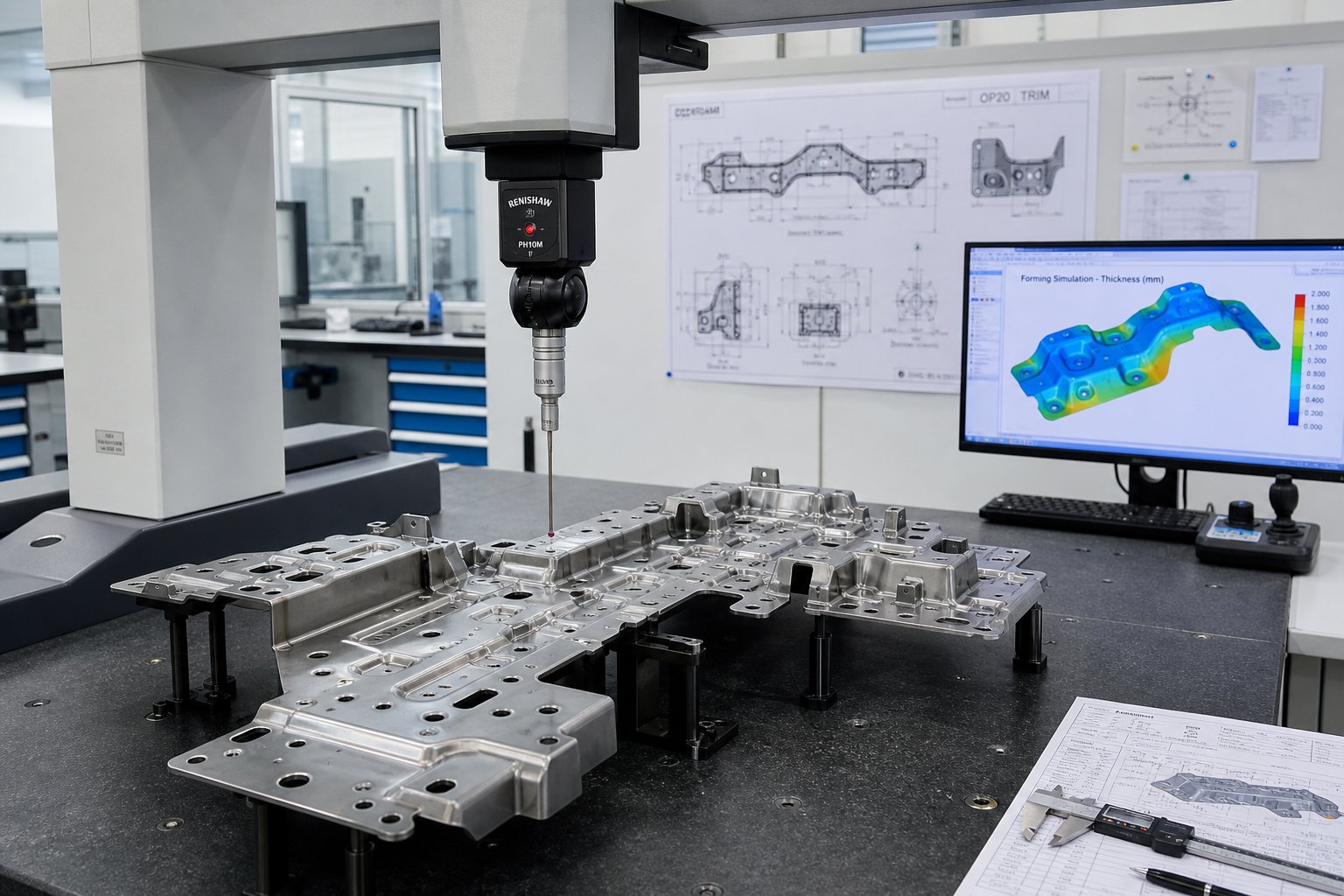
- Tolerance verification capabilities: Confirm the supplier operates CMM equipment, functional gauges, and SPC programs that can validate the dimensional requirements your part demands. A supplier quoting tight tolerances without the metrology infrastructure to verify them is making promises they can't substantiate.
- Tryout press availability: Suppliers with in-house tryout presses matching your production press tonnage and bed size can debug tooling before it ships. Without this, your production press becomes the tryout platform, consuming your floor time for their debugging.
Assessing Design Support for Complex Multi-Station Forming
The transfer die stamping partner evaluation criteria extend beyond what a supplier can manufacture. Equally important is what they can engineer. Complex parts requiring deep draws, multiple redraws, piercing across formed surfaces, and tight positional tolerances between features created at different stations demand collaborative design support from the tooling supplier.
Ask prospective partners these questions during evaluation:
- How do you determine the minimum number of stations required for a given part geometry and material?
- What forming simulation tools do you use, and can you share sample reports showing predicted thinning, wrinkling risk, and springback compensation?
- How do you design locating systems that compensate for operator placement variability in manual transfer, and how do those change when transitioning to robotic handling?
- What is your process for first-article inspection and production part approval (PPAP or equivalent)?
- Can you support design-for-manufacturability feedback before geometry is frozen?
Suppliers offering genuine engineering partnership will engage with these questions technically rather than deflecting to sales language. For example, YICHEN structures their transfer stamping die capabilities around helping engineers evaluate multi-station forming for larger or complex parts, with support spanning robotic transfer configurations and repeatability validation. That kind of engineering-forward positioning, where the supplier's process begins with collaborative evaluation rather than just quoting a price, signals the depth of design support you should expect from any serious transfer die partner.
Red flags during assessment include: suppliers who quote station count without asking about your material's formability data, partners who cannot explain their locating feature strategy for your specific part geometry, and shops that treat die tryout as a single-day event rather than an iterative process of measurement, adjustment, and revalidation.
Why Stable Repeatability Matters for Production Confidence
Ultimately, what separates a functional transfer die from a profitable one is repeatability across production lots. A die that produces good parts during tryout but drifts after 5,000 hits creates hidden cost through increased inspection, containment activities, and customer quality escapes. Your evaluation should probe how a supplier ensures dimensional stability over the tooling's full production life.
Key repeatability factors to assess:
- Tool steel selection and heat treatment: D2, A2, and M2 tool steels with proper hardening and tempering resist wear at forming surfaces and cutting edges. Ask what materials the supplier specifies for high-wear stations and how they determine when inserts need replacement.
- Preventive maintenance planning: Does the supplier provide a recommended maintenance schedule tied to hit count? As quality control research from ITD Precision documents, scheduling proactive tool maintenance based on production cycles rather than failure extends tool life and maintains part quality over longer runs.
- SPC data from tryout and initial production: Suppliers who deliver Cpk data alongside first-article parts demonstrate process capability rather than just dimensional conformance on a handful of samples.
- Documented forming process windows: Tonnage settings, lubrication specifications, blank positioning criteria, and acceptable material property ranges should be documented and delivered with the tooling. Without these, your production team is guessing at parameters that the tooling builder already optimized during development.
Production confidence comes from knowing that part number 10,000 will match part number 10 within your tolerance band. That confidence is built during supplier selection, not discovered after tooling arrives on your floor. The transfer die stamping partner you choose shapes not just what you pay for tooling today, but what your quality costs, scrap rates, and customer satisfaction look like for the entire production life of the part.
Frequently Asked Questions About Manual Transfer Die Stamping
1. What is the difference between manual transfer die stamping and progressive die stamping?
In progressive die stamping, a continuous metal strip feeds through stations while remaining attached to the carrier strip until final cutoff. Manual transfer die stamping uses individual free-standing blanks that an operator physically moves between separate die stations. This allows the workpiece to be rotated, flipped, or repositioned between operations, enabling complex geometries like deep draws and multi-axis forming that strip-fed progressive dies cannot produce. Progressive dies excel at high-volume smaller parts, while manual transfer handles medium-to-large parts with complex geometry at lower volumes.
2. What production volumes justify manual transfer die stamping over automated transfer?
Manual transfer die stamping is typically most economical for annual volumes between 1,000 and 50,000 parts. The break-even point where automated transfer becomes more cost-effective generally falls between 50,000 and 150,000 parts annually, depending on part complexity, cycle time, labor rates, and automation integration costs. Manual transfer carries lower capital investment but higher per-part labor costs, so as volume increases, the accumulated labor expense eventually exceeds the upfront automation investment spread across more pieces.
3. What tolerances can manual transfer die stamping achieve?
Manual transfer die stamping can achieve tolerances of approximately ±0.05 mm on formed features and ±0.03 mm on pierced hole locations, with precision coining stations reaching ±0.02 mm on critical surfaces. However, operator placement variability introduces a factor that automated systems eliminate. Well-designed locating features like pilot pins, nest blocks, and gauge rails compensate by guiding the workpiece to exact position regardless of slight variations in operator placement, maintaining tight dimensional control across production runs.
4. What safety systems are required for manual transfer die stamping operations?
Manual transfer die stamping requires layered safety systems per OSHA 1910.217 standards. Essential elements include two-hand controls ensuring both hands are clear during press cycling, presence-sensing light curtains that halt the press if an operator breaks the sensor plane, physical die guards or barrier devices, anti-repeat mechanisms preventing unintended second strokes, brake monitoring systems, and lockout/tagout procedures for maintenance. These redundant safeguards ensure no single failure can result in operator injury during the transfer process.
5. How do you evaluate and select a transfer die stamping supplier?
Evaluate suppliers based on multi-station die design expertise (four or more forming stations), experience with both manual and robotic transfer configurations, FEA forming simulation capabilities, material handling knowledge for larger or complex parts, tolerance verification infrastructure like CMM equipment and SPC programs, and in-house tryout press availability. Suppliers like YICHEN offer engineering-forward evaluation support for multi-station transfer dies, helping engineers assess forming feasibility before committing to tooling. Red flags include quoting station count without asking about material formability or inability to explain locating feature strategy for your specific geometry.


