


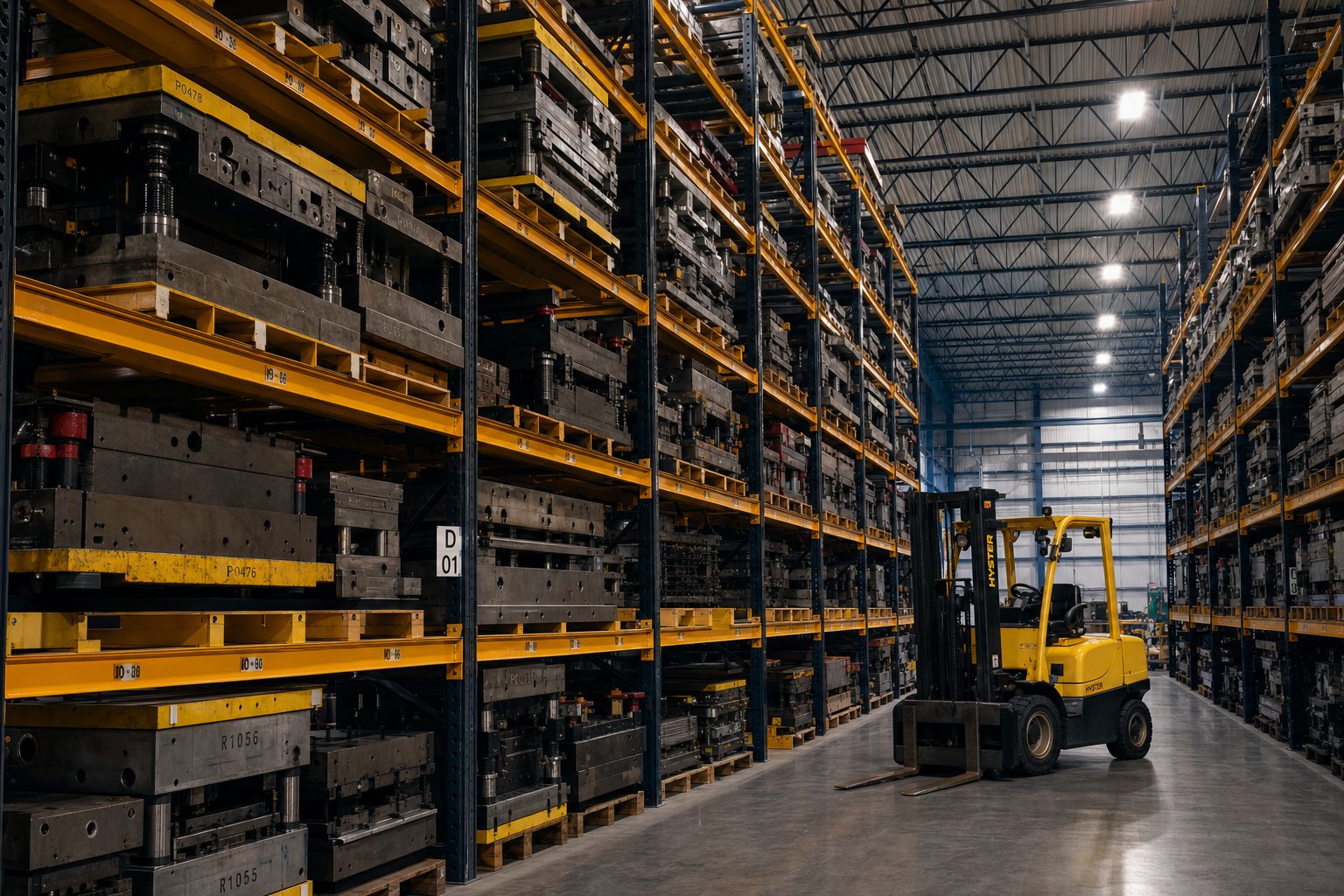
Understanding Stamping Die Storage Systems and Why They Matter
Imagine a single stamping die weighing several thousand pounds, costing tens of thousands of dollars, sitting on a pallet in the middle of your shop floor. It's exposed to forklift traffic, moisture, and accidental impacts. Every day it stays there, you're gambling with both its precision surfaces and your team's safety. That scenario plays out in stamping facilities everywhere, and it's exactly the problem that purpose-built stamping die storage systems exist to solve.
What Are Stamping Die Storage Systems
Stamping die storage systems are engineered racking and shelving structures designed specifically to support, protect, and organize heavy stamping dies between production runs, featuring reinforced load-bearing frames, precision access mechanisms, and safety interlocks that standard warehouse racking cannot provide.
These systems are a distinct category from general-purpose pallet racks for one simple reason: concentrated weight. A standard warehouse shelf distributes relatively light loads across a wide beam. A stamping die, by contrast, places thousands of pounds on a compact footprint, creating point-load stresses that conventional racking was never engineered to handle. Purpose-built die storage racks address this with structural steel frames, heavy-gauge columns, and shelf designs rated for loads typically ranging from 2,000 to 6,000 lbs per level.
Core components you'll find across most systems include reinforced main columns (often channel steel or structural I-beams), adjustable shelf heights to accommodate various die sizes, integrated safety locks to prevent unintended movement, and corrosion-resistant surface treatments that protect both the rack and the tooling it holds.
Who Needs Purpose-Built Die Storage
Three groups typically drive the decision to invest in dedicated tool and die storage racks:
- Maintenance managers evaluating workplace safety, looking to eliminate floor-level tripping hazards and reduce the risk of catastrophic shelf failures under heavy loads.
- Operations managers building a capital expenditure case, quantifying how disorganized storage inflates die changeover times and eats into press uptime.
- Engineers specifying system requirements, matching die weights and dimensions to load ratings, access methods, and facility constraints like floor load capacity and ceiling height.
If you fall into any of these roles, you'll find this article covers the full landscape: from structural I-beam die racks and roll-out drawer systems to die storage bases, widespan shelving, and custom configurations. You'll also find guidance on safety compliance, die preservation during storage, selection frameworks, workflow integration, and total cost of ownership. The goal is to give you one comprehensive resource rather than scattered product pages that each tell only part of the story.
The real question isn't whether your dies need dedicated storage. It's whether the storage you already have is quietly damaging them, and what that's actually costing you.
Why General-Purpose Storage Fails for Heavy Stamping Dies
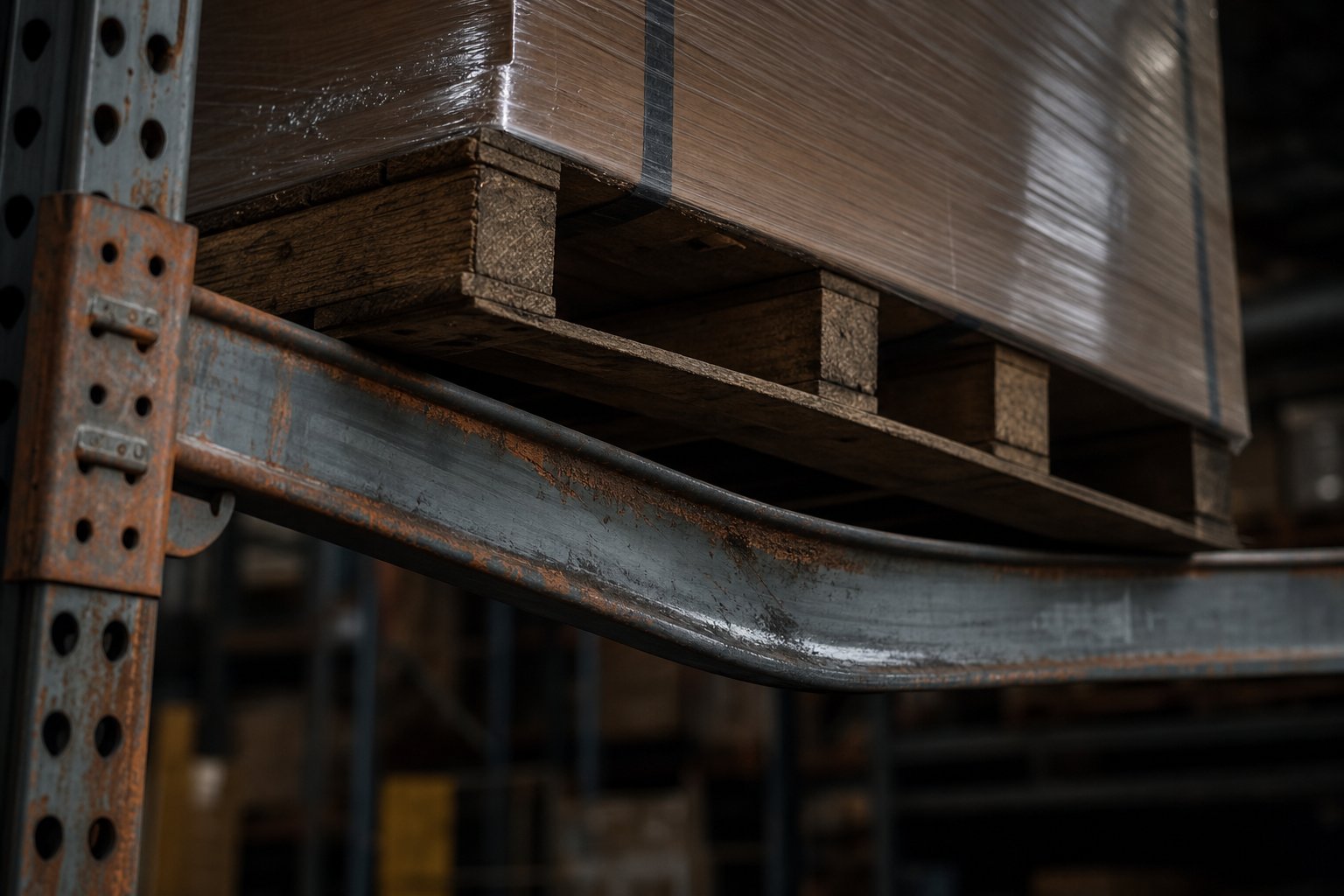
A stamping die doesn't behave like a palletized box of consumer goods. It's a dense, compact mass of hardened tool steel that concentrates thousands of pounds onto a small footprint. When you place that kind of load on a rack designed for evenly distributed cartons, you're setting the stage for a failure that may not announce itself until it's catastrophic.
Why Standard Pallet Racks Fail for Stamping Dies
The core issue comes down to how weight reaches the beam. Standard pallet racking is engineered for uniformly distributed loads-products whose weight spreads evenly across the beam's full span via flat-bottomed pallets. A stamping die does the opposite. It creates a severe point load, concentrating its entire mass on a narrow contact area. Even if the die weighs the same as a palletized load the beam was rated for, the concentrated force can cause deflection well beyond the allowable L/180 ratio specified in ANSI MH16.1 standards. That excess deflection leads to beam bowing, connection stress, and eventual structural failure.
Think of it this way: imagine standing on a frozen pond in snowshoes versus standing on the same ice in stiletto heels. The weight is identical, but the pressure per square inch is dramatically different. Heavy stamping dies exert that "stiletto heel" effect on standard rack beams.
The problem compounds at higher storage levels. Overloading and unequal load distribution are among the leading causes of warehouse racking collapses, and storing compact, heavy dies on upper shelves magnifies the risk of frame instability and toppling. Standard wire mesh decking, unless specifically engineered for point loads per ANSI MH26.2, can also fail under the concentrated weight-allowing a multi-thousand-pound die to drop without warning.
Here are the specific failure scenarios that make standard pallet racks a dangerous mismatch for die storage:
- Beam deflection beyond rated limits: Point loads from dies exceed the bowing threshold of beams designed for distributed weight, risking sudden collapse.
- Decking failure: Standard wire mesh or corrugated steel decking buckles under concentrated loads it was never engineered to handle.
- Upright overloading: Die weights frequently surpass the per-level capacity of a heavy duty racking system built for general warehouse use, stressing columns and base plates beyond safe thresholds.
- Forklift compatibility gaps: Standard shelving depths and beam heights often don't match the clearances needed for safely positioning wide or oddly shaped dies, increasing the risk of forklift collisions that dent protective coatings and expose metal to corrosion.
Hidden Risks of Floor Storage and Makeshift Solutions
When racks aren't up to the task, many shops default to the simplest option: stack dies on the floor. It seems harmless. The floor can obviously handle the weight, right? Structurally, perhaps. But the real costs of floor storage are measured in injuries, corrosion, and lost production time.
Dies sitting directly on concrete floors are exposed to standing moisture, condensation, and temperature swings that accelerate surface corrosion on precision-ground shut faces and cutting edges. That corrosion doesn't just damage the die-it degrades part quality when the tool returns to the press. Meanwhile, dies scattered across the shop floor create an obstacle course for foot traffic and forklift routes, generating tripping hazards and pinch points that standard safety walks consistently flag.
Improvised solutions introduce their own dangers. Workers often resort to wooden blocks or scrap material to prop dies at working height or keep them off damp concrete. These makeshift supports lack engineered load ratings, and a die slipping off an unstable wooden block is one of the most common sources of crush injuries in tool rooms. The risk multiplies during die handling-when a forklift sets a die onto an uneven stack of lumber, even a slight shift can send tons of steel sliding unpredictably.
Common die storage injuries tied to inadequate systems include:
- Crush injuries from dies slipping or tipping off unstable supports, particularly improvised wooden blocks without engineered load limits.
- Struck-by incidents when dies fall from overloaded or deflecting rack beams, especially at upper storage levels.
- Musculoskeletal injuries caused by awkward manual positioning of dies in floor-level or poorly accessible storage locations.
- Forklift-related accidents in cluttered floor storage areas with insufficient aisle clearance, leading to collisions with stored tooling or personnel.
- Slip and trip hazards from dies, pallets, and makeshift supports obstructing walkways and forklift travel paths.
Prevention starts with acknowledging that heavy duty die storage solutions aren't a luxury-they're an engineering requirement. Stamping die rack safety depends on matching the storage system to the actual load characteristics of the tooling it holds: concentrated weight, compact footprint, and the need for stable, secure positioning at every storage level. Any gap between what the rack is rated for and what the die demands is a gap where injuries and equipment damage happen.
The real question, then, isn't whether your current setup can physically hold a die. It's whether it can hold that die safely, repeatedly, and without silently degrading the tooling or putting your team at risk. And answering that question requires understanding the full range of storage system types engineered specifically for this job.
Comparing Every Type of Die Storage System
Not all die storage is created equal, and selecting the wrong type can cost you just as much as having no dedicated system at all. Each design solves a specific set of problems-weight capacity, access speed, floor space, budget-and understanding these tradeoffs is what separates a smart investment from an expensive mistake. Here's how the five main system types stack up against each other.
Structural I-Beam Die Racks
These are the heavy lifters of the die storage world. Built from structural steel I-beams or heavy-gauge tubular columns (typically 3" x 3" or 4" x 4" in 7- or 11-gauge steel), they deliver the highest load ratings available in a rack-style format. Shelves are usually solid sheet metal over tubular beam supports, with capacities ranging from 250 to 500 pounds per square foot-translating to 2,000 to 6,000+ lbs per shelf level depending on dimensions. Column heights reach 96", 120", or 144", and shelf widths range from 72" to 120".
Access is straightforward: forklifts slide dies on and off via integrated fork entry bars. That simplicity is both the strength and the limitation. You'll need clear aisle space for forklift maneuvering, and overhead crane access isn't built into the design. These racks work best for facilities with large die inventories, high individual die weights, and available forklift infrastructure.
Roll-Out Drawer Storage Systems
Imagine pulling a shelf toward you like a giant drawer, exposing the full die surface for overhead crane or hoist access. That's the principle behind roll-out systems. Shelves glide forward with 75% to 100% extension on heavy-duty linear bearings, with capacities reaching up to 4,000 pounds per shelf in manual configurations and even higher in powered versions.
Options include hand-crank, push-button motorized, or fully manual pull-out mechanisms. Safety interlocks prevent more than one shelf from opening simultaneously, and lock-out features hold the extended shelf in position during loading. These systems excel in tight floor spaces where aisle width limits forklift access, or in facilities relying on overhead cranes for die handling. The tradeoff? Higher upfront cost and more mechanical components requiring periodic maintenance.
Die Storage Bases and Block Systems
Die storage bases take the opposite approach to vertical racking-they keep dies at floor level on engineered steel platforms or blocks. Rather than stacking dies vertically, each base holds a single die at a consistent, stable height optimized for forklift pickup. These are essentially precision-leveled steel frames or blocks that replace the improvised wooden supports discussed earlier.
The advantage is simplicity and immediate accessibility. No vertical structure means no overhead clearance concerns, no beam deflection risk, and no climbing to upper levels. They're ideal for very large progressive dies that exceed the width or weight limits of racked systems, or for dies that cycle in and out of production so frequently that vertical storage adds unnecessary handling steps. The limitation is obvious: floor space consumption. Each die claims its own footprint with no vertical stacking benefit.
Widespan and Mold Storage Shelving
Widespan racking occupies the middle ground between standard pallet racks and full structural die racks. These systems use reinforced beams spanning wider distances (typically 72" to 96") with heavier-gauge decking, designed for moderate loads that exceed general shelving but fall below the heaviest stamping dies. They're commonly found in facilities storing injection mold storage racks alongside lighter press tooling, where die weights range from 500 to 2,000 lbs per level.
Mold storage racks in this category often feature adjustable shelf heights with closer increment spacing (as fine as 3" adjustments), making them versatile for mixed tooling inventories. Access is typically by forklift or hand-operated pallet jack for lower levels. The key limitation is capacity ceiling-these won't handle the multi-ton progressive dies that structural I-beam racks manage easily.
Custom Welded Racks
When standard configurations don't match your die inventory, custom welded racks fill the gap. These are fabricated to exact specifications-specific shelf dimensions, non-standard column spacing, integrated crane rail attachments, or unusual weight distribution patterns. They're common in automotive stamping plants where dies have unique geometries that no off-the-shelf system accommodates cleanly.
Custom solutions deliver perfect fit but sacrifice flexibility. Reconfiguring a welded rack for different die sizes usually means cutting steel and re-welding, not simply adjusting shelf positions. Lead times run longer, and engineering costs add a significant premium over catalog options.
| Type | Best For | Typical Capacity Per Level | Access Method | Floor Space Efficiency | Relative Cost |
|---|---|---|---|---|---|
| Structural I-Beam Racks | Heavy die inventories, high-volume stamping facilities | 2,000–6,000+ lbs | Forklift with fork entry bars | High (vertical stacking) | Medium-High |
| Roll-Out Drawer Systems | Crane-served shops, tight aisles, precision access | 4,000–15,000 lbs | Overhead crane/hoist after shelf extension | Very High (narrow aisle compatible) | High |
| Die Storage Bases | Very large/heavy dies, high-frequency changeovers | Single die per base (unlimited by design) | Forklift direct pickup | Low (one die per footprint) | Low |
| Widespan/Mold Storage Shelving | Mixed tooling, injection molds, lighter dies | 500–2,000 lbs | Forklift or pallet jack | Medium-High | Low-Medium |
| Custom Welded Racks | Non-standard die geometries, unique facility constraints | Varies by engineering spec | Varies (forklift, crane, or hybrid) | Optimized to application | Highest |
Each system type addresses a specific intersection of weight, access frequency, space, and budget. The right choice rarely comes down to a single factor-it's about how your dies, your facility layout, and your handling equipment work together as a system. And that system-level thinking extends beyond the rack itself into the safety standards and engineering certifications that validate whether a given configuration can actually perform as rated under real-world conditions.

Safety Standards and Compliance for Die Storage Installations
A die storage rack might look solid. The welds are clean, the columns are thick, and the sales spec sheet lists impressive numbers. But how do you know those numbers are real? Without verified engineering standards and regulatory compliance, you're trusting marketing claims with multi-ton loads suspended above your team's heads. Stamping die rack OSHA compliance isn't a checkbox exercise-it's the difference between a system that performs as rated and one that's an unverified liability.
OSHA Requirements for Heavy Die Storage
OSHA doesn't publish a regulation titled "stamping die racks." Instead, several general industry and construction standards apply directly to how heavy tooling must be stored. The most relevant provisions come from 29 CFR 1926.250 and 29 CFR 1910.176, which together establish the legal framework for safe material storage in industrial facilities.
Here's what these regulations require when applied to heavy duty tool and die racks:
- Securing against displacement: All materials stored in tiers must be stacked, racked, blocked, interlocked, or otherwise secured to prevent sliding, falling, or collapse (1926.250(a)(1)). For stamping dies, this means positive retention mechanisms-shelf lips, bolted restraints, or cradle designs that prevent lateral movement during seismic events or accidental forklift contact.
- Floor load limits: The weight of stored materials shall not exceed maximum safe load limits, and employers must conspicuously post those limits in pounds per square foot in all storage areas (1926.250(a)(2)). When you're concentrating 4,000+ lbs on a single rack footprint, knowing your slab's actual capacity matters.
- Clear aisles and passageways: Aisles must be kept clear for safe movement of material handling equipment and employees (1926.250(a)(3)). For die storage areas, this typically means maintaining minimum 12-foot aisles for standard forklifts or wider clearances when using extended-reach trucks to access upper rack levels.
- Storage area housekeeping: Areas must remain free from accumulations that create tripping, fire, or other hazards (1926.250(c)). Dies stored on floor-level blocks or bases must not obstruct emergency egress paths.
- Load rating compliance: Under 1910.176(b), storage loads must not exceed the rated capacity for racks, floors, or platforms. This is the core rule that makes verified die storage rack load capacity documentation legally necessary-not optional.
What catches many facilities off guard is the posting requirement. You'll need load capacity placards visible at each rack bay, specifying the maximum weight per shelf level. During an OSHA inspection, the absence of these placards can trigger citations regardless of whether the rack is actually overloaded.
Engineering Certifications and Load Testing Standards
Sounds straightforward-just check the spec sheet, right? The problem is that not all load ratings carry the same credibility. A manufacturer can print any number on a brochure. What you want is a PE-stamped load capacity document.
A Professional Engineer (PE) certification on load documentation means a licensed engineer has reviewed the structural calculations, verified material properties, and confirmed that the stated capacities meet applicable engineering codes under specified conditions. This isn't a rubber stamp. PEs carry personal legal liability for the accuracy of their certifications, which gives those numbers weight that marketing claims simply don't have.
When evaluating heavy duty tool and die racks, here are the certifications and standards buyers should verify before purchase:
- PE-stamped load capacity drawings: Detailed engineering documents showing maximum allowable loads per shelf level, per bay, and cumulative per frame, signed by a licensed Professional Engineer.
- ANSI MH16.1 compliance: The Rack Manufacturers Institute (RMI) specification for industrial steel storage racks, covering design calculations, load combinations, and safety factors.
- Material certifications: Mill certificates confirming steel grade. Grade 50 steel (50,000 psi minimum yield strength) in structural beams is a recognized quality benchmark for heavy-capacity racks-if a manufacturer claims it, ask for the mill cert to verify.
- Weld certifications: AWS D1.1 or D1.3 compliance for structural welding, particularly critical for custom-fabricated racks where weld quality directly determines load-bearing integrity.
- Load testing documentation: Physical load test results demonstrating performance at rated capacity, ideally at 125% of stated working load to confirm safety margin.
If a supplier can't produce PE-stamped documentation or hesitates when asked about ANSI MH16.1, that's a red flag. The die storage rack load capacity printed in a catalog means nothing without engineering validation behind it. Reputable manufacturers provide these documents as standard practice-not as an upsell.
Seismic Design and Facility Safety Factors
Here's a detail many buyers outside California overlook: seismic design requirements apply to storage racks in far more regions than you might expect. According to the Rack Manufacturers Institute, the United States experiences over 50 earthquakes per day on average, and the International Building Code now requires all pallet rack systems to be designed and built to withstand seismic activity-regardless of geographic location.
For stamping die storage, the stakes are amplified by sheer mass. A conventional warehouse rack holding cartons might shed some product during a seismic event. A die rack holding 20,000+ lbs of tool steel across multiple levels becomes a catastrophic hazard if it isn't engineered for lateral forces. The consequences of a multi-ton die displacing during even a moderate seismic event are severe enough that this factor deserves serious attention during specification.
What changes in seismic-rated die storage systems compared to standard designs?
- Larger base plates and more anchor bolts: Higher seismic zones demand wider column footprints and additional concrete anchoring to resist overturning moments.
- Heavier gauge steel and frames with bigger footprints: The lateral forces generated during ground acceleration require stiffer frame assemblies than static load calculations alone would dictate.
- Enhanced beam-to-column connections: Connector sizes increase to maintain structural integrity under dynamic cycling loads that static designs never experience.
- Thicker concrete slab requirements: Supporting slabs in high-seismic areas may need to be several inches thicker than standard, adding significant cost when multiplied across a large die storage installation.
- Site-specific engineering: Seismic requirements are no longer classified by broad "zones." Two facilities in the same state-even the same city-can have different design requirements based on precise GPS coordinates, soil classification, and building code category (ranging from A to F).
The practical implication? You can't simply buy a die rack rated for a facility in Ohio and install it in a plant near Memphis or Salt Lake City without verifying seismic compatibility. Similarly, relocating existing racks to a new facility requires a structural review confirming the system meets all loading criteria at the new location. Consulting the USGS seismic design maps with your specific address gives you the baseline parameters your rack engineer needs.
Between OSHA's storage mandates, PE-certified load documentation, and seismic design factors, the compliance landscape for die storage is more involved than most buyers initially assume. But these aren't bureaucratic hurdles-they're the engineering safeguards that determine whether your investment actually protects your tooling and your people over the long term. And protecting tooling goes beyond structural security. How dies are preserved during their time in storage-corrosion prevention, climate considerations, maintenance protocols-has just as much impact on whether they perform when they return to the press.
Die Preservation Best Practices During Storage
A structurally sound rack keeps your dies safe from collapse. But what keeps them safe from the silent, invisible damage happening while they sit idle? Corrosion, moisture infiltration, and neglected maintenance between production runs destroy more die surfaces than forklift impacts ever will. The irony is brutal: you invest in purpose-built mold die storage racks to protect expensive tooling, then let environmental conditions slowly eat away at the very precision you're trying to preserve.
Stamping die corrosion prevention isn't glamorous work. It doesn't show up in dramatic failure photos or OSHA incident reports. It shows up weeks or months later, when a die returns to the press and the first hundred parts come out with surface defects, dimensional drift, or inconsistent material flow. By then, the damage is done-and it traces back to what happened (or didn't happen) during storage.
Corrosion Prevention and Climate Control
Steel corrodes. That's not news. What catches many tooling managers off guard is how quickly it happens in uncontrolled storage environments. A stamping die with exposed tool steel surfaces can develop visible surface oxidation in as little as 24 to 48 hours when relative humidity exceeds 60%. Ground and polished shut faces are especially vulnerable because their smooth finish offers no protective oxide layer-the very precision that makes them effective in production makes them defenseless in storage.
Three layers of defense work together to prevent stamping die corrosion during storage:
- Contact corrosion inhibitors: Spray-on rust preventatives with a grease or oil-film consistency coat exposed steel surfaces to block moisture contact. Products like ZERUST Axxanol Spray-G provide protection for up to one year in outdoor conditions and two years indoors, offering a direct barrier between tool steel and ambient humidity.
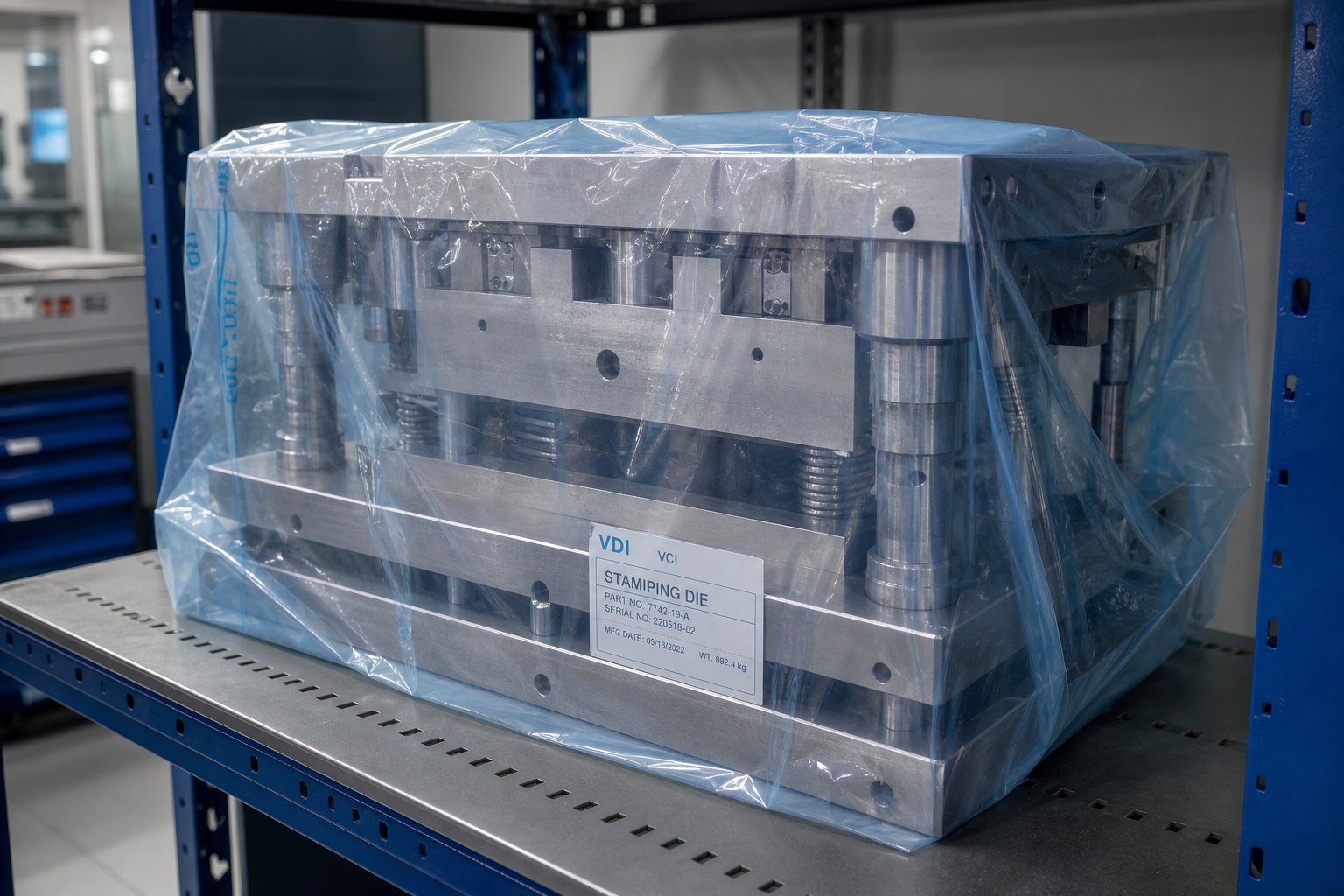
- Vapor Corrosion Inhibitor (VCI) materials: VCI technology releases invisible molecules that form a protective layer on metal surfaces within an enclosed space. VCI shrink films, packets, and paper liners protect hard-to-reach internal surfaces-cavities, channels, and recessed areas-that spray coatings can't easily cover. The critical requirement is enclosure: VCI molecules dissipate in open air, so dies must be sealed within film or wrap for the technology to function.
- Climate-controlled storage areas: Maintaining relative humidity below 50% and stable temperatures eliminates the condensation cycles that trigger flash rust. Facilities in humid climates or those with significant temperature swings between shifts benefit most from dedicated climate zones within their die storage areas. Even basic dehumidification in an enclosed rack bay makes a measurable difference.
You'll notice that these methods aren't mutually exclusive. The most effective preservation programs layer all three: direct-contact coatings on exposed surfaces, VCI materials for enclosed cavities, and environmental controls for the storage space itself. Skipping any one layer leaves a gap where corrosion finds its way in.
Maintenance Scheduling Between Production Runs
Die maintenance between production runs is where most facilities drop the ball. The die comes off the press, gets placed on a rack, and sits untouched until the next order arrives. That gap-whether it's two weeks or six months-is when preventable damage accumulates silently.
As Art Hedrick notes in The Fabricator, true preventive die maintenance involves regular scheduled activities regardless of how well the die was engineered: sharpening cutting sections before they chip, replacing springs before failure, inspecting for loose fasteners, and cleaning debris that accelerates wear. These tasks don't stop being necessary just because the die is in storage. In fact, storage is the ideal time to complete them-when production pressure isn't forcing shortcuts.
Here's a step-by-step die storage preparation checklist to follow every time a die comes off the press:
- Clean all surfaces thoroughly. Remove slugs, slivers, lubricant buildup, and any metallic debris from cutting stations, guide pins, and internal channels. Residual stamping lubricant left in place attracts contaminants and can become acidic over time.
- Inspect for damage and wear. Check cutting edges for chipping or dulling, verify all fasteners are tight, look for galled surfaces on wear plates and cam drivers, and confirm all springs are intact. Document findings in the die's maintenance record.
- Complete any due maintenance. If cutting sections need sharpening or springs are approaching end-of-life, address it now rather than discovering the problem during the next setup. Storage time is free maintenance time.
- Dry all surfaces completely. Any residual moisture-from cleaning solvents, coolant, or condensation-must be eliminated before applying protective coatings. Compressed air and lint-free cloths work for accessible areas; warm air circulation handles internal cavities.
- Apply corrosion-preventive coatings. Spray all exposed tool steel surfaces-cutting edges, forming faces, guide surfaces-with a suitable rust preventative. Pay special attention to ground and polished areas with no protective finish.
- Install VCI protection for enclosed areas. Place VCI packets or sheets between upper and lower die halves, inside cavities, and around precision components. Seal the assembly within VCI shrink film, ensuring all seams are taped with preservation tape to maintain the enclosed atmosphere.
- Record storage location and date. Log the die's rack position, preservation method used, and any pending maintenance items in your tracking system. Set a calendar reminder for periodic inspection-typically every 90 days for indoor storage, more frequently for outdoor or semi-enclosed environments.
That 90-day inspection interval matters. Even sealed VCI enclosures can develop holes from handling damage or environmental exposure. A quick visual check and integrity verification of the protective wrapping prevents a six-month corrosion problem from developing unnoticed.
How Storage Conditions Impact Die Longevity
Here's the connection that makes all this effort worthwhile: storage conditions directly determine production quality when a die returns to service. A die that sat in uncontrolled humidity for three months without protection doesn't just look rough-it performs differently. Surface oxidation on forming faces increases friction coefficients, altering material flow patterns and producing inconsistent part geometry. Corroded cutting edges fracture rather than wear gradually, leading to premature resharpening or section replacement. Pitted guide surfaces introduce play that compounds with every stroke.
The cumulative effect accelerates die degradation across its entire lifecycle. Each storage cycle without proper preservation removes a small but irreversible layer of useful die life. Over years of intermittent production, that accumulation can cut total die lifespan by 20% to 40%-a staggering cost when you consider that a complex progressive die can represent a six-figure investment.
Dies engineered with maintainability and durability in mind respond better to proper storage protocols. When surface treatments, material selections, and component designs are optimized for long-term performance stability from the outset-as manufacturers like YICHEN emphasize in their custom stamping die engineering-the tooling is inherently more resilient during storage intervals. Hardened coatings resist oxidation longer, precision-ground surfaces maintain their finish integrity under protective films, and robust component designs tolerate the minor environmental fluctuations that occur even in well-managed storage areas.
Proper die preservation isn't separate from die storage system selection-it's the other half of the equation. The rack protects against physical damage. The preservation protocol protects against chemical and environmental damage. Together, they form a complete storage strategy that maintains die accuracy and extends productive life across every production cycle.
Still, even the best preservation program can't compensate for a storage system that doesn't match your actual die characteristics. Weight, dimensions, access frequency, and facility constraints all feed into a selection decision that determines whether your investment in storage actually delivers the protection and efficiency it promises.
How to Select the Right Die Storage System for Your Facility
Knowing the system types is one thing. Knowing which one belongs in your facility-given your specific dies, your floor, your handling equipment, and your production rhythm-is where most buyers get stuck. Manufacturer spec sheets list capacities and dimensions, but they rarely explain how those numbers translate to your real-world constraints. This die storage system selection guide bridges that gap by walking through the three factors that drive every successful installation: die characteristics, facility readiness, and access patterns.
Matching Die Characteristics to Storage System Type
Start with the dies themselves. Pull your tooling inventory and sort it by weight class, because weight is the single largest determinant of which system you need. A 500 lb trim die and a 12,000 lb progressive transfer die don't belong in the same rack category-and trying to force them into one system either over-spends on lighter tooling or under-specs for the heavy stuff.
Dimensions matter nearly as much as weight. A die that's 48" wide fits comfortably on a standard 72" shelf, but a large automotive panel die spanning 96" or wider demands extended-width bays or dedicated die storage bases. Height is equally critical-tall dies reduce the number of usable shelf levels within a given rack, eating into the vertical space efficiency that makes racked storage worthwhile in the first place.
For die stamping support for large parts, where progressive dies often exceed 8 feet in length and weigh 5,000 to 15,000 lbs, roll-out drawer systems or floor-level die bases typically outperform vertical racking. The sheer footprint of these tools makes overhead crane access more practical than forklift insertion, and roll-out shelves give the crane operator full top-side exposure without maneuvering into tight rack bays.
Use this decision matrix to match your die inventory to the appropriate system type:
| Die Weight Class | Recommended System Type | Minimum Aisle Width | Floor Load Requirement | Retrieval Equipment |
|---|---|---|---|---|
| Under 1,000 lbs | Widespan shelving | 10 ft | 150–250 psf | Forklift or pallet jack |
| 1,000–3,000 lbs | Structural I-beam racks | 12 ft | 250–350 psf | Standard forklift |
| 3,000–6,000 lbs | Structural I-beam or roll-out drawer | 12–14 ft | 350–500 psf | Heavy-duty forklift or overhead crane |
| 6,000–15,000 lbs | Roll-out drawer systems | 8–10 ft (crane-served) | 500–750 psf | Overhead bridge crane |
| Over 15,000 lbs | Die storage bases (floor level) | 14+ ft (forklift) or crane bay | 750+ psf | Heavy-capacity crane or coil car |
Notice how aisle width requirements actually decrease for heavier dies when crane access replaces forklifts. That's counterintuitive until you realize the crane travels overhead-eliminating the turning radius that eats floor space with forklift-served racks.
Facility Preparation and Floor Load Assessment
Your building has limits, and discovering them after installation is expensive. Heavy die rack floor load requirements often surprise facility managers who've never concentrated this much weight in a defined area before.
Floor load capacity is expressed in pounds per square foot (psf) and varies across a building's footprint. A typical industrial slab handles 150–250 psf as a uniform distributed load. But a die rack doesn't distribute weight uniformly-it concentrates the entire bay load through four to six column base plates, each measuring roughly 6" x 6". That creates a concentrated load scenario where the effective pressure at each base plate can exceed 1,000 psi, far above what standard slabs tolerate without reinforcement.
Before committing to a system, verify three things about your facility:
- Slab thickness and reinforcement: Request the original structural drawings or commission a ground-penetrating radar (GPR) scan to confirm slab depth and rebar layout. A 6" unreinforced slab has dramatically different capacity than an 8" slab with #5 rebar on 12" centers.
- Soil conditions beneath the slab: Even a properly reinforced slab can settle or crack if the subgrade compaction is inadequate for concentrated loads. A geotechnical assessment identifies this risk before it becomes a problem.
- Column base plate sizing: Your rack supplier should provide base plate dimensions and anchor bolt patterns. Larger base plates spread the load across more slab area, reducing point pressure. If your floor capacity is marginal, specifying oversized base plates is often cheaper than reinforcing the slab.
Ceiling height is the other constraint that catches people. You need enough vertical clearance not just for the rack itself, but for the forklift mast fully extended above the top shelf level. Per warehouse design standards, a minimum clearance of 19.7 inches must remain between the top of the retracted mast and any overhead obstruction-beams, sprinkler lines, lighting, or the ceiling itself. For a rack with a 120" top shelf and a forklift requiring 160" of mast height, you'll need at least 180" (15 feet) of unobstructed ceiling height.
Access Frequency and Retrieval Method Planning
How often does each die leave storage? That question shapes your layout more than any spec sheet number. High-frequency dies-those cycling in and out weekly or more-need ground-level positions or lower rack shelves with minimal retrieval steps. Low-frequency dies, perhaps seasonal or backup tooling, can occupy upper levels where access takes longer but floor space stays available for active inventory.
Think of it like a library. The books you reference daily go on the desk. The ones you check quarterly go on the middle shelves. The ones you open once a year go on the top shelf. Your die storage layout should follow the same logic, with position assignments driven by production scheduling data rather than arbitrary placement.
Retrieval method planning also feeds directly into aisle width decisions. Forklift aisle widths correspond to the specific machine type serving the rack. Standard counterbalanced forklifts need 12 to 13 feet of clear aisle. Reach trucks reduce that to 9 to 10 feet. Crane-served systems can function with aisles as narrow as 6 to 8 feet since the load travels overhead. If your facility has fixed column spacing or limited square footage, the retrieval method you choose may dictate which rack system is even feasible.
For facilities planning automated retrieval or future integration with die tracking software, also consider utility access at the storage location-power for motorized roll-out shelves, data cabling for RFID readers, or compressed air for automated locking mechanisms. Retrofitting these utilities after rack installation means disassembly, downtime, and rework that proper upfront planning eliminates entirely.
Selecting the right system is ultimately a matching exercise: your dies' physical demands, your building's structural reality, and your operational tempo all have to align. Get that alignment right, and the storage system becomes an invisible enabler of press room efficiency rather than a constant source of friction. That efficiency connection-how storage layout directly shapes die changeover speed and workflow-is where the real operational payoff lives.
Integrating Die Storage with Press Room Workflow
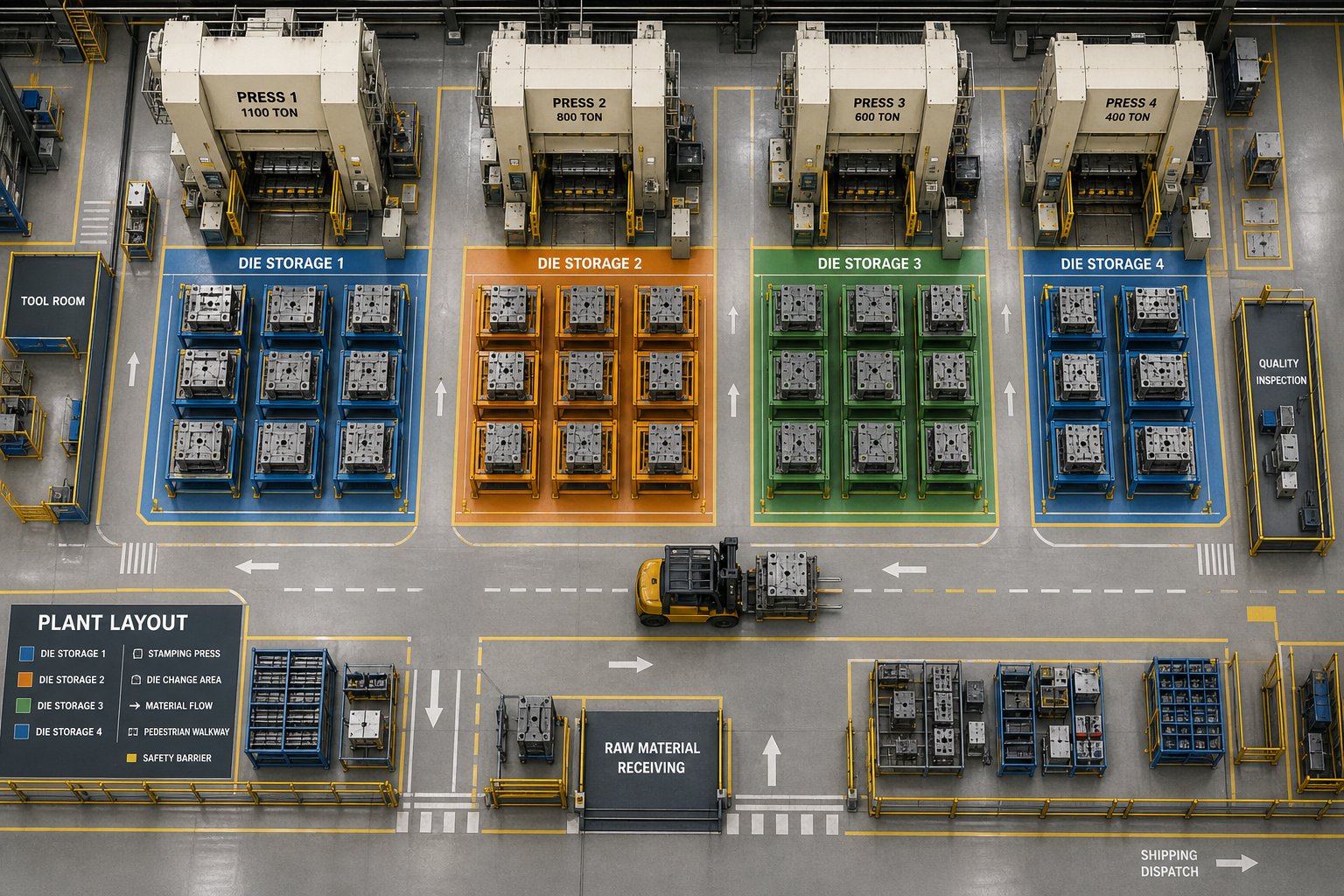
Die storage isn't a warehouse problem. It's a press room efficiency problem wearing a warehouse disguise. The moment a production scheduler calls for a die changeover, your storage system becomes the first link in a chain of events that determines how long your press sits idle. A well-organized system shaves minutes off every exchange. A disorganized one adds hours across a week of production-hours nobody tracks because they're buried in "setup time."
Connecting Storage Layout to Die Changeover Speed
The connection between storage and changeover speed traces back to a methodology developed at Toyota in the 1950s. SMED (Single-Minute Exchange of Die), created by Shigeo Shingo, defines setup time as the full interval between the last good part of one run and the first good part of the next. That interval includes everything: locating the next die, transporting it to the press, positioning it, securing it, and making initial adjustments.
Here's what most facilities miss: a significant portion of that changeover time happens before the press ever stops. SMED separates activities into "internal" tasks (requiring the press to be idle) and "external" tasks (completable while the press still runs). Locating, retrieving, and staging the next die is entirely external work-meaning it should happen during production, not after the press stops. But that's only possible when your storage layout supports it.
Imagine a die stored on an upper rack level at the far end of the building. Retrieval requires dispatching a forklift, navigating congested aisles, pulling the die, and transporting it to the press area. That sequence might take 20 minutes-20 minutes that could overlap with production if the die were pre-staged, but instead becomes dead time because nobody started the retrieval early enough. Die changeover efficiency storage depends on positioning high-frequency dies close to the presses they serve, at ground level or lower rack positions, with clear transport paths that don't compete with other traffic.
Zone-based storage assignment solves this. Group dies by the press they run on rather than by arbitrary numbering. Place them in proximity order so the next scheduled die is always within a short, predictable retrieval cycle. That predictability is what makes external staging possible-and what transforms storage layout from a static inventory decision into a dynamic production variable.
Digital Tracking and Inventory Management Integration
Knowing where a die is supposed to be and knowing where it actually is are two different things. In facilities with hundreds of dies, manual tracking-spreadsheets, whiteboard maps, memory-breaks down quickly. A die gets moved during maintenance, returned to a different slot, or borrowed for a trial run and never logged back in. Suddenly, the changeover crew spends 15 minutes hunting for tooling that should have been staged an hour ago.
RFID (Radio Frequency Identification) technology eliminates this failure mode entirely. RFID tags attached to assets emit unique identifiers that readers capture without line-of-sight scanning, meaning a tagged die is automatically logged every time it passes a reader-entering storage, leaving for the press, returning from maintenance. No manual scan required, no forgotten updates, no mystery locations.
For press room die organization systems, the practical implementation looks like this:
- RFID tags on each die: Rugged, metal-mount UHF tags survive the industrial environment and broadcast identity to fixed readers at rack entry points or handheld readers during audits.
- Fixed readers at storage zones: Portal-style antennas at rack aisle entrances automatically detect die movement in and out of designated positions.
- Software integration with scheduling: The tracking system connects to production planning tools, flagging when a die needed for an upcoming run isn't in its expected location-triggering retrieval before it becomes a changeover delay.
- Digital maintenance records linked to position: Each die's storage slot becomes a node in the maintenance management system, displaying last-run date, stroke count, preservation status, and pending maintenance tasks directly from the rack position record.
Barcode systems offer a lower-cost entry point for automation tool and die tracking, though they require line-of-sight scanning-someone physically pointing a reader at each label. For smaller die inventories (under 50 tools), barcodes deliver adequate visibility. Beyond that threshold, the labor overhead of manual scanning erodes the efficiency gains you're trying to capture.
Lean Principles Applied to Tool Room Organization
Lean manufacturing treats wasted motion, waiting, and searching as defects-no different from a scrap part. Applied to die storage, lean thinking reframes every minute spent locating, retrieving, or staging tooling as a cost that proper organization can eliminate. The goal isn't just a tidy tool room. It's a system where the right die reaches the right press with zero wasted steps.
Practical organization strategies that support this goal include:
- Color-coded zone labeling: Assign each press or press line a color. Paint rack bays, floor markings, and die identification tags to match, creating an instant visual link between tooling and its destination.
- Frequency-based position assignment: Place high-rotation dies at ergonomic access heights (levels 1–2) near their associated presses. Reserve upper levels and remote positions for seasonal or backup tooling.
- Shadow board principles for die accessories: Bolster plates, clamps, shims, and alignment tools stored at fixed, labeled positions adjacent to the die they serve. Missing items are immediately visible.
- Standardized retrieval workflows: Document the exact sequence for each changeover-which die, which rack position, which transport route, which staging area-so any qualified operator can execute without tribal knowledge.
- Visual management boards: Display current die locations, upcoming changeover schedules, and maintenance status at the storage area entrance, giving every team member situational awareness without software access.
These practices align directly with the 5S methodology-sort, straighten, scrub, standardize, sustain-that underpins most lean programs. A 5S-compliant die storage area doesn't just look organized; it functions as an extension of the press room itself, where every element exists to minimize the time between "die needed" and "die running."
The payoff compounds over time. Faster changeovers mean more available press time. More press time means smaller batch sizes become economically viable. Smaller batches reduce inventory carrying costs and improve responsiveness to customer demand. It's a cascade that starts with something as seemingly simple as where you put the die when it's not in the press-and ends with measurable gains in production flexibility and scheduling agility.
Those gains aren't free, though. Purpose-built storage, tracking technology, and organized workflows all require capital investment. The question facing operations managers isn't whether these improvements work-it's how to quantify their value against the upfront cost and build a business case that justifies the expenditure.
Total Cost of Ownership and ROI of Proper Die Storage
Here's where most die storage conversations stall. The operations team knows the current setup is costing them-damaged tooling, slow changeovers, safety near-misses. But when the capital request lands on the finance director's desk, it's just a price tag for steel and installation. Without a complete cost picture on both sides of the equation, even the most obvious upgrade dies in committee.
The mistake is comparing the purchase price of a new system against the apparent cost of doing nothing. "Doing nothing" isn't free. It just hides its costs across budget lines nobody connects: die repair invoices, overtime from extended changeovers, workers' comp claims, scrap parts from corroded tooling, and the invisible erosion of die life that shows up as premature replacement years down the road. A die storage system cost analysis that captures all of these factors paints a dramatically different picture than sticker price alone.
Total Cost of Ownership Beyond Purchase Price
Total cost of ownership (TCO) accounts for every direct and indirect expense across a system's full lifecycle-not just what you pay on day one. For stamping die storage, the key TCO components break into three categories: acquisition costs, ongoing operational costs, and the often-overlooked opportunity costs of inefficiency.
Acquisition costs extend well beyond the rack itself. You're paying for:
- Equipment purchase: The racks, shelves, drawer mechanisms, safety interlocks, and surface coatings specified in your order.
- Engineering and design: PE-stamped load calculations, seismic analysis (if applicable), and custom layout drawings tailored to your facility.
- Site preparation: Floor reinforcement, anchor bolt installation, utility runs for powered roll-out shelves, and any slab modifications identified during the floor load assessment.
- Installation labor: Assembly, leveling, anchoring, and final inspection-typically performed by the manufacturer's crew or a certified installer.
- Transition costs: Moving dies from current positions into the new system, including any temporary storage arrangements during installation.
A common budgeting error is estimating only the equipment line. Site preparation and installation can add 15% to 30% on top of the hardware cost, especially in facilities requiring slab upgrades or seismic anchoring. Getting a site survey before finalizing your budget prevents the unpleasant surprise of a six-figure floor reinforcement bill arriving after the purchase order is signed.
Ongoing operational costs are lower for purpose-built systems than for makeshift alternatives, but they're not zero:
- Periodic inspection: Rack integrity checks-looking for bent beams, loose connections, damaged base plates, and anchor bolt condition-should occur at least annually, more frequently in high-traffic areas.
- Mechanical maintenance: Roll-out drawer systems require lubrication of linear bearings, inspection of drive mechanisms, and occasional replacement of wear components. Budget for this based on manufacturer-recommended service intervals.
- Reconfiguration: As your die inventory evolves-new tooling added, old dies retired, die dimensions changing with new product launches-adjustable systems let you reposition shelves without structural modification. Welded custom racks, by contrast, may require cutting and re-fabrication, adding cost every time your tooling mix shifts.
- Durability and replacement cycle: A well-built structural steel rack with proper surface coatings can last 20 to 30 years with minimal degradation. Cheaper alternatives using lighter-gauge steel or inadequate finishes may need replacement in under a decade, resetting the acquisition cost cycle far sooner.
Opportunity costs are the hardest to quantify but often the largest. Every hour your press sits idle because a die can't be located, retrieved, or safely staged is lost production capacity. Every die that returns from storage with corrosion damage requires unplanned maintenance that displaces scheduled work. Every safety incident triggers investigation time, potential OSHA fines, and the intangible but very real cost of workforce morale and trust. These aren't hypothetical-they're happening right now in facilities relying on floor storage or undersized racking, and they compound month after month.
Building a Business Case for Die Storage Investment
Finance teams don't approve feelings. They approve numbers. To move a capital request from "nice to have" to "approved," you need a structured ROI framework that translates operational improvements into dollar values your CFO can evaluate against competing projects. The approach mirrors standard warehouse racking ROI methodology-assess initial costs, evaluate operational savings, analyze long-term benefits, and calculate net return-but adapted for the specific value drivers of die storage.
Here's the ROI calculation framework, broken into the four categories that capture the full financial impact of upgrading from inadequate storage to a purpose-built system:
- Quantify die damage reduction. Pull your die repair and refurbishment records for the past 24 months. Isolate incidents attributable to storage-related causes: corrosion from floor or unprotected storage, physical damage from drops or rack failures, surface degradation from improper positioning. Multiply the average annual repair cost by the percentage you can reasonably eliminate with proper storage. For most facilities, this ranges from 40% to 70% of storage-related repair spend. Include the cost of expedited repairs that disrupted production scheduling.
- Calculate labor savings from faster changeovers. Time your current die retrieval and staging process-from the moment a changeover is called to the moment the die is positioned at the press. Compare that against the retrieval time achievable with organized, accessible rack storage and pre-staging workflows. Multiply the time savings per changeover by the number of annual changeovers and your fully loaded labor rate (including benefits and overhead). Even a 10-minute improvement per changeover, multiplied across 200+ annual setups, translates to meaningful labor recovery.
- Estimate safety incident prevention value. Review your incident log for die-handling injuries and near-misses over the past three to five years. Calculate the direct costs (medical expenses, workers' comp premiums, OSHA penalties) and indirect costs (investigation time, production stoppages, replacement labor, potential litigation). Industry data suggests indirect costs of workplace injuries run three to five times the direct medical expense. Apply a conservative reduction factor-say 50% to 80%-reflecting the hazards that purpose-built storage eliminates: falls from overloaded racks, crush injuries from unstable floor storage, and forklift incidents in cluttered staging areas.
- Project production uptime gains. Every minute of press idle time has a calculable cost: your hourly press rate (including operator, overhead, and amortized equipment cost) divided by 60. If disorganized storage adds an average of 15 minutes per changeover across three shifts running five presses, you're losing hundreds of press-hours annually. Convert that to revenue capacity or cost avoidance depending on how your finance team models production value. This is often the largest single line item in the ROI case-and the one that gets the CFO's attention.
To calculate net ROI, subtract the total cost of ownership (acquisition plus projected lifecycle operational costs) from the sum of all savings and avoided costs over the same period-typically 10 to 15 years for structural steel systems. Divide by the initial investment and multiply by 100 to express as a percentage. A well-documented case for die storage racks manufacturers' heavy-duty systems routinely shows payback periods of two to four years, with cumulative ROI of heavy duty die racks reaching 200% to 400% over a decade.
One factor amplifies these returns significantly: the quality of the dies you're protecting. The value of proper storage multiplies when paired with dies built for durability from the outset. Manufacturers like YICHEN engineer stamping dies with attention to stable production performance-selecting materials, surface treatments, and component designs that maximize useful life under demanding conditions. When you invest in both durable tooling and proper storage, the compounding effect is powerful: the die lasts longer because it was built to last, and the storage system ensures nothing erodes that engineered longevity between runs. Protecting a $15,000 die that's designed for 500,000 additional strokes delivers far more ROI than protecting one that was already nearing end-of-life due to inferior construction.
Present your business case the way capital investment proposals are structured across industries: lead with an executive summary stating the total investment, payback period, and headline benefits. Follow with the detailed baseline cost analysis showing what inadequate storage is costing today. Then present the recommended solution with vendor specifications, and close with the financial calculations using transparent assumptions. Address different stakeholders' priorities-finance sees the ROI numbers, operations sees the uptime gains, safety sees the incident reduction, and maintenance sees the die life extension.
The facilities still storing dies on the floor or cramming them into standard pallet racks aren't saving money. They're spending it in scattered, invisible ways that never appear on a single line item. A proper die storage system cost analysis makes those hidden expenses visible-and turns a vague sense that "we should do something" into a funded project with measurable returns.
Frequently Asked Questions About Stamping Die Storage Systems
1. What is the difference between stamping die storage racks and standard pallet racking?
Standard pallet racking is engineered for uniformly distributed loads spread across flat-bottomed pallets. Stamping dies create severe point loads, concentrating thousands of pounds on a compact footprint that can cause beam deflection, decking failure, and structural collapse in conventional racks. Purpose-built die storage racks use structural steel I-beams, heavy-gauge columns, and reinforced shelf designs rated for 2,000 to 6,000+ lbs per level to safely handle these concentrated forces.
2. How do I determine which die storage system type is right for my facility?
Match your system to three factors: die characteristics (weight class and dimensions), facility readiness (floor load capacity, ceiling height, aisle width), and access frequency. Dies under 1,000 lbs suit widespan shelving; 1,000-6,000 lbs work well in structural I-beam racks; 6,000-15,000 lbs benefit from roll-out drawer systems with crane access; and dies over 15,000 lbs typically require floor-level die storage bases. Always verify your slab thickness and reinforcement before installation.
3. What OSHA requirements apply to heavy stamping die storage?
OSHA regulations under 29 CFR 1926.250 and 29 CFR 1910.176 require that stored dies be secured against displacement, that floor load limits be posted conspicuously in pounds per square foot, that aisles remain clear for material handling equipment, and that storage loads never exceed the rated rack capacity. Facilities must display load capacity placards at each rack bay, and PE-stamped engineering documentation should validate all stated weight ratings.
4. How do you prevent corrosion on stamping dies during storage?
Effective corrosion prevention layers three defenses: spray-on contact corrosion inhibitors that coat exposed tool steel surfaces, Vapor Corrosion Inhibitor (VCI) films and packets that protect enclosed cavities and hard-to-reach areas, and climate control maintaining relative humidity below 50%. Dies should be thoroughly cleaned, dried, and coated before storage, with VCI shrink film sealing all seams. Periodic inspections every 90 days catch any protective barrier failures before damage accumulates.
5. What is the typical ROI payback period for investing in purpose-built die storage systems?
Well-documented business cases for heavy-duty die storage systems routinely show payback periods of two to four years, with cumulative ROI reaching 200% to 400% over a decade. Returns come from four sources: reduced die repair costs (40-70% reduction in storage-related damage), labor savings from faster changeovers, safety incident prevention, and production uptime gains. The ROI multiplies further when paired with dies engineered for durability, such as those from manufacturers like YICHEN that optimize materials and surface treatments for long-term performance.


