


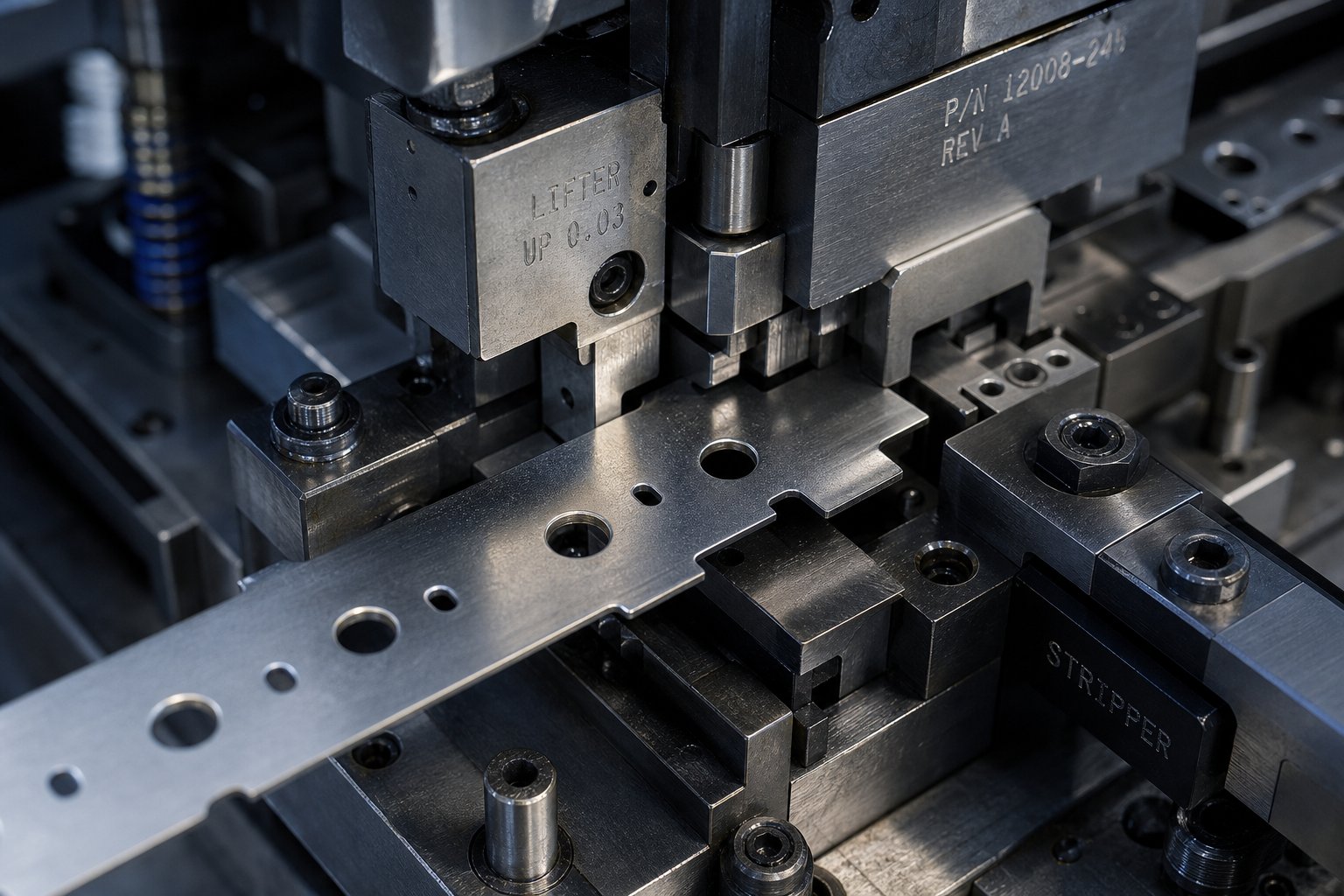
Understanding Bypass Notches and Their Role in Progressive Die Performance
Every tool and die engineer who has run a progressive stamping operation knows the feeling: the strip feeds smoothly for a thousand hits, then suddenly catches, misregisters, or hangs on a lifter. More often than not, the culprit traces back to one small but critical feature in the strip layout. That feature is the bypass notch.
Bypass notches are intentional material modifications made at the strip edge in a progressive stamping die. Their purpose is to manage how the strip interacts with lifters, pilots, and other die components as it advances station to station. In a negative and positive bypass notches sheet metal stamping die, these relief features govern whether the strip clears internal obstructions cleanly or drags against surfaces that degrade pitch accuracy over time.
The concept is straightforward. The execution is where things get interesting.
What Are Bypass Notches in Progressive Dies
Imagine a metal strip threading through a progressive die with eight or ten stations. Between each press stroke, the strip must lift, advance by one pitch length, and settle back into position for the next operation. Lifters raise the strip to clear lower die surfaces, and pilots pull the strip into final registration. Bypass notches exist to let the strip pass over or around these lifters and pilots without hanging, dragging, or colliding.
In practical terms, a bypass notch is a local relief or cutout feature added to the strip layout that prevents interference during feeding, forming, trimming, or part transfer. It is not a cosmetic detail or an afterthought. It is a deliberate strip control mechanism that the designer specifies during the layout stage, well before any steel is cut.
Two fundamental types exist: positive bypass notches, which retain material on the strip in a tab-like form, and negative bypass notches, which remove material from the strip edge entirely. Each type creates a different mechanical relationship between the strip and the die components it must navigate.
Why Notch Type Selection Matters for Strip Control
Here is where many engineers underestimate the decision. The geometric orientation of the notch directly governs strip feeding force, pitch accuracy, and station-to-station registration. A positive notch keeps material intact, preserving strip stiffness but requiring the retained tab to ride over lifter surfaces. A negative notch cuts material away, providing lifter clearance but reducing localized strip rigidity.
Choosing wrong does not just create a minor inconvenience. It introduces feeding errors that compound across every downstream station, degrades registration that shows up as dimensional variance on finished parts, and accelerates die wear in ways that shorten maintenance intervals. In negative and positive bypass notches sheet metal stamping dies, this single geometry decision ripples through the entire production process.
The choice between positive and negative bypass notches is not cosmetic. It fundamentally changes how the strip interacts with every downstream station, affecting feeding resistance, pilot engagement, and cumulative positional accuracy across the entire die.
This guide is written for tooling engineers who already understand progressive die basics but need clarity on notch geometry decisions. You will not find introductory explanations of what a progressive die is or how strip feeding works. Instead, the focus ahead is on the specific geometric, functional, and material-driven factors that determine which notch type belongs in your strip layout.
The distinction begins with geometry. How each notch type physically interacts with the strip, and what that means for your feeding mechanics, depends entirely on whether material stays or goes.
Positive Bypass Notch Geometry and Functional Mechanics
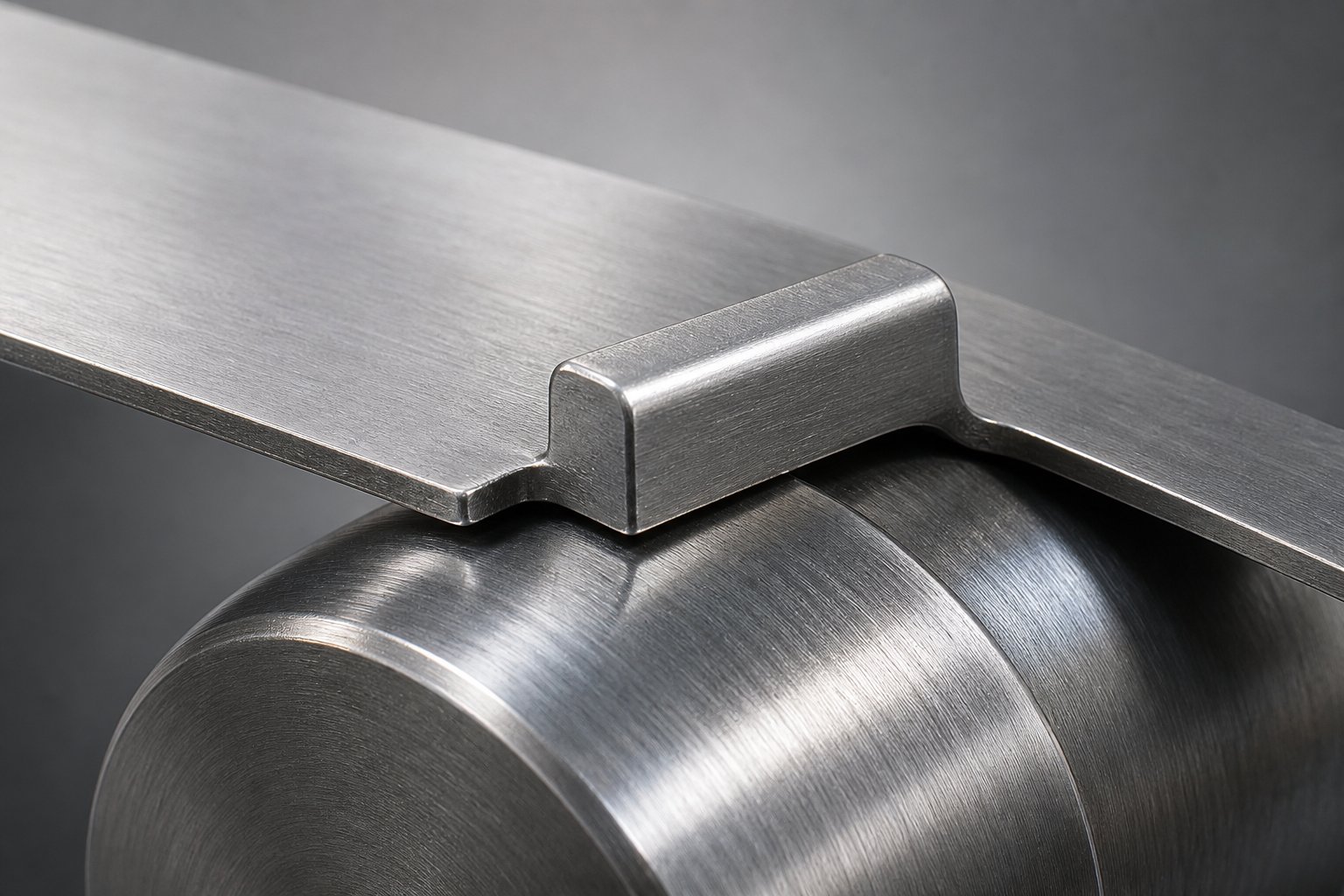
A positive bypass notch leaves material on the strip. Rather than cutting away a section of the strip edge and discarding it as scrap, the die creates a tab-like projection that remains physically attached to the strip. This retained tab extends inward or outward from the strip edge, forming a small but deliberately shaped feature that the strip carries through every subsequent station.
The practical result: the strip width at the notch location stays essentially intact. No material is lost. No slug needs to be managed. The strip retains its structural continuity, and that continuity plays a direct role in how the strip behaves during feeding.
Positive Notch Geometry and Material Retention
The cut profile for a positive notch is typically a partial shear that frees the tab on three sides while leaving it attached at one edge. Picture a small rectangular or trapezoidal tongue that has been cut on its leading edge, trailing edge, and one lateral side, but remains connected along the opposite lateral edge like a hinge. The tab can flex slightly relative to the strip plane, but it does not separate.
Many designers add angular relief to the tab's leading edge to reduce feeding drag. This relief, usually between 5 and 15 degrees depending on material thickness, prevents the tab's forward corner from catching on lifter surfaces as the strip advances. The geometry functions much like a lance and flange pitch stop, where a lanced section is bent to create both a stop and a stiffening feature on the carrier strip.
Because the tab stays attached, strip rigidity at the notch location is preserved. This matters most in thin-gauge materials where elongation under feeding tension can cause localized buckling or waviness. A strip with high elongation characteristics is particularly vulnerable to distortion at any point where cross-sectional area is reduced. By keeping the material in place, positive notches avoid creating that weak point entirely.
How Positive Notches Interact With Lifters and Pilots
As the strip advances one pitch length, the retained tab passes over the lifter crown. The tab rides along the lifter's upper surface, and the strip feeds forward without interference. When the press closes, pilots engage the strip through pilot holes for final registration, pulling the strip into precise alignment before forming or cutting operations begin.
The interaction is smooth because no edge of the strip needs to drop into or clear a gap. The tab essentially bridges the lifter, maintaining consistent contact and predictable yielding force against the lifter surface. This produces lower feeding resistance compared to configurations where a cut edge must navigate around die components.
In bypass notches sheet metal forming applications, this low-resistance behavior translates directly into better pitch consistency and reduced cumulative error across multi-station dies.
- Material is retained on the strip as an attached tab projection
- Tab geometry is typically three-sided cut with one attached edge and angular relief on the leading face
- Feeding resistance is lower because no cut edge catches on lifter or die surfaces
- Strip rigidity is preserved at the notch location, benefiting thin stock prone to buckling
- No slug is generated, eliminating slug management concerns at the notch station
This retention-based approach works well when strip stiffness is the priority. But what happens when clearance, not rigidity, becomes the controlling factor? That shifts the geometry in the opposite direction, toward material removal rather than material preservation.
Negative Bypass Notch Geometry and Functional Mechanics
Where a positive notch keeps material on the strip, a negative bypass notch takes material away. A dedicated punch removes a defined section from the strip edge, creating a void or cutout that allows the strip to clear lifters and other die components without physical contact. The removed slug drops through a die opening and is discarded. What remains is a strip edge with an intentional gap where material once existed.
This approach solves a different problem. Instead of bridging over lifters, the strip simply avoids them entirely. The void provides vertical and lateral clearance for lifter travel, eliminating any chance of the strip catching, dragging, or hanging on a lifter crown during the feed cycle. For dies where lifter height is substantial or where strip thickness makes riding over surfaces impractical, that clearance-first philosophy drives the design toward material removal.
Negative Notch Geometry and Material Removal
The cut profile is straightforward. A punch descends through the strip edge and removes a defined area, typically rectangular or trapezoidal in shape. The slug shears cleanly from the strip and ejects downward through a corresponding die opening. The result is a notch with sharp internal corners and exposed cut edges along its perimeter.
Notch dimensions are governed by the clearance required. Width must accommodate the lifter body plus any lateral strip movement during feeding. Depth must provide enough vertical clearance so the strip edge does not contact the lifter at any point during the press cycle. Deeper notches provide greater clearance margin but remove more material from the strip cross-section.
Burr direction becomes a practical concern here. Because the punch shears through the strip, bypass notches burr formation stamping creates a raised edge on the die side of the cut. If the burr faces upward during feeding, it can catch on guide rails, lifter surfaces, or other die components. Designers typically orient the die so burr direction faces downward, away from sliding contact surfaces. When that orientation is not possible, a secondary deburring operation or chamfered edge relief on the die surfaces mitigates the interference.
Unlike the lance-and-flange alternative described in progressive die literature, where a lanced section is bent down to create a stop and stiffen the carrier, a negative notch produces no secondary structural benefit. Its sole contribution is clearance. The slug exits the system, and the strip moves on lighter but less rigid at that location.
How Negative Notches Affect Strip Feeding and Registration
Removing material from the strip edge has a direct consequence: localized stiffness drops. The material modulus does not change, but the cross-sectional area resisting bending forces at the notch location decreases. For very thin or narrow strips, this reduction can create a hinge point where the strip deflects under feeding tension, causing inconsistent pitch advancement and registration drift across stations.
For thicker or wider stock, however, the remaining cross-section provides more than enough structural support. In these applications, the reduced interference with lifters delivers cleaner feeding action. The strip does not ride over anything. It simply feeds forward through open space, with lifters rising and falling inside the void without ever touching the strip edge. This makes negative notches particularly effective in dies with tall lifter heights where a retained tab would need to flex excessively to clear the lifter crown.
One trade-off engineers encounter: negative notches may generate slightly higher feeding resistance than their positive counterparts. The reason is mechanical. Cut edges at the notch perimeter, especially if burrs develop over production life, can snag on die surfaces, stock guides, or rail transitions. If those edges are not properly relieved with chamfers or radii, the strip hesitates at each feed increment. The yield stress at the cut edge is higher than the parent material due to work hardening from the shearing operation, making the edge stiffer and less compliant when it contacts other surfaces.
Registration behavior differs from positive notches as well. Because the strip edge is interrupted by a void, pilots must engage the strip at locations with full material present. The void itself cannot contribute to lateral positioning. In dies where pitch stops work alongside pilots for strip registration, the notch position must be carefully coordinated so that the void does not coincide with any registration or sensing feature.
- Material is removed from the strip edge, creating a void or cutout
- Void geometry is typically rectangular or trapezoidal, sized to clear lifter bodies and travel
- Localized strip stiffness is reduced at the notch location due to decreased cross-sectional area
- Lifter clearance is cleaner and more reliable, especially in thick stock or tall-lift applications
- Cut edges are susceptible to burr buildup, which can increase feeding resistance over die life
- Slug management is required, with the removed material ejecting through a die opening below
Both notch types solve the same fundamental problem, but their geometric approaches create distinctly different performance profiles. The real question for any strip layout is not which type is better in isolation, but which set of trade-offs aligns with the specific material, press speed, and die configuration at hand.
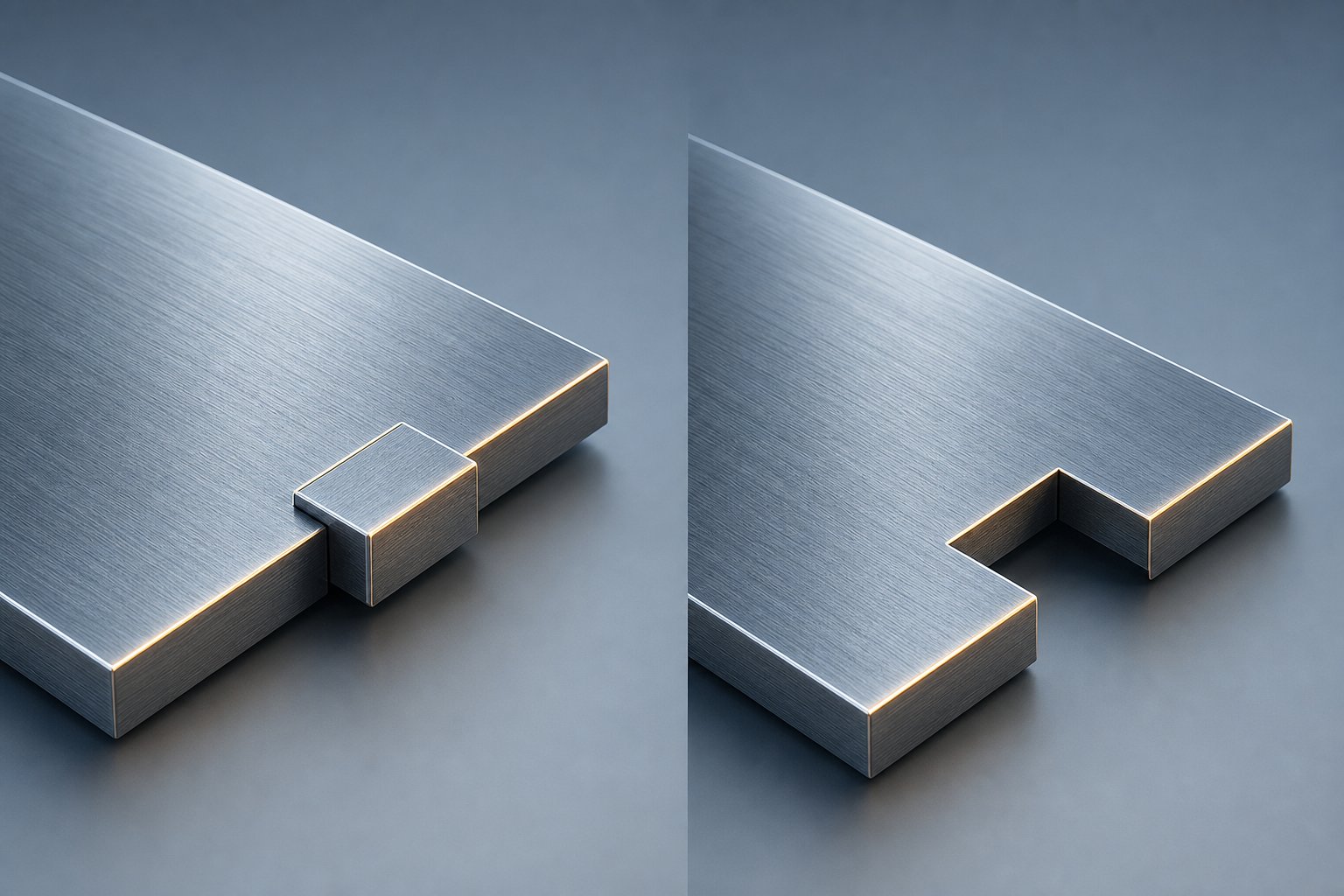
Side-by-Side Comparison of Positive and Negative Bypass Notches
Each notch type has been described individually, but strip layout decisions rarely happen in isolation. You are weighing trade-offs across multiple attributes simultaneously: feeding resistance against strip rigidity, lifter clearance against slug management complexity, burr direction against registration behavior. What tooling engineers need is a single reference that places every relevant attribute next to its counterpart so the decision becomes visible at a glance.
No widely available resource currently presents this comparison in structured form. The bypass notches sheet metal forming purpose is well understood in general terms, yet the attribute-level breakdown that drives geometry selection during strip layout remains scattered across tribal knowledge and internal design standards. The table below consolidates those factors into a format you can reference directly when evaluating notch type for a new die program.
Attribute-by-Attribute Comparison of Notch Types
| Attribute | Positive Bypass Notch | Negative Bypass Notch |
|---|---|---|
| Strip engagement method | Material retention: a tab remains attached to the strip edge, bridging over die components | Material removal: a slug is punched from the strip edge, creating a void that clears die components |
| Feeding resistance profile | Lower overall resistance; tab rides smoothly over lifter surfaces with angular relief reducing drag | Slightly higher resistance potential; cut edges may catch on die surfaces if burrs develop or relief is insufficient |
| Registration accuracy behavior | Consistent strip width maintained at notch location supports stable pilot engagement and lateral positioning | Interrupted strip edge at notch location; pilots must engage at full-material sections away from the void |
| Strip rigidity impact | Minimal reduction; retained tab preserves cross-sectional area and resists buckling under feed tension | Localized reduction proportional to notch depth and width; thin or narrow strips may deflect at notch location |
| Lifter interaction mechanics | Tab passes over lifter crown; contact is managed through relief geometry on the tab's leading edge | No contact with lifter; void provides full clearance for lifter travel regardless of lifter height |
| Slug management requirements | None; no material separates from the strip, eliminating slug ejection and disposal concerns | Required; slug must eject cleanly through a die opening, and buildup or jamming can halt production |
| Burr direction considerations | Burr forms on the tab's sheared edges; typically oriented away from sliding surfaces with minimal impact on feeding | Burr forms along the entire notch perimeter; orientation is critical because upward-facing burr catches on guides and lifters |
| Ideal use cases | Thin gauge materials, narrow strips, long progression dies requiring cumulative accuracy, applications sensitive to strip buckling | Thick stock, wide strips with ample remaining rigidity, high lifter heights, high-speed applications requiring zero lifter interference |
When Each Type Outperforms the Other
The table reveals a clear pattern. Positive notches protect what the strip already has: rigidity, width consistency, and smooth surface contact. Negative notches create what the strip needs: open space, vertical clearance, and freedom from lifter contact. The performance advantage shifts depending on which factor limits your specific application.
For thin-gauge materials, where yield strength is low relative to feeding forces and the strip is prone to buckling, positive notches outperform because they avoid removing cross-sectional area from an already fragile strip. When a strip is only 0.5 mm thick and 30 mm wide, cutting a notch several millimeters deep can create a hinge point that wanders during feeding. The retained tab prevents this by maintaining strip integrity across the full width.
For thicker stock, the calculus inverts. A 2.0 mm strip with 100 mm width has substantial bending resistance even with material removed. The notch void is a small percentage of total cross-section, and the stiffness reduction is negligible. Here, the priority shifts to lifter clearance. Thick material riding over a lifter crown generates high contact forces and accelerated wear on both the tab and the lifter surface. Removing the material entirely eliminates that wear mechanism. Understanding the relationship between yield strength vs tensile strength for a given material helps you predict whether a retained tab will deform plastically under lifter contact loads or remain elastic and ride cleanly.
Narrow strips follow the thin-material logic regardless of thickness. A narrow strip has limited edge material available, so any removal disproportionately affects its structural behavior. Positive notches preserve what little cross-section exists. Wide strips follow the thick-material logic, where ample remaining width compensates for any localized stiffness loss.
High-speed applications introduce a dynamic element. At elevated press speeds, the strip's inertia during feeding magnifies any resistance source. A tab catching momentarily on a lifter at 60 strokes per minute is a nuisance. The same catch at 400 strokes per minute becomes a misregistration event that propagates across every downstream station. For high-speed dies where lifter clearance is tight, negative notches eliminate the variable entirely by removing the interference source.
Choose the notch type that best preserves the strip characteristic most critical to your specific application. If rigidity is the limiting factor, retain material. If clearance is the limiting factor, remove it.
This decision principle sounds simple, but applying it effectively requires knowing exactly how deep, how wide, and at what angle to cut the notch geometry. Those dimensional parameters are where theory meets practice, and where proportional relationships to material thickness and strip width determine whether your chosen notch type actually delivers its intended performance advantage.
Design Parameters for Notch Depth, Width, and Angular Relief
Selecting a notch type is only half the decision. The other half is dimensioning it correctly. A positive notch with the wrong tab depth buckles under lifter contact. A negative notch cut too shallow fails to provide clearance when the lifter reaches full travel. Both failures trace back to the same root cause: the geometry was not proportioned to the material and strip characteristics that govern real-world performance.
The challenge is that no single universal formula covers every application. Notch dimensions are driven by a hierarchy of interrelated factors, and understanding which factor takes priority for your specific die prevents the trial-and-error cycles that burn through tryout time and budget.
Notch Depth and Width Relative to Material Thickness
Notch depth is the dimension that controls clearance for negative notches and tab projection length for positive notches. In both cases, material thickness anchors the starting proportion. A general principle applies: notch depth should provide functional clearance or tab engagement without compromising the strip's ability to feed consistently under tension.
For negative notches, depth must exceed lifter travel height plus any vertical strip movement during the feed cycle. If the lifter rises 4 mm and the strip oscillates 0.5 mm during advancement, a minimum notch depth of 5 mm provides reliable clearance. Going significantly deeper removes material that did not need to be removed, reducing strip rigidity unnecessarily. Overly shallow negative notches, on the other hand, leave the strip edge dangerously close to the lifter crown at top-of-stroke, where even minor strip sag causes contact and hanging.
For positive notches, tab depth determines how far the retained material projects from the strip body. Tabs that are too deep relative to material thickness become cantilevered beams prone to plastic deformation under lifter contact loads. When the tab bends permanently, it no longer clears the lifter on subsequent strokes. The elastic modulus of the strip material sets the boundary here. A tab that deflects within its elastic range returns to position after each contact. One that exceeds the yield point for steel or whatever material is in use takes a permanent set and becomes a recurring feeding obstruction.
Notch width follows a similar logic. For negative notches, width must accommodate the lifter body plus lateral strip wander during feeding. For positive notches, width defines the tab's lateral dimension and directly affects its bending stiffness. A wider tab distributes lifter contact forces across more area, reducing local stress concentration. A narrower tab concentrates force and is more susceptible to fatigue over long production runs.
The following priority sequence guides dimensioning decisions when multiple factors compete:
- Material thickness: Establishes baseline proportions for depth and width. Thicker stock tolerates deeper negative notches without stiffness loss; thinner stock demands shallower geometry to preserve structural continuity.
- Strip width: Determines how much cross-sectional area remains after the notch is cut. Narrow strips constrain maximum permissible notch depth regardless of material thickness.
- Number of stations: Longer dies accumulate positional error. Each notch location must maintain strip integrity sufficient to carry the strip through all remaining stations without progressive deflection.
- Feeding pitch: Longer pitch lengths increase the moment arm between support points. Notch locations at mid-span between lifters experience maximum sag, requiring shallower notches or stiffer tab geometry.
- Lifter height: Directly sets the minimum clearance requirement for negative notches and the minimum ride-over capability for positive notch tabs.
Angular Relief and Edge Treatment for Feeding Performance
Depth and width get the geometry into the correct range. Angular relief is what makes it feed without resistance.
For positive notches, the tab's leading edge is the surface that first contacts lifters during strip advancement. Without relief, that edge presents a square shoulder that catches on the lifter crown, creating a momentary hesitation in strip travel. Adding a chamfer or angular relief of 5 to 15 degrees on the tab's leading face allows it to ramp smoothly over the lifter surface. The tab effectively becomes a wedge that lifts itself over the obstruction rather than colliding with it.
For negative notches, the cut perimeter is the critical surface. Burrs and sharp edges along the notch walls can catch on stock guides, die surfaces, or rail transitions as the strip feeds through. Break edges, typically 0.1 to 0.3 mm chamfers applied during die construction or through secondary deburring provisions in the die design, reduce this interference. Where the modulus of elasticity of steel at the cut edge has been elevated by shearing-induced work hardening, the edge is stiffer and less compliant against contact surfaces. Chamfering softens the geometric transition without requiring material property changes.
These angular parameters scale with material thickness. Thinner stock, with its lower bending resistance, needs less aggressive relief angles because contact forces are inherently lower. Thicker stock generates higher forces during lifter interaction, demanding steeper relief angles to prevent drag from escalating to the point where strip advancement hesitates or pitch accuracy degrades.
When engineering handbooks or established company standards provide specific dimensional ratios for a given material family, those values represent validated starting points. The steel modulus of elasticity, yield limit of steel for your specific grade, and the elastic modulus metals data from material certifications give you the mechanical properties needed to calculate whether a given tab geometry stays elastic under expected lifter loads. Designers who begin with these calculated proportions and refine during tryout consistently reach stable production faster than those who dimension by visual estimation alone.
Geometry alone, however, does not tell the full story. The same notch dimensions perform differently in aluminum than in stainless steel. Material-specific behavior, including work hardening, elongation limits, and strain hardening at cut edges, introduces another layer of design adjustment that shifts the parameters you have just established.
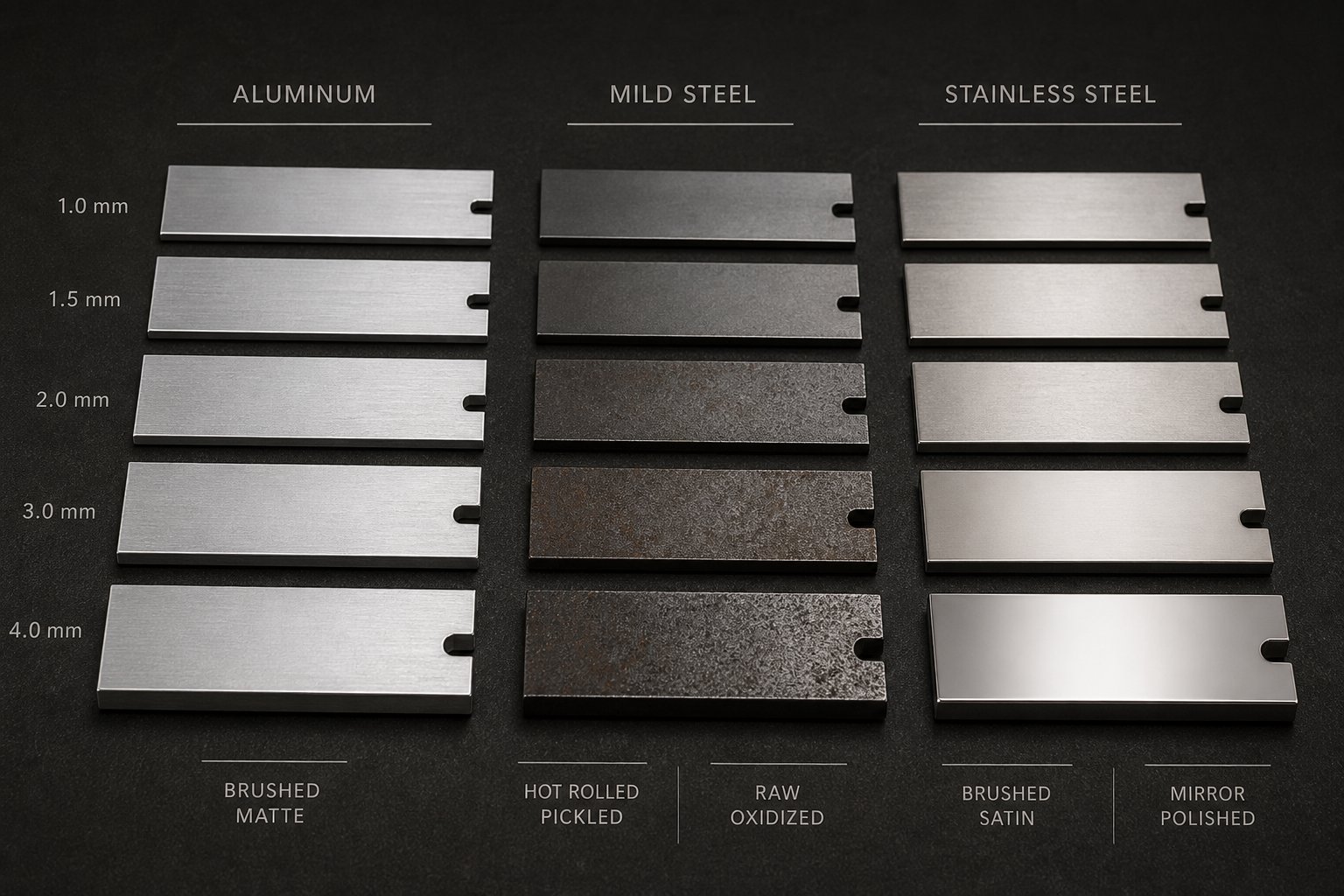
Material-Specific Considerations for Notch Type Selection
A notch dimensioned perfectly for mild steel may tear in aluminum or cause feeding hang-ups in stainless. The geometric parameters established in the previous section assume a generic material response, but real strip stock does not behave generically. Each material family brings its own combination of yield strength, elongation capacity, and strain hardening behavior that changes how the notch geometry performs under production conditions.
This is the gap most design references leave open. They acknowledge that material matters, then move on without explaining how it matters. The reality is that notch type preference, tab geometry, relief angles, and even maintenance intervals shift meaningfully when you change the coil on the decoiler. Understanding these shifts before tryout prevents the costly iteration cycle of running parts, observing failures, adjusting geometry, and running again.
Notch Behavior in Aluminum and Mild Steel
Aluminum presents a specific challenge for bypass notch design: its lower yield stress of steel equivalents means the material deforms plastically at lower feeding forces, and its higher elongation allows significant stretching before fracture. For thin-gauge aluminum, positive notches are generally preferable. The retained tab resists tearing during feeding because the material's ductility allows the tab to flex over lifter surfaces without fracturing at the attachment point. The tab absorbs contact loads through elastic and mild plastic deformation rather than cracking.
However, that same ductility creates a risk. If the tab geometry allows excessive deflection, aluminum tabs can take a permanent set after only a few hundred strokes. The low yield strain steel would resist is easily exceeded in aluminum, meaning tabs bent beyond their elastic limit stay bent. Designers compensate by making positive notch tabs wider and shallower in aluminum, distributing lifter contact forces across more area to keep local stresses below the material's proportional limit.
Negative notches in thin aluminum are problematic. Removing material from an already soft, flexible strip creates a hinge point that wanders during feeding. The strip deflects at the void location, causing pitch inconsistency that accumulates across stations. For thicker aluminum strip, typically above 1.5 mm, the remaining cross-section provides adequate support and negative notches become viable.
Mild steel, by contrast, offers the most forgiving environment for notch design. Its balanced combination of moderate yield strength of steel (typically 200 to 350 MPa), reasonable elongation (20 to 30 percent), and predictable work hardening behavior makes it tolerant of both notch types. Positive notch tabs in mild steel maintain their geometry under lifter contact because the material is stiff enough to resist permanent deflection yet ductile enough to absorb occasional overloads without cracking. Negative notches cut cleanly with minimal burr, and the cut edges do not harden excessively during the shearing operation.
This tolerance gives the designer freedom to optimize for other factors. When stamping mild steel, you can choose the notch type based purely on die layout constraints, lifter configuration, or press speed requirements rather than being forced into one type by material limitations.
Notch Design Adjustments for Stainless and High-Strength Steel
Stainless steel, particularly the 300-series austenitic grades, introduces a complication that mild steel and aluminum do not: aggressive work hardening. As MetalForming Magazine explains, strain hardening and work hardening strengthen the material as deformation continues, and newer steel grades work-harden to a greater extent than conventional high-strength grades. The 3XX-series austenitic stainless steels exhibit particularly high work hardenability.
For negative notches in stainless, the shearing operation that creates the notch is itself a forming operation. The cut edges undergo significant plastic deformation during punching, and in austenitic stainless, that deformation hardens the edge material well beyond the parent strip's yield strength. Over a production run of thousands of strokes, the cumulative effect is measurable: cut edges at the notch perimeter become progressively harder and stiffer. Where a conventional HSLA steel might see a 20 percent strength increase from work hardening, stainless grades can approach 50 percent or more in heavily worked zones. This hardened edge increases feeding resistance over die life as the stiffer edge catches more aggressively on guide surfaces and die components.
The tensile modulus steel exhibits does not change with work hardening, but the yield stress of steel at the cut edge increases substantially. What starts as a compliant edge that deflects slightly under contact becomes a rigid edge that resists deflection and transmits feeding loads directly into the strip body. For long production runs in stainless, this progressive hardening means that negative notch feeding performance degrades predictably over die life, requiring more frequent maintenance intervals or more aggressive initial relief geometry to compensate for anticipated hardening.
Positive notches in stainless avoid the cut-edge hardening problem at the strip edge but introduce their own concern. The tab attachment point, where three sheared sides meet the one connected edge, is a stress concentration zone. In stainless steel, repeated lifter contact loads at this point can initiate fatigue cracking because the work-hardened material at the tab junction becomes brittle relative to the surrounding parent material. Generous radii at the tab's internal corners and slightly wider attachment widths mitigate this risk by distributing stress across a larger area.
High-strength steels, including dual-phase (DP), complex phase (CP), and press-hardened grades, present the opposite problem from aluminum. These materials have high yield strength but reduced elongation. A DP1000 grade, for example, offers excellent strength but limited ability to deform plastically without fracturing. Positive notch tabs in high-strength steel can fracture at the attachment point if the tab geometry creates stress concentrations. The elastic modulus of steel remains roughly constant across grades (approximately 200 GPa), but the narrow gap between yield and ultimate strength in these grades leaves very little room for plastic deformation before failure occurs.
Research on high-strength steel cut edges confirms that defects introduced during shearing act as stress raisers and crack initiation points. A study published in Metals journal found that high-strength steels can experience up to a 40 percent reduction in fatigue performance due to manufacturing defects from punching and trimming operations. For bypass notch applications, this means both notch types require careful edge quality management in high-strength steel. Negative notch cut edges must be clean with minimal fracture zone depth to avoid creating crack initiation sites. Positive notch tab connections must avoid sharp internal corners that concentrate stress beyond the material's limited ductility.
| Material Family | Recommended Notch Type | Key Concern | Parameter Adjustment Guidance |
|---|---|---|---|
| Aluminum (thin gauge) | Positive preferred | Tab permanent deformation from low yield strength; strip buckling at void locations | Wider, shallower tabs; reduced lifter contact loads; avoid negative notches in strips below 1.5 mm |
| Mild steel | Both types viable | Minimal material-driven limitations; optimize for die layout and speed factors instead | Standard proportions apply; material is tolerant of both geometries across common thickness ranges |
| Austenitic stainless steel | Positive preferred for long runs | Progressive work hardening at negative notch cut edges increases feeding resistance over die life | Aggressive initial relief angles on negative notches; generous radii at positive tab junctions; shorter maintenance intervals |
| High-strength steel (DP, CP, AHSS) | Negative preferred for thick gauge | Reduced elongation causes tab fracture at stress concentration points in positive notch geometry | Generous internal radii on all notch corners; clean cut edges with minimal fracture zone; avoid sharp tab junctions |
| Press-hardened steel (22MnB5) | Negative preferred | Very low ductility post-hardening; tabs fracture under repeated cyclic loading from lifter contact | Maximize edge quality; consider two-stage shearing for negative notch edges; avoid any positive tab geometry |
The pattern in this table reveals a principle worth internalizing: materials with high elongation and low yield strength favor positive notches because the retained tab can absorb contact loads without permanent deformation. Materials with low elongation and high yield strength favor negative notches because retained tabs in these materials fracture rather than flex. The strain hardening and work hardening characteristics of the specific alloy then determine how the notch geometry ages over production life.
Material selection alone, though, does not close the loop on notch design. The same material running through a six-station die at 100 strokes per minute behaves differently than it does in a twenty-station die at 500 strokes per minute. Strip layout complexity and press speed introduce dynamic factors that amplify or dampen the material-specific behaviors just described.
Strip Layout and Press Speed Factors in Notch Selection
A notch geometry that feeds flawlessly in a six-station die running at 80 strokes per minute can become a recurring misregistration source in a twenty-station die running at 400. The difference is not the notch itself. It is the system context surrounding it: how many stations the strip must traverse, how far it travels per stroke, and how fast the press cycles between feed events. These variables amplify or suppress the strengths and weaknesses of each notch type in ways that material properties alone cannot predict.
Strip Progression Direction and Station Count Impact
Longer progressive dies accumulate positional error. Every station the strip passes through introduces a small registration variance, and those variances stack. By the time the strip reaches station fifteen or twenty, the cumulative drift from the original pilot registration can exceed acceptable tolerances if the strip's lateral positioning is not consistently maintained at every intermediate point.
Positive bypass notches offer an advantage here. Because the retained tab preserves strip width at the notch location, the strip presents a consistent edge for pilot engagement and guide rail contact throughout the entire progression. There are no voids disrupting the lateral reference surface. Guides and sensors, including any inductive proximity sensor used for strip position monitoring, see a uniform strip edge regardless of notch location. This consistency helps maintain cumulative accuracy across long die progressions where even 0.02 mm of drift per station compounds into a meaningful error at the cutoff station.
Shorter dies with fewer stations face less accumulated error. In a four- or six-station die, the strip passes through limited feed events before the part separates. Here, negative notches provide adequate registration accuracy with simpler tooling because there are simply fewer opportunities for positional error to compound. The clearance benefit of material removal outweighs the minor stiffness loss when the strip only needs to maintain accuracy across a handful of stations. Experienced die designers often take advantage of modern material nesting software for length of material optimization during strip layout, but the notch type decision still rests on how many stations that optimized layout requires and how much cumulative error the part tolerances can absorb.
Press Speed and Production Volume Considerations
Speed changes the physics of strip feeding. At low press speeds, the strip advances in a controlled, quasi-static motion where inertial effects are negligible. At high speeds, strip dynamics become dominant. The strip accelerates and decelerates aggressively during each feed cycle, creating oscillation, bounce, and momentary loss of contact with guides. Any source of feeding resistance, no matter how minor at low speed, becomes amplified into a measurable pitch inconsistency at high speed.
In high-speed metal forming operations running above 250 strokes per minute, the notch type that minimizes feeding resistance takes priority. If the die geometry allows either type, and the material's properties do not force the decision, press speed often becomes the tiebreaker. Positive notches with well-relieved tabs generate lower drag at speed because there is no cut edge to snag. Negative notches provide zero lifter interference, which matters when aggressive lifter timing at high speed leaves almost no clearance margin between the strip and the lifter crown.
Production volume adds another dimension. High-volume runs expose any wear mechanism that shorter runs would never reveal. A notch configuration that feeds perfectly for 50,000 strokes may develop progressive resistance at 500,000 strokes as edges wear, burrs grow, and tab geometry degrades. For long production campaigns, choosing the notch type with better wear resistance in your specific material reduces unplanned downtime and extends maintenance intervals.
The priority ordering shifts depending on whether your application demands speed or precision:
- High-speed application priorities (above 250 SPM): Minimize feeding resistance first; ensure lifter clearance margin exceeds strip dynamic oscillation; select notch type with lowest drag coefficient; prioritize wear resistance for the specific material; optimize angular relief for inertial feeding forces
- Low-speed precision application priorities (below 150 SPM): Maximize registration accuracy first; select notch type that preserves strip rigidity for consistent pilot engagement; minimize cumulative positional error across all stations; prioritize dimensional stability of the notch geometry over die life; ensure notch placement coordinates with all sensing and registration features
The common thread is predictability. Whether running fast or slow, the notch must behave the same way on stroke one million as it did on stroke one. That predictability depends on how the notch geometry degrades over time, which brings the discussion squarely into wear behavior and die life management.
Wear Patterns and Die Life Impact by Notch Type
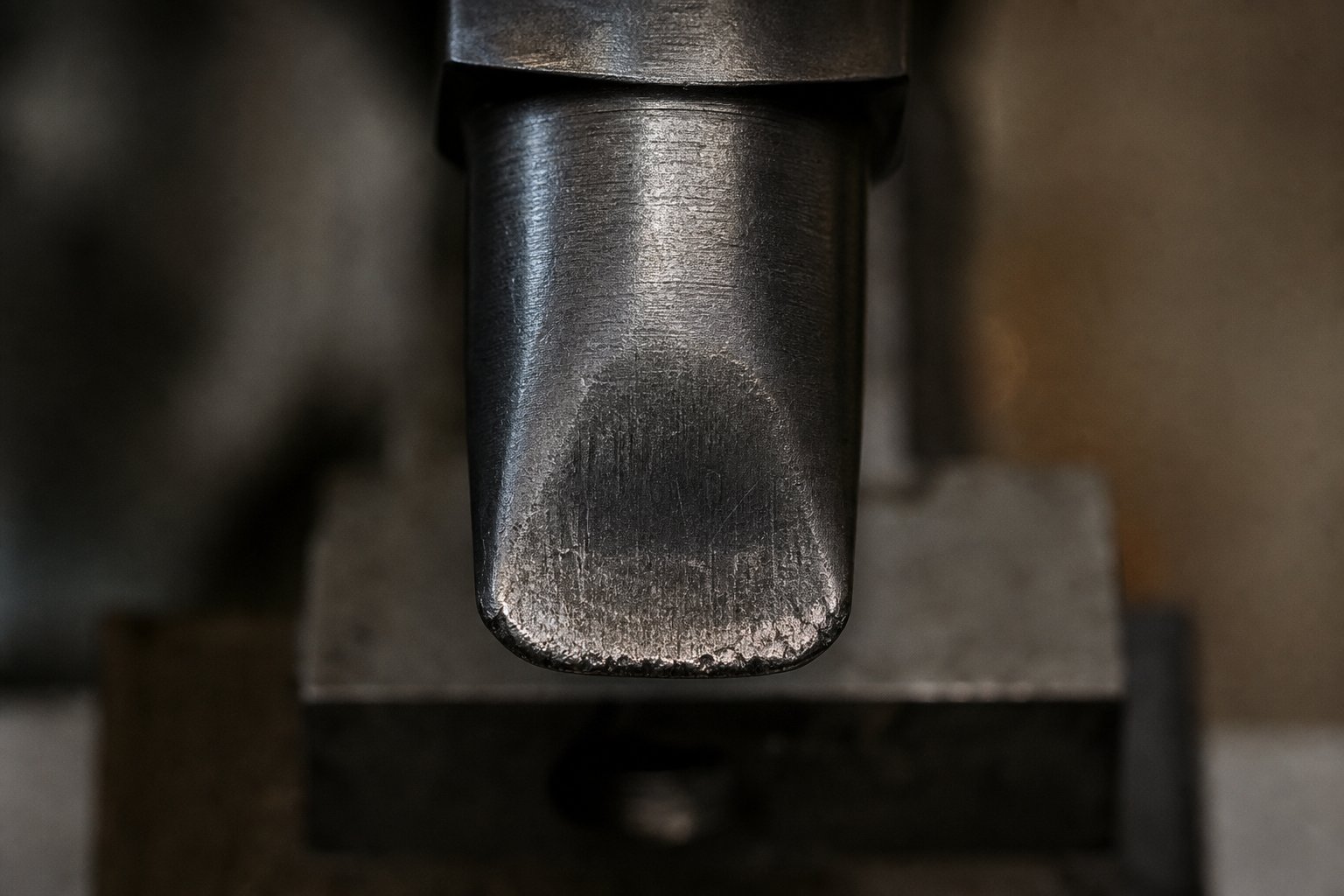
A notch that feeds perfectly on day one will not feed perfectly on day three hundred. Every production stroke subjects the punch and die surfaces to compressive impact, abrasive contact with the strip material, and micro-scale fatigue cycling. Over thousands or millions of hits, these forces reshape the cutting geometry in subtle but cumulative ways. The critical insight for tooling engineers is that positive and negative notches do not wear the same way. Their degradation patterns differ in location, progression rate, and observable symptoms, which means their maintenance strategies must differ too.
Ignoring these differences leads to reactive troubleshooting: the strip starts misregistering, someone pulls the die, and only then does the team discover worn notch geometry that has been degrading for weeks. Understanding the specific wear signature for each type transforms that reactive cycle into a predictive one.
Wear Progression in Positive Notch Tooling
The punch edges forming positive notch tabs experience wear along the three sheared sides that free the tab from the strip body. These edges are the working surfaces that maintain the tab's crisp geometry, and they degrade progressively through a predictable sequence.
Early in die life, the cutting edges are sharp and produce clean tab separation with minimal burr. The tab's perimeter is well-defined, and its angular relief geometry remains intact. As production continues, adhesive and abrasive wear mechanisms round the punch edges incrementally. Understanding punch and die wear patterns reveals that repeated stress cycles cause microscopic cracks that eventually propagate into larger defects through fatigue wear, a mechanism particularly relevant to the thin sections at tab perimeters.
You will notice the degradation through a specific symptom chain:
- Tab edges develop radii where sharp corners once existed, reducing the definition of the tab profile
- Burrs begin forming on the tab's sheared edges, creating raised material that catches on lifter surfaces during strip advancement
- The tab's angular relief effectively flattens as the leading edge rounds, increasing contact area with lifters and raising drag
- Feeding resistance climbs gradually, measurable as increasing strip misregistration at downstream pilot stations
- Parts begin showing dimensional drift consistent with progressive pitch error accumulation
The key word here is gradually. Positive notch wear does not cause sudden failures. It introduces a slow, linear increase in feeding resistance that often goes unnoticed until registration tolerance is exceeded. Engineers monitoring strip registration data over time can identify the upward trend and schedule maintenance before the degradation reaches a failure threshold.
Because the tabs have been work hardened at their sheared edges during the initial forming operation, deformation hardening at those cut surfaces initially provides some resistance to abrasive wear. However, once the hardened layer wears through, underlying softer material erodes more quickly, sometimes creating an inflection point where wear accelerates after an initial stable period.
Wear Progression in Negative Notch Tooling
Negative notch punches wear at the cutting perimeter, the rectangular or trapezoidal edge that shears material from the strip. As this perimeter rounds, the functional consequence is different from positive notch wear: the removed area effectively shrinks.
Here is why that matters. When the punch edge rounds, it no longer cuts a clean, full-width void. The notch becomes slightly narrower and shallower than its original design geometry. Each thousandth of a millimeter lost to edge rounding reduces the clearance margin between the strip edge and the lifter body. Over tens of thousands of strokes, the gap narrows until the strip begins contacting the lifter again, producing the same hang-up problems the notch was designed to prevent.
Simultaneously, burr buildup compounds the problem. As the punch dulls, burrs grow taller on the strip's cut edges. Mate Precision Technologies recommends sharpening tools when edges are worn to a 0.01 inch (0.25 mm) radius, noting that frequent touch-ups work better than waiting for the punch to become very dull. For negative notch tooling, this principle is especially critical because the burrs are not just a quality issue. They directly interfere with feeding by catching on guide rails, die surfaces, and lifter crowns as the strip advances. Research on lateral burr formation in notching operations confirms that burr severity increases when punch/die clearance relationships shift from their original design values, exactly what happens as edges wear and effective clearance tightens.
The failure mode for negative notches tends to be more abrupt than for positive notches. Feeding resistance stays relatively stable while adequate clearance exists, then spikes sharply when the reduced notch geometry finally allows strip-to-lifter contact. This makes negative notch wear harder to detect through gradual trend monitoring and more likely to present as a sudden production interruption.
Maintenance Strategies by Notch Type
Regrinding protocols differ because the wear locations and functional objectives differ.
For positive notch tooling, regrinding focuses on restoring the sharp tab separation edges. The goal is to re-establish crisp shear lines on the three freed sides of the tab so that the tab geometry returns to its as-designed profile. This typically involves surface grinding the punch face to remove the worn layer, restoring the cutting edge geometry. If your tooling was originally finished using EDM wire machining for the intricate tab profiles, regrinding must preserve those contours rather than simply flattening the punch face.
For negative notch tooling, regrinding restores the full clearance geometry. The objective is to return the punch perimeter to its original dimensions so the void cut into the strip matches its designed width and depth. Because the functional consequence of wear is reduced clearance, even small amounts of regrinding restore meaningful performance. Deburring the die opening is equally important since slug passage and ejection can degrade with wear buildup inside the die cavity.
In both cases, the total regrind budget is finite. Each sharpening removes material from the punch face, shortening it incrementally. When cumulative regrinding approaches the punch's length tolerance, replacement becomes necessary rather than continued sharpening.
Understanding the distinct wear pattern for each notch type allows predictive maintenance scheduling rather than reactive troubleshooting. Positive notches degrade gradually through increasing feeding resistance. Negative notches degrade through clearance reduction that eventually triggers abrupt strip hang-ups. Monitor accordingly.
Wear behavior completes the picture of how each notch type performs across its full lifecycle. From initial geometry selection through material-specific dimensioning, strip layout integration, and finally maintenance planning, the decision framework for bypass notch design spans the entire die program. Bringing these threads together into an actionable implementation sequence gives tooling engineers a clear path from design intent to validated production.
Implementation Workflow and Custom Die Engineering Resources
Every concept discussed so far, from geometry selection to material behavior to wear management, converges at a single point: the moment you commit a notch design to steel. That commitment happens within a workflow, and the engineers who execute that workflow systematically produce better results than those who jump from concept to cut without a structured path between them.
The reality of negative and positive bypass notches sheet metal forming stamping dies is that no single factor drives the decision in isolation. Material type informs notch preference. Strip width constrains depth. Press speed shifts priority between rigidity and clearance. Station count determines how much cumulative error you can tolerate. These factors interact, and the implementation workflow must account for all of them in the correct sequence.
Decision Framework for Tooling Engineers
When you sit down with a new strip layout, the notch type decision follows a logical progression. Skipping steps or reordering them creates gaps that surface during tryout, often as mysterious feeding problems that resist quick fixes. The following sequence reflects how experienced tool and die maker professionals approach bypass notch design from first principles:
- Assess material type and thickness. Identify the alloy family, gauge, yield strength, elongation, and work hardening characteristics. This determines whether material-driven constraints force you toward positive or negative notches before any other factor is considered.
- Evaluate strip width and number of stations. Calculate the remaining cross-sectional area after notch geometry is applied. Determine how many stations the strip must traverse and estimate cumulative positional error tolerance at the final station.
- Determine lifter requirements. Establish lifter type (round, bar, or strip), lifter height, and lifter location relative to the strip edge. Map lifter travel against strip position at every point in the press cycle to identify potential interference zones.
- Select notch type based on priority factor. If rigidity preservation is the limiting constraint (thin material, narrow strip, long die, precision tolerance), choose positive. If clearance is the limiting constraint (thick stock, tall lifters, high-speed operation, wide strip with ample rigidity margin), choose negative.
- Dimension notch geometry proportional to stock parameters. Set depth, width, and angular relief using the proportional relationships established by material thickness, lifter travel, and strip stiffness requirements. Apply material-specific adjustments for work hardening behavior, elongation limits, and edge quality expectations.
- Validate through tryout and adjust. Run the die at progressive speed increments. Monitor strip registration at pilot stations. Measure pitch accuracy across the full die length. Verify that feeding resistance remains stable and that no strip-to-lifter contact occurs throughout the lifter cycle. Refine relief angles, notch depth, or edge treatment based on observed performance.
This sequence is not rigid. Some projects present constraints that collapse multiple steps into a single obvious conclusion. A 0.3 mm aluminum strip in a twenty-station die practically demands positive notches before you even assess lifter height. A 3.0 mm high-strength steel in a four-station blanking die points to negative notches before strip width enters the calculation. But for the many applications that fall between these extremes, working through each step prevents the common mistake of optimizing for one factor while ignoring another that ultimately controls performance.
Documentation matters here too. The die maker who records the rationale behind each geometry decision, not just the final dimensions, creates a reference that accelerates future programs in similar materials and layouts. When a similar application comes through the shop six months later, the documented reasoning eliminates the need to re-derive every parameter from first principles.
Connecting Design Intent to Custom Die Solutions
Bypass notch design does not exist in a vacuum. It is one element within a complex die structure that includes punches, lifters, pilots, guide rails, carrier webs, and overall strip management systems. The notch geometry must integrate with every one of these components. A perfectly dimensioned notch that conflicts with pilot placement, interferes with lifter rail geometry, or creates slug ejection problems in the die shoe delivers zero value regardless of how well its proportions match the engineering calculations.
This integration challenge is where many tooling programs stall. The individual design parameters make sense in isolation, but combining them into a functioning die assembly requires experience managing the spatial and timing relationships between components. Lifter travel must coordinate with notch clearance. Pilot entry timing must align with strip position after notch-controlled feeding. Burr direction from notch cutting operations must not interfere with downstream forming stations. Slug ejection paths from negative notches must clear parallels and die shoe openings without obstruction.
Working with experienced die engineering teams ensures these integration details receive the attention they demand. YICHEN's custom stamping die solutions address exactly this class of design-heavy challenge, where bypass notch optimization must coordinate with die structure, lifter integration, clearance management, and material flow control across the entire die assembly. For tooling engineers who have worked through the design theory and are ready to translate geometry decisions into production tooling, partnering with a team that handles the full integration scope prevents the iterative rework that burns through tryout budgets.
The workflow closes a loop. Strip layout drives notch type selection. Notch geometry drives dimensioning. Dimensioning drives validation. Validation either confirms the design or feeds corrections back into the geometry. And throughout production, wear monitoring ensures that the validated geometry remains within its performance envelope until the next scheduled maintenance event restores it to specification.
Every stamping die tells a story through its strip. The notches, whether positive or negative, are chapters in that story. They define how the material moves, where it pauses, and how it registers. Getting them right means the strip feeds smoothly from first hit to last. Getting them wrong means the strip fights the die at every station. The difference between those outcomes is not luck. It is engineering, applied systematically from design intent through production validation.
Frequently Asked Questions About Bypass Notches in Stamping Dies
1. What is the difference between positive and negative bypass notches in a progressive stamping die?
A positive bypass notch retains material on the strip as a tab-like projection that rides over lifters during feeding, preserving strip rigidity. A negative bypass notch removes material from the strip edge, creating a void that provides clearance for lifters without physical contact. The choice between them depends on whether your application prioritizes strip stiffness (positive) or lifter clearance (negative). Thin materials and narrow strips generally benefit from positive notches, while thick stock and high-speed operations often perform better with negative notches.
2. How do I determine the correct notch depth and width for my strip layout?
Notch depth and width are proportioned primarily to material thickness, lifter travel height, and strip width. For negative notches, depth must exceed lifter travel plus any vertical strip oscillation during feeding. For positive notches, tab depth must stay within the material's elastic deflection range under lifter contact loads. Width accommodates the lifter body plus lateral strip wander. A dimensioning priority sequence starts with material thickness, then considers strip width, station count, feeding pitch, and lifter height in that order.
3. Which bypass notch type works best for stainless steel stamping?
Positive notches are generally preferred for long production runs in austenitic stainless steel. The reason is work hardening at cut edges. When negative notches are punched in stainless, the sheared edges harden progressively during production, increasing feeding resistance over die life. Stainless grades can see up to 50 percent strength increases in heavily worked zones. Positive notches avoid this issue at the strip edge, though designers must add generous radii at tab junctions to prevent fatigue cracking from repeated lifter contact loads.
4. How do bypass notch wear patterns affect die maintenance scheduling?
Positive and negative notches wear differently and require distinct monitoring approaches. Positive notch tooling degrades gradually as punch edges round, causing tabs to develop burrs that slowly increase feeding resistance. This allows trend-based predictive maintenance. Negative notch tooling degrades by reducing the void size as edges round, eventually causing abrupt strip hang-ups when clearance becomes insufficient. Negative notch wear is harder to detect early, making interval-based sharpening schedules more appropriate than condition monitoring alone.
5. Can I use both positive and negative bypass notches in the same progressive die?
Yes, experienced die engineers sometimes combine both types within a single strip layout when different stations present different constraints. For example, stations with tall lifters may use negative notches for clearance, while downstream stations in a narrow carrier section use positive notches to preserve rigidity. The key is ensuring consistent feeding behavior across the full progression. Working with custom die engineering teams like YICHEN (yichen-group.com/stamping-die/) helps coordinate multi-notch-type layouts where integration between lifters, pilots, and notch geometry must function as a unified system.


