


Die Stamping Decoded: From Raw Metal to Flawless Finished Parts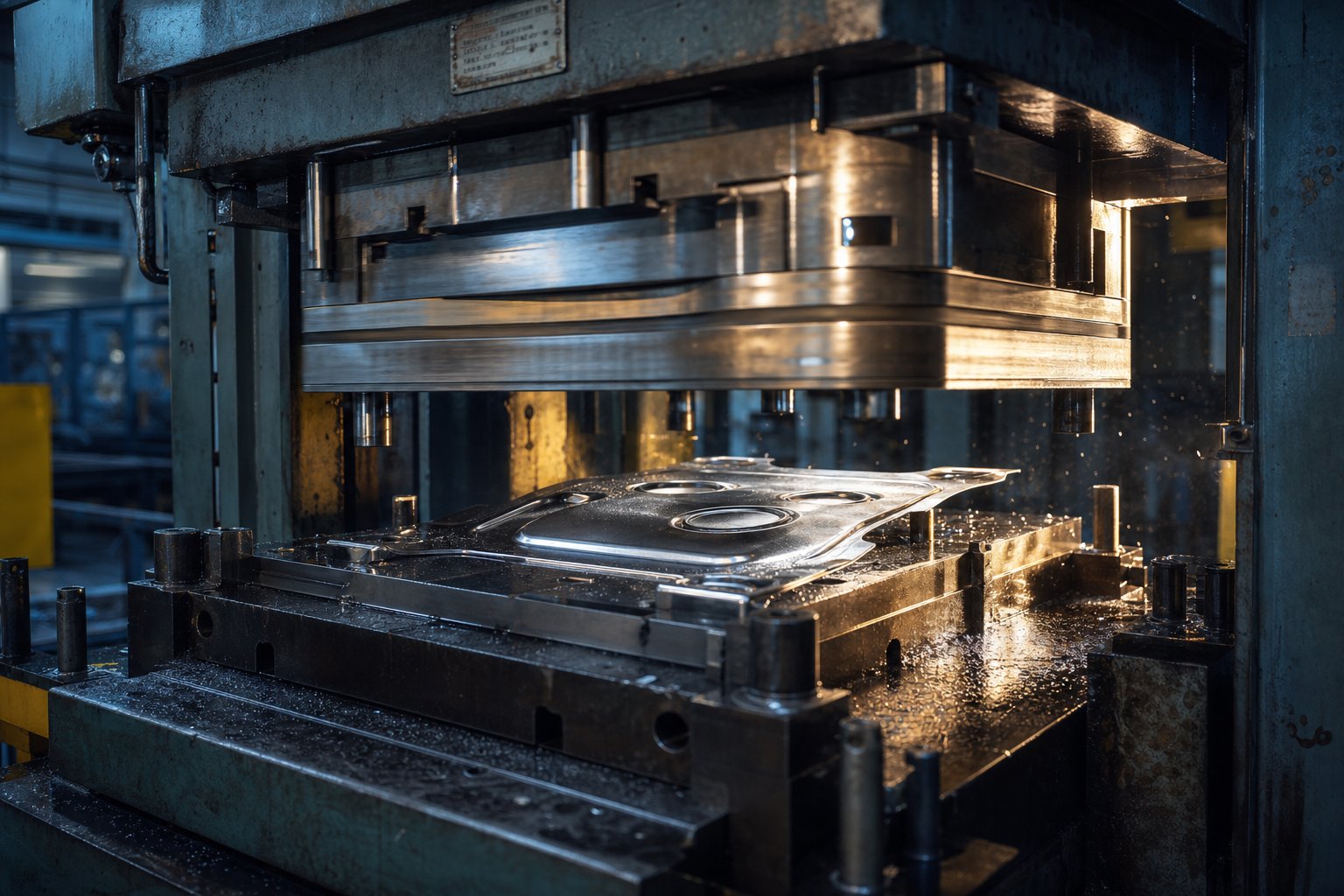
What Is Die Stamping and Why Every Manufacturer Should Understand It
Imagine turning a flat, featureless sheet of steel into a precisely shaped automotive bracket, an electrical connector, or an appliance housing - all in a fraction of a second. That is exactly what die stamping accomplishes millions of times a day across factories worldwide. Yet despite its prevalence, the process is frequently misunderstood or confused with entirely different manufacturing methods. Whether you are a design engineer specifying parts, a sourcing manager evaluating suppliers, or a manufacturer exploring production options, a clear grasp of this process gives you a real competitive edge.
What Die Stamping Means in Manufacturing
So, what is stamping in a manufacturing context? At its core, die stamping is a cold-forming metalworking process that uses a stamping press fitted with specialized tooling - a matched punch and die set - to transform flat sheet metal or coil stock into finished or near-finished parts. The press applies force measured in tons, driving the punch into the die cavity to cut, bend, draw, or form the workpiece into a precise shape. All of this happens at room temperature, which preserves material strength and produces components that conform to tight tolerances.
Die stamping is a high-speed, cold-working manufacturing process in which a die and punch mounted inside a stamping press shape flat sheet metal into finished parts through operations such as blanking, bending, drawing, and forming - producing strong, repeatable components at scale.
You might wonder, "what is a die, exactly?" In manufacturing, a die is the hardened steel tooling block that contains the cavity or profile into which the material is formed or cut. The punch is its counterpart - a matching tool that descends into the die to perform the shaping operation. Together, these two halves make up the die set, and understanding what is dies in manufacturing really means understanding this precision-engineered partnership between punch and cavity.
A common point of confusion worth clearing up: die stamping is not die casting, and it is not die cutting. Die casting involves pouring molten metal into a mold cavity - a fundamentally different process suited to complex three-dimensional shapes in non-ferrous alloys. Die cutting, on the other hand, typically refers to slicing thin, flat materials like paper, rubber, or foam. Die stamping sits in its own category: it shapes solid sheet metal through mechanical force, combining cutting and forming operations in a single press cycle or across multiple progressive stations.
Who Uses Die Stamping and Why It Matters
From the brackets under your car's dashboard to the shielding inside your smartphone, stamped metal parts are everywhere. The automotive industry alone consumes vast quantities of stamped components for body panels, structural reinforcements, and electrical systems. Electronics manufacturers rely on the process for connectors, terminals, and heat sinks. Aerospace, medical devices, and home appliances round out the list of sectors where what is metal stamping is not just an academic question - it is a daily production reality.
Why does it remain so dominant? The economics are compelling. Once tooling is built, a stamping press can produce identical parts at speeds ranging from hundreds to thousands of strokes per hour, driving per-unit costs far below alternative methods at high volumes. The tooling itself, made from hardened materials, withstands thousands of cycles without excessive wear. For manufacturers weighing what is a stamping operation worth investing in, the answer often comes down to volume: the higher the quantity, the greater the cost advantage.
This article takes a practitioner-focused approach, walking you through the complete process, die types, material considerations, common defects, cost drivers, and modern technology - everything you need to make informed decisions about your next stamping project. The journey begins with the step-by-step workflow that turns a part concept into production-ready tooling and finished components.
The Die Stamping Process from Design to Finished Part
Every stamped part begins its life as a concept on a screen and ends as a production-ready component ejected from a press. What happens between those two points - and in what order - determines whether a project hits its cost, quality, and timeline targets. The metal stamping process is not a single event; it is a carefully sequenced chain of decisions and operations where each step sets the conditions for the next.
From Part Design to Production-Ready Tooling
The earliest stages of any stamping manufacturing process carry disproportionate weight. A dimensional tolerance chosen carelessly during design, or a material specified without considering formability, can cascade into expensive die modifications or chronic quality problems months later. Here is the full workflow, laid out in the order experienced practitioners actually follow it:
Part design and DFM review - Engineers define the part geometry, tolerances, and functional requirements. A thorough Design for Manufacturability review evaluates whether features like bend radii, hole spacing, and wall angles are compatible with the stamping process. Minimum bend radii, for example, should typically be at least 1.0 to 1.5 times the material thickness to avoid cracking.
Material selection - The workpiece metal - cold-rolled steel, stainless steel, aluminum, brass, or copper - is chosen based on strength, formability, corrosion requirements, and cost. This choice directly influences die clearances, lubrication needs, and expected tool wear.
Stamping simulation and feasibility analysis - Finite element analysis (FEA) software models material flow, thinning, springback, and potential wrinkling before any steel is cut. This digital validation step saves weeks of physical tryout.
Detailed die design - Engineers create the complete die layout, including strip layout for progressive dies, station sequencing, and pilot pin placement. Every forming, cutting, and idle station is mapped to ensure the sheet metal stamping process runs without interference.
Die Building, Press Setup, and Production Runs
With the design locked, the die making process moves into the physical realm. This is where precision machining meets hands-on craftsmanship:
CNC machining and EDM of die components - Die blocks, punches, and forming inserts are shaped through high-precision die machining - including wire EDM for intricate profiles and CNC milling for cavity work. Tolerances at this stage are measured in thousandths of an inch.
Die assembly and bench fitting - Machinists assemble the upper and lower die halves, carefully aligning guide pins, stripper plates, and spring assemblies. Hand fitting and blue-matching ensure punch-to-die clearances are uniform across every station.
Press setup and tonnage calculation - The completed die set is mounted in a stamping press rated for the required tonnage. Press speed, shut height, and feed length are dialed in based on the part geometry and material.
Trial runs and sample inspection - Initial hits produce sample parts that undergo dimensional inspection, visual evaluation, and functional testing. Engineers measure critical features against specification and adjust the die as needed - sometimes through multiple tryout iterations.
Full production stamping - Once samples meet all requirements, the press runs at production speed. In-process inspections and statistical process control (SPC) maintain consistency across thousands or millions of cycles.
Secondary operations - Finished parts may require deburring, surface finishing, plating, coating, heat treatment, or welding assembly before they are ready for shipment. These post-stamping steps refine edges, enhance corrosion resistance, and integrate sub-components into final assemblies.
Why the Workflow Sequence Matters
Sounds like a lot of steps? It is - and every one earns its place. The die process is sequential for a reason: each phase validates the assumptions made in the phase before it. Skipping or compressing the early stages - particularly simulation and trial runs - is the single most common source of costly rework, premature die failure, and missed launch dates. A stamping simulation that catches a thinning problem costs a fraction of what a cracked die insert costs to replace on the shop floor.
Think of it this way: the design and simulation stages are where you buy information cheaply. The machining and tryout stages are where mistakes get expensive. Manufacturers who invest adequate time in feasibility analysis and iterative sample inspection consistently achieve shorter total lead times and lower scrap rates than those who rush straight to cutting steel.
The workflow itself, however, is only half the equation. Equally critical is the type of die selected for the job - progressive, transfer, compound, or combination - because that choice shapes every station in the strip layout and every dollar in the tooling budget.
Types of Stamping Dies and How to Pick the Right One
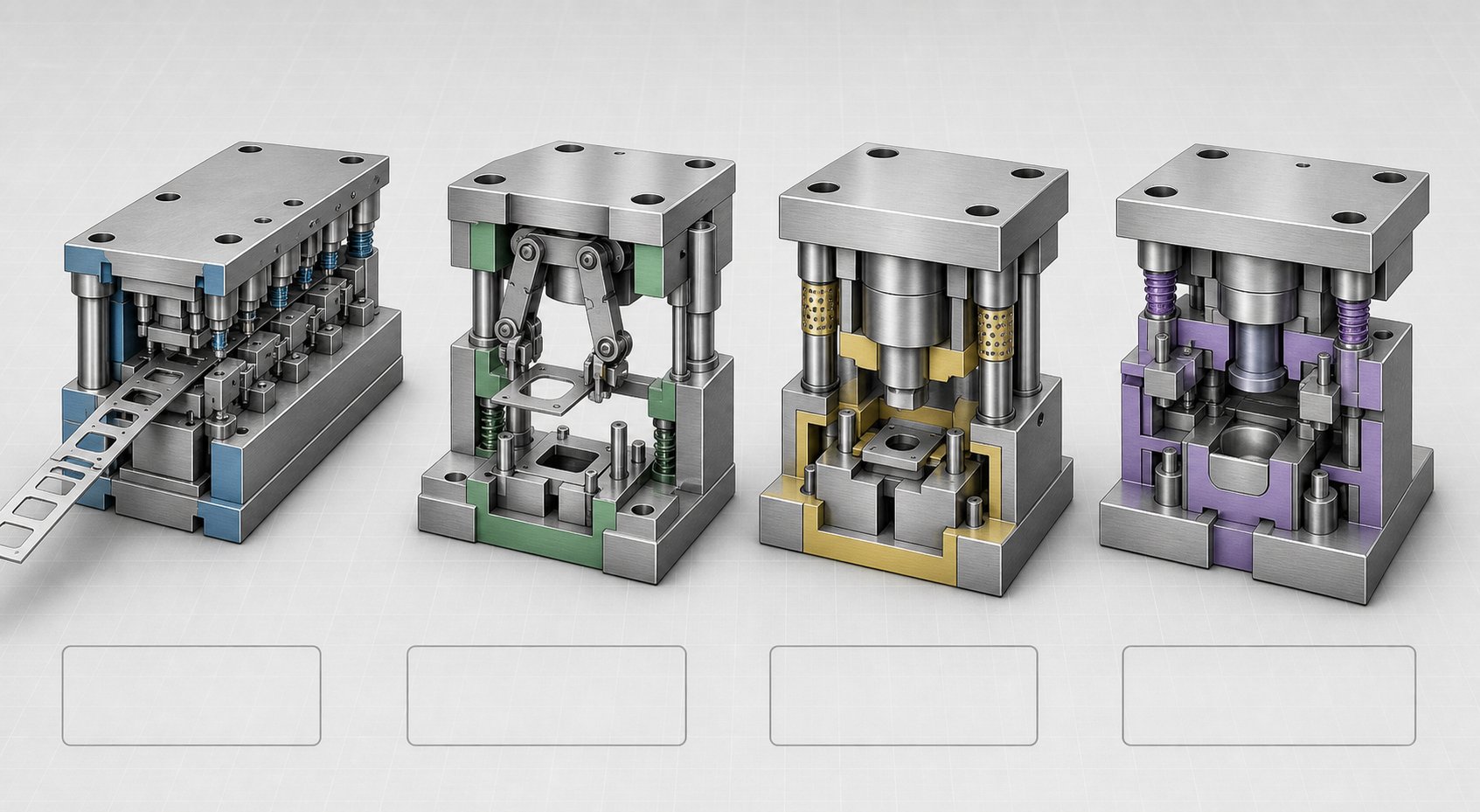
Choosing the wrong die type is one of the most expensive mistakes a project team can make - and one of the easiest to avoid with the right information. The four primary types of stamping dies each occupy a distinct sweet spot defined by part geometry, production volume, and budget. Yet finding a clear, side-by-side comparison can be surprisingly difficult. The table below puts all four options in one place so you can evaluate them against your specific project requirements.
Progressive, Transfer, Compound, and Combination Dies
| Die Type | How It Works | Typical Applications | Ideal Production Volume | Relative Tooling Cost | Complexity Level | Key Advantages / Limitations |
|---|---|---|---|---|---|---|
| Progressive Die | A continuous metal strip advances through a series of stations inside one die set. Each station performs a distinct operation - blanking, piercing, bending, or forming - and the finished part separates from the strip at the final station. | Automotive brackets and clips, electrical connectors, terminals, appliance hardware | High (100,000+ parts) | High | High | Advantages: Fast cycle times, low per-part cost at volume, minimal material handling. Limitations: Expensive upfront tooling; design changes after build are costly. |
| Transfer Die | A blank is cut from the strip first, then mechanically transferred between independent stations by automated fingers or grippers. Each station performs a separate forming or cutting operation. | Large automotive body panels, structural reinforcements, deep-drawn enclosures, heavy-duty appliance housings | Medium to High (10,000–500,000+ parts) | High | High | Advantages: Handles larger parts and deeper draws than progressive dies; less carrier-strip waste. Limitations: Slower cycle times; transfer mechanisms add setup complexity. |
| Compound Die | Multiple cutting operations - such as blanking and piercing - occur simultaneously in a single press stroke. All features are produced in one plane. | Flat washers, gaskets, simple electronic shields, precision flat components | Low to High (flexible) | Low to Medium | Low to Medium | Advantages: Excellent flatness and concentricity; tight tolerances between features. Limitations: Limited to flat parts; cannot perform bending or drawing operations. |
| Combination Die | Combines both cutting and non-cutting (forming, bending, drawing) operations in a single press stroke, merging the capabilities of compound and forming dies. | Small formed brackets with pierced holes, drawn cups with trimmed flanges, parts needing cut-and-form in one hit | Low to Medium (1,000–100,000 parts) | Medium | Medium to High | Advantages: Reduces secondary operations; produces more complex parts than compound dies alone. Limitations: More intricate die design; not ideal for very high volumes where progressive dies excel. |
A few points jump out from this comparison. The progressive die stamping process dominates high-volume production because the strip feeds continuously and multiple operations happen with each press stroke, keeping cycle times short and per-part costs low. Progressive dies are the workhorses behind small-to-medium-sized stamped parts that need piercing, forming, and blanking in rapid succession.
Transfer die stamping steps in when parts are too large to stay connected to a carrier strip, or when deep draws and complex three-dimensional shapes exceed what a progressive layout can manage. Because the part is free from the strip, transfer stamping also reduces material waste - the carrier web that a progressive die needs is eliminated, and grippers move each piece independently through the stations.
Compound die stamping earns its place whenever flatness and tight feature-to-feature tolerances are non-negotiable. Since all cutting happens in a single stroke, there is no cumulative positioning error from station-to-station transfers. The trade-off is simplicity: if your part requires any bending or drawing, you will need to look elsewhere.
Combination dies bridge the gap between compound and progressive tooling. They handle parts that need both cutting and forming but do not justify the cost of a full progressive die - think low-to-medium production runs where consolidating two operations into one stroke saves meaningful setup time.
How to Choose the Right Die Type for Your Project
With four options on the table, the decision comes down to matching your project's specific constraints to each die type's strengths. Here is a practical framework:
Part geometry and size: Small-to-medium flat or moderately formed parts favor progressive dies. Larger parts, deep draws, or complex 3D shapes point toward transfer stamping. Purely flat, cut-only parts suit compound dies.
Production volume: High-volume runs (hundreds of thousands or more) almost always justify progressive tooling costs. Medium runs may benefit from transfer or combination dies. For shorter runs, compound or combination sheet metal stamping dies typically deliver better ROI.
Tolerance requirements: When concentricity or feature-to-feature accuracy in a single plane is critical, compound dies offer the tightest control. Progressive and transfer dies achieve excellent tolerances as well, but through careful station-to-station registration rather than a single-stroke approach.
Number of operations: Parts needing many sequential operations - piercing, notching, bending, coining - are natural candidates for progressive or transfer dies. Parts needing only one or two operations can often be produced more economically with compound or combination tooling.
Budget constraints: If upfront tooling budget is limited and volumes are moderate, compound or combination dies keep initial investment manageable. Progressive and transfer dies demand higher capital but repay it through lower per-part costs at scale.
Ultimately, the right choice balances all five factors together - not any single one in isolation. A part that looks perfect for a progressive die on volume alone might actually require a transfer die because of a deep-draw feature. Conversely, a seemingly simple flat part produced in large quantities could justify compound tooling precisely because its tolerances are too tight for progressive strip feeding.
Selecting the die type is a pivotal decision, but it only tells half the story. The individual components inside that die - punches, die blocks, strippers, guide pins - each play a specific mechanical role that determines whether the finished part meets specification or ends up in the scrap bin.
Essential Stamping Die Components and How They Function
Picture a die set as a finely tuned machine within a machine. Every pin, plate, and spring serves a precise mechanical purpose, and if even one element is out of position or worn beyond tolerance, the stamped part suffers. Whether you are specifying a new die tool for a product launch or troubleshooting quality issues on an existing line, knowing what each component does - and where it sits inside the assembly - transforms abstract tooling conversations into concrete engineering decisions.
Upper and Lower Die Assembly Components
A complete stamp die set divides into two halves: the upper die (mounted to the press ram) and the lower die (bolted to the press bed). Each half houses components that work in precise alignment to cut, form, or hold the sheet metal during every stroke. The table below maps out the major stamping die components, their location, and the specific role each one plays.
| Component Name | Location | Primary Function |
|---|---|---|
| Die Shoe (Upper) | Upper die | Serves as the top mounting plate and structural foundation. All upper-die components - punches, retainers, and backing plates - are secured to this shoe. Typically machined from steel or aluminum alloy for rigidity and dimensional stability. |
| Die Shoe (Lower) | Lower die | Acts as the bottom foundation plate, holding the die block, guide posts, and stock guides. Together the upper and lower die shoes form the structural backbone of the stamping die set. |
| Punch | Upper die | The cutting or forming tool that descends into the die block. Available in a wide range of nose shapes - round, oblong, square, rectangular, or custom profiles - each shaped to match the feature it creates in the workpiece. Punches can pierce holes, trim edges, or bend material depending on their geometry. |
| Die Block (Die Cavity / Die Button) | Lower die | Provides the opposing cutting edge or forming profile that receives the punch. The die button's opening is offset slightly larger than the punch nose - typically 5–10% of material thickness per side - creating the controlled clearance that allows clean shearing. |
| Stripper Plate | Upper die (or lower die in some designs) | Holds the sheet metal flat against the die block during cutting and strips it off the punch as the upper die retracts. Prevents the material from lifting with the punch and ensures consistent part positioning. |
| Backing Plate | Upper die (behind punches) | A hardened plate positioned between the punch heads and the die shoe. Distributes punch forces over a wider area to prevent the punch shanks from embedding into the softer shoe material over thousands of cycles. |
| Shank | Upper die (top center) | A cylindrical projection that fits into the press ram's clamping hole, centering the upper die assembly directly under the ram. Common on smaller die sets where a single-point connection is sufficient. |
| Guide Pins and Guide Bushings | Spanning both halves (pins typically on lower die; bushings on upper die) | Align the upper and lower die halves with extreme precision - often within 0.0001 inches. Ball-bearing guide pins have become the industry standard due to their smooth separation and consistent accuracy, though friction-type pins are still used where tighter die guidance is needed. |
| Pilot Pins | Upper die | Enter pre-pierced holes in the strip stock to precisely locate the material at each station before the forming or cutting operation begins. Critical for maintaining station-to-station registration in progressive dies. |
| Spring Assemblies | Upper and/or lower die | Provide the controlled force needed to clamp, strip, or eject material. Mechanical (wire coil) springs handle standard loads, while nitrogen gas springs deliver higher, more consistent force in a compact package - a key choice that affects stripping performance and die life. |
| Stock Guides | Lower die | Channel the incoming strip stock so it feeds in a straight, consistent path through the die. Proper stock guidance prevents misfeeds that would otherwise cause misregistration, double hits, or strip buckling. |
Think of this table as a field reference you can return to whenever a die builder or supplier mentions a component by name. Each part is purpose-built, and the interplay between them is what separates a reliable sheet metal die from one that produces scrap.
How Die Components Work Together During a Press Stroke
Reading a parts list is useful, but the real insight comes from understanding how these components move together in a single press cycle. Imagine watching a progressive die in slow motion - here is what happens in roughly one-half second of real time:
The upper die descends. Driven by the press ram, the upper die shoe moves downward, carrying the punches, stripper plate, and pilot pins toward the strip stock resting on the lower die.
Pilot pins engage the strip. Before any cutting or forming begins, the pilot pins enter previously pierced holes in the strip. This locks the material in exact position - ensuring every feature aligns with the stations that created preceding operations.
The stripper plate contacts the material. Spring-loaded, the stripper plate presses the strip firmly against the die block surface. This clamping action prevents the metal from lifting, shifting, or distorting during the cutting stroke.
Punches perform cutting or forming operations. With the material held securely, the punches continue downward into their matching die buttons or forming cavities. Piercing punches shear through the metal; forming punches bend, coin, or draw it into shape. The controlled clearance between each punch and its die block - that 5–10% offset - determines whether the cut edge is clean or ragged.
The upper die retracts. As the ram reverses, the stripper plate holds the strip down while the punches withdraw cleanly from the material. Springs push the stripper to its extended position, ensuring the strip does not cling to the punch face.
The strip advances. Stock guides channel the strip forward by exactly one pitch length - the distance between stations - positioning the next section of material for the following stroke. In a transfer die, mechanical fingers or grippers move the free blank to the next station instead.
This entire sequence repeats hundreds or even thousands of times per hour. You will notice that proper clearance between the punch and die block appears throughout the cycle as the single most critical dimensional relationship. Too little clearance and the punch experiences excessive force, accelerating wear and risking fracture. Too much clearance and the sheared edge develops heavy burrs, rough break lines, and dimensional inaccuracy. Getting this clearance right - calibrated to the specific material type and thickness - is one of the first things experienced die makers verify during assembly and tryout.
The mechanical elegance of these die sets is impressive, but every component is subject to wear, heat, and fatigue over millions of cycles. What determines how long each part lasts - and how well it performs under stress - ultimately comes down to the materials those components are made from and the surface treatments applied to them.
Die Material Selection and Surface Treatments That Maximize Tool Life
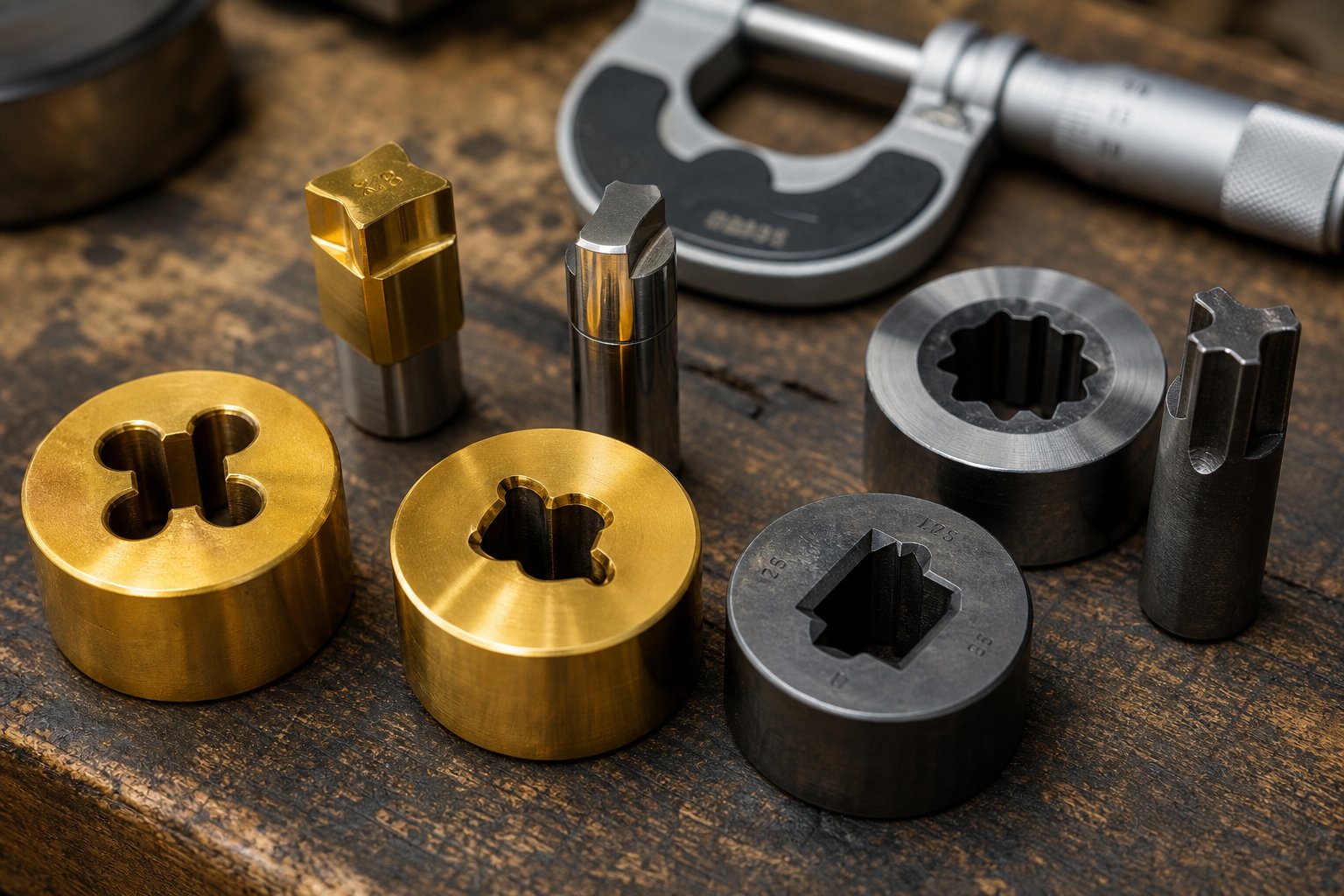
A stamping die is only as durable as the steel it is made from and the surface protection applied to it. Two identically designed dies - same geometry, same press, same part - can deliver wildly different lifespans if one uses the wrong tool steel grade or skips a critical coating step. For engineers and sourcing managers evaluating tooling dies, understanding the material behind the metal die is not optional; it is one of the most consequential cost and quality decisions in the entire project.
Tool Steel Grades for Stamping Dies
Selecting a tool steel grade always involves trade-offs among three core properties: hardness (resistance to deformation and edge dulling), toughness (resistance to chipping or cracking under impact), and wear resistance (ability to withstand repeated abrasive contact without dimensional loss). A harder steel holds a sharper cutting edge longer, but it becomes more brittle - and in a stamping die absorbing thousands of high-speed impacts per hour, brittleness can mean catastrophic fracture. The table below compares the grades most commonly used in steel stamping dies.
| Grade | Key Properties | Typical Applications in Die Stamping | Relative Cost |
|---|---|---|---|
| D2 | High carbon (1.4–1.6%), high chromium (11–13%). Excellent wear resistance and edge retention; maximum hardness around HRC 62–65. Lower toughness than shock-resistant grades. | Long-run blanking and forming dies, piercing punches, progressive die stations that see heavy abrasive wear from steel sheet stamping. | Medium |
| A2 | Air-hardening with 5% chromium. Very fine grain structure; excellent dimensional stability during heat treatment. Maximum hardness around HRC 62–65. Good balance of wear resistance and toughness. | Die shapes, slitters, stripper plates, medium-run metal press dies where distortion during hardening must be minimized. | Medium |
| S7 | Shock-resistant, medium carbon. Combines high impact strength with moderate wear resistance. Maximum hardness around HRC 59–61. Outstanding toughness for absorbing repeated shock loads. | Forming and bending stations, heavy-gauge blanking where impact forces are severe, progressive die inserts subjected to high shock. | Medium-High |
| M2 | High-speed steel with tungsten and molybdenum. Retains hardness at elevated temperatures (red-hardness). Maximum HRC 65. Superior abrasion resistance but lower toughness than cold-work steels. | High-speed piercing punches, trim stations running at elevated press speeds, metal stamping die components that generate significant frictional heat. | High |
| DC53 | Modified cold-work steel (Daido Steel). Roughly twice the toughness of D2 at comparable hardness (HRC 62–63). Better machinability and reduced chipping risk compared to conventional high-chromium grades. | Progressive die stations stamping high-strength steel or stainless steel, high-impact blanking, applications where D2 chips or cracks prematurely. | Medium-High |
A practical takeaway: D2 remains the default choice for many blanking and piercing operations because of its proven wear life and moderate cost. When parts demand heavy forming or the press delivers high shock loads, S7's toughness advantage makes it the safer pick. DC53 has emerged as a popular upgrade path for shops that experience chipping failures with D2, offering a meaningful toughness boost without sacrificing hardness.
For the most demanding stations in a progressive stamping die - pilot-hole piercing or fine-blanking inserts that see millions of cycles - carbide inserts (typically tungsten carbide) replace tool steel entirely. Carbide delivers hardness above HRC 80 and wear resistance that can outlast steel inserts by five to ten times, though at a significantly higher material and machining cost. The decision to use carbide is usually station-specific, reserved for the one or two positions where wear rates would otherwise drive unacceptable maintenance frequency.
Surface Treatments and Coatings That Extend Die Life
Even the best tool steel grade benefits from surface enhancement. Coatings and treatments add a protective layer - or alter the steel's surface chemistry - to combat the specific wear mechanisms that shorten die life. Each option targets a different failure mode:
Ion/Plasma Nitriding diffuses nitrogen into the die surface, forming an extremely hard compound layer without adding dimensional thickness. Unlike coatings, nitriding does not chip or peel because it becomes part of the substrate itself. Studies cited by Advanced Heat Treat Corp. found that nitrided die surfaces lasted over 850,000 hits in automotive stamping environments where chrome-plated equivalents reached only 600,000 hits. Nitriding is especially effective on cast iron and cast steel dies forming advanced high-strength steels (AHSS), where high contact stresses quickly degrade thinner surface coatings.
TiN (Titanium Nitride) Coating is applied via physical vapor deposition (PVD), producing a thin, gold-colored layer with surface hardness around HV 2,300. TiN reduces friction and resists abrasive wear, making it well suited for piercing punches and forming inserts that process mild and medium-strength steels. Its limitation is thickness - typically 2 to 5 micrometers - meaning it performs best on tool steel substrates that are already hardened.
TiCN (Titanium Carbonitride) Coating builds on TiN with added carbon for higher hardness (approximately HV 3,000) and improved adhesion resistance. TiCN is the go-to upgrade when galling - adhesive wear where workpiece material welds onto the die surface - becomes a recurring problem, particularly with stainless steel and aluminum stampings.
Chrome Plating has long served as a workhorse surface treatment for stamping dies, valued for its smooth, low-friction surface that promotes material flow during deep draws. A chrome die surface performs well with conventional steels, but its limitations become more pronounced with harder workpiece materials. Because chrome is deposited electrolytically, the coating tends to be thicker on protruding areas and thinner in recesses, potentially creating slight dimensional inconsistencies. Additionally, environmental regulations around hexavalent chromium emissions have increased the cost and complexity of chrome plating operations.
Choosing the right treatment is not a one-size-fits-all decision. The optimal surface strategy depends on several interacting factors:
Workpiece material: Harder or stickier metals (stainless steel, aluminum, AHSS) demand coatings with higher hardness and better anti-galling properties - TiCN or nitriding over standard chrome.
Production volume: High-volume runs justify the added expense of nitriding or PVD coatings because the per-part cost savings from extended die life compound over millions of strokes.
Lubrication strategy: Dry or minimal-lubrication stamping operations put more stress on the die surface, favoring low-friction coatings like TiN or TiCN. Well-lubricated processes may perform adequately with chrome or even uncoated hardened steel.
Required surface finish on stamped parts: Visible or cosmetically critical parts need smooth die surfaces - chrome plating and polished TiN coatings both reduce surface roughness on the finished component.
Ultimately, die material and surface treatment choices are intertwined engineering and economic decisions. A less expensive tool steel paired with an optimized coating can outperform a premium grade left uncoated - and vice versa. The goal is to match the wear environment to the protection strategy so that tooling dies deliver consistent part quality across their full intended production life, not just the first few thousand hits.
Steel grade and coating protect the die itself, but they do not operate in isolation. The workpiece material feeding through the press exerts its own demands on clearances, lubrication, and forming limits - a relationship that deserves its own detailed examination.
Metal Compatibility Guide for Stamping Die Design
Every metal fights back differently when forced through a stamping die. Low-carbon steel bends cooperatively with modest lubrication, while titanium demands aggressive cooling and punishes tooling that is not up to the task. The workpiece material you choose does not just determine the part's mechanical properties - it dictates die clearances, lubrication strategy, tool steel selection, and even the surface treatments discussed in the previous section. Ignoring these material-specific demands is one of the fastest routes to premature die wear, chronic defects, and ballooning per-part costs.
What follows is a practical compatibility reference - the kind of consolidated table that engineers and sourcing managers can keep on hand when evaluating stamped metal parts for new projects.
Common Metals and Alloys in Die Stamping
The table below maps six of the most frequently stamped materials to the die design parameters that matter most. You will notice that clearance values shift significantly from one alloy to the next - a reflection of how each metal's hardness, ductility, and tensile strength influence shearing behavior.
| Material | Typical Die Clearance (% of Material Thickness, Per Side) | Lubrication Requirements | Forming Limit Considerations | Common Applications |
|---|---|---|---|---|
| Low-Carbon Steel (1008/1010/1018) | 5–8% | Light mill oil or water-soluble lubricant; standard application is usually sufficient. | Excellent formability with high elongation (typically 30–40%). Accommodates deep draws and tight bend radii with minimal cracking risk. | Automotive brackets, chassis reinforcements, appliance housings, general-purpose sheet metal stamping components. |
| Stainless Steel (304/316) | 6–8% | Heavy-duty EP (extreme pressure) lubricants required. Chlorinated or sulfurized compounds are common; dry-film lubricants used for cleanroom applications. | High work-hardening rate limits draw depth compared to low-carbon steel. Significant springback - overbending of 2–5 degrees is typical. Requires higher press tonnage per unit thickness. | Food processing equipment, medical device housings, marine hardware, corrosion-resistant fasteners, architectural trim. |
| Aluminum (5052/6061) | 7–10% | Non-chlorinated lubricants strongly preferred to prevent staining. Dry-film coatings (e.g., Drycote) offer superior galling prevention over conventional mill oils. | Good elongation in annealed temper, but prone to orange-peel surface texture at aggressive draw depths. 6061-T6 is significantly less formable than 5052-O; temper condition is critical to forming success. | Automotive structural panels, electronic enclosures, heat sinks, aerospace brackets, consumer electronics housings. |
| Brass (C26000/C27200) | 5–7% | Light mineral oil or soluble oil; brass stamps cleanly with minimal lubrication in most applications. | Excellent cold-forming characteristics with elongation values above 50% in cartridge brass (C26000). Accommodates intricate shapes with low springback. | Electrical terminals, connectors, decorative hardware, plumbing fittings, stamped musical instrument components. |
| Copper (C11000/C10200) | 5–7% | Light oil sufficient; copper's natural lubricity reduces friction at the punch-die interface. | Extremely ductile with elongation often exceeding 45%. Deep draws and complex forms are achievable. Softness increases burr formation risk if clearances are excessive. | Bus bars, electrical contacts, heat exchangers, RF shielding, grounding straps. |
| Titanium (Grade 2 CP/Grade 5 Ti-6Al-4V) | 8–12% | Aggressive EP lubricants mandatory. Some operations require heated dies or warm forming (200–400 °C) to improve ductility. Dry spots cause immediate galling. | Limited cold formability - elongation typically 15–20% for CP Grade 2, lower for Grade 5. High springback requiring substantial overbending compensation. Notch-sensitive; sharp internal radii risk cracking. | Aerospace structural components, medical implants, marine fasteners, high-performance sports equipment, chemical processing parts. |
A quick scan of the clearance column reveals an important pattern. Softer, more ductile metals like brass and copper sit at the low end (5–7%), while titanium pushes toward 12%. This aligns with a fundamental principle: harder, higher-tensile-strength materials require increased clearance to allow proper fracture propagation during shearing. Set the clearance too tight on stainless steel or titanium, and punch forces spike dramatically - accelerating wear and risking tool breakage.
How Workpiece Material Drives Die Design Decisions
The table above provides starting points, but real-world die design requires deeper consideration of how each material interacts with the tooling throughout the aluminum stamping process, steel sheet stamping runs, and everything in between. Three material-driven challenges shape most design decisions:
Springback compensation. When you bend a piece of stamped steel, it largely stays where you put it. Bend the same geometry in 304 stainless or Grade 2 titanium, and the part springs back toward its original shape the moment pressure releases. High-strength materials store more elastic energy during forming, and that energy tries to unbend the part as soon as the punch retracts. Die designers compensate by overbending - machining the forming punch and cavity to bend the part several degrees past the target angle so that springback brings it to the correct final position. The amount of overbending is material-specific and often validated through simulation before the die is cut.
Galling prevention. Galling - the cold welding of workpiece material onto the die surface - is not a universal problem. It is overwhelmingly associated with specific material combinations. Aluminum is the most notorious offender: research conducted at Oakland University's Center of Advanced Manufacturing and Materials demonstrated that aluminum alloy strips galled onto uncoated cast steel die inserts at clamping forces as low as 13 kN when no lubricant was applied. The same study showed that appropriate dry-film lubricants raised the galling threshold significantly - from 7 MPa to 40 MPa of average contact pressure on ductile iron inserts. For any stamping sheet metal operation involving aluminum, die components typically require TiCN coatings, nitriding, or polished chrome surfaces specifically to prevent adhesive buildup. Stainless steel presents a similar, though less severe, galling tendency that likewise calls for enhanced surface treatments.
Die steel and tonnage upgrades. Harder workpiece materials do not just change clearances - they demand more robust die construction across the board. Stamping 304 stainless instead of 1010 low-carbon steel can require 50–60% more press tonnage for the same part geometry. That increased force flows through every component: punches need tougher grades like DC53 or S7 rather than standard D2, die blocks require carbide inserts at high-wear stations, and spring assemblies must deliver higher stripping forces. Ignoring these cascading effects leads to premature failures that look like tooling problems but are actually material-compatibility problems.
Material selection should happen in parallel with die design, not as an afterthought - because the workpiece alloy directly determines clearances, tonnage requirements, surface treatments, and tool steel grades throughout the entire die set.
When you treat stamped sheet metal selection as an upstream engineering decision rather than a procurement checkbox, every downstream choice becomes more predictable. The clearance values tighten around validated ranges, lubrication strategies target specific failure modes, and die life estimates gain real accuracy. Conversely, switching materials late in the project - say, upgrading from mild steel to stainless for corrosion resistance - can invalidate an entire die design and force a costly retooling cycle.
Material compatibility sets the stage for consistent production, but even perfectly matched materials and tooling cannot prevent every problem. Defects still emerge from wear, process drift, and overlooked variables - making a structured approach to identifying and troubleshooting stamping defects an essential skill for any production team.
Common Die Stamping Defects and How to Prevent Them
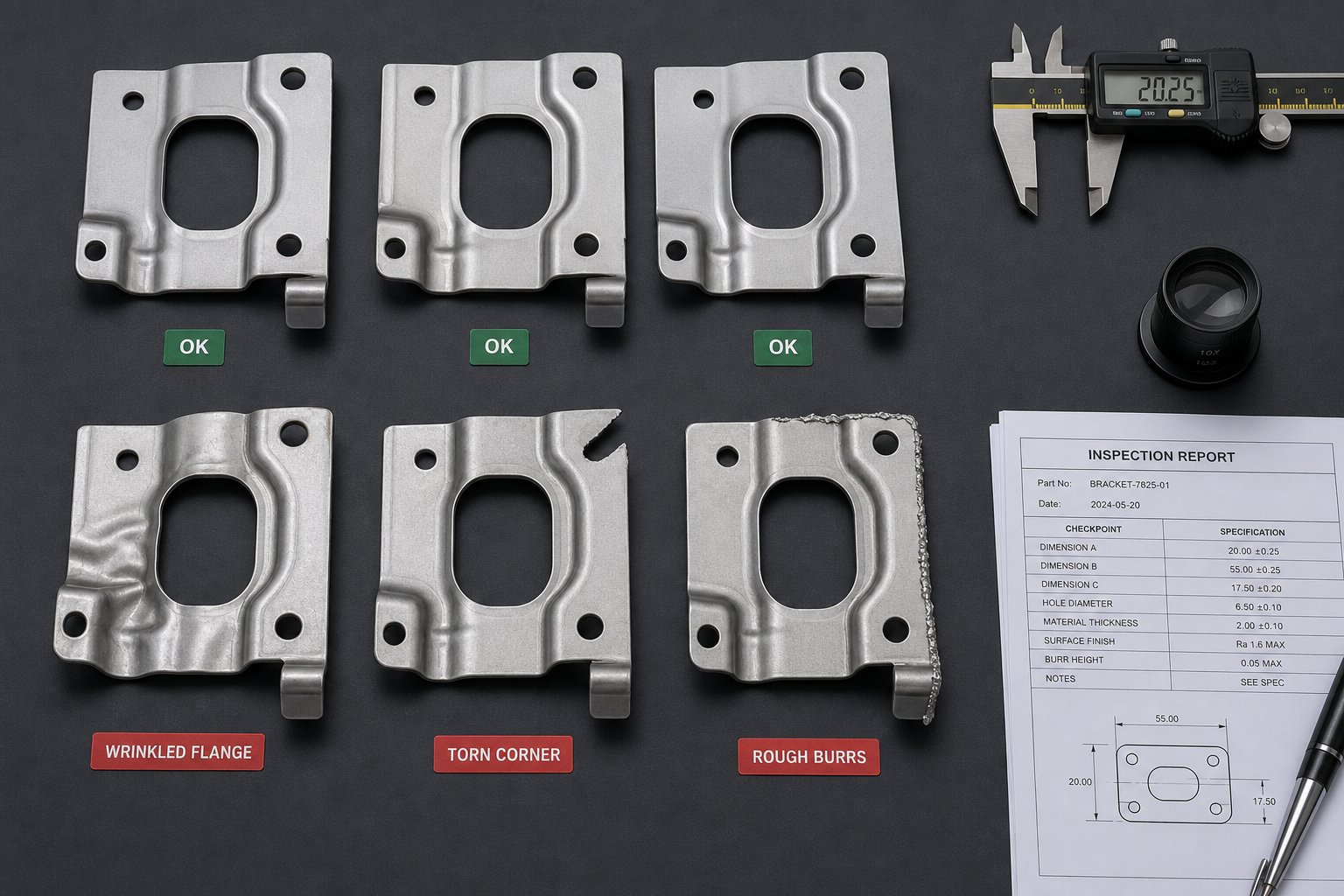
A perfectly designed die running the ideal material can still produce scrap. Wear progresses, press settings drift, lubrication runs thin, and suddenly a batch of parts shows wrinkles, cracks, or burrs that were not there an hour ago. Stamping forming issues rarely announce themselves with a single dramatic failure - they creep in gradually, and by the time someone spots the problem, hundreds or thousands of defective parts may have already stacked up. Knowing what each defect looks like, what causes it, and how to stop it before it starts is what separates reactive firefighting from genuine process control.
Identifying the Most Common Stamping Defects
The table below catalogs the six defects that account for the vast majority of quality rejections in pressing and stamping operations. Each entry includes a visual description so you can identify the problem on the shop floor, along with root causes and actionable prevention strategies drawn from real production experience.
| Defect Name | Visual Description | Root Causes | Prevention Strategies |
|---|---|---|---|
| Wrinkling | Wave-like folds or creases on the flange area or sidewall of drawn parts. Material bunches rather than flowing smoothly into the die cavity. | Insufficient blank holder force; excessive draw ratio attempting too much deformation in a single stroke; die fillet radii too small, creating friction that redirects material flow unevenly. | Increase blank holder pressure incrementally until wrinkles disappear. Reduce single-stage draw ratios by splitting deep forms across multiple draw stations. Polish die fillet radii to reduce resistance and promote uniform material flow. |
| Tearing / Splitting | Visible fractures or splits, typically at the bottom radius of drawn parts or at sharp transitions between formed features. Edges appear ragged and torn rather than cleanly sheared. | Material stretched beyond its forming limit; draw coefficient too aggressive for the alloy's elongation capacity; inadequate lubrication causing excessive friction; punch radii too tight, concentrating stress at a single line. | Select materials with sufficient elongation for the intended geometry. Optimize punch and die radii to distribute stress over a broader area. Apply appropriate EP lubricants - particularly for stainless steel and titanium. Use stamping simulation software to validate draw depths before cutting the die. |
| Springback | The formed part partially rebounds toward its original flat shape after the punch retracts. Bend angles measure several degrees wider than the die cavity angle, and flanges do not sit at their target position. | Elastic recovery inherent to the metal - more pronounced in high-strength steels, stainless steel, and titanium. Insufficient dwell time at bottom dead center. Die angle designed without springback compensation. | Build overbend compensation into the die design (typically 2–5 degrees for stainless, more for titanium). Use corrective bending or coining at the final station to set the bend permanently. Consider servo press technology with programmable dwell at bottom of stroke. |
| Excessive Burring | Sharp, raised metal edges or thin whiskers protruding from the cut perimeter of blanked or pierced features. The sheared edge shows a large rollover zone and rough break line rather than a clean, narrow fracture band. | Worn or dulled cutting edges on punches and die buttons. Improper punch-to-die clearance - either too tight (excessive force) or too loose (material pulls rather than shears cleanly). Wrong clearance percentage for the workpiece material. | Maintain sharp cutting edges through scheduled regrinding. Set clearances to the material-specific percentages detailed in the compatibility table (Chapter 6). Use wear-resistant coatings like TiN or TiCN on punching stamping stations to extend intervals between sharpening cycles. |
| Misalignment / Misregistration | Features - holes, notches, bends - are offset from their intended positions relative to each other or to the part datum. Parts fail dimensional inspection even though individual features are correctly formed. | Worn or damaged pilot pins failing to locate the strip accurately. Guide pin and bushing wear allowing upper and lower die halves to shift. Stock guide misadjustment causing lateral strip wander. Feed length errors in the press or servo feeder. | Inspect and replace pilot pins at defined intervals. Monitor guide pin-to-bushing clearance and replace bushings before slop exceeds tolerance. Calibrate feed length against actual strip pitch. Verify strip width against stock guide settings at every setup. |
| Surface Scratches / Galling | Linear score marks, scuffs, or material buildup visible on the part surface. In severe galling cases, workpiece material cold-welds onto the die face, leaving raised lumps that transfer onto every subsequent part. | Dirty or damaged die surfaces; insufficient or incorrect lubricant; aluminum or stainless steel's inherent tendency to adhere to untreated tool steel; debris trapped in the die cavity between strokes. | Keep die faces clean with standardized wipe-down protocols between runs. Apply material-appropriate lubricants - dry-film coatings for aluminum, EP compounds for stainless. Coat forming inserts with TiCN or nitriding to resist adhesive wear. Remove trapped slugs and debris before they embed into the die surface. |
You will notice that many of these defects share overlapping root causes - worn tooling, incorrect clearance, and poor lubrication appear across multiple rows. That overlap is actually good news: it means a disciplined approach to a few core process variables prevents a wide range of failures simultaneously.
Troubleshooting Defects in Production
When a defect appears mid-run, resist the urge to immediately adjust the die. Experienced press operators follow a systematic diagnostic sequence that isolates the real root cause before any corrective action is taken. Jumping straight to die adjustment without diagnosis often masks the actual problem - or introduces a new one.
Follow this practical troubleshooting checklist in order:
Inspect the strip or blank first. Check incoming material for thickness variation, surface contamination, edge damage, or incorrect temper. Material inconsistencies - especially in high-strength alloys - are a frequent but overlooked source of stamping blanking and forming defects. Verify that the coil or sheet matches the material certification on file.
Check die clearances and component wear. Measure punch-to-die button clearances with feeler gauges or optical measurement. Compare current dimensions to the die build specification. Even a few thousandths of an inch of wear on a cutting edge can shift burr height from acceptable to out-of-spec.
Verify press tonnage and speed settings. Confirm that the press is running at the tonnage and strokes-per-minute specified in the setup sheet. Incorrect shut height, over-tonnage, or excessive speed can all produce defects that mimic tooling problems. Use a tonnage monitor if available.
Evaluate lubrication type and application. Confirm that the correct lubricant formulation is being used and that it is reaching all critical surfaces - particularly forming radii and deep-draw cavities. Dry spots are invisible during a run but show up clearly as scratches or galling on the finished part.
Review material certification against specification. Cross-check the heat number, alloy grade, temper condition, and mechanical properties on the mill certificate against the engineering specification. A material substitution or out-of-spec coil can explain defects that no amount of die adjustment will fix.
This sequence moves from the simplest, fastest checks to the more involved ones - eliminating the most common causes before you ever pick up a wrench to touch the die. In practice, material and lubrication issues account for a surprising percentage of defects that initially look like tooling failures.
Prevention Through Design and Maintenance
Troubleshooting is a reactive skill. The real payoff comes from designing defects out of the process before production begins - and then maintaining that quality baseline over the life of the die.
If you have followed the earlier sections of this article, you already have most of the prevention toolkit in hand. Proper die material selection (Chapter 5) directly reduces wear-related defects like burring and galling. Choosing the right tool steel grade and surface coating for your specific workpiece material means cutting edges stay sharper longer and forming surfaces resist adhesive buildup. Correct clearance for the workpiece material (Chapter 6) prevents both excessive burring and premature tearing - two defects that sit at opposite ends of the clearance spectrum.
Scheduled stamping die maintenance ties it all together. Dies do not fail suddenly - they degrade progressively. A cutting edge dulls incrementally, a pilot pin wears a few tenths of a thousandth per hundred thousand hits, and a spring assembly loses force over millions of cycles. Without a preventive maintenance program that tracks hit counts and triggers sharpening, component replacement, and dimensional verification at defined intervals, quality drifts downward so gradually that operators adapt to it rather than correct it. By the time defects become visually obvious, the die may need far more extensive - and expensive - rework than a simple regrind would have prevented weeks earlier.
Simulation software adds another layer of prevention entirely. Modern FEA-based stamping simulation can predict wrinkling, thinning, splitting, and springback before the die is ever built - catching metal stamping techniques that will not work with the chosen material and geometry before any steel is cut. Features like negative and positive bypass notches in sheet metal stamping dies, used to control material flow around complex geometries, can be modeled and optimized digitally rather than through costly physical trial-and-error. Engineers who invest in simulation during the design phase consistently report fewer tryout iterations and faster production ramp-up.
Defect prevention is ultimately a cost management strategy. Every wrinkled part, every torn blank, every scrapped run carries a price - in wasted material, lost press time, and delayed shipments. The investment in proper design, material-matched tooling, and disciplined maintenance pays for itself many times over across a production run. And that connection between quality and cost leads naturally to a broader question most sourcing managers eventually need to answer: what does a die stamping project actually cost, and where do the dollars go?
Understanding Die Stamping Costs and Project Economics
Defect-free parts are the quality goal - but even flawless stamping parts still need to make financial sense. Surprisingly, detailed cost breakdowns for die stamping projects are rarely discussed in technical resources, leaving engineers and sourcing managers to navigate budgets with incomplete information. Whether you are quoting your first project or benchmarking an existing supplier, understanding where the money goes - and where you can recover it - turns a vague estimate into a confident business decision.
What Drives Die Stamping Tooling Costs
Tooling represents the single largest upfront investment in any metal stamping manufacturing program. A simple compound die for a flat washer might cost a few thousand dollars, while a complex multi-station progressive die for an automotive bracket can range from $10,000 to $100,000 or more depending on the level of precision and part complexity involved. What drives that range? Several interconnected factors determine where a specific project lands on the cost spectrum:
Die complexity and number of stations - A 12-station progressive die with forming, piercing, and trimming operations requires far more engineering, machining, and assembly labor than a 3-station tool performing simple blanking. Every additional station adds material, EDM time, and alignment work.
Die material and surface treatment selections - Upgrading from D2 tool steel to DC53 or adding carbide inserts at high-wear stations increases raw material and machining costs. PVD coatings and nitriding treatments add further expense - but often pay for themselves through extended die life on long runs.
Part tolerances and surface finish requirements - Tighter tolerances demand more precise machining of die components, finer polishing of forming surfaces, and additional inspection steps during die build. A metal stamped part held to +/-0.02 mm costs meaningfully more to tool than one specified at +/-0.10 mm.
Die size driven by part geometry - Larger parts require bigger die shoes, longer guide pins, heavier die steel blocks, and higher-tonnage presses. The physical scale of the tooling directly affects both material cost and the machine hours needed to manufacture it.
Design engineering hours including simulation - Feasibility analysis, strip layout design, CAE simulation, and iterative DFM reviews all consume skilled engineering time. These hours represent a modest percentage of total tooling cost but deliver outsized returns by preventing expensive rework downstream.
Most suppliers structure tooling payments as 50% upfront and 50% upon sample approval - a standard arrangement that aligns incentives around successful tryout. The critical point is that this upfront investment is amortized across production volume. A $50,000 die producing 500,000 stamped components adds just $0.10 per part in tooling cost. The same die producing only 5,000 parts carries a $10.00 per-part burden - a hundredfold difference that makes volume the dominant variable in project economics.
Per-Part Economics and Break-Even Analysis
Beyond tooling, the per-unit cost of each metal stamped part bundles several underlying drivers. Industry data shows the typical breakdown: material accounts for roughly 45–55% of unit cost, labor 15–25%, overhead 10–20%, quality control 2–8%, and packaging 2–5%. Setup charges, which cover die installation and press calibration for each production run, are spread across the batch - meaning smaller orders absorb disproportionately higher per-piece setup costs.
The relationship between volume and per-part cost is steeply inverse. At low quantities, alternatives like laser cutting or CNC machining often win because they require little or no tooling investment. As volume climbs, the math shifts decisively. Consider a simplified but illustrative comparison: if a laser-cut part costs $4.50 each with no tooling, and a stamped version costs $0.30 each with a $40,000 die, the break-even point falls near 9,500 units. Below that threshold, laser cutting is more economical. Above it, stamping pulls ahead - and the gap widens dramatically at higher volumes. At 100,000 parts, the total stamping cost in this scenario would be roughly $70,000 versus $450,000 for laser cutting.
For industrial metal stamping programs targeting annual volumes above 100,000 parts - common in automotive, electronics, and appliance sectors - the per-part economics become overwhelmingly favorable. Progressive die systems running at high strokes per minute can push unit costs to levels no other metal parts stamping method can match.
Strategies to Reduce Die Stamping Costs
Cost optimization does not mean cutting corners - it means making smarter decisions at every stage. The following strategies consistently deliver measurable savings without sacrificing part quality or die reliability:
Prioritize DFM optimization early. Simplifying part geometry - eliminating unnecessary features, using symmetrical designs, and relaxing non-critical tolerances - directly reduces die complexity. Fewer stations, simpler punch profiles, and more forgiving forming operations all translate into lower tooling cost and faster build times. As one industry analysis notes, investing in early prototyping and DFM review helps identify potential issues before mass production, avoiding costly redesigns and tooling adjustments later.
Consolidate operations into fewer die stations. Every station in a progressive die adds engineering, machining, and maintenance cost. If two operations can be combined into one station without compromising quality - for example, piercing and forming in a single stroke using a combination approach - the savings compound across the entire tool build.
Standardize materials across product lines. Running multiple metal stamping components from the same alloy and gauge reduces material procurement complexity, enables bulk purchasing, and allows die designs to share common clearance and lubrication specifications. Standardization creates economies of scale that lower both material and engineering costs.
Plan for die maintenance rather than premature replacement. A well-maintained die can produce millions of parts across its lifetime. Scheduling regrinding, replacing worn pilot pins and springs at defined hit-count intervals, and recoating forming inserts before wear becomes critical extends useful tool life significantly. The incremental cost of preventive maintenance is a fraction of the cost of building a replacement die - or absorbing the scrap produced by a deteriorating one.
Optimize material utilization in strip layout. Experienced die designers minimize scrap by nesting parts efficiently within the strip and taking advantage of piercing slugs to reduce waste. Even small improvements in material utilization - a few percentage points - accumulate into substantial savings across high-volume runs where raw material is the largest single cost component.
Taken together, these strategies address both sides of the cost equation: reducing what you spend to build the tool and reducing what each part costs to produce. The most effective cost reduction happens when engineering, procurement, and manufacturing collaborate from the project's earliest stages - not when someone reviews the final invoice and asks where the budget went.
Cost discipline keeps a project viable, but it does not push the process forward. The technologies reshaping die stamping today - servo presses, digital simulation, and sensor-driven automation - are doing exactly that, opening performance windows that were not possible even a decade ago.

Modern Advancements Shaping the Future of Die Stamping
A decade ago, a die stamping press was essentially a brute-force machine - a flywheel spun up, a clutch engaged, and the ram slammed down at a fixed velocity dictated by mechanical linkage. The die either worked or it did not, and the operator's main lever was tonnage. Today, the picture looks radically different. Programmable motion profiles, predictive digital models, and sensor networks embedded inside the die itself are redefining what stamping technology can achieve - and raising the bar for every manufacturer still running legacy equipment.
Servo Press Technology and Precision Control
Traditional flywheel-driven presses deliver a single, fixed slide-motion curve. The ram accelerates, hits bottom dead center at peak velocity, and retracts - the same profile every stroke, regardless of part geometry or material behavior. Servo-driven presses replace that rigid cycle with a programmable slide motion controlled by high-torque electric motors. Engineers can tailor velocity, dwell time, and acceleration at every point in the stroke.
Why does that matter? Imagine forming a deep-drawn stainless steel housing. With a conventional press, the punch hits the material at full speed, and the metal must flow into the cavity before the ram reverses - a narrow window that often produces wrinkling or tearing. A servo die stamping machine lets the operator slow the ram during the critical forming phase, hold it at bottom dead center for a programmable dwell to set the material, then retract quickly. The result is a wider forming window, fewer defects, and significantly reduced noise levels on the shop floor.
The benefits multiply with difficult materials. High-strength steels used in automotive stamping die applications and lightweight aluminum alloys - both notorious for springback and splitting - respond dramatically to optimized slide profiles. Servo presses also enable the progressive stamping process to consolidate operations that previously required separate stations, because the press can execute different motion profiles within a single stroke cycle. For precision die stamping programs demanding tight flatness or aggressive draw ratios, servo technology has shifted from luxury to baseline expectation.
CAE Simulation and Digital Die Development
Cutting steel for a die before validating its design digitally is like building a bridge without running structural calculations - technically possible, but financially reckless. Modern finite element analysis (FEA) and stamping simulation software model every aspect of material behavior during forming: flow patterns, thinning distributions, springback magnitudes, wrinkling risk zones, and minimum required press force. Engineers run virtual die tryouts - hundreds of iterations if needed - in hours rather than the weeks that physical tryout demands.
The impact on project timelines is substantial. Simulation predicts where splits will occur so punch radii can be adjusted before machining. It calculates springback so overbend compensation is built into the die geometry from day one. It even optimizes blank shape to maximize material utilization - a direct cost savings on every production run. For stamping tooling development targeting advanced high-strength steels or complex geometries, simulation has become the difference between a three-iteration tryout and a ten-iteration ordeal.
Forward-thinking die suppliers now integrate CAE simulation into their standard workflow, running feasibility analysis before quoting and validating every design change digitally before cutting a single tool steel block. YICHEN, for example, embeds simulation into its development process from initial feasibility through trial runs and final inspection - an end-to-end approach that compresses lead times and catches design problems when they are still inexpensive to fix. This kind of integrated digital-physical workflow represents where the industry is heading: simulation is no longer a separate step handed off to a specialist; it is woven into the entire die development cycle.
Industry 4.0, Sensors, and Automation in Die Stamping
The intelligence does not stop once the die hits the press. Industry 4.0 principles are embedding real-time sensing, connectivity, and automated decision-making directly into stamping operations - transforming the press from a standalone machine into a node in a data-rich production network.
In-die sensing represents one of the highest-value applications. Load cells and strain gauges mounted inside the die set monitor tonnage at each station in real time, detecting anomalies - a slug stuck in a die button, a misfed strip, a worn punch pulling excessive force - before they produce defective parts or damage the tooling. Misalignment sensors verify that the upper and lower die halves are registering correctly stroke by stroke, catching guide-pin wear or press deflection that would otherwise go unnoticed until parts fail inspection.
Automated press feeding and part removal eliminate the variability and safety risks of manual handling. Servo-driven coil feeders synchronize strip advancement to the press cycle with sub-millimeter accuracy, while robotic pick-and-place systems extract finished parts and orient them for downstream operations. Together, these systems enable a die stamping press to run at maximum rated speed without operator intervention at the point of operation.
Predictive maintenance ties it all together. IoT-connected presses stream vibration data, temperature readings, and lubricant condition metrics to cloud-based analytics platforms. Machine learning algorithms identify patterns that precede equipment failures - a bearing heating up, a hydraulic system losing pressure - and trigger maintenance alerts before an unplanned shutdown disrupts production. As one industry analysis notes, this approach minimizes unexpected downtime and extends the lifespan of critical machinery, converting maintenance from a reactive cost into a planned investment.
These technologies are not isolated innovations - they reinforce each other. Servo press data feeds simulation models, improving their accuracy for the next die design. In-die sensors generate the quality data that predictive algorithms need to learn. Automation frees skilled operators to focus on analysis and optimization rather than manual feeding and part handling. The net effect is a stamping operation that runs faster, produces fewer defects, and costs less to maintain - advantages that compound with every production cycle.
Technology creates capability, but capability only delivers results when paired with the right partner. The final question most manufacturers face is not which press or software to use, but which supplier can integrate all of these elements - design, simulation, machining, tryout, and production support - into a single, accountable relationship.
How to Choose the Right Die Stamping Partner for Your Project
Servo presses, CAE simulation, and in-die sensors only deliver value when they are in the hands of a supplier who knows how to use them together. For engineers, sourcing managers, and tooling professionals, the real challenge is not understanding die stamping technology - it is finding a die maker who integrates all of it under one roof. A fragmented supply chain, where design happens at one vendor, machining at another, and tryout at a third, introduces handoff errors, communication gaps, and accountability blind spots that inflate cost and timeline. The right partner eliminates those gaps entirely.
Key Capabilities to Evaluate in a Die Stamping Supplier
If you are asking yourself what is tool and die capability worth evaluating, the answer goes far beyond whether a shop owns a CNC machine. True tool and die manufacturing competence spans the full project lifecycle. Use this checklist when vetting potential suppliers - any serious candidate should demonstrate strength across every item:
In-house die design and CAE simulation capability - The supplier should run feasibility studies and stamping simulations internally, not outsource them. This keeps design intent and manufacturing knowledge in one team.
CNC machining and EDM capacity - Wire EDM, sinker EDM, and multi-axis CNC milling are non-negotiable for precision tool die making. Ask about machine age, accuracy specs, and capacity to handle your die size requirements.
Material expertise across multiple metals - A qualified partner understands how steel, aluminum, stainless, brass, copper, and titanium each interact with die tooling. This expertise shapes clearance, lubrication, and coating decisions that prevent the defects covered earlier in this article.
Trial run and sample inspection protocols - Rigorous tryout procedures, dimensional reporting (CMM, optical measurement), and structured sample approval workflows separate professional die manufacturing operations from shops that hand you parts and hope for the best.
Quality certifications and measurement equipment - ISO 9001 certification is a baseline. For automotive programs, IATF 16949 demonstrates process maturity. Verify that the supplier maintains calibrated gauges, CMMs, and documented traceability systems.
Communication transparency throughout the project - Regular progress updates, open access to trial data, and a single point of contact reduce the friction that derails complex tooling programs. As industry experience confirms, a single-source partner with clear accountability streamlines scheduling, simplifies quality control, and cuts lead times compared to multi-vendor arrangements.
Moving from Research to a Production-Ready Solution
So what is tool & die work actually look like when you engage a capable supplier? The typical journey follows a predictable arc - and the best partnerships cover every stage without handing you off to a subcontractor:
Initial feasibility review - The supplier evaluates your part geometry, material, tolerances, and volume to confirm that die stamping is the right process and to identify potential design-for-manufacturing improvements.
CAE-based tooling design - Engineers develop the strip layout (for progressive dies) or station sequence (for transfer dies), validating material flow, thinning, and springback through simulation before any machining begins.
Die machining and assembly - CNC and EDM operations produce the die components, followed by precision assembly, bench fitting, and clearance verification - the hands-on what is tool and die work that turns digital designs into physical tooling.
Trial runs with dimensional inspection - Sample parts are stamped, measured against specification, and evaluated for surface quality and functional fit. Adjustments are made iteratively until every critical dimension passes.
Production handoff - The approved die enters full production, supported by documented setup parameters, maintenance schedules, and ongoing quality monitoring.
YICHEN exemplifies this integrated approach, covering the complete journey from feasibility analysis and CAE simulation through precision machining, trial runs, and final inspection - all managed in-house. For manufacturers, sourcing managers, and tooling engineers ready to move from research to action, their end-to-end process offers a direct path to RFQ-ready custom stamping die solutions for metal parts, without the coordination headaches of a fragmented vendor chain.
Choosing a die stamping partner is ultimately the decision that connects every topic covered in this article. The die type, tool steel grade, surface treatment, workpiece material, defect prevention strategy, and cost structure you have studied all depend on a supplier capable of executing them with precision and accountability. Successful projects are built on informed decisions - about process, materials, and the partnership that brings it all together. Start with the right knowledge, apply it through the right partner, and the path from raw metal to flawless finished parts becomes remarkably straightforward.
Frequently Asked Questions About Die Stamping
1. What is the difference between die stamping and die casting?
Die stamping is a cold-forming process that uses a punch and die set inside a stamping press to shape flat sheet metal through mechanical force - performing operations like blanking, bending, drawing, and piercing at room temperature. Die casting, by contrast, involves injecting molten metal into a mold cavity under high pressure, producing complex three-dimensional shapes primarily in non-ferrous alloys like aluminum and zinc. The two processes serve fundamentally different applications: stamping excels at high-volume flat or moderately formed sheet metal parts, while casting handles intricate 3D geometries that cannot be formed from flat stock.
2. How do I choose between a progressive die and a transfer die?
The choice depends on part size, geometry complexity, and production volume. Progressive dies are ideal for small-to-medium parts requiring multiple operations at high volumes (100,000+ pieces), because the strip feeds continuously through sequential stations for fast cycle times. Transfer dies suit larger parts, deep-drawn components, or complex 3D shapes that cannot remain connected to a carrier strip. Transfer setups use mechanical fingers or grippers to move free blanks between independent stations, which reduces material waste but runs at slower cycle times. If your part fits within a progressive strip layout and volume justifies the tooling cost, progressive is typically the more cost-effective option.
3. What tool steel is best for stamping dies?
There is no single best grade - the right choice depends on the balance of hardness, toughness, and wear resistance your application demands. D2 is the most widely used grade for blanking and piercing due to its excellent wear resistance and moderate cost. S7 is preferred for forming and bending stations where high impact forces risk chipping harder steels. DC53 offers roughly twice the toughness of D2 at comparable hardness, making it a strong choice for stamping high-strength steels or stainless steel. For extreme-wear stations in progressive dies, tungsten carbide inserts can outlast tool steel by five to ten times, though at significantly higher cost.
4. How much does a stamping die cost?
Stamping die costs vary widely based on complexity, size, material, and tolerance requirements. A simple compound die for a flat part may cost a few thousand dollars, while a multi-station progressive die for an automotive component can range from $10,000 to over $100,000. Key cost drivers include the number of die stations, tool steel grade and surface treatments, part tolerances, die physical size, and engineering hours for design and simulation. Importantly, tooling cost is amortized across production volume - a $50,000 die producing 500,000 parts adds only $0.10 per piece, making high-volume programs extremely cost-effective.
5. What causes burrs on stamped metal parts and how can they be prevented?
Excessive burring on stamped parts is primarily caused by worn or dulled cutting edges on punches and die buttons, or by incorrect punch-to-die clearance. When clearance is too loose, the material pulls and tears rather than shearing cleanly, producing rough edges and raised burrs. When clearance is too tight, excessive cutting force accelerates tool wear, which eventually leads to the same problem. Prevention requires setting clearances to material-specific percentages (for example, 5-8% of thickness per side for low-carbon steel, 6-8% for stainless), maintaining a scheduled regrinding program based on hit counts, and applying wear-resistant coatings like TiN or TiCN to extend sharpening intervals.


